
Tutorial Categories
Last Updated: February 13, 2026 at 13:30
Cognitive Biases in Financial Management: How Human Psychology Shapes Corporate Decisions and Risk
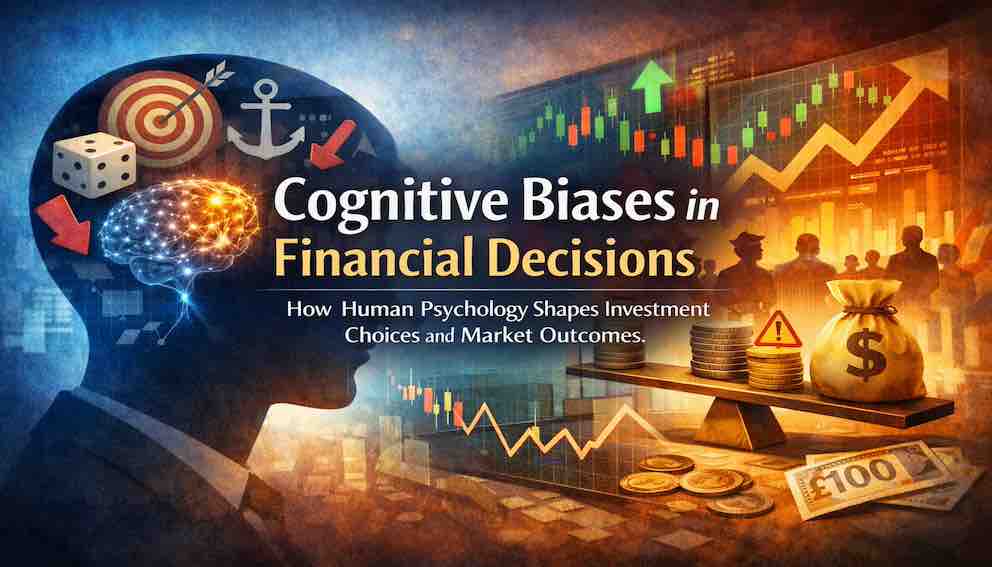
Even the most experienced managers and executives make systematic errors because of cognitive biases—predictable patterns in how humans process information, assess risk, and make decisions. These biases influence capital allocation, project evaluation, treasury actions, and operational choices, often regardless of the data, analysis, or models available. This tutorial explores the most relevant cognitive biases for financial managers, provides concrete corporate examples, and offers practical strategies to recognize and mitigate their effects. By understanding human psychology in financial decision-making, managers can improve resource allocation, safeguard organizational value, and enhance resilience under uncertainty.
Introduction: Why Human Psychology Matters in Financial Management
In earlier tutorials, we examined structural and systemic forces shaping finance: leverage, liquidity, hedging, and operational risk. These frameworks provide critical tools, but they are interpreted, applied, and executed by human beings.
Humans are not emotionless calculators. We are evolved to detect patterns quickly, react to immediate threats, and make rapid judgments in familiar contexts. These same traits can mislead us in the modern corporate environment, where probabilistic reasoning, long-term planning, and abstract risk are essential.
Managers’ decisions—whether approving a new capital expenditure, issuing debt, hedging foreign currency exposure, or planning for liquidity contingencies—are affected by cognitive biases. Recognizing these predictable errors allows organizations to create processes, governance structures, and checks that prevent small misjudgments from cascading into large financial consequences.
Overconfidence: When Skill and Experience Blind Judgment
Manifestation in Corporate Finance
Overconfidence is the tendency to overestimate knowledge, skill, or the accuracy of forecasts. A seasoned CFO might assume that past success in securing favorable financing will automatically repeat in future capital markets. Project managers may underestimate timelines and budgets because they have “always delivered” in the past. Even boards can be overconfident in their oversight of risk management.
Consequences
Overconfidence can lead to excessive leverage, underestimation of contingency needs, or overcommitment to high-risk projects. Managers may ignore early warning signs of project underperformance, assuming they can control outcomes that are inherently uncertain.
Mitigation Strategies
- Document assumptions and predictions, comparing them to actual outcomes.
- Use scenario planning to test project viability under adverse conditions.
- Require independent review of forecasts and project plans.
- Encourage a culture where questioning assumptions is rewarded, not punished.
Anchoring: The Subtle Pull of Initial Numbers
Manifestation
Anchoring occurs when initial data disproportionately influences later decisions. For example, a project budget set during initial planning may unduly constrain later adjustments, even when new information suggests higher or lower costs. Similarly, a historical revenue figure may anchor executives’ expectations for future performance, creating blind spots during strategic planning.
Mitigation Strategies
- Reevaluate assumptions independently at each decision stage.
- Ask “Would we approve this project today at this cost?” without reference to previous budgets.
- Encourage multiple forecasts and use comparative benchmarks rather than single historical anchors.
Loss Aversion: Avoiding Loss at the Expense of Rational Decisions
Manifestation
Losses feel more painful than equivalent gains feel pleasurable. In corporate finance, this bias manifests when companies cling to underperforming projects or failing investments, unwilling to write off sunk costs. Loss aversion can also drive overly conservative capital allocation, leaving growth opportunities unexploited.
Mitigation Strategies
- Establish formal review points where underperforming projects are objectively assessed for continuation.
- Focus on portfolio-level outcomes rather than individual projects.
- Use decision framing: “Would we start this investment today with current information?”
Confirmation Bias: Seeing Only What Fits
Manifestation
Managers naturally seek information that confirms existing beliefs. A CFO convinced of a revenue growth trajectory may overweight positive sales reports while discounting warning signs in operating metrics. This bias can lead to repeated strategic missteps, unchecked cost overruns, or underestimation of market changes.
Mitigation Strategies
- Assign teams to challenge assumptions (“red teams”) during planning or risk assessment.
- Conduct pre-mortems to imagine failure scenarios before committing capital.
- Seek diverse perspectives actively, not just for compliance but for effective decision-making.
Herding and Organizational Conformity
Manifestation
Herding occurs when managers or departments mimic others’ decisions, often because of social pressure, career incentives, or fear of standing out. For example, firms may adopt popular financing structures or accounting treatments without independent analysis, creating systemic vulnerabilities.
Mitigation Strategies
- Foster independent evaluation and documentation of rationale for major decisions.
- Encourage transparent debate in board or management committees.
- Separate incentive structures from peer-relative outcomes when possible.
Recency, Availability, and Mental Accounting in Corporate Contexts
- Recency Bias: Managers overweight recent events, such as last quarter’s losses or gains, when projecting future cash flows or risks.
- Availability Bias: Highly publicized corporate failures may distort perceived probabilities of risk.
- Mental Accounting: Departments may treat resources differently based on their source (internal vs. external funding), leading to suboptimal allocation.
Mitigation requires formalized processes for budgeting, risk assessment, and resource allocation that rely on objective data rather than emotional reactions or easily recalled examples.
Conclusion: The Aware Manager
Cognitive biases are not signs of incompetence—they are the predictable product of human cognition. For financial managers:
- Overconfidence can inflate risk-taking.
- Anchoring can distort budgets and forecasts.
- Loss aversion can prevent rational divestment decisions.
- Confirmation bias can blind oversight.
- Herding can propagate suboptimal industry practices.
The goal is not to eliminate human judgment—that is impossible—but to recognize predictable errors and build organizational scaffolds that reduce their consequences. Structured processes, scenario planning, independent review, and cultural awareness transform human fallibility into organizational resilience.
Between perfect rationality and systematic error lies the astute financial manager: one who understands both the numbers and the human mind, anticipates predictable mistakes, and ensures that corporate resources are managed with deliberate care. That manager is your organization’s most powerful hedge against uncertainty.
About Swati Sharma
Lead Editor at MyEyze, Economist & Finance Research WriterSwati Sharma is an economist with a Bachelor’s degree in Economics (Honours), CIPD Level 5 certification, and an MBA, and over 18 years of experience across management consulting, investment, and technology organizations. She specializes in research-driven financial education, focusing on economics, markets, and investor behavior, with a passion for making complex financial concepts clear, accurate, and accessible to a broad audience.
Disclaimer
This article is for educational purposes only and should not be interpreted as financial advice. Readers should consult a qualified financial professional before making investment decisions. Assistance from AI-powered generative tools was taken to format and improve language flow. While we strive for accuracy, this content may contain errors or omissions and should be independently verified.