
Tutorial Categories
Last Updated: February 13, 2026 at 13:30
Financial Crises and Fragility: How Leverage, Liquidity, and Systemic Risks Amplify Market Shocks
Financial crises do not come from a single mistake; they emerge from accumulated fragility. Leverage, liquidity gaps, and hidden interconnections quietly amplify shocks across firms. Even well-managed organizations can be caught off guard when vulnerabilities align. The skilled financial manager does not try to predict every spark but prepares for the unexpected, maintaining buffers, monitoring exposures, and building resilience to navigate uncertainty.
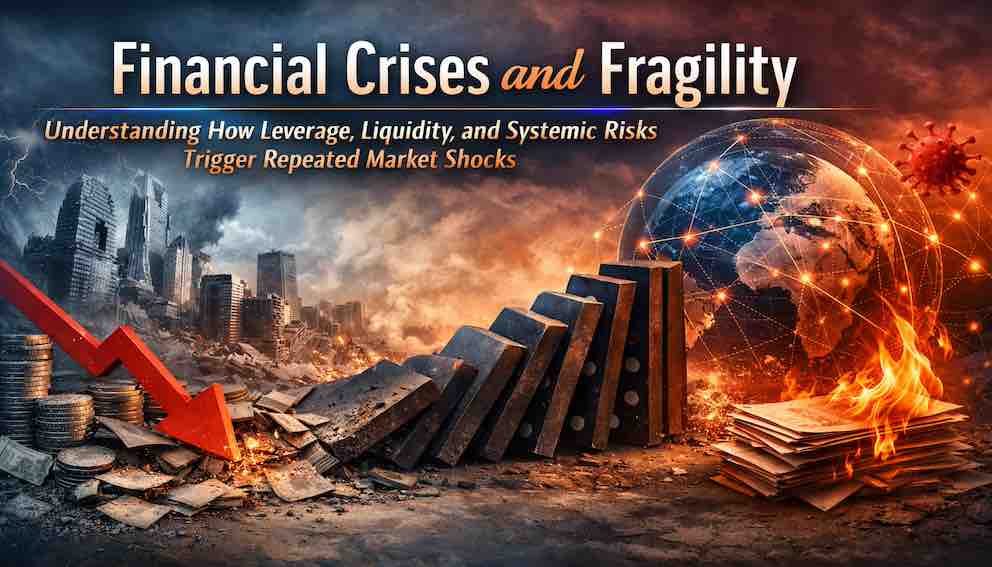
Imagine a vast forest on a dry summer day. Leaves crackle underfoot, branches are brittle, and the sun beats down relentlessly. A single spark falls from a careless hiker’s match. It smolders, then dies. Another spark falls, and again nothing happens. Then, a third lands in a patch of dry brush(low lying vegetaion), and within hours, flames race across the landscape. The forest does not care which spark caused the fire. What matters is that the conditions for combustion existed and that one spark found them.
Financial crises behave in much the same way. They do not hinge on a single mistake or a single weak firm. They emerge from the gradual accumulation of fragility—leverage layered upon leverage, liquidity promised but unavailable, and unseen interconnections across firms. The spark that triggers a crisis may be minor or unpredictable. What matters is the vulnerability that has been quietly growing underneath.
In previous tutorials, we explored risk from the perspective of individual firms: managing cash flow, hedging currency exposure, or meeting debt obligations. These are essential lessons. But even perfectly managed firms can be caught in crises if the system itself is fragile. This tutorial raises the lens, moving from individual firm decisions to organizational and system-wide fragility, helping financial managers understand where vulnerabilities accumulate and how to prepare.
Why Crises Repeat: The Double-Edged Nature of Growth
History shows us a recurring pattern: periods of expansion, rising leverage, accumulated fragility, sudden shock, panic, and collapse. From the Great Depression to the 2008 crisis, the tools, institutions, and triggers may differ, but the underlying mechanics remain.
It is tempting to attribute crises to incompetence or greed, but the truth is more subtle. The forces that create growth—borrowing to finance expansion, extending credit, and innovating with new financial instruments—also create fragility. Leverage can boost returns. Liquidity transformation can fund investment. Innovation can expand markets. But these same forces, when layered without awareness of vulnerabilities, set the stage for sudden, widespread disruption.
For a financial manager, understanding crises is not about pointing fingers. It is about recognizing where operational, funding, and structural weaknesses could collide. It is about seeing the dry brush before the spark lands.
Leverage: The Amplifier of Organizational Vulnerability
Leverage is the use of borrowed funds to finance assets. On its own, it is a powerful tool, allowing firms to pursue opportunities beyond the limits of internal capital. But when leverage is widespread and interdependent, it becomes a systemic amplifier of losses.
Consider a manufacturing company that finances a new plant largely through debt. Its equity cushion is modest compared to the total investment. If demand falls slightly, the firm may need to sell assets, delay payments, or renegotiate loans. If multiple firms in the same sector face similar shocks, they compete for the same buyers, suppliers, and capital, driving down prices and tightening liquidity. Small declines in revenue or asset values are amplified into existential threats.
Key insight for financial managers: Leverage is not inherently dangerous. Its risk emerges when many firms carry similar exposures and are interconnected through markets, supply chains, or credit relationships. Awareness and active management of leverage, including stress-testing, covenant headroom, and contingency plans, are critical.
Liquidity: Confidence Is the True Asset
Liquidity is often misunderstood. It is not simply a property of an asset; it is a reflection of the market’s confidence in your ability to meet obligations. Even profitable firms can fail if cash is unavailable when needed.
Example: A corporate treasurer may oversee a company with healthy receivables, inventory, and strong earnings. On paper, the company is solvent. But if short-term funding dries up, suppliers demand early payment, or lenders tighten covenants unexpectedly, liquidity stress can become critical. The firm may need to sell assets at a discount, halt operations, or draw emergency lines of credit.
Lesson: Liquidity risk is a daily concern for financial managers. Maintaining cash buffers, undrawn credit lines, and careful monitoring of working capital can mean the difference between weathering a shock and succumbing to it.
Contagion: Interconnections That Magnify Risk
Even when a single firm is well-managed, system-wide fragility arises from interconnections. These can take several forms:
- Direct financial exposure: Loans, guarantees, or derivative contracts with other firms.
- Shared suppliers or customers: If one firm defaults, others may experience immediate operational stress.
- Funding dependencies: Firms relying on the same short-term credit markets can be affected when liquidity tightens.
For example, the collapse of a bank dependent on wholesale funding can trigger ripple effects. Suppliers may delay deliveries, counterparties may tighten credit, and confidence in similar institutions may erode. Financial managers must recognize that no firm operates in isolation. Systemic shocks can propagate through otherwise healthy balance sheets.
Micro-Decisions, Macro-Consequences
Rational, individually sound decisions can aggregate into systemic fragility. A few examples:
- Reducing capital ratios to improve return on equity may leave a sector collectively undercapitalized.
- Concentrating operations or financing in popular assets or short-term markets can increase sector-wide vulnerability.
- Stretching payables to suppliers improves internal cash flow but pressures smaller firms downstream.
Financial managers need to anticipate how their firm’s choices contribute to broader vulnerabilities and plan for contingencies that extend beyond the company’s immediate balance sheet.
The Limits of Models and the Necessity of Judgment
Quantitative models are indispensable—they simplify reality, help estimate probabilities, and guide decision-making. But they are never infallible. Historical correlations can break. Stress scenarios can exceed model assumptions.
Example: A model might assume normal business cycles and average interest rate changes. But a sudden macroeconomic shock—like a pandemic, geopolitical disruption, or rapid credit market freeze—can render the model’s predictions irrelevant. Judgment and experience are required to interpret signals and recognize when the future may not resemble the past.
Recognizing Fragility: What Financial Managers Should Watch
Rather than predicting the next crisis, financial managers should monitor structural conditions that create vulnerability:
- High and concentrated leverage: Identify areas where debt is high relative to equity, and many firms are exposed to similar shocks.
- Maturity transformation: Watch for firms or departments funding long-term initiatives with short-term liabilities.
- Opacity: Understand where financial, operational, or supply chain complexity hides risk.
- Rapid growth: Expansion is healthy, but fast growth can outpace risk controls and governance capacity.
- Complacency: Beware the belief that previous stability guarantees future safety.
These conditions are not inherently negative, but awareness is key to managing risk responsibly.
Practical Takeaways for Financial Managers
- Stress-test leverage and liquidity scenarios: Assume that correlated shocks can amplify losses beyond model predictions.
- Maintain cash and undrawn credit capacity: These are the buffers that allow operations to continue when external funding evaporates.
- Align funding duration with asset life: Avoid rolling short-term debt to finance long-term projects.
- Question assumptions based on historical periods: Economic conditions can differ drastically from recent decades.
- Build covenant headroom: Ensure debt agreements allow temporary downturns without triggering technical default.
Conclusion: Navigating the Unseen Forces
Financial crises are not anomalies. They emerge from the same mechanisms that create growth: leverage, liquidity management, innovation, and interconnectedness. They will recur.
The role of the financial manager is not to predict every spark. It is to understand the forest—the underlying conditions—and prepare for the unexpected. By monitoring leverage, liquidity, operational exposure, and systemic interconnections, managers can safeguard their organizations even when shocks occur.
Humility, judgment, and preparation are the hallmarks of resilience. Models and data provide guidance, but the capacity to survive, adapt, and continue operations under stress defines financial mastery.
The dry brush is always there. The spark may be unpredictable. A well-prepared financial manager is the one who keeps the organization safe, steady, and ready to navigate the flames.
About Swati Sharma
Lead Editor at MyEyze, Economist & Finance Research WriterSwati Sharma is an economist with a Bachelor’s degree in Economics (Honours), CIPD Level 5 certification, and an MBA, and over 18 years of experience across management consulting, investment, and technology organizations. She specializes in research-driven financial education, focusing on economics, markets, and investor behavior, with a passion for making complex financial concepts clear, accurate, and accessible to a broad audience.
Disclaimer
This article is for educational purposes only and should not be interpreted as financial advice. Readers should consult a qualified financial professional before making investment decisions. Assistance from AI-powered generative tools was taken to format and improve language flow. While we strive for accuracy, this content may contain errors or omissions and should be independently verified.