Tutorial Categories
Last Updated: February 13, 2026 at 19:30
Ethics in Financial Management: How Integrity Shapes Risk, Value, and Long-Term Success
Imagine two loan officers at the same bank. Both meet targets, comply with rules, and approve loans. One approves risky borrowers because bonuses depend on volume; the other declines borderline loans to protect long-term trust. Both are legal. Only one is ethical. This tutorial explores why ethical behavior in finance matters, how lapses create hidden risks, and why integrity is a strategic advantage. Through vivid examples and practical frameworks, you’ll learn how ethical foresight preserves firm value, strengthens reputation, and ensures sustainable success.
Introduction: From Governance to Ethics
In our previous tutorial, we explored corporate governance—the architecture of authority, accountability, and oversight that determines who controls a firm and how they are monitored. We examined boards that failed to challenge dominant CEOs, shareholders who remained passive while value was destroyed, and compensation systems that incentivized short-term metrics over long-term health. Governance asks a critical question: Who watches the watchers?
Ethics asks a different, complementary question: When no one is watching, how do people decide?
This is not a question about rules. Rules are necessary but incomplete. Even the most exhaustive compliance manual cannot anticipate every circumstance, every gray area where competing obligations collide. In those gaps, character and judgment determine outcomes.
The financial crisis of 2008 illustrates this vividly. Most of the conduct that precipitated the crisis—subprime mortgage origination, securitization, and credit rating opinions—was technically legal. Yet it was unsustainable, deceptive, and corrosive of trust. Ethics, therefore, is not about virtue; it is about durability. Markets are ecosystems, not machines. Trust is not sentimental—it is an asset. And the space between what is permissible today and what is sustainable tomorrow is where value is preserved or destroyed.
Why Ethics Matters in Finance
Finance is often portrayed as a mathematical discipline. We teach discounted cash flow, capital asset pricing, option pricing, and value at risk. These models create the impression that financial decisions can be reduced to formulas, and uncertainty tamed with calculation.
This impression is misleading.
Every financial model rests on assumptions about human behavior. The discounted cash flow model assumes managers invest in projects with positive net present value. The capital asset pricing model assumes investors hold diversified portfolios. The option pricing model assumes markets are frictionless and continuous.
When behavior deviates from these assumptions—managers pursue empire-building, investors herd, markets seize up—the models fail.
Example: A mortgage loan officer’s model may indicate that a borrower's credit score and debt-to-income ratio satisfy underwriting standards. The loan is profitable. The bonus is attractive. The transaction is legal. But the model cannot capture that the borrower misunderstands the adjustable-rate feature, will struggle to refinance, and that the loan will be sold to investors who trust the bank’s standards. These missing variables are ethical, not quantitative.
Ethics bridges the gap between how models assume people behave and how they actually behave. It provides judgment when the numbers run out.
Legal Compliance vs. Sustainable Practice
Many professionals assume that if an action is legal, it is acceptable. This reasoning is comforting—it delegates responsibility to regulators. If the law permits it, the actor feels absolved.
This reasoning is false. Laws are imperfect, slow, and often lag behind market innovation. A loophole is not an endorsement; it is an invitation to exercise judgment.
Illustrative Example: Tax Shelters and the Illusion of Cleverness
Imagine a multinational company that reports £5 billion in annual pre-tax profit. Under normal circumstances, it would owe approximately £1 billion in corporate taxes across the jurisdictions in which it operates.
Its tax advisors identify a complex but technically defensible structure involving intellectual property transfers, intra-group loans, and subsidiaries in low-tax jurisdictions. By routing profits through these entities, the company reduces its tax liability to £100 million.
On paper, the result looks brilliant.
The company has just increased after-tax profit by £900 million in a single year. Earnings per share rise. Executive bonuses tied to net income increase. The share price may even jump as investors reward the higher reported profit.
Legally, the arrangement is compliant. The company has disclosed it. External counsel has issued an opinion that the structure is “more likely than not” to survive regulatory scrutiny.
So where is the ethical risk?
It begins with perception.
Investigative journalists uncover the structure and publish an exposé explaining that the company, despite massive profitability, pays an effective tax rate of just 2 percent. Customers react negatively. Social media campaigns call for boycotts. Politicians cite the company as an example of corporate irresponsibility. Regulators, under public pressure, begin audits and propose new legislation to close the loophole.
Now consider the financial consequences.
Suppose the company’s market capitalization is £60 billion. Following the controversy, the share price falls by 8 percent due to reputational damage and regulatory uncertainty. That represents a loss of £4.8 billion in shareholder value—more than five times the annual tax savings.
At the same time:
- The company incurs legal and advisory costs defending its position.
- Regulators challenge past filings, creating the risk of retroactive assessments.
- Lawmakers change the rules, eliminating the structure for future years.
- Large institutional investors question governance oversight.
- Recruitment becomes more difficult as employees express discomfort with the firm’s public image.
The £900 million tax saving that appeared as a clean improvement to net income has triggered multi-year costs that far exceed the initial benefit.
Nothing illegal occurred.
No rule was broken.
But the decision failed the sustainability test.
The company asked, “Can we do this?” and “Will we get away with it?” It did not ask, “If this becomes public knowledge, will stakeholders view us as acting responsibly?” It optimized for short-term accounting gain without accounting for reputational capital as an economic asset.
This is why ethical foresight matters in financial management. The law measures compliance in binary terms—legal or illegal. Markets measure conduct in continuous terms—trusted or distrusted, respected or scrutinized, stable or risky.
And markets are often harsher than regulators.
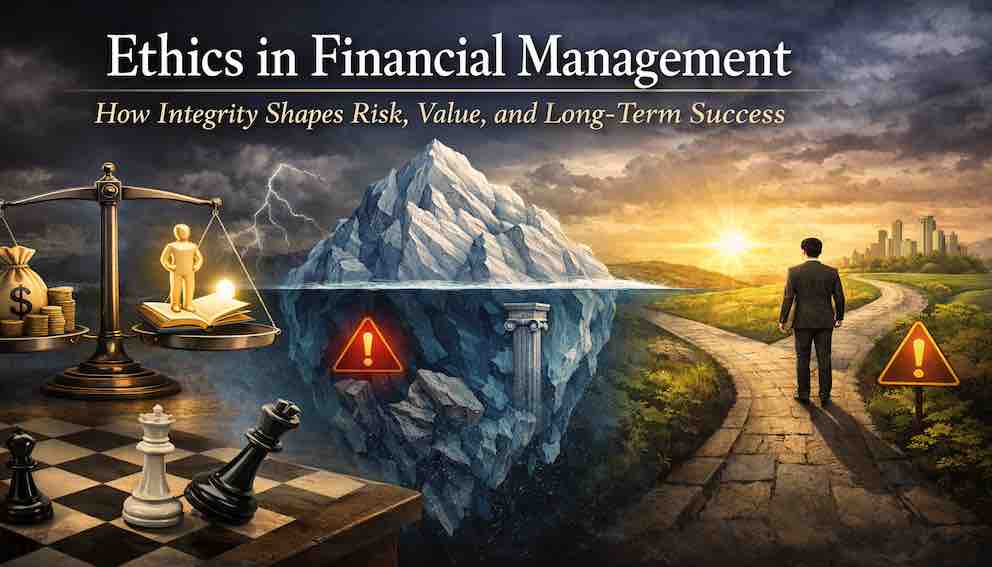
The Iceberg of Ethical Risk
Imagine a ship sailing in iceberg-infested waters. The captain sees only the tip above water. Legal compliance is the visible tip. Violating it causes immediate damage.
Beneath the surface lies the larger mass: ethical risk. Legal today, scandalous tomorrow. Standard practice today, public outrage tomorrow.
Ethical risk accumulates through:
- Complexity: Transactions designed to be too intricate to understand.
- Opacity: Withholding information from those who bear consequences.
- Incentive asymmetry: Decision-makers gain upside but avoid downside.
- Cultural silence: Concerns suppressed; dissent punished.
These are often legal conditions but precursors to catastrophic ethical failure.
Case Studies: Lessons from Ethics in Action
Wells Fargo: Incentives Without Ethics
Aggressive cross-selling targets created a culture where employees opened accounts without customer consent. Legal compliance was initially maintained, but the lack of ethical foresight produced predictable misconduct. The result: over $3 billion in penalties, CEO resignation, and a shattered reputation. The lesson: incentives without ethics are a recipe for disaster.
Enron: Legal Until It Wasn’t
Enron used complex off-balance-sheet entities to hide debt and inflate earnings. Initially legal, these transactions were unethical because they deceived investors. When exposed, they led to bankruptcy, lost savings, and dissolved auditing firm Arthur Andersen. The lesson: pushing boundaries of legality is gambling with firm survival.
Volkswagen: Culture and Complicity
Engineers manipulated emissions tests due to a culture that rewarded results over integrity. No individual lawbreaker designed the system, but the culture made cheating thinkable. The result: $30+ billion in fines, executive resignations, and a damaged reputation. The lesson: culture is a governance variable and an ethical determinant.
Reputation: The Invisible Asset
Reputation is not on the balance sheet, but it is critical:
- Customers trust your product.
- Investors trust your reporting.
- Regulators may exercise discretion.
- Employees feel pride and motivation.
Yet it is fragile. Built over decades, destroyed in hours. Firms that understand this ask not, “Is it legal?” but, “If this becomes public, will we survive?”
Ethical Incentives in Practice
Ethical failure often stems from misaligned incentives rather than bad character. Most individuals respond rationally to the signals embedded in compensation systems. When rewards are tied narrowly to short-term performance metrics, behavior will naturally converge toward optimizing those metrics, even if doing so introduces hidden risks. Properly designed incentives can prevent these lapses by aligning individual decision-making with the firm’s long-term health and stakeholder trust.
Gateways: Bonuses should be contingent not only on achieving financial targets but on achieving them without compliance violations, excessive risk-taking, or substantiated customer complaints. A trader who generates exceptional profits but breaches risk limits should not be rewarded simply because the numbers look impressive. The gateway principle communicates that how results are achieved matters as much as the results themselves.
Deferrals: A meaningful portion of compensation can be released over several years and tied to the durability of outcomes. For example, a loan officer’s bonus might depend on whether the loans perform over a three- to five-year horizon rather than on origination volume alone. This structure reduces the temptation to prioritize immediate gains at the expense of future losses.
Qualitative assessment: Not everything that matters can be measured numerically. Managers should evaluate professional judgment, transparency, teamwork, and adherence to firm values when determining compensation. This introduces human oversight into systems that might otherwise become purely mechanical and vulnerable to manipulation.
Symmetry: Employees should participate, at least partially, in the downside consequences of their decisions. This can be approximated through clawback provisions, reduced future bonus pools after losses, or equity compensation that retains value only if the firm performs sustainably. When individuals share in downside exposure, their risk tolerance naturally becomes more aligned with the organization’s long-term stability.
These practices are not easy to implement because they may reduce short-term competitiveness in compensation and require uncomfortable judgment calls. However, they are essential for sustainable value creation, because incentives are not merely payment mechanisms—they are behavioral architecture. When designed thoughtfully, they transform ethics from an abstract ideal into a structural feature of financial management.
Practical Ethical Decision-Making Frameworks
Even without clear legal guidance, managers can navigate ethical dilemmas using frameworks:
- Disclosure Test: Would you be comfortable if the decision appeared on the front page, unfiltered?
- Long-Term Test: Does the decision remain defensible over the next decade?
- Stakeholder Test: Who bears the consequences, and have they consented?
- Reversibility Test: If wrong, can it be undone without catastrophic damage?
Everyday Example: A portfolio manager considers selling a stock aggressively to meet quarterly targets. The sale is legal and profitable, but clients may lose trust. Applying these tests may advise a more measured, ethical approach that protects long-term relationships.
The Strategic Advantage of Integrity
Ethics is not a constraint—it is a source of value:
- Reduces uncertainty: Ethical firms are predictable and easier to value.
- Reduces friction: Trust lowers negotiation and enforcement costs.
- Attracts talent: Skilled professionals prefer integrity-aligned firms.
- Enables autonomy: Regulators trust ethical management and reduce oversight.
Firms that integrate ethics outperform peers over the long term.
Conclusion: Ethics as Durability
Ethics in financial management is not about virtue—it is about durability, foresight, and sustainability.
- The loan officer approving default-prone borrowers violates trust, not law.
- The firm exploiting tax loopholes erodes its social license and invites long-term costs.
- The trader chasing short-term gains responds to misaligned incentives, creating systemic risk.
Failures are rarely malevolent. They are failures of ethical imagination: the inability to foresee consequences, anticipate public exposure, or recognize trust as irreplaceable.
Ethics allows organizations to build a margin of safety between actions and the line they will not cross. This margin is not a limitation—it is the foundation of enduring value creation. Firms that survive and thrive are those that integrate foresight, incentives, culture, and integrity into every financial decision.
About Swati Sharma
Lead Editor at MyEyze, Economist & Finance Research WriterSwati Sharma is an economist with a Bachelor’s degree in Economics (Honours), CIPD Level 5 certification, and an MBA, and over 18 years of experience across management consulting, investment, and technology organizations. She specializes in research-driven financial education, focusing on economics, markets, and investor behavior, with a passion for making complex financial concepts clear, accurate, and accessible to a broad audience.
Disclaimer
This article is for educational purposes only and should not be interpreted as financial advice. Readers should consult a qualified financial professional before making investment decisions. Assistance from AI-powered generative tools was taken to format and improve language flow. While we strive for accuracy, this content may contain errors or omissions and should be independently verified.