
Tutorial Categories
Last Updated: January 29, 2026 at 10:30
Cost Behavior and Operating Leverage Explained: Why Scale Amplifies Both Strength and Fragility in Business - Financial Management Series
This tutorial explores cost behavior not as an accounting classification, but as a structural commitment to an uncertain future. By examining fixed, variable, and semi-fixed costs through real business examples, it shows how operating leverage quietly determines how revenue volatility turns into profit or loss. You will see why scale can simultaneously create efficiency and fragility, and why high profitability in good times often carries hidden risks in bad times. The focus is not on formulas, but on understanding how cost structures shape cash flow sensitivity, forecasting error, and business resilience over time.
Introduction: The Structure Beneath the Story
Once we understand financial statements as connected stories and ratios as compressed signals, we naturally ask: what creates these patterns? The most powerful force shaping the financial story is often cost behavior—not just how much a business spends, but when it commits to those costs relative to when it earns revenue. Costs are more than expenses; they are bets placed on an uncertain future. A business’s cost structure determines whether uncertainty is absorbed smoothly or transmitted violently into profits and cash flow.
Two Bakeries: The Same Loaf, A Different Bet
To grasp this concept intuitively, forget accounting definitions. Instead, picture two bakeries on the same street, both selling the same £3 loaf of bread for the same price.
Bakery A (The Flexible Baker): Rents a small storefront month-to-month. It buys flour and yeast daily from a cash-and-carry wholesaler. The owner and one part-time assistant do all the baking in small, traditional ovens, adjusting the number of batches each morning based on the previous day’s sales.
Bakery B (The Scalable Baker): Signs a five-year lease on a large industrial unit. It takes out a loan to buy a £50,000 automated baking line that can produce thousands of loaves a day with a small team. It signs an annual contract with a flour mill for bulk discounts.
Both are legitimate businesses. But they have made fundamentally different bets. Bakery A has chosen to buy capacity little by little, as demand reveals itself. Its costs rise and fall closely with each loaf it decides to bake. Bakery B has chosen to lock in capacity far in advance. Its big costs—the lease, the loan payment, the bulk contract—are incurred whether it sells 100 loaves or 10,000 on any given day. This difference in commitment is the essence of cost behavior.
Fixed vs. Variable Costs: A Matter of Timing, Not Just Accounting
Now we can name what we’re seeing. Variable costs (like Bakery A's daily flour) change directly with the level of activity. Fixed costs (like Bakery B's lease and loan payment) remain largely unchanged across a wide band of activity. The critical insight is that this is a difference in decision timing. Fixed costs are decisions made early, under greater uncertainty. Variable costs are decisions made later, with more information. Fixed costs concentrate risk; variable costs distribute it.
The Bridge Between Fixed and Variable: The "Relevant Range"
It’s crucial to understand that no cost is fixed forever. A “fixed” cost is only fixed within a relevant range of normal business activity. If Bakery B’s sales explode, it will eventually need a second factory—its “fixed” costs will take a sudden step up. If sales collapse completely, it can break its lease (with penalty) and sell its oven. The concept of the "relevant range" reminds us that cost structures are not permanent cages; they are flexible commitments that can, with pain and time, be changed when reality shifts dramatically outside of expected bounds.
Operating Leverage: The Amplifier
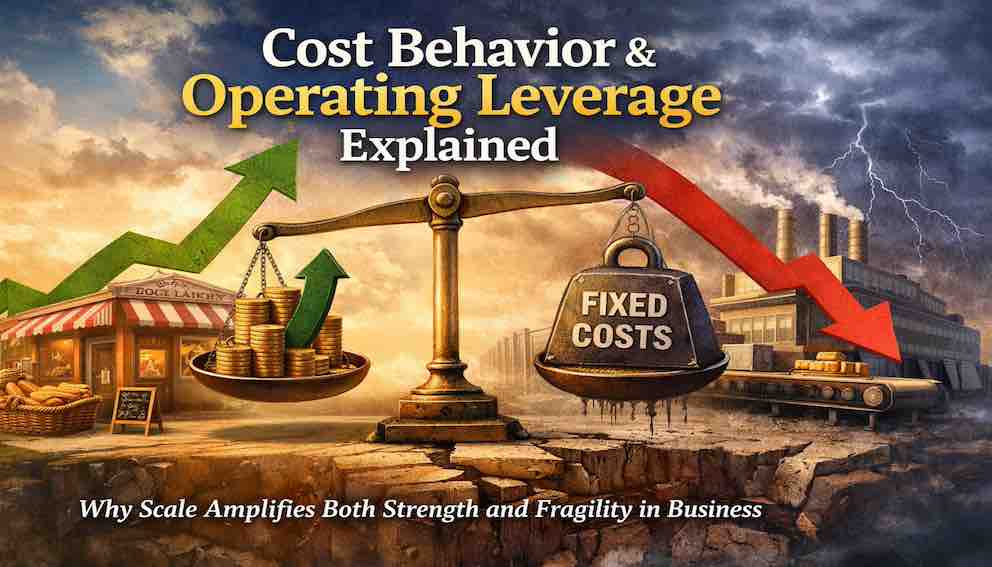
The mix of fixed and variable costs creates a powerful financial phenomenon: operating leverage. This is simply the mechanical result of having high fixed costs. Let’s see it in action with our bakeries.
Imagine both bakeries sell 1,000 loaves a day, making the same modest profit. Now, demand surges 20% to 1,200 loaves daily.
- Bakery A (Flexible): To bake 200 more loaves, it must buy more flour, yeast, and pay for extra part-time hours. Its costs rise almost in line with revenue. Profit goes up, but not dramatically.
- Bakery B (Scalable): Its ovens are already running; it just keeps them on a bit longer. The extra flour comes from its bulk contract. Its fixed costs (lease, loan) don’t budge. Almost all the extra revenue from 200 loads falls straight to the bottom line. Profit soars.
Operating leverage is a powerful engine in good times. But engines work in reverse. If demand falls by 20% to 800 loaves:
- Bakery A buys less flour and cuts part-time hours. Profit shrinks, but it likely stays profitable.
- Bakery B still pays its full lease and loan. It’s now spreading those huge fixed costs over fewer loaves. Its profit plunges, potentially turning into a deep loss. The same structure that amplified gain now amplifies pain.
The Break-Even Cliff vs. The Gradual Slope
This brings us to the break-even point—the level of sales needed to cover all costs. For our two bakeries, this point tells a story.
- Bakery B (Scalable) has a high break-even point because it must sell many loaves just to cover its large fixed costs. Once past that cliff, profit pours in. But it lives perilously close to the edge; a small sales dip can push it into loss territory.
- Bakery A (Flexible) has a low break-even point. It’s easier to cover its small fixed commitments. However, profit margins are slimmer on each loaf, so the climb to high profitability is a gradual slope.
Neither model is "better." One chooses explosive potential with higher risk. The other chooses resilience with more modest rewards.
The Hidden Danger of Step Costs
Real businesses rarely have purely fixed or variable costs. Most face step costs or semi-fixed costs—commitments that jump in discrete lumps. Think of them as fixed costs within a certain "step" of the relevant range.
Example: A rapidly growing online retailer uses a third-party warehouse. Sales are booming, and the current warehouse is full. The only option is to rent a second, identical-sized warehouse. Overnight, the fixed cost of warehouse space doubles. Sales now have to grow significantly just to maintain the same level of profitability. This "step" in costs is a moment of high fragility that often coincides with over-optimism, making businesses suddenly vulnerable to even a minor slowdown.
Why Forecasting Errors Are Magnified
Cost structure dictates how wrong you can afford to be. A forecast is usually off by a percentage, not a total disaster. A 10% sales shortfall for a flexible business is manageable. For a business with high operating leverage, that same 10% error can wipe out most or all of its profit. High fixed costs don’t just affect performance; they magnify the financial consequence of being slightly wrong.
Strategic Implications: The Push for Volume
A high-fixed-cost structure doesn't just influence profits; it dictates strategy. A business locked into large fixed commitments is biologically driven to seek volume to cover them. This is why airlines slash prices to fill empty seats, and steel mills run at all costs. Unused capacity is a direct financial wound. This can trigger brutal price wars in downturns, not as clever strategy, but as a desperate scramble for survival dictated by the cost structure itself.
Business Models as Cost Structure Choices
Ultimately, your chosen business model is a statement about cost behavior.
- A software company (high upfront R&D fixed costs, low variable costs per user) bets on scalable, recurring demand.
- A consulting firm (low fixed costs, high variable costs in partner salaries) bets on flexibility and premium pricing.
- A manufacturer (high fixed costs in factories) bets on stable, high-volume demand.
Each is vulnerable in different ways. The software company fears a drop in user growth. The consultant fears a loss of key talent. The manufacturer fears a dip in utilization. Their financial statements will tell wildly different stories because of these foundational bets.
Conclusion: The Invisible Architecture of Risk
In this tutorial, we’ve moved beyond seeing costs as line items. We’ve seen them as strategic commitments made in time. Fixed costs represent an early, confident bet on future demand. Variable costs represent a cautious, pay-as-you-go approach. Operating leverage is the natural financial force this mix creates—an amplifier of both success and failure.
This framework explains why two equally profitable companies can have diametrically opposed destinies when the economy shifts. It shows why "efficiency" can be a hidden risk, and why "fragility" often wears the mask of high profitability during a boom. By understanding cost behavior, you stop asking, “Is this business profitable?” and start asking the more revealing question: “What must be true about the stability of its world for this profit to be sustainable?” The answer is written not in its latest sales figures, but in the invisible architecture of its costs.
About Swati Sharma
Lead Editor at MyEyze, Economist & Finance Research WriterSwati Sharma is an economist with a Bachelor’s degree in Economics (Honours), CIPD Level 5 certification, and an MBA, and over 18 years of experience across management consulting, investment, and technology organizations. She specializes in research-driven financial education, focusing on economics, markets, and investor behavior, with a passion for making complex financial concepts clear, accurate, and accessible to a broad audience.
Disclaimer
This article is for educational purposes only and should not be interpreted as financial advice. Readers should consult a qualified financial professional before making investment decisions. Assistance from AI-powered generative tools was taken to format and improve language flow. While we strive for accuracy, this content may contain errors or omissions and should be independently verified.