
Tutorial Categories
Last Updated: January 29, 2026 at 10:30
Break-Even Thinking and Margin of Safety: Where Business Survival Actually Lives - Financial Management Series
This tutorial explains why break-even is not a formula but a survival boundary created by earlier cost and pricing decisions. It shows how margins function as buffers against uncertainty rather than rewards for efficiency, and why many businesses fail despite apparently healthy demand. Through concrete examples, the essay reveals how fragile business models can be identified long before revenues collapse. The focus is not on calculating profitability, but on understanding how far a business can fall before it stops existing.
Introduction: The Question of Survival
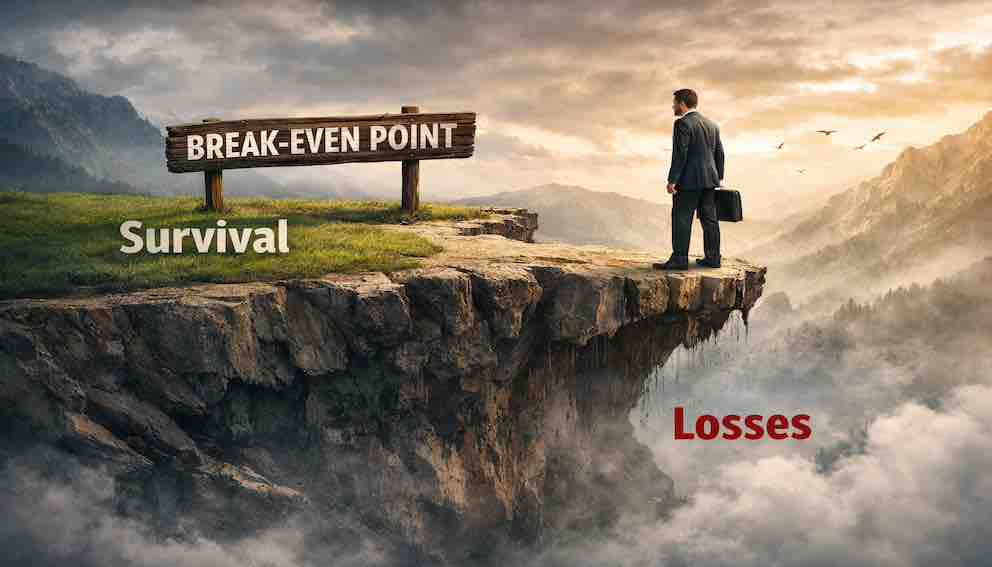
Once we understand that a business’s cost structure determines how uncertainty flows into its profits, a more urgent question emerges. It’s no longer about whether the business can succeed in good times, but whether it can survive when reality is uncooperative. Break-even thinking exists at this critical boundary. It’s not a calculation of profitability, but an examination of the minimum level of economic cooperation the world must provide for the business to continue existing.
Break-Even: The Line Between Existence and Extinction
Break-even is often presented as a neutral line on a chart where losses turn to profits. This hides its true nature. Break-even is the point where past, locked-in cost commitments finally meet present market conditions. Everything above this line is optional success. Everything below it is a failure to survive. It’s not a target; it’s a non-negotiable demand the business places on its environment.
A Tale of Two Business Models
To see this, let’s compare two real businesses:
- The Specialty Manufacturer: Leases a factory, employs permanent skilled workers, and runs expensive machinery that requires constant maintenance. Its costs are largely fixed—they are incurred whether orders arrive or not.
- The Boutique Consulting Firm: Rents a small office month-to-month and hires freelance experts project-by-project. Its costs are largely variable—they scale up and down with client work.
Both may be profitable. But their relationship to survival is completely different. The manufacturer’s survival depends on demand arriving fast enough, consistently enough, and in large enough volume to cover its heavy fixed costs. The consultant can weather volatile demand because its cost commitments are low and flexible. The consultant has a built-in margin of safety; the manufacturer lives much closer to the edge.
Seeing the Margin of Safety in Numbers
Let’s make this contrast concrete with simplified numbers.
Company A (High Fixed Costs - The Manufacturer):
- Monthly Fixed Costs (Rent, Salaries, Loan): £80,000
- Variable Cost per Unit: £20
- Selling Price per Unit: £100
- Contribution Margin per Unit (Price - Variable Cost): £80
- Break-Even Point (Units): £80,000 / £80 = 1,000 units/month.
Company B (Low Fixed Costs - The Consultant):
- Monthly Fixed Costs (Rent, Admin): £20,000
- Variable Cost per "Project Day" (Freelancer Pay): £400
- Price per "Project Day": £1,000
- Contribution Margin per Day: £600
- Break-Even Point (Days): £20,000 / £600 = ~34 project days/month.
Now, imagine both are doing well, selling 1,500 units and billing 50 days respectively. A sudden downturn hits, and demand drops 30%.
- Company A sales fall to 1,050 units. It’s just 50 units above its break-even cliff. A tiny further slip, or a small cost increase, pushes it into loss. Its margin of safety is razor-thin (50 units).
- Company B billings fall to 35 days. It’s still profitable, sitting comfortably above its break-even point. It has a wide margin of safety and can endure this shock easily.
This shows that survival isn't about peak profitability, but about the distance between your current reality and your break-even cliff.
Margins as Shock Absorbers, Not Trophies
Commonly, profit margins are seen as trophies for efficiency. Through the break-even lens, their true function is revealed: margins are shock absorbers. They are the buffer that protects the business when things go wrong.
A grocery store operates on tiny margins but high volume. This seems stable until a small rent increase or supply chain cost wipes out that thin buffer, pushing it below break-even. It fails not because customers vanished, but because it had no margin of safety.
A niche software company charges high prices, yielding fat margins. Even if half its clients leave, the large contribution from each remaining sale covers fixed costs. Its high margins aren't just a reward; they are its life raft in a storm.
How Pricing and Growth Can Secretly Erase Safety
Every business decision moves the break-even line, often in dangerous ways we don't notice.
The Pricing Trap: A company cuts prices by 10% to gain market share. Volume grows 20%. Revenue is up! But the contribution margin per unit has shrunk. The business may now need to sell far more units than before just to reach its original break-even point. It has traded margin of safety for volume, sprinting faster toward a cliff.
The Growth Trap (Capacity Expansion): A bakery buys a second oven to meet growing demand. Its fixed costs (loan, maintenance) jump immediately. Its break-even point rises today, but the new demand to cover it may take months to materialize. The business has made itself more fragile in pursuit of growth. If demand stumbles, it now has two ovens’ worth of fixed costs to cover with one oven’s worth of sales.
Why Failures Are Predetermined, Not Sudden
Many business failures blamed on "a sudden drop in sales" were actually predetermined by earlier commitments. A company with a high, rigid break-even point lives in a narrow corridor where performance must be near-perfect. A minor demand hiccup, a delayed contract, or a small cost overrun becomes fatal because there is no buffer. The collapse seems sudden, but the fragility was built into the structure months or years earlier.
Conclusion: Thinking in Terms of the Cliff's Edge
Break-even thinking forces a vital shift in perspective: from asking "How profitable are we?" to asking "How far can we fall before we cease to exist?"
It teaches us that survival is not guaranteed by strong demand or good intentions. It is a structural outcome determined by the relationship between your locked-in costs and the volatility of your revenue. The margin of safety is the measure of your business's endurance. By identifying where your break-even cliff lies and honestly assessing the distance to it, you can see fragility long before the numbers collapse. In the end, the most important financial statement is not the income statement of the past, but the survival statement of the future that break-even thinking helps you write.
About Swati Sharma
Lead Editor at MyEyze, Economist & Finance Research WriterSwati Sharma is an economist with a Bachelor’s degree in Economics (Honours), CIPD Level 5 certification, and an MBA, and over 18 years of experience across management consulting, investment, and technology organizations. She specializes in research-driven financial education, focusing on economics, markets, and investor behavior, with a passion for making complex financial concepts clear, accurate, and accessible to a broad audience.
Disclaimer
This article is for educational purposes only and should not be interpreted as financial advice. Readers should consult a qualified financial professional before making investment decisions. Assistance from AI-powered generative tools was taken to format and improve language flow. While we strive for accuracy, this content may contain errors or omissions and should be independently verified.