
Tutorial Categories
Last Updated: February 6, 2026 at 15:30
Valuation 101: Price, Value, and Relative Metrics - Fundamental Analysis Series
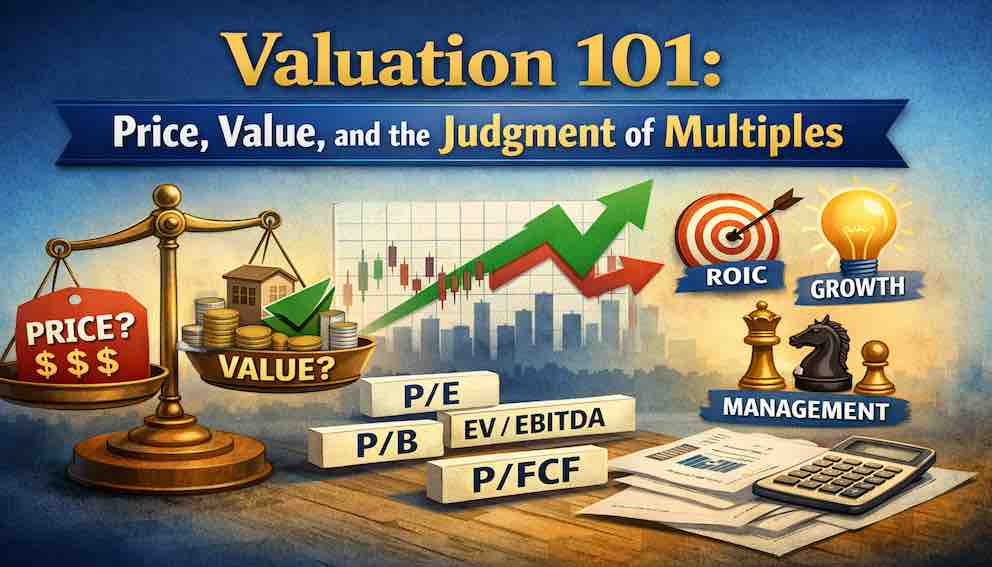
Valuation is the final bridge between understanding a business and making an investment decision. This tutorial moves beyond simple formulas to explore valuation as a practical judgment. You will learn the critical distinction between price and value, master how to interpret common metrics like P/E and P/FCF in context, and understand why a company's growth, ROIC, and management quality dictate what it deserves to trade for. By the end, you'll have a repeatable framework to assess whether a market price reflects optimism, pessimism, or reasonable expectations, turning abstract multiples into a tool for confident decision-making.
Introduction: The Meeting Point of Analysis and Action
In our previous tutorials, we built a complete picture of a business: how it generates cash, earns returns on capital, and is steered by management. But one question remains: What should you pay for it?
Valuation answers this. It is the discipline that connects everything you've learned to the price tag set by the market. A fantastic business can be a terrible investment if you overpay, while an average business can be a winner if bought at a discount. Here, fundamental analysis meets the noisy reality of the stock market.
Crucially, valuation is not about finding a single, precise number. It is about analyzing the expectations baked into the current price and comparing them to your own assessment. This tutorial will equip you with the judgment to do just that.
Part 1: The Foundational Split – Price vs. Value
Understanding this split is the bedrock of all sensible investing.
Price is the number on the screen. It is set by the collective buy and sell orders of millions of investors at any given moment. It is volatile, swayed by news, sentiment, fear, and greed. Think of price as the weather—constantly changing, often unpredictable.
Value is your estimate of what the business is truly worth. It is grounded in the company's ability to generate cash for its owners over time. Value changes slowly, evolving with the company's competitive position, profitability, and reinvestment opportunities. Think of value as the climate—the long-term, underlying reality.
A Practical Analogy:
Imagine two investors looking at the same house.
- Investor A sees the asking price is $500,000 and thinks, "That's what similar houses cost, so it must be fair."
- Investor B also sees the $500,000 price but does the work. They hire an inspector, research neighborhood trends, and calculate renovation costs. They determine the house's intrinsic value is $450,000 due to an aging roof and foundation issues.
Both see the same price. Only one has estimated the value. The goal in investing is to be Investor B: to develop an independent view of value so you can act with confidence when the market's price is irrational.
Part 2: Multiples – The Shorthand of Value
Since we can't inspect a company like a house, we use financial multiples as shorthand tools. They answer a simple question: “What am I paying for a unit of this business's output?”
However, using multiples is less like reading a single dial on a machine and more like examining a watch through a jeweler's loupe. Each multiple offers a specific lens—magnifying profit, cash, assets, or owner returns. To tell the full story, you must look through each lens and understand what it’s designed to show and, just as importantly, what it hides.
Let’s examine four critical multiples through two starkly different companies:
- Steady Power Utility: A regulated, slow-growth, capital-intensive business.
- CloudSoft Inc.: A high-growth, capital-light software-as-a-service (SaaS) company.
Here’s how their valuation stories unfold, lens by lens.
Lens 1: The Profitability Illusion (P/E Ratio)
The Price-to-Earnings (P/E) Ratio is the most common multiple. It compares a company's share price to its earnings per share (EPS). The formula is:
P/E Ratio = Share Price ÷ Earnings Per Share (EPS)
- What It Magnifies: The price you pay for a dollar of accounting profit. It’s a snapshot of market sentiment about a company's current earnings power.
- What It Hides: Everything that happens before the “E”—reinvestment needs, debt burden, and the quality and sustainability of those earnings.
Through the Lens:
- Steady Power Utility might have a P/E of 15. This means investors pay $15 for each $1 of its annual profit. This modest multiple reflects its predictable but slow growth and high capital expenditure needs.
- CloudSoft Inc. might have a P/E of 40. Investors pay $40 for the same $1 of profit, betting that today’s earnings are a tiny fraction of tomorrow’s.
Insight & When to Use It:
The P/E is most useful for comparing mature companies in the same industry with similar capital structures. It’s a quick reality check. A P/E of 50 for a steel manufacturer is a screaming warning sign, while the same P/E for a dominant, fast-growing tech platform might be justified. Use the P/E to gauge the market’s growth expectations, but never in isolation. A high P/E asks the question: “What future growth is already baked into this price?”
Lens 2: The Whole-Business View (EV/EBITDA)
The Enterprise Value-to-EBITDA (EV/EBITDA) Ratio zooms out. Instead of just equity (share price), it values the entire enterprise—what it would cost to buy the whole company, including its debt, minus its cash. It compares this to EBITDA (Earnings Before Interest, Taxes, Depreciation, and Amortization)—a proxy for core operating cash profit.
EV/EBITDA = (Market Cap + Debt - Cash) ÷ EBITDA
- What It Magnifies: The value of the company's core operations, stripping away the effects of different capital structures (debt levels), tax situations, and non-cash accounting charges like depreciation.
- What It Hides: The vital cost of maintaining and growing the business (capital expenditures, or CapEx), which is a real cash expense.
Through the Lens:
- Steady Power Utility, with its stable but heavy debt load for infrastructure, might have an EV/EBITDA of 10. Its enterprise value is 10 times its operating cash profit.
- CloudSoft Inc., with little debt and high-margin, scalable profits, might command an EV/EBITDA of 25.
Insight & When to Use It:
EV/EBITDA is the tool of choice for comparing companies across industries or with different levels of debt, such as in mergers and acquisitions or leveraged buyout analysis. It answers: “Ignoring how it’s financed, how expensive is this business’s cash-generating engine?” A low EV/EBITDA can signal a potential bargain or a business in secular decline.
Lens 3: The Tangible Asset Trap (P/B Ratio)
The Price-to-Book (P/B) Ratio compares a company's market value to the accounting value of its net assets (Assets - Liabilities = Book Value or Shareholders' Equity).
P/B Ratio = Share Price ÷ Book Value Per Share
- What It Magnifies: The relationship between what the market thinks a company is worth and the stated accounting value of its tangible assets. It’s rooted in balance sheet valuation.
- What It Hides (Crucially): The value of intangible assets—brands, intellectual property, software, human talent, and competitive moats—which are the primary drivers of value in the modern economy.
Through the Lens:
- Steady Power Utility, whose value is tied to physical power plants and grids, might trade at P/B of 1.2. The market values it slightly above the replacement cost of its tangible assets.
- CloudSoft Inc., whose value is in its codebase, brand, and network of users, might trade at a P/B of 8. Its market value vastly exceeds its accounting book value.
Insight & When to Use It:
The P/B ratio is most relevant for asset-heavy, commodity-like businesses—banks, insurance companies, utilities, and industrial manufacturers—where book value is a reasonable proxy for tangible capital invested. For “knowledge economy” companies (tech, pharma, consumer brands), a high P/B is normal, and a low P/B is often a red flag indicating broken economics. Use P/B where assets are the business; ignore it where ideas are the business.
Lens 4: The Owner's Cash Reality (P/FCF Ratio)
The Price-to-Free Cash Flow (P/FCF) Ratio is often the most revealing. It compares share price to Free Cash Flow (FCF)—the real cash left over after the business has paid all operating expenses and reinvested in maintaining its assets (Capital Expenditures).
P/FCF Ratio = Share Price ÷ Free Cash Flow Per Share
- What It Magnifies: The price you pay for the actual, spendable cash the business generates for its owners. This is the cash that can fund dividends, buy back shares, pay down debt, or make new investments.
- What It Hides: Very little, which is its strength. It cuts through accounting noise to the economic heart of the business.
Through the Lens:
- Steady Power Utility, requiring massive, continuous reinvestment in grid upkeep, might have a P/FCF of 12. It generates decent cash relative to its price, but much is consumed by maintenance.
- CloudSoft Inc., with its “capital-light” model (low CapEx), might have a P/FCF of 35. Investors pay a high premium for this exceptionally efficient cash-generating machine.
Insight & When to Use It:
P/FCF is the ultimate lens for assessing capital efficiency and financial flexibility. A company with a low and stable P/FCF may be a cash cow, while a high P/FCF indicates high expectations for future cash flow growth. It’s essential for valuing any company, but especially those where earnings and cash flow diverge significantly. Use P/FCF to stress-test a growth story: are those exciting future profits ever expected to turn into real cash for shareholders?
Synthesizing the Story: Corroboration, Not Contradiction
Looking through all four lenses at our examples, a coherent, multi-dimensional picture emerges:
Steady Power Utility: P/E: 15 | EV/EBITDA: 10 | P/B: 1.2 | P/FCF: 12
- The story: A stable, low-growth, asset-intensive business priced for moderate profitability and modest cash generation relative to its asset base. The multiples are low and consistent, signaling low expectations.
CloudSoft Inc.: P/E: 40 | EV/EBITDA: 25 | P/B: 8 | P/FCF: 35
- The story: A high-growth, asset-light, cash-efficient business commanding a premium across every lens. The market is pricing in rapid expansion of profits, operational cash flow, and owner returns. The uniformly high multiples corroborate a single narrative of exceptional quality and growth.
Key Insight: Multiples rarely contradict when you understand the business. Instead, they corroborate the same core story from different angles. A “cheap” P/E paired with an “expensive” P/FCF is a red flag—it suggests the market doubts the quality or sustainability of those earnings. Your job is not to find the one “true” multiple, but to listen to the choir of ratios. Are they all singing the same tune of quality and reasonable price, or is there dissonance warning of hidden risks or missed opportunities? This multi-lens analysis transforms valuation from a search for a magic number into a disciplined process of narrative verification.
Part 3: Context is King – The Story Behind the Number
A multiple in isolation is meaningless. The number only makes sense when you read the story behind it. To interpret any multiple, you must investigate these key contextual drivers, which are direct continuations from our previous tutorials on cash flow and management.
1. Growth Durability & Return on Invested Capital (ROIC): These are the engine of value. Fast, predictable growth justifies a higher multiple, but only if it's fueled by a high ROIC. Remember, a 20% ROIC means every dollar reinvested creates 20 cents of new value. A company that can reinvest at high rates for years is a compounding machine and deserves a higher multiple. Two companies with the same ROIC can even trade at different multiples if one has a proven management team that allocates capital brilliantly while the other has a history of wasteful projects.
2. Business Model & Industry Economics: Is the business capital-light or capital-intensive? Is the industry stable or cyclical? This is critical. For example, a mining company's earnings swing violently with commodity prices. Its P/E may look "cheap" at the peak of a cycle just before earnings collapse, or "expensive" at the trough just before they recover. This cyclical trap is why you must normalize earnings over a full economic cycle when valuing such companies.
3. Financial Risk & Capital Allocation: A company drowning in debt is riskier and deserves a lower multiple than one with a strong balance sheet. Furthermore, as covered in our management tutorial, a company that uses its cash flow to buy back undervalued shares or invest in high-ROIC projects amplifies per-share value, justifying a higher multiple over time.
Part 4: The Intrinsic Value Anchor – From Ranges to Judgment
Professional investors don't hunt for a single "true" value. They estimate a range of intrinsic value. The most rigorous method is a Discounted Cash Flow (DCF) analysis, which values a company by forecasting its future cash flows and discounting them back to today.
Think of it this way: A DCF is the full, detailed engineering report on a house's value. Simpler tools like Free Cash Flow Yield (FCF/Enterprise Value) or Earnings Power Value are like professional appraisals. Multiples like P/E are the quick comparable market analysis. The simple tools are useful, but they are proxies for the deeper principle captured by DCF: value is the present value of future cash flows.
Your goal is not precision but direction. If your analysis suggests a company's intrinsic value likely lies between $60 and $80 per share, and it trades at $50, you have identified a potential opportunity. This range-based thinking embraces uncertainty.
Part 5: Navigating Pitfalls, Psychology, and Sentiment
Markets are driven by people. Two major traps await, both rooted in psychology:
The Value Trap: A low multiple can be a siren song. The stock is often "cheap" for a reason—a dying industry, terrible management, or a cyclical downturn (like our mining example). Always ask: "Why is this so cheap?" before buying.
The Narrative Trap: This is where market psychology reigns. A soaring multiple fueled by an exciting story (e.g., "the future of AI!") can cause investors to ignore deteriorating fundamentals. Markets can remain irrational longer than you can remain solvent, as the saying goes. High multiples driven by momentum and euphoria can persist, but when sentiment shifts, the fall can be brutal.
Your defense is discipline. Anchor your valuation in the fundamental drivers—ROIC, cash flow, balance sheet strength—not the prevailing narrative. This allows you to be cautious when others are greedy and see opportunity when others are fearful.
Conclusion & Your Immediate Action Plan
Valuation is the culmination of your analysis. To apply it, follow this structured framework the next time you evaluate a company:
Step 1: Identify the Price. Note the current market price.
Step 2: Gather the Multiples. Collect the key ratios: P/E, P/FCF, EV/EBITDA, and P/B.
Step 3: Establish Context & Tell the Story. Find 2-3 direct competitors. Compare their multiples and, crucially, the fundamental drivers behind them: growth rates, ROIC, margins, and debt levels. Craft the narrative: "My company trades at a premium because it grows faster and generates more cash per dollar of sales than its peers."
Step 4: Estimate a Value Range. Based on the context and fundamentals, use a simple model like FCF Yield or a multiples comparison to bracket what the company might be worth. Is it likely worth between $60 and $80, versus a $50 price?
Step 5: Check for Psychological Pitfalls. Are you falling for a "cheap" cyclical stock at the wrong time? Are you being swept up in a popular growth story? Re-anchor to the fundamentals.
Step 6: Make Your Decision. If the price is far below your estimated value range and the story is sound, you may have found an opportunity. If the price already reflects or exceeds the best-case scenario, the market's optimism outweighs the fundamentals.
By mastering this process, you shift from asking "Is this stock cheap?" to the more powerful question: "What does this price tell me about the market's expectations, and do I agree?" This judgment—forged from fundamentals, tempered by context, and executed with patience—is the ultimate goal of valuation. It transforms you from a passive price-taker into an active value-assessor.
About Swati Sharma
Lead Editor at MyEyze, Economist & Finance Research WriterSwati Sharma is an economist with a Bachelor’s degree in Economics (Honours), CIPD Level 5 certification, and an MBA, and over 18 years of experience across management consulting, investment, and technology organizations. She specializes in research-driven financial education, focusing on economics, markets, and investor behavior, with a passion for making complex financial concepts clear, accurate, and accessible to a broad audience.
Disclaimer
This article is for educational purposes only and should not be interpreted as financial advice. Readers should consult a qualified financial professional before making investment decisions. Assistance from AI-powered generative tools was taken to format and improve language flow. While we strive for accuracy, this content may contain errors or omissions and should be independently verified.