
Tutorial Categories
Last Updated: February 6, 2026 at 16:30
Putting the Pieces Together: How to Synthesize Financial Metrics and Avoid Contradictions in Fundamental Analysis - Fundamental Analysis Series
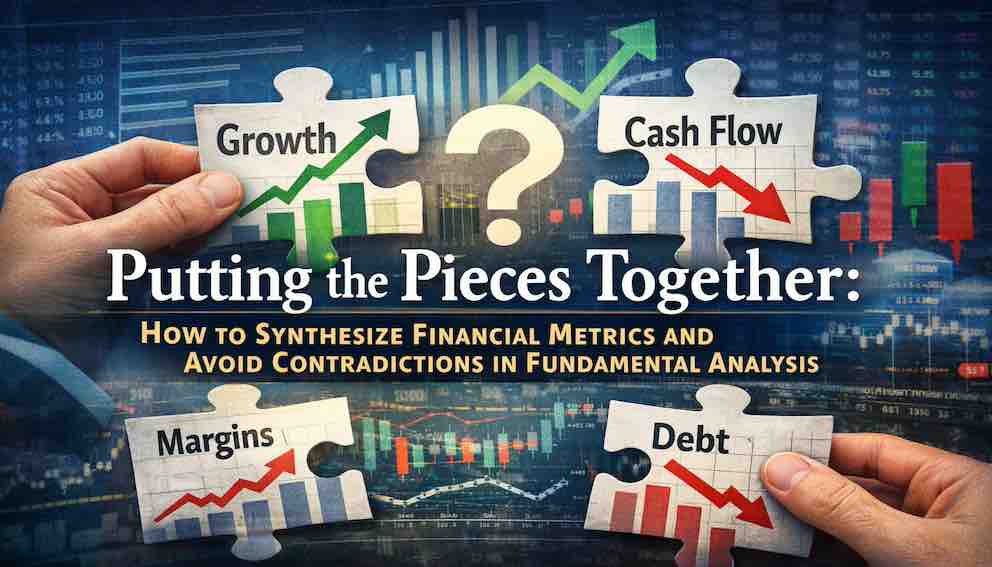
Financial analysis rarely presents clean, perfectly aligned signals. Growth, margins, cash flow, leverage, and valuation often disagree—and that disagreement is where real insight lives. This tutorial teaches investors how to synthesize metrics instead of treating them as isolated checkboxes, how to distinguish meaningful warning signs from temporary distortions, and how to build a coherent economic story when numbers appear to contradict each other. Rather than eliminating uncertainty, learners develop the judgment required to interpret it intelligently. This is the step where mechanical analysis ends and true fundamental understanding begins.
Introduction: When the Numbers Refuse to Agree
Most people begin their investing journey believing that careful analysis will eventually produce a clear answer. If they examine enough ratios, build a detailed model, and compare enough peers, the truth should emerge neatly, like the solution at the end of a math problem. Early education often reinforces this belief by teaching metrics one at a time, as if each number reveals a separate and reliable slice of reality.
Then comes the uncomfortable moment every serious investor encounters.
Revenue is growing quickly, yet free cash flow is weak. Operating margins look strong, yet debt keeps rising. A discounted cash flow model suggests upside, while business quality metrics quietly deteriorate. Instead of clarity, analysis produces tension.
At this stage, many learners assume they are doing something wrong. They believe the confusion reflects a lack of skill. If this feels harder than memorizing ratios, that is precisely the point—you are progressing. In reality, you are finally seeing the business as it actually exists. Contradictions are not analytical failure; they are the natural state of real-world businesses.
This tutorial begins precisely where tidy models end. The objective is not to make numbers agree artificially, but to learn how to think across them, understand why they diverge, and decide which signals matter most. This is the transition from calculation to judgment.
Why Financial Metrics Conflict in the First Place
To understand contradiction, we must remember what financial metrics are. They are not truth itself, but measurements of different economic processes at different points in time. Think of them as vital signs for a patient—a high temperature, low blood pressure, and rapid pulse don't all tell the same story, but together they guide a diagnosis.
- Growth metrics (like revenue) measure activity.
- Profitability metrics (like margins) measure efficiency.
- Cash flow metrics measure economic reality.
- Balance sheet metrics (like debt) measure resilience and risk.
- Valuation metrics measure market expectations.
These aspects do not—and should not—move in lockstep. Consider "FastGrow Tech," a company expanding into a new continent. Its revenue is soaring, but its profit margins are shrinking because it's spending heavily on marketing. Its cash flow is negative because it's investing in new offices and inventory. Its debt is rising to fund this push. None of these signals are wrong; they are all interconnected consequences of a single strategic choice: aggressive expansion.
Your task is not to demand agreement but to understand this causality. The real question is: What single business reality is producing all these different numbers?
The Hierarchy of Truth: Leading vs. Lagging Indicators
Not all metrics shout with the same urgency. Some whisper early warnings; others merely confirm what has already happened. Good synthesis respects this hierarchy.
Leading Indicators (The Early Whisperers):
- Cash Flow: This is often the most honest metric. It reveals the real economic burden of growth. A company can report beautiful earnings for years while its cash flow quietly erodes, hinting at trouble before it hits the income statement.
- Balance Sheet Strength: Changes in debt levels, inventory, or customer payments (receivables) can signal future stress. A company borrowing heavily to fund day-to-day operations is borrowing from its future.
Lagging & Descriptive Indicators (The Confirmers):
- Earnings and Margins: While crucial, these are often lagging. They tend to look their best just before a downturn and their worst just after a recovery begins.
- Valuation Multiples (P/E, P/B): These are largely descriptive. A low P/E doesn't mean "buy"; it means "the market currently has low expectations." Valuation becomes meaningful only after synthesis, because the price is not a signal of business quality, but a test of whether the market's story aligns with yours.
A useful analogy is driving a car. Your cash flow and balance sheet are like the engine temperature gauge and oil light—they warn you of impending mechanical failure. Your earnings are like the speedometer—they tell you how fast you've been going. Relying only on the speedometer while ignoring the warning lights is a sure path to a breakdown.
Decoding Common Contradictions: Classifying the Tension
Not every contradiction deserves the same emotional response. Your critical task in synthesis is not to eliminate contradictions, but to classify them correctly.
- Temporary Contradictions resolve themselves as investments mature or timing differences catch up. They reflect the normal friction of running a business.
- Structural Contradictions persist and often widen. They point to a fundamental aspect of the business model or strategy.
- Warning-Sign Contradictions intensify quietly before becoming obvious. They are the most dangerous, often revealed by leading indicators pointing in the opposite direction of lagging ones.
Let's apply this lens to the most common tensions you'll face.
Contradiction 1: Strong Growth, Weak Cash Flow
This is the story of "FastGrow Tech." Is it a temporary phase or a warning sign?
- The Temporary & Healthy Scenario: Cash is being spent on value-creating reinvestment. For a SaaS company, this might be upfront costs to acquire long-term subscribers. The key test is the return on invested capital (ROIC). If each dollar spent generates more than a dollar in future value, the contradiction is expected and healthy. It will resolve as those investments begin to pay off.
- The Warning-Sign Scenario: Cash is being consumed by declining business quality. For a manufacturer, this might mean offering longer credit to desperate customers just to book a sale, causing receivables to balloon. The growth is artificial, purchased by weakening the financial foundation. This is a structural problem that will worsen.
Contradiction 2: Strong Profitability, Rising Risk
Here, a company like "SteadyEddy Industrials" might show great margins and Return on Equity (ROE), but its debt pile is growing.
- The Illusion: Remember, ROE can be artificially inflated by simply taking on more debt (which reduces the equity denominator). The impressive profitability might be a leverage-fueled illusion.
- The Test: The critical question is resilience. Can those high profits survive an economic shock or a rise in interest rates? If the business needs constant refinancing and perfect conditions to stay afloat, its high margins are built on sand. True strength is found in metrics like Return on Invested Capital (ROIC), which is harder to manipulate with financial engineering. When such a contradiction persists, it often reflects management incentives—prioritizing short-term reported returns over long-term stability—rather than mere accounting noise.
The Synthesis in Action: Building a Coherent Narrative
Synthesis is the act of weaving metrics into a single, causal story. It's the ultimate test of your analysis. A coherent narrative must answer:
- What is the company's core strategy?
- What financial trade-offs does that strategy force?
- Do the numbers consistently reflect those trade-offs?
Example: Two Retailers, One Metric, Two Stories
Both "ValueMart" and "StyleFront" report rising inventory levels.
- For ValueMart, this is paired with slowing sales growth and declining cash flow. The narrative? Inventory is piling up because products aren't selling. This is a classic warning sign of weakening demand and poor management.
- For StyleFront, rising inventory is paired with explosive sales growth and strong, consistent cash flow. The narrative? The company is successfully stocking up ahead of a predicted surge in demand. This is a temporary, strategic decision reflecting operational confidence.
The same metric—rising inventory—has opposite meanings based on the story told by the other metrics. Your job is to write that story and correctly classify the contradiction it reveals.
The Discipline to Avoid "Metric Shopping"
The greatest pitfall in analysis is "metric shopping"—unconsciously highlighting the numbers that support your pre-existing bias and rationalizing away the uncomfortable ones.
The disciplined analyst does the opposite. They actively hunt for contradiction. They give the loudest voice to the metrics that challenge their initial thesis. If you think a stock is a bargain because of its low P/E, you must spend extra time examining its cash flow and debt. The contradiction is not your enemy; it is the most important data point you have.
Conclusion & Your Framework for Action
You have now moved beyond isolated metrics. You understand that financial analysis is not a search for unanimous agreement but an exercise in diagnostic synthesis. You've learned to classify contradictions and listen to the hierarchy of financial signals.
Your Actionable Framework:
- Collect the Vital Signs: Gather data across all five categories: Growth, Profitability, Cash Flow, Balance Sheet, and Valuation.
- Interrogate & Classify the Contradictions: Where do the numbers disagree? Actively look for tension. Then classify it: Is it Temporary, Structural, or a Warning Sign?
- Apply the Hierarchy: Listen to the leading indicators (cash flow, balance sheet changes) first. Let them question the story told by the lagging ones (earnings, margins).
- Build and Stress-Test the Narrative: Force yourself to write a three-sentence story that explains all the key metrics, especially the conflicting ones. Ask: "What would make this narrative fall apart?"
- Finally, Consider Valuation: Only now, with a synthesized view of the business, can you judge if the market's price represents a divergence between story and reality that you can act upon.
This synthesis is what separates a technician from an investor. It transforms a spreadsheet of conflicting data into a clear portrait of economic reality—one that allows you to act with informed confidence amidst the inherent uncertainty of markets. This is where true fundamental understanding begins.
About Swati Sharma
Lead Editor at MyEyze, Economist & Finance Research WriterSwati Sharma is an economist with a Bachelor’s degree in Economics (Honours), CIPD Level 5 certification, and an MBA, and over 18 years of experience across management consulting, investment, and technology organizations. She specializes in research-driven financial education, focusing on economics, markets, and investor behavior, with a passion for making complex financial concepts clear, accurate, and accessible to a broad audience.
Disclaimer
This article is for educational purposes only and should not be interpreted as financial advice. Readers should consult a qualified financial professional before making investment decisions. Assistance from AI-powered generative tools was taken to format and improve language flow. While we strive for accuracy, this content may contain errors or omissions and should be independently verified.