
Tutorial Categories
Last Updated: January 31, 2026 at 19:30
Investment Strategies for Beginners: A Comprehensive Guide to Building Your Portfolio - Introduction to Investing
Confused by all the investing approaches? This guide simplifies your choices. We compare the three main paths for beginners: the hands-off Indexing path, the hunter's Value path, and the visionary's Growth path. Learn why Dollar-Cost Averaging is your best behavioural tool and how the Buy-and-Hold mindset is non-negotiable. With a clear "Core & Satellite" model and a step-by-step action plan, you'll leave ready to invest with confidence, not confusion.
Introduction: Your Investment Journey – Which Path Will You Take?
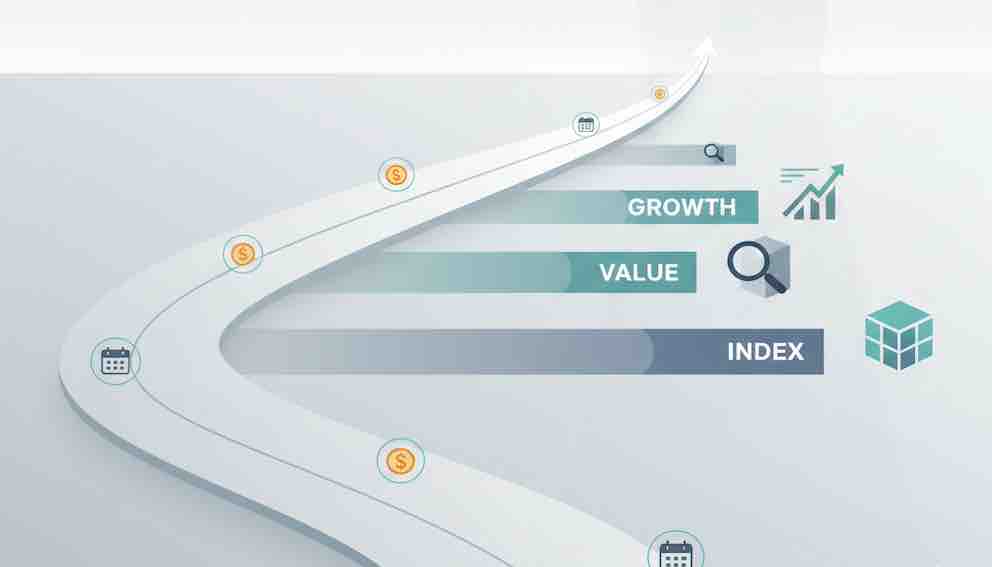
You have your toolkit (stocks, bonds, ETFs) and your blueprint (asset allocation). Now, how do you actually travel from here to your financial goals? Do you try to find hidden shortcuts, follow a trusted guide, or build a steady, self-driving vehicle?
For beginners, there are three primary paths, each with a different philosophy. Your choice defines your experience, effort, and likely outcome.
- The Indexing Path: The efficient, automated highway.
- The Value Path: The treasure-hunting detour.
- The Growth Path: The visionary's mountain road.
This tutorial will map each path for you. We'll also give you the one vehicle that works on all of them (Dollar-Cost Averaging) and the essential traveller's mindset (Buy-and-Hold).
Part 1: Your Vehicle & Mindset – Non-Negotiable Basics
Before you choose a path, you need the right travel habits.
Your Vehicle: Dollar-Cost Averaging (DCA)
This is simply investing a fixed amount of money at regular intervals (e.g., £200 on the 1st of every month).
- Why it's essential: It's a behavioural shield. It automates your investing, removing the temptation to "time the market"—a futile effort rooted in overconfidence. When prices are down, your fixed amount buys more. When they're up, it buys less. It turns market volatility from a threat into a mechanical benefit.
- Action: Set up a monthly standing order from your bank to your investment account. This is your most important first step.
Your Mindset: Buy-and-Hold
This isn't a strategy you do; it's a mindset you adopt. It means you buy investments with the intention of holding them for decades, not days.
- Why it's non-negotiable: It's the antidote to panic selling and chasing returns. It forces you to believe in the long-term trend of the economy, not the daily news cycle. Selling in a downturn is the single greatest wealth destroyer for beginners. Buy-and-Hold is your commitment to never do that.
Part 2: The Three Paths – Choose Your Adventure
Path 1: The Indexing Path (Recommended Starting Point)
- The Philosophy: "Don't look for the needle in the haystack. Buy the haystack." – John C. Bogle
- How it works: You invest in low-cost funds that track the entire market (e.g., a global stock index ETF). You accept the market's average return in exchange for near-zero effort, maximum diversification, and the lowest costs.
- The Reality: Over 10+ years, ~90% of professional fund managers fail to beat the market after fees. By indexing, you guarantee you'll do better than most professionals.
- For You If: You want simplicity, low stress, low cost, and evidence-based results. This is the recommended default path for 95% of beginners.
Path 2: The Value Path (The Analytical Hunter)
- The Philosophy: "Price is what you pay. Value is what you get." – Warren Buffett
- How it works: You search for quality companies trading for less than their intrinsic worth (like a £1 coin selling for 70p). You look at financials (P/E ratios, debt) and wait for the market to recognize the "fair price."
- The Reality: It requires deep research, patience (the "discount" might last years), and the stomach to buy when others are fearful. It's work.
- For You If: You love analysing businesses, have immense patience, and want to actively study investing as a skill.
Path 3: The Growth Path (The Visionary)
- The Philosophy: Bet on the future.
- How it works: You invest in companies you believe will grow revenues/earnings much faster than average (often in tech, biotech, innovation). You pay a high price today for explosive potential tomorrow.
- The Reality: It's high-risk, high-volatility. For every Amazon, there are dozens of failed growth companies. It often involves investing in stories rather than current profits.
- For You If: You have high risk tolerance, believe strongly in specific future trends, and can accept large swings in your portfolio's value.
Part 3: The "Core & Satellite" Model – A Balanced Approach
You don't have to choose just one path exclusively. A sophisticated yet simple approach is the "Core & Satellite" model.
- The CORE (80-90% of your portfolio): Built on The Indexing Path. This is your reliable, low-cost, diversified engine. It ensures you capture global market growth.
- The SATELLITES (10-20% of your portfolio): Your "play money." This is where you can consciously explore The Value or Growth Paths with individual stocks or thematic ETFs. It satisfies the urge to pick without risking your financial future.
Why This Model Wins: It combines the certainty of a market-matching core with the excitement and learning of active picks. If your satellites fail, your core ensures your journey continues unscathed.
Part 4: A Complete Beginner's Action Plan: Your First 90 Days
Let's make this concrete. Follow these steps to go from reading to invested.
Month 1: Foundation
- Choose Your Core: Open a Stocks and Shares ISA with a low-cost platform (e.g., Vanguard, Trading 212).
- Set Your Allocation: Decide on your stock/bond split (e.g., 70% Global Stocks / 30% Global Bonds – a moderate blueprint).
- Implement Your Core: Set up a monthly standing order (DCA) to buy two ETFs:
- ETF 1: A Global Stock Index ETF (e.g., VWRL)
- ETF 2: A Global Bond Index ETF (e.g., VAGP)
Month 2: Mindset & Education
- Do Nothing. Let your first automated investment happen. Your job is to not log in and check the price daily.
- Educate. If interested in Value/Growth, read one company annual report or a book on the topic (e.g., The Little Book of Common Sense Investing for Indexing).
Month 3: Optional Satellite (If You're Curious)
- Allocate: Decide that no more than 10% of future contributions can go to satellites.
- Research & Buy: If you've done the work, use a small portion of one month's contribution to buy one individual stock or thematic ETF that fits your chosen satellite path.
- Document: Write down why you bought it. This creates a learning record.
Conclusion: Stay on the Path
Investing isn't about finding a secret. It's about choosing a sensible, evidence-based path and having the discipline to stay on it.
- Your Default Choice: The Indexing Path with DCA and a Buy-and-Hold mindset. This alone will make you a successful investor.
- Your Learning Framework: The "Core & Satellite" model lets you learn by doing without gambling your future.
- Your Enemy: Your own psychology. The strategies in this tutorial are systems designed to defeat fear and greed.
You now have a map, a vehicle, and the right mindset. The only thing left is to take the first step and then, crucially, keep walking. Consistency and time are the fuels that will take you where you want to go.
About Swati Sharma
Lead Editor at MyEyze, Economist & Finance Research WriterSwati Sharma is an economist with a Bachelor’s degree in Economics (Honours), CIPD Level 5 certification, and an MBA, and over 18 years of experience across management consulting, investment, and technology organizations. She specializes in research-driven financial education, focusing on economics, markets, and investor behavior, with a passion for making complex financial concepts clear, accurate, and accessible to a broad audience.
Disclaimer
This article is for educational purposes only and should not be interpreted as financial advice. Readers should consult a qualified financial professional before making investment decisions. Assistance from AI-powered generative tools was taken to format and improve language flow. While we strive for accuracy, this content may contain errors or omissions and should be independently verified.