
Tutorial Categories
Last Updated: February 9, 2026 at 19:30
The Margin of Safety Explained: Benjamin Graham’s Timeless Strategy for Protecting Downside Risk and Building Long-Term Wealth
Before asking how much money you might make, the intelligent investor first asks how much they could lose. The Margin of Safety, introduced by Benjamin Graham, is the discipline of buying assets at prices meaningfully below conservative estimates of their true worth, creating a buffer against mistakes, misfortune, and an uncertain future. This tutorial explores margin of safety not as a formula, but as a layered philosophy that combines cautious valuation, durable businesses, and strong balance sheets. You will also learn why long-term survival matters more than short-term brilliance, and how building redundancy into your decisions quietly tilts the odds in your favor over time.
Introduction: Why Downside Protection Comes Before Everything Else
When people first begin learning about investing, they often focus almost exclusively on returns. They want to know how to find the next big winner, how to double their money, or how to discover companies that might become the next household name. While these goals are understandable, they start from a flawed foundation. Before thinking about how much money you can make, you must first think carefully about how much money you could lose.
Investing is not only a game of upside potential. It is equally, and perhaps more importantly, a game of risk management. A single severe loss can wipe out years of steady progress, and recovering from such losses is mathematically and emotionally difficult. For example, if your portfolio falls by fifty percent, you must then earn one hundred percent just to get back to where you started. This simple reality explains why experienced investors devote enormous attention to protecting capital.
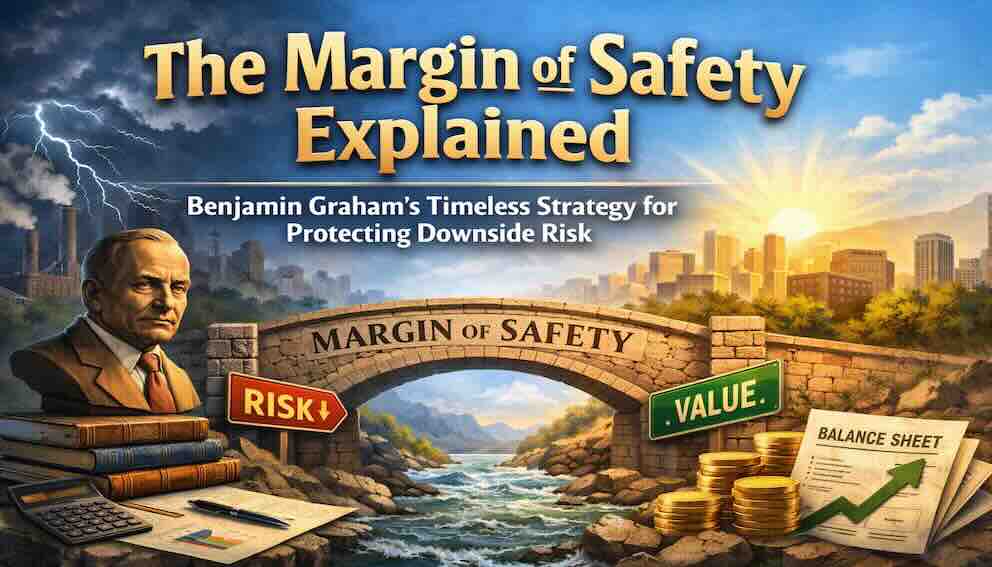
Imagine two engineers tasked with designing the same bridge.
The first engineer assumes ideal conditions. The materials will be perfect. Traffic will never exceed projections. Weather will behave normally. On this basis, the bridge is designed to carry exactly the expected maximum load.
The second engineer approaches the task differently. This engineer assumes that materials may contain flaws, storms will arrive, trucks may exceed weight limits, and usage may increase over time. As a result, the bridge is designed to hold far more weight than it is ever expected to face.
Both bridges may look similar when completed. Yet only one has been built for the real world.
Benjamin Graham believed investing should follow the second engineer’s philosophy. Because the future is uncertain, because our analysis is always imperfect, and because markets are often emotional and irrational, every investment decision must contain extra strength.This extra strength is what Graham called the “Margin of Safety” a term he borrowed from engineering.
It offers something valuable: a disciplined way to survive bad luck, flawed analysis, and unpredictable economic events.
Margin of safety is not about predicting what will happen. It is about preparing for what might go wrong.
Benjamin Graham’s Core Idea: Paying Less Than Something Is Worth
No investor can perfectly predict the future. Every estimate about a company’s earnings, growth, or competitive position contains some degree of error. At its simplest level, margin of safety means buying an asset for significantly less than a conservative estimate of its intrinsic value.
If careful analysis suggests a business is worth $100 per share, a purchase at $95 offers little protection. A purchase at $60 or $70 offers meaningful protection.
That difference between value and price is not primarily a source of profit. It is a buffer against error.
Graham accepted three uncomfortable truths:
- The future cannot be known with precision.
- Human judgment is flawed.
- Markets frequently misprice assets.
Margin of safety does not attempt to eliminate these realities. It accepts them and builds defenses around them.
This is why Graham often used the phrase “paying sixty cents for a dollar.” The goal is not elegance. The goal is resilience.
Why Survival Beats Brilliance
It is tempting to admire investors who make spectacular calls. Stories of people who identified a tiny company that later became a giant dominate financial media. These narratives create the illusion that success in investing comes from extraordinary insight or bold predictions.
Yet the quieter truth is that wealth is usually built through avoidance of disaster rather than discovery of miracles.
A portfolio that compounds steadily for decades without suffering catastrophic losses will almost always outperform a portfolio that occasionally hits spectacular winners but repeatedly experiences deep drawdowns.
Consider two hypothetical investors.
Investor A earns an average of ten percent per year for thirty years without experiencing large drawdowns.
Investor B earns twenty-five percent in some years but also suffers multiple fifty percent losses.
Even though the second investor appears more “brilliant” at times, the first investor is likely to end up wealthier due to consistency and capital preservation. The mathematics are unforgiving:
- A 50% loss requires a 100% gain to recover.
- A 75% loss requires a 300% gain to recover.
Margin of safety exists to prevent these life-altering setbacks.
You do not need genius. You do not need perfect timing. You need a process that helps you survive. Survival allows compounding to do its work. Compounding is powerful only when capital remains intact.
The Three Layers of Margin of Safety
Margin of safety is best understood not as a single calculation, but as three reinforcing layers:
- Conservative valuation
- Durable business quality
- Financial strength through the balance sheet
When all three layers align, downside risk is dramatically reduced.
Layer One: Conservative Valuation
Valuation asks a simple but difficult question:
What is this business reasonably worth?
This estimate should never rely on optimistic assumptions. Instead, it should lean toward caution.
Consider a company that has grown profits by 25% annually for several years. An optimistic valuation might assume this growth continues far into the future. A conservative valuation asks harder questions:
Will competition increase?
Is the market becoming saturated?
Could margins compress?
Could growth slow?
Rather than projecting the best-case scenario, the conservative investor often values the company using:
- Average earnings over a full business cycle
- Modest growth assumptions
- Or even zero growth, unless strong evidence suggests otherwise
This approach builds the first margin of safety directly into the valuation itself.
You are not asking, “What is the most exciting future?”
You are asking, “Does this investment still make sense under ordinary conditions?”
Margin of safety enters when you deliberately choose conservative assumptions. Instead of assuming optimistic growth, you might assume moderate or even slow growth. Instead of assuming perfect execution by management, you might assume occasional missteps. If, under these cautious assumptions, the stock still appears attractively priced, you are likely operating with a margin of safety.
Layer Two: The Quality and Durability of the Business
A low price alone does not create safety.
A weak business can be cheap for very good reasons.
The second layer examines whether the company itself has staying power.
Important questions include:
Does the company have a competitive moat?
A moat may come from brand loyalty, switching costs, cost advantages, network effects, or regulatory protection. A moat does not guarantee success, but it increases the probability that profits persist.
Is the business easy to understand?
Warren Buffett famously said, “Never invest in a business you cannot understand.” Complexity hides risk. Simpler businesses make it easier to evaluate what could go wrong.
Does the company have a long track record?
Businesses that have remained profitable across multiple economic environments demonstrate resilience.
Think of the difference between:
A company selling essential products used every day
and
A company dependent on a single trendy product
The first offers a built-in margin of safety. The second does not.
Layer Three: The Financial Fortress (Balance Sheet Strength)
Even excellent businesses can fail if their finances are fragile.
The balance sheet shows:
What a company owns
What it owes
Strong balance sheets usually feature:
- Low or manageable debt
- Significant cash or liquid assets
This matters because:
A company with little debt can survive recessions.
A company drowning in debt may collapse during mild downturns.
Benjamin Graham went even further in some cases. He searched for companies trading below their net-net working capital, meaning the market price was less than current assets minus all liabilities. In such situations, the operating business was effectively being valued at zero or less.
While such extreme net-net bargains were more common in Graham’s era, they are far rarer in modern markets. This does not mean the idea has lost relevance. It means the principle must be understood at a higher level. The enduring lesson is not to hunt obsessively for statistical unicorns, but to consistently demand financial strength, conservative assumptions, and a meaningful discount to value. Even when true net-nets cannot be found, insisting on strong balance sheets and generous margins of safety remains one of the most reliable ways to protect capital. When evaluating a company, paying attention to debt levels, liquidity, and overall financial health is just as important as analyzing earnings.
Price and Value Are Not the Same Thing
Market prices fluctuate constantly, often driven by emotion, headlines, and short-term expectations. Value, on the other hand, changes more slowly and is tied to the underlying economics of a business.
Markets quote prices. Investors estimate value.
The two frequently diverge.
Margin of safety exists because these gaps occur.
Consider a high-quality company that experiences a temporary setback, such as a disappointing quarter or a regulatory investigation. Investors may panic and sell, driving the stock price down sharply. If the long-term prospects remain intact, this drop may create a margin of safety opportunity.
Conversely, a popular company with exciting growth stories may trade at extremely high prices. Even if the business performs well, the lack of margin of safety means that any disappointment could lead to severe losses.
When pessimism dominates, prices may fall far below reasonable value.
When excitement dominates, prices may rise far above reasonable value.
The patient investor waits for pessimism.
The Final Gate: The Price You Pay
All analysis ultimately converges on one decision:
Is the current price sufficiently below conservative value?
A wonderful business bought at a terrible price can produce poor returns.
A good business bought at a deeply discounted price can produce excellent returns.
Margin of safety is not complete until the price itself provides protection.
This requires patience.
It often means doing nothing.
It often means watching others chase fashionable stocks while you wait quietly.
Waiting is not inactivity. It is discipline.
Uncertainty Buffers: Accepting What You Cannot Know
One of the most dangerous traps in investing is overconfidence. It is easy to believe that with enough research, you can predict the future with high accuracy. In reality, the world is filled with unknowns.
Technological changes, regulatory shifts, competitive dynamics, and macroeconomic events can all reshape industries in ways that are difficult to foresee. Even the best-run companies face risks that are outside their control.
The margin of safety acknowledges this uncertainty. Instead of trying to eliminate uncertainty, it builds buffers around it.
For example, if you believe a company’s fair value is somewhere between $80 and $120, buying at $90 leaves little room for error. Buying at $50, however, provides a wide buffer. Even if negative surprises push fair value toward the lower end of your estimate, you may still be protected.
Uncertainty buffers can take many forms:
Buying at low multiples of earnings or cash flow
Favoring companies with diversified revenue streams
Preferring simple, understandable business models
Avoiding businesses dependent on a single product or customer
Each of these choices reduces the likelihood that a single mistake or unexpected event will permanently impair your capital.
Practical Example: Buying a House vs. Buying a Stock
A helpful analogy is real estate. If you were shopping for a house, you would likely compare prices of similar properties in the area. If most comparable homes sell for around $300,000 and you find one for $200,000 in decent condition, you would probably view this as a bargain. The discount provides a cushion in case you underestimated repair costs or future market conditions weaken.
If, on the other hand, you pay $350,000 for a house worth $300,000, you start your ownership with a disadvantage. Even modest problems could result in financial pain.
Stocks work in a similar way. Buying well below reasonable estimates of value gives you room for error. Buying above value leaves no cushion.
Psychological Benefits of Margin of Safety
Beyond its financial advantages, the margin of safety offers psychological comfort. When you know you purchased a business at a significant discount to value, you are less likely to panic during market volatility.
Short-term price declines feel different when you believe the underlying value remains intact and your purchase price already included a buffer. This emotional stability makes it easier to hold through turbulence and avoid impulsive decisions.
Investors who lack margin of safety often experience constant anxiety. They are highly sensitive to news and price movements because their investment thesis depends on everything going right. Over time, this stress can lead to poor decisions.
Common Mistakes That Erode Margin of Safety
Many investors unintentionally destroy their margin of safety through certain behaviors.
One common mistake is paying for perfection. When investors assume flawless execution, rapid growth, and favorable conditions indefinitely, they leave no room for disappointment.
Another mistake is excessive leverage. Borrowing money to invest magnifies both gains and losses. Even a modest decline can become catastrophic when leverage is involved.
A third mistake is ignoring balance sheet risks. Attractive earnings can mask underlying financial fragility.
Being aware of these pitfalls helps reinforce the importance of discipline.
Building a Margin of Safety Mindset
Margin of safety is not a mechanical formula. It is a way of thinking.
The principle extends beyond stocks.
In personal finance, it appears as an emergency fund.
In career planning, it appears as transferable skills.
In behavior, it appears as humility.
One might call this approach prudence over presumption, preparation over prediction, patience over impulse.
It is a mindset suited for an uncertain world.
It emphasizes patience, waiting for opportunities rather than chasing excitement. It values durability over flashiness.
Over time, this mindset shapes every investment decision. You begin to ask not only, “How much can I make?” but also, “How much could I lose if I am wrong?”
This shift in perspective is transformative.
Conclusion: What We Have Learned
We have explored margin of safety as the central organizing principle of intelligent investing. We saw that it means buying well below conservative estimates of value, choosing durable businesses, favoring strong balance sheets, and demanding a protective price. We learned why survival matters more than brilliance, and how avoiding catastrophic losses allows compounding to work quietly over time.
Margin of safety does not promise excitement. It promises endurance.
And in investing, endurance is what ultimately builds wealth.
About Swati Sharma
Lead Editor at MyEyze, Economist & Finance Research WriterSwati Sharma is an economist with a Bachelor’s degree in Economics (Honours), CIPD Level 5 certification, and an MBA, and over 18 years of experience across management consulting, investment, and technology organizations. She specializes in research-driven financial education, focusing on economics, markets, and investor behavior, with a passion for making complex financial concepts clear, accurate, and accessible to a broad audience.
Disclaimer
This article is for educational purposes only and should not be interpreted as financial advice. Readers should consult a qualified financial professional before making investment decisions. Assistance from AI-powered generative tools was taken to format and improve language flow. While we strive for accuracy, this content may contain errors or omissions and should be independently verified.