
Tutorial Categories
Last Updated: February 9, 2026 at 20:30
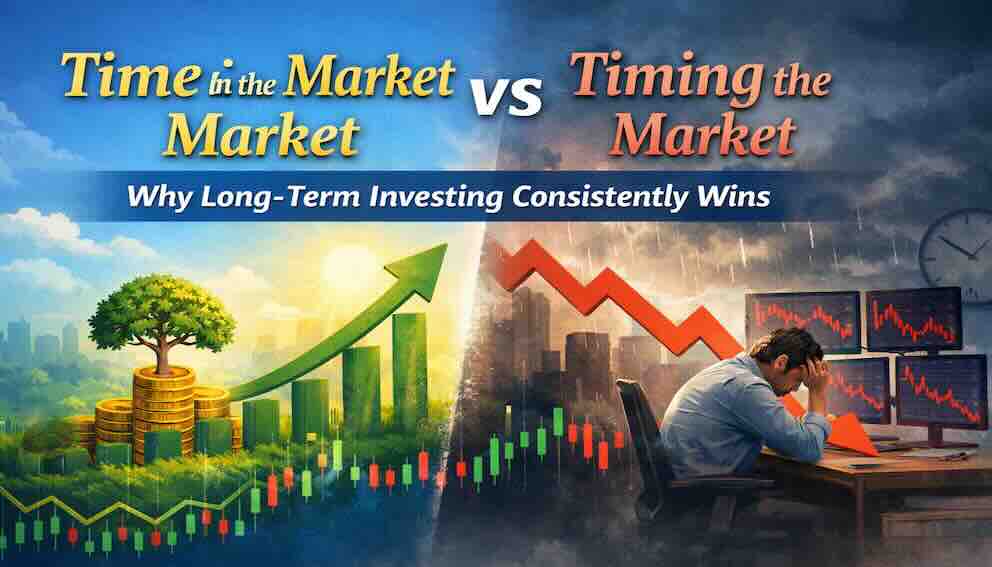
Time in the Market vs Timing the Market: Why Long-Term Investing Consistently Beats Perfect Predictions
Many investors believe success comes from perfectly predicting when to buy and when to sell, yet decades of market history quietly show a different truth. This tutorial explains why staying invested for long periods tends to outperform even the most skilled attempts at market timing. We explore missed best-days data in a gentle and understandable way, unpack why timing feels so logical but often fails in practice, and show how patience becomes a powerful structural advantage. By the end, you will see why consistency and endurance quietly outperform cleverness in investing.
Introduction: Two Competing Philosophies
Every investor, whether they realize it or not, eventually encounters two very different ways of thinking about building wealth in the stock market. One philosophy says that success comes from identifying the perfect moments to enter and exit, buying right before prices rise and selling right before prices fall. This approach is commonly called timing the market. It is seductive, dramatic, and frequently celebrated in movies, headlines, and social media stories.
The second philosophy is quieter and far less glamorous. It suggests that the real secret is simply staying invested for long periods, owning quality assets, and allowing growth and compounding to do most of the heavy lifting. This approach is known as time in the market.
At first glance, timing the market feels like the superior strategy. After all, if you could avoid crashes and only participate in rallies, your returns would obviously be higher. The problem is that real life rarely cooperates with such elegant logic. Markets are complex systems influenced by millions of decisions, countless economic variables, and human emotions that swing between optimism and fear.
In this tutorial, we will carefully and slowly explore why time in the market has proven more reliable than timing the market. We will examine real-world patterns, explain missed best-days data in a gentle way, and show why patience is not just a personality trait but a structural advantage embedded into how markets function.
What Does “Timing the Market” Really Mean?
Timing the market refers to the attempt to predict short-term movements in prices in order to buy before an increase and sell before a decrease. In theory, this sounds straightforward. An investor might think, “The market seems high right now, so I should wait,” or “Prices have fallen a lot, so I should buy before the rebound.”
The idea appeals to our sense of control, because human beings naturally prefer strategies that make them feel active, involved, and clever. Clicking buttons, making decisions, and reacting to news creates the feeling that we are directly shaping outcomes. Timing fits neatly into this psychological preference.
However, in practice, successful timing requires being correct twice:
- You must correctly decide when to get out.
- You must correctly decide when to get back in.
Getting either of these wrong can severely damage long-term returns. Getting both right repeatedly over many years is extraordinarily rare.
Markets can rise unexpectedly during periods of bad news. They can fall even when economic data looks strong. Prices move not only based on what is happening now, but also on what investors collectively expect to happen in the future. These expectations constantly change.
As a result, timing becomes less like a skill-based game and more like trying to hit a moving target in the dark.
What Does “Time in the Market” Mean?
Time in the market simply means staying invested across many years and decades, regardless of short-term fluctuations. It assumes that markets will experience ups and downs, recessions, crashes, and recoveries, but that over long periods they tend to grow as businesses innovate, populations expand, and productivity increases.
This philosophy does not require predicting specific events. Instead, it relies on a broad historical pattern: despite wars, pandemics, political turmoil, and financial crises, major stock markets have trended upward over the long run.
Time in the market shifts the investor’s focus away from short-term price movements and toward long-term ownership. Rather than asking, “What will the market do next month?” the question becomes, “What will productive businesses likely be worth in twenty or thirty years?”
This change in perspective dramatically reduces stress, decision fatigue, and emotional mistakes.
The Gentle Reality of Missed Best-Days Data
One of the most powerful pieces of evidence supporting time in the market comes from what is known as missed best-days data. This data examines what happens when investors are not invested during the market’s strongest days.
To understand this concept, imagine an investor who stays fully invested in a broad stock index for 30 years. Now imagine another investor who attempts to time the market and happens to miss only a handful of the best-performing days over that same period.
What researchers consistently find is that missing just a small number of the market’s best days can reduce long-term returns dramatically.
For example, historical studies often show something similar to this pattern:
- An investor who stayed invested might earn an average annual return of around 9–10%.
- Missing the best 10 days over several decades can cut that return roughly in half.
- Missing the best 20 or 30 days can reduce returns to near zero.
These patterns appear consistently in long-term studies of broad U.S. stock indices such as the S&P 500 across multiple 20–30 year periods, though exact percentages vary slightly depending on the timeframe. This is not because those few days happen to be magical. It is because market gains are highly concentrated. A surprisingly large portion of total long-term growth occurs during a small number of very strong days.
The uncomfortable truth is that many of those best days occur during periods of fear and uncertainty, often near market bottoms. When investors are most pessimistic, markets sometimes stage sudden and powerful rebounds.
If someone steps out of the market because things feel scary, they risk being absent precisely when the market surges.
Missed best-days data does not require perfect memory or technical knowledge to understand. It simply tells us that being consistently present matters far more than trying to be selectively present.
Why Timing Feels Logical but Fails in Reality
Timing feels logical because human reasoning naturally prefers clear cause-and-effect stories. If bad news is everywhere, it feels reasonable to assume prices will fall. If good news dominates headlines, it feels reasonable to assume prices will rise.
The problem is that markets usually move ahead of news, not after it. Prices adjust based on what investors expect, not just on what is currently happening.
Consider a simple example. Suppose everyone expects a company to report poor earnings. When the company reports earnings that are bad but slightly better than feared, the stock might rise sharply. On the surface, this seems illogical. Why would a stock rise on bad news? It rises because reality turned out to be less bad than expectations.
This dynamic makes timing extremely difficult. You are not just predicting events. You are predicting how events compare to collective expectations.
Additionally, emotions interfere. Fear pushes investors to sell after prices have already fallen. Greed pushes investors to buy after prices have already risen. These emotional responses lead people to do the opposite of what long-term success requires.
Timing strategies often look good in hindsight. Looking backward, it is easy to point at a chart and say, “I should have sold here and bought back here.” Living through those moments in real time, with incomplete information and emotional pressure, is an entirely different experience.
The Structural Advantage of Patience
Patience in investing is not merely a virtue. It is a structural advantage, meaning it is built into how markets reward behavior over time.
Markets reward those who provide capital and allow it to remain productive. When you own shares of businesses, those businesses reinvest profits, expand operations, develop new products, and increase efficiency. Over time, these activities tend to increase earnings and value.
Compounding then amplifies this effect. Compounding occurs when returns themselves begin to generate additional returns. The longer money remains invested, the more powerful compounding becomes.
For example, imagine two investors:
- Investor A invests $10,000 at age 25 and leaves it untouched.
- Investor B waits until age 35 and invests the same amount.
Assuming the same average return, Investor A will end up with dramatically more money, even though both invested the same amount. The difference is time.
Patience gives compounding more years to work, and compounding is one of the most powerful forces in finance.
How Dividends Quietly Accelerate Time in the Market
When we talk about stock market returns, many people picture only the share price rising. But for long-term investors, there is another, quieter engine of growth: dividends.
Dividends are cash payments that many companies share with their shareholders, typically from their profits. Think of them as a small reward for being a part-owner. An investor who chooses to reinvest these dividends uses the cash to automatically buy more shares of the company or fund.
This simple act creates a powerful second layer of compounding.
- You own 100 shares and receive a dividend.
- That dividend buys you 3 more shares.
- Next quarter, you earn dividends on 103 shares.
- Those dividends buy more shares, and the cycle repeats.
Over decades, this process snowballs. You are not just earning a return on your initial capital; you are earning returns on the growing number of shares that your own dividends have purchased. This is compounding in its purest form. It happens quietly, automatically, and requires only one thing from you: staying invested. Investors who jump in and out often interrupt this virtuous cycle, missing out on both the dividend payments and the future shares they would have bought.
Time in the market, therefore, captures a dual reward: the potential for price growth and the relentless, quiet accumulation of income-generating shares.
Volatility Is the Price of Admission
Many people view market volatility as a problem that must be avoided. In reality, volatility is better understood as the price paid for the higher returns that stocks offer compared to safer assets.
If stock markets did not fluctuate, they would not offer higher long-term returns. The discomfort of short-term declines is the cost investors pay for long-term growth. This perspective becomes even clearer when we consider the silent erosion of cash by inflation. Money kept on the sidelines to "wait for a better time" slowly loses purchasing power. Staying invested in productive assets is historically one of the most reliable ways to grow wealth faster than inflation rises.
Time in the market accepts volatility as normal. Timing the market tries to avoid volatility, but often ends up amplifying its negative effects through emotional decision-making.
When investors accept that downturns are inevitable, they stop treating them as emergencies and start treating them as temporary phases in a much longer journey.
A Simple Story: Two Investors Over 30 Years
Imagine two friends, Sarah and Michael.
Sarah decides that she will invest regularly in a diversified stock fund and ignore short-term news. She contributes every month and does not attempt to predict crashes or rallies.
Michael decides he will wait for “better opportunities.” When markets seem high, he stays in cash. When markets fall, he becomes nervous and waits for confirmation that things are safe again.
Over 30 years, Sarah experiences many market crashes, recessions, and frightening headlines. She feels uncomfortable at times, but she stays invested.
Michael occasionally makes good calls. Sometimes he avoids a portion of a downturn. But he also misses many recoveries because he waits too long to re-enter.
At the end of 30 years, Sarah’s portfolio is significantly larger, even though Michael worked harder and spent more time thinking about the market.
This story plays out repeatedly in real life.
The Quiet Power of Investing Regularly
Sarah’s approach in our story has a name: dollar-cost averaging. It is the simple practice of investing a fixed amount of money at regular intervals (like every month), regardless of what the market is doing.
This unassuming strategy embodies the philosophy of time in the market. It works because it is mechanical and emotionless. When prices are high, your fixed contribution buys fewer shares. When prices are low, that same contribution buys more shares. Over time, this can result in a lower average cost per share than if you had tried to time a single large investment.
More importantly, it builds discipline. It turns investing from a series of high-stakes predictions into a steady, automatic habit. It ensures you are consistently present, paying your "price of admission" through volatility, and positioned to capture those critical best days without having to predict when they will come.
While academic research has shown that investing a lump sum immediately tends to outperform spreading purchases over time in most historical periods (because markets rise more often than they fall), dollar-cost averaging usually proves superior in real life: it prevents paralysis when facing large sums, reduces the emotional sting of investing right before a drop, and turns investing into a sustainable habit.
The Hidden Cost of Being “Almost Right”
Timing strategies often fail not because investors are always wrong, but because being “almost right” is still harmful.
Suppose an investor correctly predicts that a downturn is coming and sells. The market falls 20%, but then rebounds 25% very quickly. If the investor waits for reassurance before buying back in, they may miss most of that rebound.
Even though the initial prediction was correct, the overall result is worse than simply staying invested.
Markets tend to recover faster than people expect. By the time conditions feel comfortable again, prices have often already risen substantially.
Even Professionals Rarely Time Markets Well
A common rebuttal is that while individuals may fail, surely professional investors with teams of analysts and sophisticated models can time the market successfully. The evidence suggests otherwise.
Studies consistently show that the vast majority of actively managed mutual funds fail to beat their benchmark index over 10- and 15-year periods. If timing the market were a reliably skill-based endeavor, we would see more consistent outperformance from these highly resourced professionals. Instead, their performance is often inconsistent, and the few who succeed in one period are rarely the same ones who succeed in the next.
This isn't a criticism of their skill or effort. It is a testament to the inherent difficulty—perhaps near impossibility—of consistently predicting short-term market movements, even with the best information and tools. It reinforces the idea that the game of timing is extraordinarily hard to win, not just for amateurs, but for everyone.
Why Simplicity Wins Over Sophistication
Financial media frequently highlights complex strategies, technical indicators, and elaborate trading systems. These approaches look impressive, but complexity does not guarantee better results.
Simple strategies, such as regularly investing in diversified funds and holding for decades, succeed because they align with human limitations. They reduce the number of decisions required. They minimize emotional interference. They rely on long-term economic growth rather than short-term prediction.
Time in the market works not because it is exciting, but because it is robust.
Time in the Market Does Not Mean Never Adjusting
It is important to clarify that embracing "time in the market" does not mean setting your portfolio on autopilot and never looking at it again. It is not about blind inactivity.
The core principle is avoiding short-term, emotion-driven bets on the overall direction of the market. Within that framework, thoughtful, long-term strategies are not only possible but wise. These include:
- Rebalancing: Periodically adjusting your portfolio back to its target mix of stocks and bonds to maintain your desired level of risk.
- Lifecycle Adjustments: Gradually shifting to a more conservative asset allocation as you approach a specific goal, like retirement.
- Increasing Contributions: Boosting your investment rate as your income grows.
The key distinction lies in the motivation. These are rules-based, strategic adjustments made with a long-term plan in mind. They are fundamentally different from reactive, emotional timing based on a prediction about next month's or next year's market move. One is a calm plan; the other is a reaction to noise.
Building a Mindset for Long-Term Investing
Adopting a time-in-the-market mindset involves several quiet but important shifts:
- Viewing market declines as temporary rather than catastrophic.
- Focusing on ownership of businesses, not daily price quotes.
- Measuring success over decades, not months.
- Accepting that discomfort is part of the journey.
These shifts do not eliminate uncertainty, but they make it manageable.
Conclusion: What We Have Learned
In this tutorial, we explored the fundamental difference between timing the market and time in the market. We saw how missed best-days data gently but powerfully demonstrates that being consistently invested matters far more than trying to jump in and out. We examined why timing feels logical, yet fails in practice due to unpredictable markets, emotional pressures, and the difficulty of being right twice—a challenge that even professionals seldom overcome consistently.
We learned that patience is a structural advantage, supercharged by the dual engines of price growth and the silent, relentless compounding of reinvested dividends. We saw practical tools like regular investing (dollar-cost averaging) that build discipline, and we clarified that a long-term view is compatible with thoughtful, rules-based portfolio management.
The central lesson is simple but profound: wealth is more often built through endurance than through brilliance. Investors who give their money time to grow, who remain present through uncertainty, and who resist the urge to constantly intervene place themselves in alignment with how markets have historically rewarded participants. Time in the market does not promise perfection, but it consistently offers something far more valuable: a reliable path toward long-term financial growth. The real victory, then, is not in beating the market this year, but in building a calm, resilient system that works quietly for you for the rest of your life.
About Swati Sharma
Lead Editor at MyEyze, Economist & Finance Research WriterSwati Sharma is an economist with a Bachelor’s degree in Economics (Honours), CIPD Level 5 certification, and an MBA, and over 18 years of experience across management consulting, investment, and technology organizations. She specializes in research-driven financial education, focusing on economics, markets, and investor behavior, with a passion for making complex financial concepts clear, accurate, and accessible to a broad audience.
Disclaimer
This article is for educational purposes only and should not be interpreted as financial advice. Readers should consult a qualified financial professional before making investment decisions. Assistance from AI-powered generative tools was taken to format and improve language flow. While we strive for accuracy, this content may contain errors or omissions and should be independently verified.