
Tutorial Categories
Last Updated: February 11, 2026 at 16:30
Growth Investing Explained: Opportunity, Risk, and How to Think Beyond the Hype
Growth investing focuses on companies that are expanding quickly and promise strong future earnings, but those promises come with unique risks. This tutorial explores how to distinguish powerful growth narratives from real business fundamentals, why growth stocks are extremely sensitive to valuation, and what typically causes growth investing strategies to fail. Through simple explanations and real-world style examples, you will learn how excitement can inflate prices beyond reason, and how disappointment can cause dramatic declines. By the end, you will have a clear framework for evaluating growth opportunities with realism rather than emotion.
Introduction: The Allure and Peril of Tomorrow
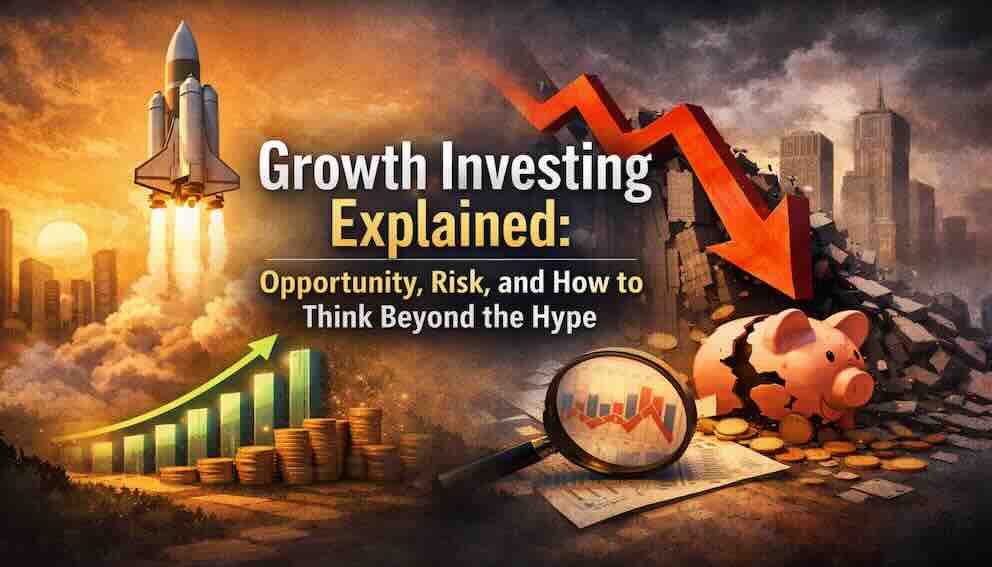
Growth investing is a philosophy anchored in the future. It is not about what a company is worth today, but what it could become tomorrow. The idea of discovering the next transformative business—of being an early passenger on a rocket ship headed for the stars—holds a powerful allure. Stories of those who saw the potential in Amazon, Apple, or Tesla long before the crowd have become modern investing folklore, fueling the belief that one brilliant insight can change a financial destiny.
Yet, for every rocket that reaches orbit, countless others sputter on the launchpad or explode. The same dynamic that creates legendary returns also creates catastrophic losses. Growth investing, therefore, is a discipline that lives at the intersection of imagination and evidence, hope and arithmetic, boundless potential and unforgiving reality.
This tutorial will guide you through this nuanced landscape. We will learn to separate compelling narratives from durable business models, understand the razor’s edge of valuation, and recognize the predictable patterns that lead growth stories to fail. Our goal is not to make you a speculator, but to equip you with the perspective and questions necessary to approach growth investing not as a dreamer, but as a clear-eyed analyst of the future.
The Core Tension: Narrative vs. Fundamentals
Every great growth story begins with a narrative: a compelling vision of how a company will change an industry, a habit, or the world. This narrative is the spark. But a spark is not a fire. For the investment to succeed, the narrative must be steadily fueled by fundamentals—the measurable, quantitative proof that the story is becoming real.
- The Narrative is the why. It’s the vision of a revolutionary technology, a massive untapped market, or a visionary leader. It’s what makes a company exciting and captures our imagination. Narratives are powerful; they create momentum and can drive stock prices for years on pure belief.
- The Fundamentals are the how. They are the tangible, reportable facts: revenue growth, profit margins, customer retention, cash flow, and balance sheet strength. They are the bricks and mortar that build the castle of the narrative.
The most dangerous mistake in growth investing is falling in love with the why while ignoring the how. A captivating story about a company building the “next-generation metaverse” is meaningless if its user growth is stalling and it’s burning a billion dollars in cash each quarter with no path to profitability. The narrative gets you interested; the fundamentals tell you whether to stay invested.
The Three Pillars of Healthy Growth: How to Spot Real Potential
When evaluating a growth company, look past the headline growth rate. True potential is built on the quality and sustainability of that growth. Examine these three pillars:
1. The Quality of Growth: Where is it coming from?
Sustainable growth is typically organic and efficient. Ask:
- Is revenue rising because the product is genuinely superior and attracting new customers, or is it just from raising prices or making expensive acquisitions?
- Are customers staying and spending more over time (strong retention and expanding wallets), or is the company on a treadmill, constantly spending to replace those who leave?
2. The Path to Profitability: Is there a viable engine?
Many growth companies lose money early on. This is acceptable only if there is a visible and credible path to future profits. Scrutinize the trend lines:
- Are gross margins (the profit after making the product) improving as the company scales?
- Are operating losses shrinking as a percentage of revenue?
- Does management articulate a clear, logical plan for when and how the business will become self-sustaining? Ask not only if profitability is possible, but what must be true for it to happen. A company whose losses widen faster than its sales is not scaling; it’s digging a hole.
3. Financial Resilience: Can it survive the journey?
Growth consumes cash. The company’s financial foundation determines whether it can weather inevitable setbacks without begging for more capital on unfavorable terms.
- How much cash does it have, and how fast is it burning through it (its “cash runway”)?
- Is it funding itself through its own operations, or is it reliant on constantly selling new shares (diluting owners) or taking on debt?
- A strong balance sheet provides optionality and time. A weak one creates desperation.
Valuation Sensitivity: The High-Wire Act of Paying for the Future
This is the defining challenge of growth investing. A growth stock’s price is not anchored primarily to what the company earns today, but to what it is expected to earn many years from now. You are therefore not buying present reality so much as a vision of a future business. Because of this, growth stocks are exquisitely sensitive to two forces: changes in growth expectations and changes in interest rates.
The Expectations Trap
During the 2020–2021 boom, many cloud software companies were growing revenues at 30–40% per year. Investors became comfortable paying extraordinary prices—often 50 to 80 times earnings or 20 to 40 times annual sales—because they believed this pace of expansion would persist for a long time.
In 2022 and 2023, growth at many of these companies slowed from around 35% to the low-to-mid 20% range. From a business standpoint, this remained excellent growth. From a valuation standpoint, it was insufficient to justify the prices investors had previously paid. As a result, many of these stocks fell 50–70%.
The lesson is simple and uncomfortable:
You can be right about a company being strong and still lose money if you paid a price that assumed near-perfection.
A useful way to think about this is to imagine paying luxury penthouse prices for a very nice suburban home. The home may be high quality, but the outcome is poor because the price left no room for reality.
The Interest Rate Anchor
Growth stocks also tend to suffer disproportionately when interest rates rise.
Most of their value comes from cash flows expected far in the future—sometimes ten or more years ahead. When interest rates increase, those future dollars are worth less in today’s terms, which pushes valuations lower even if the company’s long-term prospects remain intact.
This dynamic was visible in 2022, when rising rates coincided with steep declines across growth stocks, while many slower-growing but profitable businesses fell far less.
Why This Makes a Margin of Safety So Important
Growth stocks face a double vulnerability:
- If growth expectations fall → valuation compresses
- If interest rates rise → valuation compresses
Both can happen at the same time.
This is why declines can be so violent.
A company might:
- Grow 22% instead of 30%
- Face higher discount rates
Neither sounds disastrous.
Together, they can cut a stock price in half.
Because growth stocks are vulnerable both to changing expectations and to changing interest rates, a margin of safety in growth investing is very crucial—though it’s harder to define for growth stocks. For a growth investor, the margin of safety may come from paying a price that assumes realistic, not euphoric, growth, or and from favoring companies that already generate cash or hold strong balance sheets.
The central question becomes:
If this company turns out merely good instead of extraordinary, does today’s price still make sense?
If the answer is no, the risk is not just temporary volatility. The risk is permanent capital loss.
Great Companies Are Not Always Great Investments
A company can be doing everything right operationally and still be a poor investment at the current price. This distinction is critical in growth investing because expectations are often embedded deeply into valuations.
- A great company is one that builds strong products, grows revenue, delights customers, and expands its market presence.
- A great investment is one where the price you pay leaves room for upside even if the future is merely good rather than perfect.
Growth investors often lose money not because they misidentified quality businesses, but because they overpaid for excellence.
The Lifecycle of a Growth Story: From Hype to Reality
Growth investing tends to follow a recognizable emotional and financial cycle.
- Phase 1: The Discovery. A compelling narrative emerges. Early investors, often driven by vision and technical understanding, get in. Fundamentals are weak but show promise.
- Phase 2: The Hype. The story catches fire. Media coverage intensifies. The stock price soars as momentum and FOMO (Fear Of Missing Out) drive buying. Valuations detach from any reasonable fundamental anchor.
- Phase 3: The Test. Reality intervenes. The company must deliver quarter after quarter of flawless execution to justify the soaring price. This is where narratives are stress-tested by fundamentals.
- Phase 4: Resolution (Triumph or Collapse).
Triumph: The company consistently meets or exceeds lofty expectations, grows into its valuation, and eventually becomes a profitable, dominant player. Early visionaries are rewarded.
Collapse: Execution stumbles. Growth slows, losses persist, competition intensifies. The narrative breaks. Sentiment reverses violently, and the stock price craters as the “story” investors flee.
Understanding this cycle is key to managing your psychology. The greatest danger is getting swept up in Phase 2 (Hype) and mistaking a rising price for validation of your intelligence. The greatest opportunity often lies in the careful analysis of Phase 1 (Discovery) or in the sober re-evaluation of a good company that has been punished in Phase 4.
Successful growth investing almost always requires a long time horizon and immense patience. Many true winners experience multiple 30–50% drawdowns along the way. The ability to hold through these periods depends not on blind optimism, but on continued fundamental confirmation. Without patience, even correct theses can fail at the portfolio level.
Common Failure Modes: Why Growth Stories Break
History shows that growth investments fail in predictable ways. Being aware of these patterns is your first line of defense.
- Growth Slows: This is the most common killer. No company can grow at 40% forever. Markets saturate, competition enters, or the law of large numbers takes effect. A stock priced for perpetual hyper-growth is devastated by mere “very good” growth.
- The Flawed Model Reveals Itself: Some models look brilliant in a spreadsheet but fail in the real world. High customer acquisition costs that never come down, low customer loyalty, or unsustainably thin margins eventually overwhelm top-line growth.
- Competition and Commoditization: High profits and rapid growth attract competitors. If a company cannot defend its turf with a true moat—a unique technology, network effects, or powerful brand—its advantages erode.
- Financial Exhaustion: The company runs out of cash before reaching profitability. This is especially fatal when capital markets turn skeptical and new funding is unavailable or ruinously dilutive.
- The Narrative Collapses: When belief shatters, it shatters quickly. The same investors who ignored losses while focusing on the “total addressable market” suddenly focus only on the losses. This psychological shift can cause declines far steeper than the fundamental deterioration.
A Disciplined Framework for the Growth Investor
How do you navigate this treacherous but rewarding landscape? By adopting a process that respects both the opportunity and the risk.
- Begin with Skepticism, Not Euphoria. Assume every exciting narrative is wrong until the fundamentals prove it right. Let data, not headlines, be your guide.
- Interrogate the Three Pillars. For any company, rigorously assess the Quality of Growth, the Path to Profitability, and Financial Resilience. If one pillar is cracked, proceed with extreme caution.
- Respect Valuation, Even When Imprecise. You cannot calculate a precise intrinsic value, but you can identify insanity. If the price assumes a company will conquer 200% of its addressable market, it’s insanity. Use scenarios: “What if growth is good but not perfect? What would the stock be worth then?”
- Practice Ruthless Position Sizing. The high risk of permanent loss in growth investing means you must never bet the farm on a single story. Size each position so that if it goes to zero, your financial journey continues.
- Know Your Exit Criteria Before You Enter. Define what would make you sell. Is it a breakdown in a key fundamental metric? The CEO leaving? Valuation reaching a level you deem absurd? Having a pre-defined exit strategy prevents you from becoming a prisoner of hope during a decline.
Manage your portfolio-level expectations. Most growth portfolios will have more losers than winners. The strategy works only if the outsized gains from a small number of exceptional successes outweigh the many small or moderate failures.
Conclusion: The Stewardship of Future Potential
Growth investing is not a game of simple optimism. It is the rigorous stewardship of future potential. It requires the imagination to see what could be, paired with the discipline to demand evidence of what is actually being built.
We have seen that the siren song of a good story is not enough; it must be validated by durable fundamentals. We’ve learned that paying for dreams is a high-wire act, where small changes in expectations can lead to dramatic falls. Most importantly, we’ve built a framework that prioritizes business quality, financial sanity, and personal emotional discipline.
In the end, successful growth investing is less about picking rockets and more about being a meticulous engineer, checking every system before countdown, understanding the physics of ascent, and always, always knowing the risks of the void. It is a path that can lead to extraordinary rewards, but only for those who walk it with their eyes wide open to both the stars above and the hard ground below. Growth investing succeeds when imagination is always subordinated to evidence, and hope is always constrained by arithmetic.
About Swati Sharma
Lead Editor at MyEyze, Economist & Finance Research WriterSwati Sharma is an economist with a Bachelor’s degree in Economics (Honours), CIPD Level 5 certification, and an MBA, and over 18 years of experience across management consulting, investment, and technology organizations. She specializes in research-driven financial education, focusing on economics, markets, and investor behavior, with a passion for making complex financial concepts clear, accurate, and accessible to a broad audience.
Disclaimer
This article is for educational purposes only and should not be interpreted as financial advice. Readers should consult a qualified financial professional before making investment decisions. Assistance from AI-powered generative tools was taken to format and improve language flow. While we strive for accuracy, this content may contain errors or omissions and should be independently verified.