Tutorial Categories
Last Updated: January 29, 2026 at 18:30
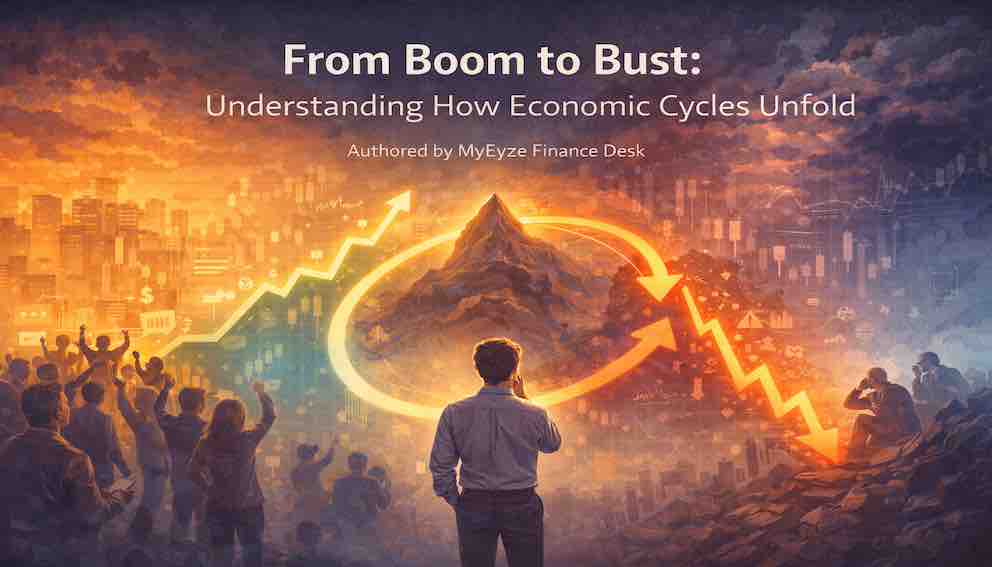
From Boom to Bust: Understanding How Economic Cycles Unfold
Economic cycles show how the economy naturally moves through periods of growth, peak, contraction, and recovery, shaped by spending, investment, credit, and human behavior. Expansions are driven by optimism and borrowing, while downturns are amplified by fear, debt, and loss aversion. Understanding the phases of the cycle, along with key indicators like GDP, employment, credit, and consumer sentiment, helps identify risks and opportunities before they fully unfold. Behavioral factors such as herding, overconfidence, and Minsky-style leverage cycles often push markets beyond fundamentals, while policy tools like interest rates and fiscal measures aim to stabilize growth but have limits. Historical examples, from 1970s stagflation to recent inflationary cycles, show recurring patterns of excess, correction, and recovery. By combining data, behavioral insights, and policy understanding, readers can anticipate turning points, navigate volatility, and make informed decisions.
Introduction: The Rhythm of the Economy
Economic activity rarely grows in a straight line. Instead, it moves in cycles—periods of expansion, peaks, contraction, and eventual recovery. These cycles are driven not just by numbers or policy, but by human behavior. Optimism encourages spending, investment, and risk-taking, fueling expansions. Conversely, fear, caution, and loss aversion can deepen slowdowns or trigger recessions.
Monitoring economic cycles is critical because they:
- Indicate where an economy is in the cycle, helping policymakers and investors anticipate the next phase.
- Highlight risks building in the system, such as debt accumulation or asset bubbles.
- Signal when policy interventions may be needed to stabilize growth or rein in overheating.
The core question for this tutorial is: Where are we in the cycle, and what vulnerabilities are developing?
The central premise: Economic cycles are predictable in their mechanics and dynamics, but their timing and intensity are influenced by human psychology. Understanding them allows societies and markets to prepare rather than react.
Phases of the Economic Cycle
Understanding the distinct phases helps interpret data and anticipate outcomes.
Expansion
During an expansion, output grows steadily, employment improves, and confidence supports consumption and investment. Credit is generally available and used productively, allowing firms to expand without excessive strain on balance sheets. Policymakers typically maintain a neutral or mildly accommodative stance, focusing on sustaining growth while monitoring inflation and financial excess. In this environment, equity markets tend to perform well—especially cyclical sectors—while credit spreads remain stable and risk appetite is healthy.
Peak / Overheating
As the cycle matures, the economy approaches capacity limits. Labor markets tighten, inflationary pressures emerge, asset prices rise, and leverage increases. Optimism often turns speculative as households and firms extrapolate recent growth. Policymakers respond by tightening monetary conditions or withdrawing fiscal support to prevent overheating. Markets become more volatile: equity valuations grow fragile, bond yields rise, and highly leveraged or speculative assets become vulnerable to sharp corrections.
Contraction / Recession
When imbalances unwind, growth slows or reverses. Unemployment rises, spending and investment retrench, and credit conditions tighten, often amplifying the downturn. Confidence collapses as uncertainty dominates decision-making. Policy shifts aggressively toward stabilization through rate cuts, fiscal stimulus, and liquidity support. Financial markets reflect this stress: defensive assets outperform, bond yields fall as investors seek safety, credit spreads widen, and equity markets typically decline.
Trough / Early Recovery
Eventually, economic activity stabilizes. Job losses slow, output stops falling, and confidence begins to recover cautiously. Policy remains supportive but becomes more targeted, with authorities preparing for gradual normalization once recovery appears durable. Markets usually turn before the data improves—equities often recover early, cyclical sectors begin to rebound, and credit conditions slowly ease.
Structural or Behavioral Distortions
Not all downturns are driven by broad demand weakness. Some reflect deeper structural issues—such as skill mismatches, demographic shifts, or sector-specific debt—or behavioral excesses built during prior booms. In these cases, traditional stimulus is less effective. Policymakers rely more on structural reforms, retraining, targeted regulation, or sector-specific support. Markets show greater divergence, with clear winners and losers rather than a uniform recovery.
Hidden Slack / Underemployment
At times, headline growth and unemployment figures mask underlying weakness. Participation may decline, underemployment may rise, and labor resources remain underutilized despite stable GDP. This hidden slack can mislead policymakers into tightening too early or delaying support. Markets may overestimate economic resilience, increasing the risk of abrupt demand shocks once the underlying weakness becomes visible.
Additional Context: Corporate Finance Channel
Even in a strong economy, heavily indebted firms may hold back on hiring and wages, weakening growth and increasing the risk that a small shock turns into a larger downturn.
Tracking leverage, credit spreads, and debt levels helps identify whether corporate balance sheets are likely to amplify or dampen the business cycle.
How to Read the Signs: Key Indicators of Economic Cycles
You don't need a crystal ball to see where the economy is headed. Policymakers and analysts watch specific data points called economic indicators. These are like the economy's vital signs.
Leading Indicators (They Hint at the Future)
- Business Investment: Rising capex signals confidence; declining investment signals caution.
- Credit Growth & Lending Surveys: Expanding credit fuels activity; contraction signals tightening.
- Consumer Sentiment: Optimism drives spending; pessimism predicts reduced consumption.
- Stock Market Indices: Reflect expectations about future profits and economic growth.
Coincident Indicators (Confirm the present)
- GDP Growth: Measures the overall pace of economic activity.
- Industrial Production: Tracks output trends in key sectors.
- Payroll Employment: Captures real-time labor market trends.
Lagging Indicators (Confirm the Aftermath)
- Unemployment Rate: Peaks after a recession has started.
- Corporate Defaults and Bankruptcies: Show the severity of prior imbalances.
- Inflation Adjustments: Price pressures often continue even after contractions begin.
How to Use Indicators Effectively
- Look for confirmation across categories, not single data points.
- Combine hard data (GDP, jobs) with behavioral signals (confidence, risk appetite).
- Track financial conditions, since leverage and credit often amplify cycles.
- Always account for policy feedback, which can delay or distort signals.
Common Pitfalls
Economic indicators can mislead because of seasonality, later data revisions, and biased surveys. To reduce false signals, compare adjusted data with raw releases, watch how GDP estimates change over time, and cross-check sentiment surveys against broader indicators such as the LEI or real-time nowcasts. Emphasize persistent trends and cross-checks rather than reacting to single headlines.
👉 Key idea:
Economic cycles are not just about growth rates. Each phase reflects an interaction between data, behavior, financial structure, and policy response — and markets react to all four simultaneously.
The Mechanics of Economic Cycles
Economic cycles emerge from imbalances that build up over time, which eventually require correction. The main drivers include:
- Excessive borrowing: High leverage by households, businesses, or governments can fuel spending but leaves the economy vulnerable to shocks.
- Asset price bubbles: Overvalued real estate, stocks, or other assets encourage speculative behavior that can reverse sharply.
- Overheating demand: When demand exceeds supply capacity, inflation rises, and policy tightening may be required.
How It Spreads Through the Economy:
These imbalances don't stay in one place. They propagate through interconnected channels that can either reinforce growth or amplify downturns.:
- Household Spending: Rising income and confidence drive consumption, which boosts production and profits.
- Business Investment: Optimistic firms expand operations, hire workers, and invest in innovation.
- Labor Market Feedback: Increased employment fuels further spending, creating a self-reinforcing expansion.
- Financial Markets: Abundant credit, favorable interest rates, and rising asset valuations make financing easier, reinforcing business expansion, hiring, and investment.
Importantly, these channels are symmetric—when confidence breaks or credit tightens, the same feedback loops reverse, amplifying contractions through reduced spending, investment cuts, job losses, and financial stress.
Key Insight: A cycle isn't a predictable machine. Its timing and strength are heavily influenced by human behavior, credit conditions, and overall market sentiment.
To understand why these drivers and channels produce recurring booms and busts, economists interpret cycles through different theoretical lenses.
- Classical / Neutral View: Economic cycles are natural, efficient adjustments to shocks. Real Business Cycle (RBC) theory emphasizes supply-side factors such as productivity changes, technological shocks, and labor supply shifts which temporarily alter output and employment. In this view, recessions are efficient corrections, and markets self-adjust over time.
- Keynesian View: Cycles are largely demand-driven. They arise because spending fluctuates and markets do not adjust instantly. Drops in consumption or investment reduce demand, leading to layoffs and idle capacity, which can persist due to sticky wages and prices. Without intervention, downturns can feed on themselves, making policy stabilization important.
- Financial / Minskyian View: Economic stability can sow the seeds of instability. According to Minsky, periods of stability encourage increasing leverage and risk-taking (hedge → speculative → Ponzi finance), which eventually triggers crises. This directly supports the “excessive borrowing” driver.
- Putting It Together: No single lens has all the answers. A complete view uses all three: recognizing supply shocks (Classical), managing demand (Keynesian), and guarding against financial folly (Minskyian).
To see this in action, consider the following recent example of supply shocks exacerbating demand and leverage imbalances
The 2022-2023 period vividly illustrated how supply shocks can interact with demand overheating and Minskyian leverage buildup. Global supply chain disruptions and energy price spikes (e.g., oil prices surging over 50% due to geopolitical tensions) collided with pent-up consumer demand from pandemic stimulus, pushing U.S. CPI inflation to 9.1% in June 2022. Households and firms, flush with low-interest credit, engaged in speculative borrowing, amplifying the boom. As inflation persisted, central banks tightened policy aggressively—e.g., the Fed raised rates from near-zero to over 5%—triggering a mild contraction in some sectors. This cycle highlighted the Minskyian shift from stable to speculative finance, where initial stability encouraged risk-taking that ultimately required correction.
The Role of Human Behavior in Economic Cycles
Economic cycles are driven by more than just supply, demand, and interest rates. They are powerfully shaped by human psychology—the collective moods of confidence and fear among households, firms, and investors. These psychological forces can amplify booms and deepen busts, often pushing the economy further than fundamentals alone would suggest.
1. The Behavioral Engine: Confidence and Herding
Two common behaviors act as the primary engine for these psychological swings:
- Animal Spirits: This is the broad swing between economic optimism and pessimism. When confidence is high, people spend and invest more, fueling a virtuous cycle of growth. When fear takes over, spending halts, creating a vicious cycle of contraction. These shifts in mood magnify the natural ups and downs of the business cycle.
- Herding Behavior: People, especially investors, often follow the crowd. This means that once a trend starts—whether buying tech stocks in the 1990s or bidding up house prices in the 2000s—more and more people pile in, not based on fundamental value but on the fear of missing out. Herding accelerates trends, inflating bubbles on the way up and worsening crashes on the way down.
Example: The 2021 meme stock phenomenon (like GameStop) was a pure example of herding. Prices soared not due to company profits, but because a crowd of investors coordinated to buy, creating a self-fulfilling but fragile boom that eventually collapsed.
2. The Minsky Framework: How Stability Breeds Instability
The economist Hyman Minsky provided a crucial theory that explains why these behaviors lead to crisis. He showed that prolonged economic stability and optimism sow the seeds of the next crash through predictable stages of increasing risk:
- Hedge Finance: Borrowers can meet both interest and principal obligations from cash flows. During stable periods, this encourages measured risk-taking and gradual growth.
- Speculative Finance: Borrowers can cover interest but must roll over principal(refinance the original loan instead of repaying it). Optimism and herding behaviors push risk higher, as firms and households take on more leverage than they might in calm periods.
- Ponzi Finance: Borrowers rely on rising asset prices to meet both interest and principal. Euphoria and delayed recognition of risk make the system vulnerable, and even small shocks can trigger sharp corrections.
Minsky's Key Insight: A long period of calm ("Hedge") encourages more risk-taking ("Speculative"), which eventually mutates into dangerous speculation ("Ponzi"). The entire financial system becomes fragile, and a small shock (like a rise in interest rates) can trigger a widespread default and a sharp economic correction.
3. The Psychological Amplifier: Loss Aversion
The final piece of the puzzle is a core rule of psychology: people feel the pain of a loss much more intensely than the pleasure of an equivalent gain. This "loss aversion," formalized in Prospect Theory, explains why downturns can be so severe.
When a Minsky-style correction begins, loss aversion kicks in powerfully. Investors don't just sell; they panic sell, rushing for the exits. Consumers don't just cut back slightly; they slash spending aggressively. This behavioral stampede can deepen a recession by an estimated 1–2% of GDP, making the downturn much worse than the initial economic shock warranted.
Key Insight: The Complete Behavioral Cycle
These concepts form a complete story of behavioral economics in action:
- Confidence and Herding drive the economy beyond sustainable fundamentals during a boom.
- Minsky's Hypothesis explains how this confidence progressively builds a fragile, debt-fueled financial structure.
- Loss Aversion then magnifies the collapse when the fragile structure finally cracks.
Understanding this cycle allows analysts to watch for warning signs—like a shift toward "Ponzi" finance in corporate debt or extreme herd behavior in markets—to anticipate turning points rather than just react to them.
6. Policy Responses and Market Implications
Governments have two main toolkits to manage economic cycles:
- Monetary Policy – Managed by the central bank
- Fiscal Policy – Managed by the government
During a Recession (Fighting a Bust)
Goal: Stimulate spending and investment to shorten the downturn.
Monetary Policy:
- Cut interest rates → borrowing becomes cheaper
- Use Quantitative Easing (QE) → central bank buys bonds to inject money into the financial system
Fiscal Policy:
- Increase government spending (infrastructure, benefits)
- Cut taxes → puts money directly in people’s pockets to boost demand
During an Overheating Boom (Fighting Inflation)
Goal: Slow the economy and bring inflation under control.
Monetary Policy:
- Raise interest rates → borrowing becomes more expensive, reducing spending
Fiscal Policy:
- Cut government spending
- Raise taxes → removes money from the economy
Policy Limitations and Trade-Offs
While these tools sound straightforward, policymakers face important limits and trade-offs. Actions take time to work, and each tool can have side effects, so decisions are never risk-free.
Key Policy Limitations (Explained Simply)
Policy Lags:
- Decisions take time to implement and affect the economy
- Policymakers are always acting with “rearview mirror” information
Zero Lower Bound (ZLB):
- Interest rates can’t go much below zero
- Central banks must use unconventional tools like QE
Debt Overhang:
- High public debt restricts how much the government can spend during a recession
- Spending too much can raise solvency concerns
Macro-prudential Policy:
- Rules like countercyclical capital buffers help prevent banks and firms from taking excessive risks
- Acts as a safety net to reduce boom-bust extremes
Expectations Matter:
- Markets react not just to the current phase, but to what people expect will happen next
- Imbalances (high debt, overheating sectors) influence both policy and market behavior
Key Insight: Markets and policy do not respond to the current phase alone—they respond to expectations of the next phase and the imbalances that could trigger it.
Historical Case Studies: Lessons in Action
Economic cycles are not just abstract theory—they show up in real economies. The following episodes illustrate how supply shocks, structural constraints, and behavioral dynamics can shape booms, busts, and recoveries.
1970s Stagflation
- What happened: Oil price shocks and structural bottlenecks drove inflation above 10% while unemployment rose.
- Why it matters: This episode shows that supply shocks can distort normal cyclical dynamics. Traditional demand-side stimulus could not resolve the problem immediately, highlighting limits of policy and the importance of structural factors.
1980s Latin American Debt Crisis
- What happened: Rapid borrowing during the 1970s oil boom left several countries with unsustainable debt. When global interest rates rose, governments could not service their loans, triggering defaults and sharp recessions.
- Why it matters: Demonstrates Minsky’s insight that stability encourages leverage. External shocks exposed fragile balance sheets, amplifying the downturn.
1997–1998 Asian Financial Crisis
- What happened: Excessive short-term borrowing by corporations, coupled with overvalued currencies, led to widespread defaults when capital flows reversed. Growth collapsed in multiple economies, and social costs were high.
- Why it matters: Shows the interaction of leverage, herd behavior, and market sentiment. Panic spread rapidly once confidence broke, amplifying contractions across borders.
2010–2012 European Sovereign Debt Crisis
- What happened: Several Eurozone countries faced high public debt and fiscal deficits after the 2008 crisis. Market fears about solvency triggered rising borrowing costs, forcing austerity measures that slowed recovery.
- Why it matters: Highlights the trade-offs in policy response—high debt constrains fiscal options, and market expectations can amplify downturns even after a shock has passed.
Key Insights from History
From these examples, several lessons emerge:
- Leverage and debt amplify cycles: Excess borrowing—by households, firms, or governments—can accelerate expansions but intensifies contractions when shocks occur.
- Policy has limits and trade-offs: Structural shocks or high debt levels can constrain monetary and fiscal responses, making timing and expectations crucial.
- Behavior matters: Herding, optimism, and panic can magnify both booms and busts, often beyond what fundamentals alone would justify.
Final Insights: Turning Economic Cycles into Smarter Decisions
- Cycles Matter: Expansions and contractions affect jobs, income, and asset prices. Knowing the current phase helps you act deliberately rather than react to noise.
- Watch Key Signals: Credit and debt levels, consumer sentiment, and asset valuations act as early warning lights for turning points.
- Behavior Drives Extremes: Herding, overconfidence, and loss aversion can inflate booms and deepen busts—stay disciplined, avoid panic, and don’t chase trends.
- Leverage Amplifies Risk: Debt boosts gains in good times but magnifies losses in downturns. Track your own exposure and the companies you invest in.
- Policy Helps, but Has Limits: Stimulus or rate changes lag behind the cycle. Markets often move first—so rely on indicators, not headlines alone.
- Learn from History: Past cycles—from the 1970s stagflation to the 1997 Asian financial crisis—show recurring patterns: excess debt, speculative bubbles, and sharp reversals. Observing history highlights risks and opportunities.
- Practical Takeaways: Diversify, avoid overleveraging, monitor early indicators, and maintain patience. Discipline across cycles compounds long-term gains and reduces losses.
Key Idea: Economic cycles are predictable in mechanics, but not timing. By combining data, behavior, and market signals, you can position yourself to benefit from booms, survive busts, and make smarter financial decisions.
Conclusion: The Big Picture
Economic cycles are the heartbeat of the economy, revealing the interplay of production, consumption, credit, and human behavior.
Mastering this framework allows us to:
- Identify the current phase of the cycle
- Anticipate risks and vulnerabilities
- Make more informed policy, investment, and business decisions
Cycles are not just numbers—they represent the opportunities and vulnerabilities that shape economic life.
References / Data Sources
Official Data Sources
- U.S. Bureau of Economic Analysis (BEA): https://www.bea.gov
- U.S. Bureau of Labor Statistics (BLS): https://www.bls.gov
- Federal Reserve Economic Data (FRED): https://fred.stlouisfed.org
Key Academic References
- Blanchard, O., & Johnson, D. R. (2012). Macroeconomics (6th ed.). Pearson.
- Schumpeter, J. A. (1939). Business Cycles. McGraw-Hill.
- Minsky, H. P. (1986). Stabilizing an Unstable Economy. Yale University Press.
- Shiller, R. J. (2000). Irrational Exuberance. Princeton University Press.
- Kahneman, D., & Tversky, A. (1979). Prospect Theory: An Analysis of Decision under Risk.
About Swati Sharma
Lead Editor at MyEyze, Economist & Finance Research WriterSwati Sharma is an economist with a Bachelor’s degree in Economics (Honours), CIPD Level 5 certification, and an MBA, and over 18 years of experience across management consulting, investment, and technology organizations. She specializes in research-driven financial education, focusing on economics, markets, and investor behavior, with a passion for making complex financial concepts clear, accurate, and accessible to a broad audience.
Disclaimer
This article is for educational purposes only and should not be interpreted as financial advice. Readers should consult a qualified financial professional before making investment decisions. Assistance from AI-powered generative tools was taken to format and improve language flow. While we strive for accuracy, this content may contain errors or omissions and should be independently verified.