Tutorial Categories
Last Updated: January 29, 2026 at 19:30
Reading Fiscal Policy: Decoding the Government's Economic Strategy
Fiscal policy—government spending, taxation, and borrowing—is the primary tool for steering the economy. Is the government trying to spark a recovery or cool down inflation? This tutorial provides a clear diagnostic framework to move beyond the headlines, identify the policy stance, and understand its implications for growth and your financial security.
What is Fiscal Policy?
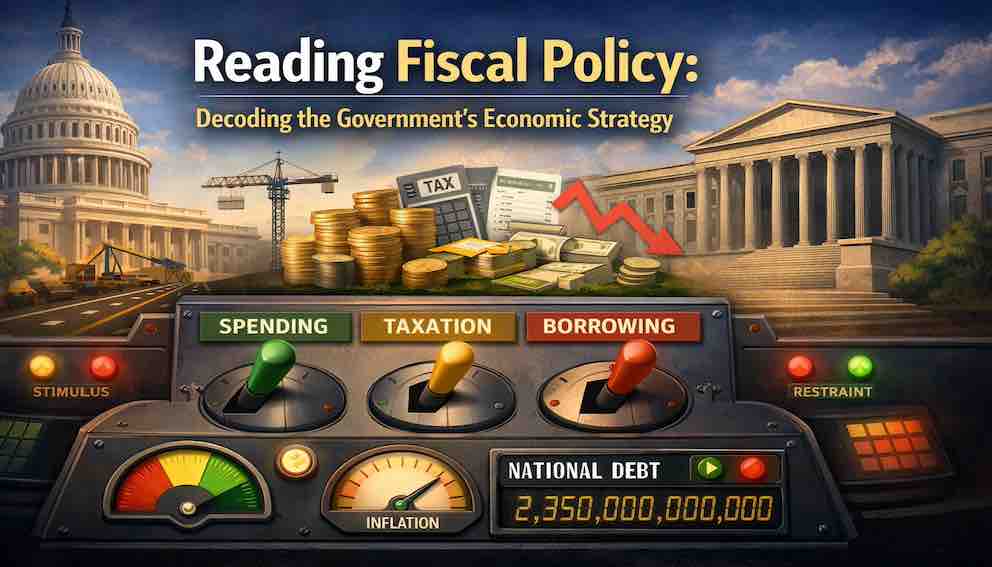
Fiscal policy is the government’s plan for how it collects and spends money to influence the economy. It consists of three main tools: spending, taxation, and borrowing. By adjusting these levers, governments can try to stimulate growth during a slowdown or slow the economy if inflation is rising too fast.
The roads you drive on, the taxes in your paycheck, and the schools in your neighborhood—all of these reflect choices made through fiscal policy. Fiscal policy is the main way governments influence the economy. Through spending, taxation, and borrowing, governments can:
- Boost spending when the economy slows down
- Slow things down if the economy is overheating or prices are rising too fast
- Support long-term growth through infrastructure, education, and innovation
Core Question: At this moment, is the government trying to encourage growth or to constrain it?
Every headline about a new spending bill or tax debate is a clue. But what's the bigger story? This tutorial gives you the detective's toolkit. You'll learn the three fiscal levers, but more importantly, you'll master a simple framework to piece together the clues, diagnose whether the government is in "stimulus" or "restraint" mode, and decipher what that strategic choice means for the economy's direction—and for your wallet and your future?
The Three Levers and how to spot them
Think of fiscal policy as a machine with three primary levers: Spending, Taxation, and Borrowing. Pulling on each one changes the amount of money flowing through the economy in a different way. These influence how much money is in your pocket today and how strong the economy will be tomorrow.
1. The Spending Lever: The Direct Boost
Government spending is the direct purchase of goods and services. It injects money into the economy by paying workers, contractors, and suppliers, immediately raising demand and incomes. This is the most direct tool. When the government funds a new highway, a research grant, or a school lunch program, it isn't just buying a service—it is directly creating jobs and income.
- 🔍 Spot It in the News: Look for headlines about new public investment, like "Federal Bill Funds National Push for Semiconductor Plants." This is a clear signal the government is opening the spending tap to stimulate a specific sector.
- 📊Why It Works – The Fiscal Multiplier: This spending has a ripple effect. Each dollar can generate more than a dollar in total economic activity as it gets re-spent. This "multiplier" is most powerful during a recession when there are idle workers and resources ready to be put to use.
For example: During the Great Depression, programs like the Works Progress Administration(WPA) directly employed millions to build infrastructure. Because wages were spent immediately, the impact on demand was faster and more reliable than tax cuts, which can be partly saved—especially when confidence is low.
2. The Taxation Lever: Changing What's in Your Pocket
Tax policy determines how much income households and businesses retain. Tax cuts increase disposable income and profits, supporting spending and investment; tax increases reduce demand by taking income out of circulation.
- 🔍 Hear It in a Debate: When a politician promises to "make the recent tax cuts permanent," they are directly adjusting this lever. The immediate questions become: "What will this do to the national deficit in the long run?" and "Which groups—workers, investors, or business owners—stand to benefit the most?"
- 📊A Key Nuance: While powerful, tax changes often have a smaller immediate economic impact than direct spending. The reason is simple: some people may choose to save their tax cut rather than spend it right away.
3. The Borrowing Lever: Spending Tomorrow's Money Today
Borrowing fills the gap when government spending exceeds tax revenue. It allows the government to support the economy without immediately raising taxes.
When the government spends more than it collects, it runs a deficit and borrows to cover the difference. This borrowing is especially important during crises, such as funding emergency relief or recession support.
- 🔍 How to Spot It – The Deficit Headline: News that the "Federal Deficit Ballooned to $1.7 Trillion" can sound alarming. A deliberately widening deficit often signals expansionary policy. The vital follow-up question is: "Is this borrowing sustainable?"
- 📊The Sustainability Rule – Debt Dynamics: The answer lies in the relationship between the interest rate on the debt (r) and the economy's growth rate (g). If the economy grows faster than the interest rate (g > r), the debt burden can stabilize even with ongoing deficits.
- The Automatic Stabilizers- The Economy’s Shock Absorbers: Alongside these active levers are automatic stabilizers— policies that work automatically, without new legislation, cushioning economic swings. Example : programs like unemployment insurance expand when the economy slows, giving people money to spend, and fall during booms.
Core Insight: Fiscal policy smooths short-term economic bumps while building long-term foundations—roads, education, research. Understanding these levers lets you interpret everyday headlines and see where the economy is heading.
Fiscal Policy and the Economic Cycle: The Counter-Cyclical Dance
These levers are not used randomly or in isolation. Their use depends heavily on where the economy sits in the business cycle. To understand why governments choose certain combinations of spending, taxes, and borrowing, we need to look at how fiscal policy responds to economic expansions and recessions. Governments engage in a continuous counter-cyclical dance with the economy, trying to smooth out its natural ups and downs.
The Core Rule of the Dance: When the economy steps back (into recession), the government steps forward with stimulus. When the economy leaps ahead too fast (into an inflationary boom), the government steps back to restrain it.
Move 1: Stepping Forward in a Recession
When the economy's rhythm breaks—layoffs rise, spending falls—the government's role is to lead, injecting confidence and demand back into the system.
- The Steps: Expand spending (on infrastructure, benefits) and cut taxes.
- How It Works: Automatic stabilizers, like unemployment insurance, provide the first, instinctive counter-step. Discretionary stimulus, like a new jobs program, is the deliberate follow-up move.
- The Goal: To restart the beat of spending and employment, preventing a downward spiral.
Move 2: Stepping Back in an Expansion
As the economy finds its rhythm again and growth accelerates, the government's role shifts from leader to stabilizer. It must temper the pace to prevent a runaway boom that leads to inflation.
- The Steps: Slow spending growth, raise taxes, or aim for a budget surplus.
- How It Works: This move is less popular but critical. It builds "fiscal space"—saving its strength (resources) for the next time it needs to step forward.
- The Goal: To cool inflationary pressures and ensure the expansion is sustainable, not chaotic.
The Art and Difficulty of the Dance
The entire skill lies in two judgments that make this dance incredibly difficult:
- Timing: When do you step in or step back? Act too late in a recession, and the slump deepens. Step back too early in a recovery, and you stifle growth.
- Scale: How much do you move? A stimulus package that's too small is ineffective; one that's too large can create debt or asset bubbles. A tax hike that's too aggressive can trigger a new downturn.
Key Takeaway: Fiscal policy is inherently counter-cyclical—it tries to smooth out the bumps. By understanding what phase of the "dance" the economy is in, you can instantly classify any new policy announcement as either a stimulative move or a restrictive one.
Your Diagnostic Framework – Reading the Indicators
Understanding this counter-cyclical role gives context, but it does not yet tell you how to interpret real-world policy decisions. In practice, fiscal actions arrive through messy headlines, partial measures, and political compromises. The next step is learning how to read those signals together and diagnose the government’s actual policy stance.
Think of it like being a detective. You are presented with the scene (the state of the economy). Your job is to sift through the available evidence (the policy moves and headlines) to deduce the strategy at play. Let's practice with two very different economic "scenarios" and see what the policy evidence tells us.
Scenario 1: "The Stormy Recession" (Expansionary Stance)
The Context: the news is full of bad economic reports: rising layoffs, falling consumer confidence.
Your Evidence (The Policy Moves):
- You see a major headline: "Congress Passes $500 Billion Infrastructure Bill to Rebuild Roads and Bridges." A clue from Spending. This is a direct signal the government is actively injecting money into specific sectors to create jobs and spur activity.
- At the same time, there's a political push for "temporary payroll tax cuts to boost take-home pay." A clue from Taxes. This is a direct plan to put more money in people's pockets to encourage spending.
- Naturally, financing this leads to another headline: "Budget Deficit Projected to Hit Record $2 Trillion." A clue from Borrowing: This isn't necessarily a panic sign yet. This shows the government is borrowing aggressively to finance support for the economy.
- The Bigger Picture: (Debt & Automatic Help)- Crucially, this happens while long-term national debt is seen as manageable, and you hear stories about unemployment benefits automatically supporting those who lost jobs.
Your Deduction: The government is pulling all three levers in the same direction—spending more, taxing less, and borrowing to pay for it. This combination of evidence points clearly to an expansionary stance. They are trying to stimulate growth.
Scenario 2: An Overheating Economy (Contractionary Stance)
The Context: Headlines about high inflation, rising prices, and an economy that might be "running too hot."
Your Evidence (The Policy Moves):
- The debate in Washington is about "imposing strict caps on federal agency budgets." This clue from spending signals a desire to rein in government expenditure.
- There are serious proposals to "raise the corporate tax rate to help reduce the national debt." clue from taxes aims to pull money out of the corporate sector.
- The Treasury Secretary announces a goal to "halve the deficit within three years." This clue from borrowing clearly targets reducing government borrowing.
- The Bigger Picture:(Debt & Automatic Help) -These moves are often driven by worries over "the national debt nearing a record high." Meanwhile, in a strong job market, far fewer people are claiming unemployment benefits—the automatic stabilizers are quiet.
Your Deduction: Here, the levers are also moving in unison—but in the opposite direction. Spending is being reined in, taxes are being discussed as a tool to cool demand, and deficit reduction is a goal. This pattern signals a contractionary stance. They are trying to slow the economy down. This is a contractionary stance.
Sharpening Your Analysis
These scenarios show how individual policy moves combine into a broader strategy. However, real-world policy signals are often mixed, incomplete, or deliberately framed for political reasons. To avoid being misled, it’s essential to refine how you interpret fiscal news. Focus on patterns—not isolated actions.
- Look for Alignment: One policy can mislead. If you see a "middle-class tax cut" (which looks expansionary) but it's paired with "deep cuts to healthcare and education spending" (which is contractionary), the net effect may cancel out. Always ask: "What are the other levers doing at the same time?"
- Look beyond the label: Ask what's really changing. A headline about a "new spending bill" begs the question: Is this new money or just maintaining the status quo? The difference between "record investment" and "funding existing programs" is what tells you the policy direction.
- Context is Everything (Recession vs. Boom): The same policy means different things in different times. A big infrastructure bill during a recession is medicine. The exact same bill passed during a strong, inflationary boom could be fuel on a fire. Always tag the news with the current economic weather: Are we in a downturn or a boom?
- Watch Automatic Stabilizers: These programs are a powerful sign of the economic cycle itself. When they are heavily engaged, it confirms the economy is under stress.
- Assess the Limits (The Debt Backdrop): Debt determines how much room does the government have to act? Headlines like "Social Security trust funds may be depleted by 2033" are not just far-off problems. They limit how aggressively the government can spend in the next crisis. A manageable, stable debt level gives policymakers room to use deficits in a crisis without sparking a market panic.
Key Takeaway: By learning to read these patterns, you move from passively consuming news to actively diagnosing the government's economic strategy. This is the critical first step in answering the ultimate personal question: What does this mean for my wallet and my future?
The Psychology and Messy Reality of Fiscal Policy
Even the most perfectly designed fiscal plan runs into two big challenges: human behavior and real-world friction. Understanding these is key to seeing why policy doesn't always work as neatly as the textbooks suggest.
The Human Factor: How Moods and Mindsets Shape Impact
Fiscal policy doesn't work on robots; it works on people whose feelings about the future change how they act today.
Confidence and Expectations:
A tax cut is just numbers on paper unless people feel confident enough to spend the extra money. If households fear a future recession or higher taxes, they might save the cash instead, muting the policy's effect. Conversely, a big infrastructure announcement can boost business optimism, leading to more private investment than the government spending alone would create.
Following the Herd:
Clear government signals can start a stampede. A major green energy subsidy can trigger a herd of investors into solar stocks, amplifying the policy's goal. But this can also inflate bubbles if the rush is based more on hype than fundamentals.
The Long-Term Mood:
Years of low taxes and rising deficits can create a permanent optimism where individuals and businesses take on more debt, assuming the good times will never end. This can build hidden risks in the financial system.
Key Takeaway: The success of a spending bill or tax change depends as much on public trust and prevailing mood as it does on the dollar amount.
The Limits and Trade-Offs
Governments don't have a magic wallet. Every fiscal action involves a choice and faces practical hurdles.
The Crowding Out / Crowding In Dilemma:
This is the classic trade-off of government spending: does it help or hurt private investment?
Crowding Out: Imagine your city uses its limited budget to build a new stadium. That might mean fewer resources for fixing schools or roads. At a national level, when the economy is near full capacity, massive government borrowing can push up interest rates, making it harder for businesses to get loans to expand. The public sector "crowds out" the private sector.
Crowding In: Now imagine that new stadium spurs new restaurants, hotels, and jobs in a once-dormant neighborhood. Here, government spending "crowded in" private investment. This often happens in a recession when private money is idle; public investment can create the confidence and infrastructure that gets private capital flowing again.
Political Constraints: It's Never Just Economics
Simply point to the news cycle. The constant, dramatic fights over the debt ceiling or government shutdowns are the most visceral examples. Policy isn't set by dispassionate economists but through political compromise, election cycles, and public opinion. This can lead to stimulus being too small or too late, or tax reforms that favor short-term popularity over long-term economic health.
Implementation Lags: The Slow Wheels of Government
Next time there's a natural disaster, note the timeline. There's a gap between the promise of federal relief funds and the day the rebuilt bridge actually opens. This "implementation lag" is everywhere: designing a new program, passing it through legislation, hiring staff, and getting money out the door can take years. By the time the spending hits the economy, the crisis may have evolved.
The Debt Sustainability Tightrope
"National debt tops $34 trillion" is a scary headline. The real question is sustainability. As explained earlier, the r - g rule (interest rate vs. growth rate) is key. But high debt also creates a political tightrope: it can limit future crisis-fighting ability and force tough choices between raising taxes or cutting popular programs.
The Coordination Challenge with the Fed
Fiscal policy doesn't work in a vacuum. If the government is spending heavily to fight a recession (expansionary fiscal policy) while the central bank is raising rates to fight inflation (contractionary monetary policy), they work at cross-purposes, weakening both efforts. The most powerful effects happen when the White House and the Federal Reserve are pulling in the same direction.
Final Insight: Fiscal policy is a powerful but imperfect tool. Its effectiveness is constantly shaped by human psychology, political battles, slow implementation, and the delicate balance of debt. Recognizing these messy realities is what separates a theoretical understanding from a real-world analysis.
From Policy to Your Pocket: What It Means for You
If the Government is in an Expansionary Stance (Pushing for Growth):
- Jobs & Income: The risk of layoffs decreases. Companies may hire more. Wages might rise more easily, especially in sectors directly funded by government spending (e.g., construction, manufacturing).
- Investments: Stock markets often respond positively to stimulus (more spending = higher corporate profits). However, if stimulus is extreme, it can later fuel inflation, which hurts long-term bond values.
- Debt: If you have a fixed-rate mortgage or loan, it becomes easier to manage as your nominal income may grow while your payments stay the same. However, the government's own borrowing can sometimes push long-term interest rates up over time.
- The Risk: The main future risk is higher inflation. If the government overstimulates, the value of your cash savings erodes faster, and everyday goods become more expensive.
If the Government is in a Contractionary Stance (Pulling Back to Cool Inflation):
- Jobs & Income: Job growth will likely slow. Raises may be harder to come by as companies become more cautious. The risk of unemployment may rise modestly, though the goal is a "soft landing."
- Investments: Stock markets may become volatile or decline as higher taxes and less government spending reduce corporate profit expectations. Borrowing costs for companies rise.
- Debt: This stance is often accompanied by higher interest rates set by the central bank. This makes new loans (like a car loan or mortgage) more expensive. It's a good time to be a saver, not a borrower.
- Benefit: The intended goal is to preserve your purchasing power by bringing inflation under control. Your savings and fixed income won't lose value as quickly.
Conclusion: The Lifeline of Government Action
Fiscal policy defines how governments actively shape economic outcomes through spending, taxation, and borrowing. Mastering the framework of its levers, indicators, and cyclical role transforms your understanding of economic news and government action.
This knowledge provides a diagnostic lens. You can now systematically assess whether policy is expansionary or contractionary, anticipate its likely effects on growth and inflation, and understand the practical constraints that shape its implementation.
Ultimately, fiscal policy is a powerful but imperfect tool for managing demand and investing in long-term prosperity. Understanding its mechanics and limits is essential for interpreting the economic forces that impact markets, businesses, and personal financial security.
References / Data Sources
- U.S. Congressional Budget Office (CBO) – https://www.cbo.gov
- IMF Fiscal Monitor – https://www.imf.org/en/Publications/FM
- World Bank Fiscal Data – https://data.worldbank.org
- NBER Working Papers on Fiscal Policy – https://www.nber.org
About Swati Sharma
Lead Editor at MyEyze, Economist & Finance Research WriterSwati Sharma is an economist with a Bachelor’s degree in Economics (Honours), CIPD Level 5 certification, and an MBA, and over 18 years of experience across management consulting, investment, and technology organizations. She specializes in research-driven financial education, focusing on economics, markets, and investor behavior, with a passion for making complex financial concepts clear, accurate, and accessible to a broad audience.
Disclaimer
This article is for educational purposes only and should not be interpreted as financial advice. Readers should consult a qualified financial professional before making investment decisions. Assistance from AI-powered generative tools was taken to format and improve language flow. While we strive for accuracy, this content may contain errors or omissions and should be independently verified.