
Tutorial Categories
Last Updated: January 29, 2026 at 19:30
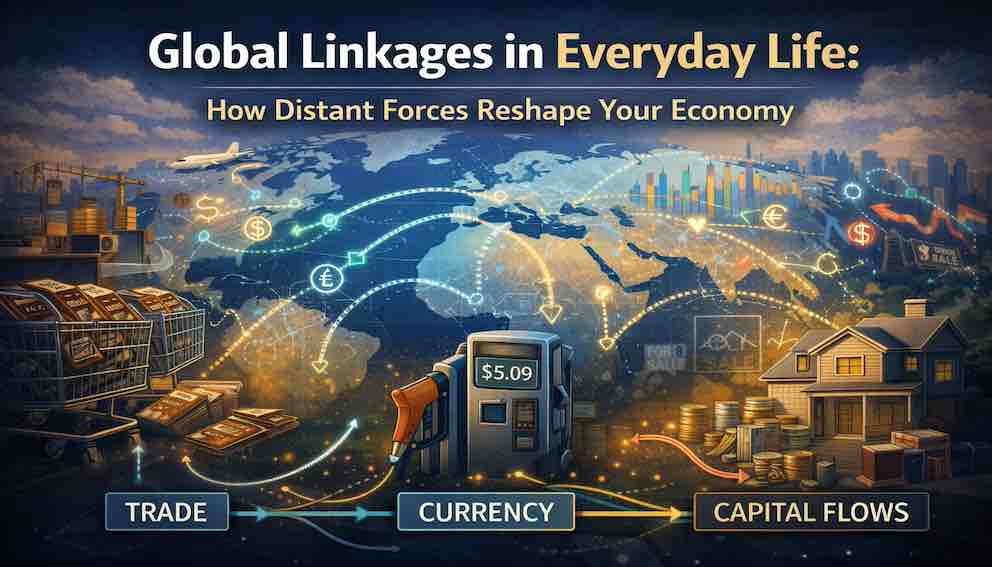
Global Linkages in Everyday Life: How Distant Forces Reshape Your Economy
Why did chocolate prices rise sharply even though local demand didn’t? Why do stock markets fall together across countries on the same day? And why can inflation increase even when wages stay flat? This tutorial explains how global trade, currencies, and capital flows quietly shape everyday economic outcomes. Using real, recent examples—from cocoa shortages to synchronized market sell-offs—it shows how external shocks travel through supply chains, exchange rates, and financial markets before reaching households. The goal is not prediction, but understanding: learning to see how global forces turn distant events into local price changes, asset swings, and policy dilemmas.
Problem: We see economic outcomes but not their causes.
Example: The 2024-25 chocolate price shock.
Core Insight: Many forces shaping daily economic life begin not at home, but through trade, currencies, and capital flows.
Key Question: "What is happening globally—and how is it being transmitted here?"
Trade - When Your Supermarket Shelf is a Global Network
The Real-World Shock
Between 2024 and 2025, a simple consumer good—chocolate—underwent a dramatic change. A standard 200g bar in UK supermarkets shrank to 180g, while its price increased from around £1.00 to £1.65 over a four-year period. Consumers experienced classic "shrinkflation"—paying more for less. The explanation wasn't local but global.
What's Really Happening: The Supply Chain Transmission
West Africa supplies approximately 70% of the world's cocoa. In 2024, consecutive poor harvests in Ghana and Côte d'Ivoire—driven by climate stress, crop disease, and higher farming costs, cut global cocoa supply by more than 14%. With less cocoa available worldwide, prices rose everywhere.That shock then travelled.
Mechanism of Transmission
- Global Commodity Shock: Poor cocoa harvests reduce the physical supply of beans.
- Price Signal: Scarcity pushes up global cocoa prices.
- Corporate Response: Chocolate manufacturers can either absorb higher costs (reducing profit margins) or pass them on to consumers.
- Consumer Impact: Most firms do a mix—raising prices while shrinking product sizes (shrinkflation).
Academic Framework: The gravity model of trade explains why these shocks matter. It shows that trade flows are larger between bigger economies and smaller when countries are far apart or face high trade barriers. Longer global supply chains have increased efficiency, but they also make economies more vulnerable to shocks in concentrated production areas.
Why It Feels Persistent
Even when cocoa prices began to moderate in late 2025, chocolate prices didn't fall proportionally. This is called price stickiness downward—once businesses adjust to higher input costs across multiple areas (not just cocoa but also energy, transport, and wages), they rarely reverse prices fully. Consumers remember the old price, creating a perception gap between market reality and lived experience.
Why Price Effects Feel Persistent
Even after cocoa prices started to ease in late 2025, chocolate prices didn’t drop as much. This is called price stickiness downward. Once prices go up, they do not fall easily, even if the underlying costs or conditions that caused the increase go back to normal.
- The price rise is generally due to cost increase across multiple areas—cocoa, energy, transport, wages. Even if one cost falls (cocoa), the total cost is still higher than before, so prices don’t fully drop.
- When businesses raise prices, consumers notice and remember the new price. If a chocolate bar was £3.85 and now is £4.50, consumers remember the new price. If the firm drops the price back to £4.25, consumers may still perceive it as expensive. So firms often keep prices elevated.
Currencies: The Hidden Effect on Imported Goods
The Unseen Price Adjuster
Imagine two identical chocolate bars: one costs £3.85 in London, the other $5.00 in New York.
- The implied Purchasing Power Parity (PPP) exchange rate is about £0.77 per $1 (£3.85 ÷ $5.00).
- If the actual exchange rate is lower, like after sterling weakened post-Brexit, British consumers pay more for the same imported goods.
This is called imported inflation—prices rise even if domestic wages or demand haven’t changed.
How PPP Works
Purchasing Power Parity (PPP) is the idea that exchange rates should adjust so identical goods cost the same in different countries when expressed in a common currency.
In reality, prices rarely match perfectly because of:
- Transport Costs and Tariffs: moving goods and paying taxes adds extra costs
- Non-Tradable Components: Local rents, wages, and services differ across countries.
- Market Imperfections: Branding, consumer preferences, and distribution deals make identical goods cost different amounts
Example: After Brexit, sterling's depreciation made imported food components—cocoa, sugar, packaging—more expensive in pound terms. This pushed UK food inflation higher than in the Eurozone during the same period, despite similar global commodity prices.
The Corporate Buffer: Incomplete Pass-Through
Not all currency changes immediately show up in store prices.
- Businesses often absorb part of the cost to stay competitive.
- Research shows only 50–60% of a currency drop typically passes through to prices in the short term. The rest is absorbed in margins or operational efficiencies.
Key Insight
Currency movements act like a continuous repricing system for all imported goods.
- A 10% depreciation of the pound can raise the cost of living quickly for anyone buying imported products, even if the local economy is stable.
- Understanding this helps explain why inflation can rise without any domestic demand boom.
Capital Flows — Why Your Pension and Property Value Move with Global Mood
The Synchronized Market Phenomenon
In October 2023, stock markets in London, Frankfurt, Tokyo, and New York all fell by about 2–3% on the same day. There was no single UK-specific event that explained this.
What changed was global risk sentiment. Investors around the world revised their expectations about future interest rates, especially in the U.S. As a result, they reduced risk everywhere at once.
This is a common feature of modern financial markets: asset prices across countries often move together, even when domestic economic conditions are different.
How Capital Flows Transmit These Shifts
Capital flows are movements of money across borders in search of return or safety. These flows affect domestic economies through several channels:
| Channel | Mechanism | Everyday Impact |
| Portfolio Investment | Global funds buy and sell stocks and bonds based on relative returns and risk | Your pension or ISA value rises and falls with global markets |
| Foreign Direct Investment (FDI) | Firms decide where to build factories or expand operations | Jobs are created or lost depending on global competitiveness |
| Bank Lending | International banks adjust credit as global liquidity changes | Mortgage rates and business loans tighten or loosen |
| Exchange Rates | Capital inflows and outflows change demand for currencies | Import prices and export competitiveness shift |
These channels operate quickly, often faster than trade or wages adjust.Academic Perspective: Financial Contagion and the Global Financial Cycle
Economists describe this synchronization using the Global Financial Cycle hypothesis.
The idea is simple:
- When major central banks—especially the U.S. Federal Reserve—keep interest rates low, global investors take more risk.
- Capital flows into equities, property, and emerging markets.
- When policy tightens, capital pulls back rapidly across countries.
IMF research shows that global factors now explain around 25–30% of domestic financial market movements in open economies. Before 2008, this figure was closer to 15%. Domestic markets have become more exposed to global financial conditions.
Real-World Consequence: Housing and Asset Prices
This helps explain why housing markets in cities like London, Toronto, and Sydney often rise and fall together.
Even when population growth or local demand differs, global capital searching for yield pushes prices up simultaneously. When financial conditions tighten, prices soften together.
Key Insight
Capital markets globalize financial cycles.
Domestic asset prices—stocks, bonds, housing—are no longer determined only by local fundamentals. They are increasingly shaped by global interest rates, investor sentiment, and cross-border capital flows.
Understanding this helps explain why financial stress can appear suddenly, even when the local economy seems stable.
The Cascading Shock — How Global Linkages Compound
Chocolate’s Full Journey: From Climate to Checkout
To see how global linkages work together, let’s follow one shock all the way to the shop shelf.
- Initial Shock (Climate): Climate stress and crop disease reduce cocoa harvests in West Africa.
- Trade Channel: Global cocoa supply falls by about 14%. Because cocoa production is concentrated in a few countries, this scarcity pushes global futures prices sharply higher.
- Currency Channel: Cocoa is priced in U.S. dollars. When the pound is weak, UK importers pay more in pounds for the same dollar price, even if cocoa prices stop rising.
- Policy Layer: Tariffs on packaging materials and higher trade costs raise production expenses further.
- Corporate StrategyManufacturers respond by:
- Raising prices
- Reducing bar sizes (shrinkflation, around 10%)
- Over four years, prices rise by roughly 65%.
- Consumer Impact: Consumers face lower purchasing power. Even when cocoa prices later ease, retail prices remain high due to downward price stickiness.
- Secondary Effects: Firms report pressure on profit margins. Some shift toward cheaper ingredients or smaller product ranges.
This chain shows why economic outcomes often feel far removed from their original cause. By the time a shock reaches consumers, it has passed through trade, currency, policy, and corporate pricing decisions.
The Policy Dilemma
Governments and central banks face real limits when responding to global shocks.
For example:
- A central bank may raise interest rates to fight imported inflation caused by a weaker currency.
- Higher interest rates can attract foreign capital inflows.
- These inflows may push the currency up or inflate asset prices, creating new risks.
This tension is known as the international finance trilemma:
A country cannot simultaneously have:
- Fixed exchange rates
- Free capital movement
- Independent monetary policy
Only two of the three are possible at the same time.
Conclusion: Building Global Economic Literacy
A Framework for Understanding the Economy
Understanding global linkages gives people a way to interpret economic news more clearly:
- Diagnose before prescribing - Is inflation caused by domestic demand, or by imported costs? The policy response is very different.
- See interconnections - A conflict disrupts shipping → energy prices rise → transport costs increase → food prices rise → wage pressure follows.
- Recognize limits - Domestic policy works within global constraints. Open economies are affected by trade and capital flows whether they like it or not.
- Think in channels - Trade, currencies, and capital flows transmit shocks at different speeds and in different ways.
Why This Matters Now
Globalization is not disappearing—it is changing shape.
Supply chains are becoming more regional, geopolitics is reshaping trade, and digital services are expanding cross-border activity.
In this world, understanding where economic pressures come from is essential—not just for economists, but for:
- Businesses planning prices and investment
- Policymakers designing responses
- Households making savings, housing, and career decisions
Final Perspective
The most economically literate people are not those who focus only on local details. They are the ones who can connect everyday experiences to global forces.
The price of chocolate, the value of a home, and the stability of a job are increasingly shaped by a complex global system—one that quietly influences daily life through linkages we only notice once we learn how to see them.
About Swati Sharma
Lead Editor at MyEyze, Economist & Finance Research WriterSwati Sharma is an economist with a Bachelor’s degree in Economics (Honours), CIPD Level 5 certification, and an MBA, and over 18 years of experience across management consulting, investment, and technology organizations. She specializes in research-driven financial education, focusing on economics, markets, and investor behavior, with a passion for making complex financial concepts clear, accurate, and accessible to a broad audience.
Disclaimer
This article is for educational purposes only and should not be interpreted as financial advice. Readers should consult a qualified financial professional before making investment decisions. Assistance from AI-powered generative tools was taken to format and improve language flow. While we strive for accuracy, this content may contain errors or omissions and should be independently verified.