
Tutorial Categories
Last Updated: February 11, 2026 at 18:30
Using Bonds in a Portfolio: Allocation, Stability, and Income
Bonds are more than just safe investments or sources of steady income; they play a critical role in shaping the behavior of an investment portfolio. This tutorial explores how bonds reduce portfolio volatility, provide predictable income, and allow investors to match investments to time horizons and risk tolerance. We will demystify common misconceptions about how bonds move relative to stocks and explain how different types of bonds serve distinct portfolio goals. By the end, you will understand why bonds are not just return-generating assets—they are tools that help control risk, stabilize outcomes, and support long-term wealth creation.
Introduction: Bonds as the Conductor, Not Just a Soloist
In earlier tutorials, we examined bonds individually—looking at credit risk, interest rate sensitivity, coupon payments, and maturities. Now, it’s time to step back and see the bigger picture. In a portfolio, a bond is not merely a solo instrument playing its own tune. Think of it as the orchestra’s conductor, setting the tempo, managing dynamics, and ensuring that the high-risk, high-reward “brass section” (stocks) and the steady, foundational “strings section” (bonds) perform in harmony.
The purpose of bonds in a portfolio is not to generate the loudest or fastest returns. Their value is realized in stability, predictability, and risk management—helping investors maintain a steady course, even when markets become turbulent. Bonds shape portfolio outcomes more than they drive returns. Understanding this principle is key to building a portfolio that survives both good times and bad.
Part 1: Stability as a Strategic Asset
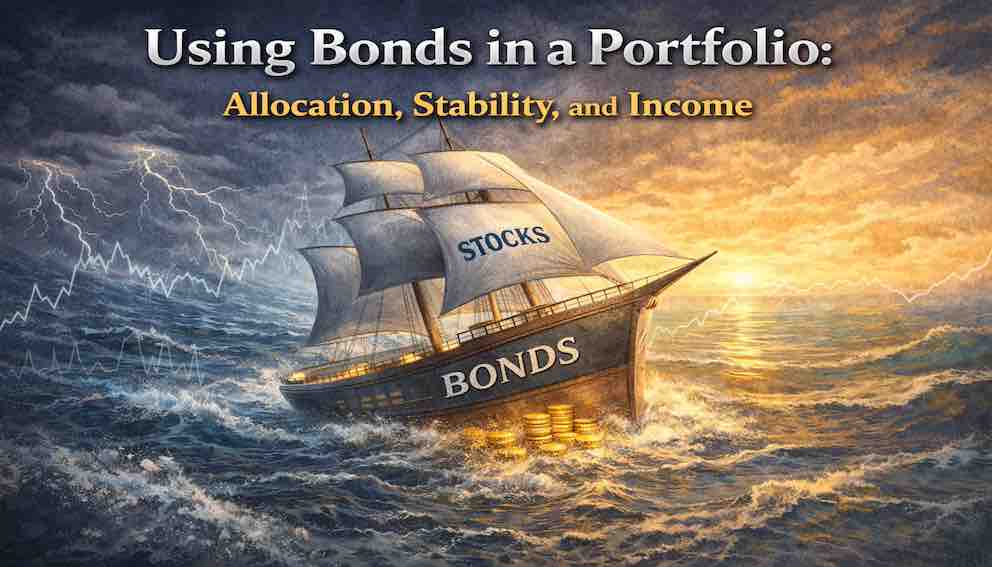
The most common misunderstanding about bonds is to view them as “low-return” or boring. This perspective misses their real purpose: stability and protection. Imagine your portfolio as a ship on the open sea. Stocks are the sails and engines—they provide forward motion and speed. Bonds are the ballast and rudder—they keep the ship upright in a storm and allow you to steer a steady course. The value of the ballast isn’t measured by speed, but by its ability to prevent a catastrophic capsize.
Numerical Example: How Bonds Reduce Volatility
Consider two investors, each with £100,000:
- Investor A: 100% stocks
- Investor B: 60% stocks / 40% high-quality bonds
In a market downturn where stocks fall 30%:
- Investor A’s portfolio drops £30,000 → total value £70,000
- Investor B’s stocks drop 30% (£18,000), but bonds gain 5% (£2,000), net portfolio drop = £16,000 → total value £84,000
This difference of £14,000 is not just numbers. It represents emotional margin, reducing the likelihood of panic-selling and keeping the investor on track for long-term goals. The bond allocation is most valuable when it prevents losses, not when it produces returns.
Part 2: Understanding Correlation – Bonds’ Dance With Stocks
Many investors assume that bonds and stocks move in opposite directions like a seesaw. In reality, their relationship is more like a dance—it changes depending on economic conditions and the types of bonds in your portfolio.
Market Scenarios: The Dance of Bonds and Stocks
Risk-Off Waltz (Market Panic)
- Fear grips the market; investors flee risky assets.
- High-quality government bonds (e.g., U.S. Treasuries) rise in value.
- Stocks fall, bonds rise → classic negative correlation.
Growth Tango (Strong Economy & Rising Rates)
- Central banks raise interest rates to cool inflation.
- Rising rates hurt existing bond prices, while a strong economy boosts stock returns.
- Bonds and stocks may move in the same direction or show muted gains. Correlation can turn positive.
Inflation Samba (High Inflation Shock)
- Unexpected inflation erodes bond fixed payments.
- Stocks may also suffer due to higher financing costs and margin pressures.
- Both bonds and stocks may decline simultaneously—a rare but painful scenario.
Key Takeaway: You cannot assume bonds will always rise when stocks fall. The type of bond matters: long-term Treasuries for stock crash protection, short-term bonds for stability in a rising-rate environment, and TIPS for inflation protection.
Part 3: Bond Income Mechanics – Cash Flow You Can Count On
One of the most overlooked benefits of bonds is predictable income. Bonds pay coupons (interest payments) at regular intervals. Unlike stock dividends, which can be cut during downturns, bond coupons are contractual promises, assuming no default.
Example:
- Investment: £50,000 in a bond paying 4% annually
- Annual income: £50,000 × 4% = £2,000
- Income is independent of stock market movements and can be reinvested or used for expenses
Bonds therefore provide a reliable cash flow, which is particularly valuable for retirees or investors who prioritize steady income over high growth.
Part 4: Matching Bonds to Your Life Stage
Bond allocation should reflect your time horizon, financial goals, and risk tolerance. Let’s explore three archetypal investors:
1. Early Accumulator (Age 30, 30+ years to retirement)
- Goal: Maximize long-term growth
- Bond Role: Stability and rebalancing; 10–20% allocation in intermediate-term high-quality bonds (e.g., Total Bond Market ETFs)
- Strategy: Bonds act as “dry powder.” If stocks fall, you can rebalance, selling bonds to buy stocks at lower prices
2. Mid-Career Balancer (Age 50, 10–15 years to retirement)
- Goal: Preserve capital while growing it
- Bond Role: Substantial ballast and income foundation; 40–50% allocation
- Strategy: Diversify within bonds: core total market funds, TIPS for inflation, and some high-quality corporate bonds for yield
3. Retired Distributor (Age 70, in retirement)
- Goal: Generate reliable, inflation-sensitive income and protect principal
- Bond Role: Income and stability engine; 50–70% allocation
- Strategy: Build bond ladders (e.g., 5-year Treasury ladder), allocate to TIPS, use bond income to cover expenses without selling equities
Part 5: Individual Bonds vs Bond Funds / ETFs
Investors can access bonds in two main ways: buying individual bonds directly, or investing indirectly through bond funds or ETFs. Each approach has its own advantages and trade-offs.
Individual Bonds
- Principal Protection: If you hold the bond to maturity and the issuer doesn’t default, your principal is guaranteed.
- Diversification: Limited. To spread credit risk, you would need to buy multiple bonds from different issuers.
- Liquidity: May be less liquid, depending on the market for that bond.
- Reinvestment: You must manually reinvest coupon payments if you want them to compound.
- Complexity: Requires tracking maturities, interest payments, and credit quality of each bond.
Bond Funds / ETFs
- Principal Protection: Not guaranteed. The fund’s value fluctuates daily with interest rates and market conditions.
- Diversification: High. A single fund can hold hundreds of bonds, spreading credit and interest-rate risk.
- Liquidity: Highly liquid; you can buy or sell shares at market prices anytime the exchange is open.
- Reinvestment: Often automatic. Most funds reinvest interest payments, simplifying the process.
- Complexity: Managed by professionals. You don’t have to track individual bonds, but you need to understand the fund’s strategy, duration, and credit exposure.
Example in Practice:
Imagine you want to invest £50,000 in bonds:
- Buying individual 5-year U.S. Treasuries guarantees principal at maturity and pays fixed interest annually, but you would need to buy several bonds to diversify.
- Investing in a Total Bond Market ETF spreads your money across hundreds of government and corporate bonds, giving diversification and automatic reinvestment, but the ETF’s price will fluctuate daily with interest rates.
Part 6: Actionable Framework – Building Your Bond Allocation
Define Your “Sleep-at-Night” Ratio
- Decide how much loss you can tolerate without panic-selling
- Adjust bond allocation accordingly (e.g., 40–50% bonds for 15% max loss tolerance)
Choose Bonds Based on the Economic Environment
- Stock crash protection: Long-term government bonds (e.g., TLT)
- Stability in rising rates: Short/intermediate-term bonds, floating rate notes
- Inflation protection: TIPS funds (e.g., SCHP)
Select the Right Tools
- Simple exposure: Total Bond Market ETF (e.g., BND, AGG)
- Goal-based ladders: Individual Treasuries or CDs for near-term needs
- Tax efficiency: Use municipal bonds in taxable accounts; corporates in retirement accounts
Part 7: Illustrative Portfolio Scenario
Portfolio: £200,000
- Stocks: 50%
- Government Bonds: 30%
- Corporate Bonds: 20%
Market outcome:
- Stocks +10% → +£10,000
- Government Bonds -2% → -£1,800
- Corporate Bonds +3% → +£1,200
Net portfolio gain: £9,400 (≈4.7%)
While equities did the heavy lifting, bonds reduced volatility and provided stability, illustrating how they moderate risk without being the main return engine.
Conclusion: Bonds as Your Portfolio’s Insurance Policy
Bonds are the stabilizers, ballast, and conductors of a portfolio. Their value is not just in yield, but in reducing emotional and financial risk. They provide predictable income, shape portfolio outcomes, and allow equities to perform effectively over the long term.
The ultimate mental model: bonds are shock absorbers. You don’t judge a shock absorber by speed; you judge it by how smoothly it handles bumps. By aligning bonds with your timeline, risk tolerance, and economic landscape, they become an active strategic tool. You move from being a passenger in the market to the captain, steering calmly toward your financial destination.
About Swati Sharma
Lead Editor at MyEyze, Economist & Finance Research WriterSwati Sharma is an economist with a Bachelor’s degree in Economics (Honours), CIPD Level 5 certification, and an MBA, and over 18 years of experience across management consulting, investment, and technology organizations. She specializes in research-driven financial education, focusing on economics, markets, and investor behavior, with a passion for making complex financial concepts clear, accurate, and accessible to a broad audience.
Disclaimer
This article is for educational purposes only and should not be interpreted as financial advice. Readers should consult a qualified financial professional before making investment decisions. Assistance from AI-powered generative tools was taken to format and improve language flow. While we strive for accuracy, this content may contain errors or omissions and should be independently verified.