
Tutorial Categories
Last Updated: February 8, 2026 at 19:30
Das Kapital Explained: Why Karl Marx’s Critique of Capitalism Still Shapes Global Finance
Das Kapital is one of the most influential and controversial books ever written about money, labor, and capitalism. Written during the upheavals of the Industrial Revolution, Karl Marx set out to explain how profits are created, why inequality emerges, and why economic systems carry internal tensions. This tutorial explores the historical conditions that shaped the book, the core ideas Marx introduced, and the parts of his analysis that proved remarkably durable. It also examines where Marx was wrong, what changed in modern economies, and why Das Kapital remains essential reading for anyone trying to understand finance, labor, and power in the modern world.
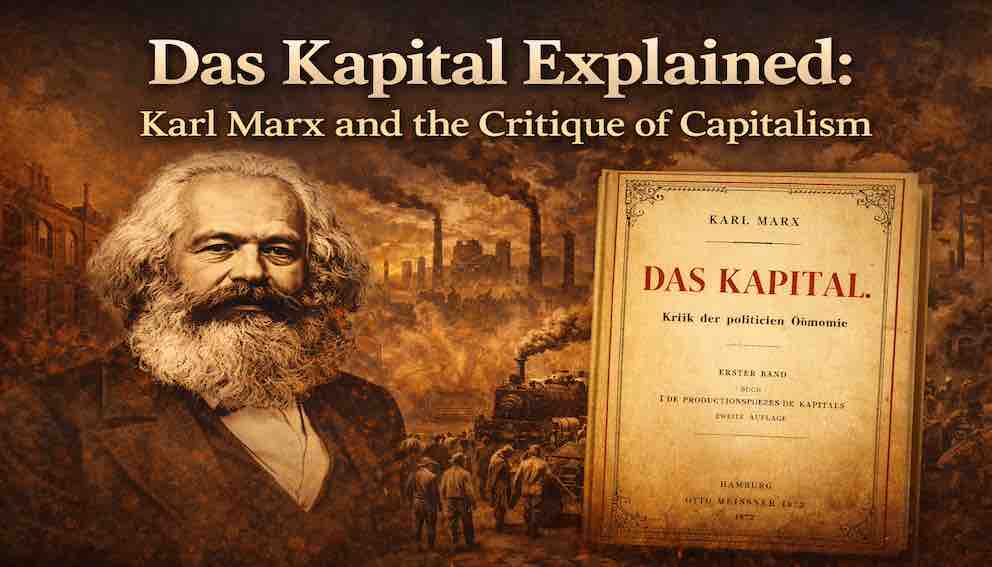
Welcome to the first article in our series Books That Shaped World Finance. Our objective is simple: to introduce you to a foundational text, explain what it teaches, and explore the conditions that brought it into being. We start with perhaps the most influential and controversial economic text ever written—a book you cannot avoid if you wish to understand the deep currents of our financial world.
If this series aims to explain how ideas shape global finance, then our starting point is inevitable. It is the foundational critique of the system itself. Even if you’ve never read a single page of Karl Marx’s work, you live in a world deeply shaped by its arguments. Every modern debate about inequality, wages, corporate power, and the very nature of capitalism is conducted in a language he helped systematize. This is not a book about investing, but a book about what makes investing—and profit—possible in the first place.
This tutorial will not treat Das Kapital as sacred scripture, nor dismiss it as outdated ideology. Our goal is to understand it on its own terms: to walk through the world that forged it, grasp its central revolutionary idea, acknowledge what it got strikingly right, identify where it fell short, and, ultimately, explain why it remains an indispensable lens for understanding finance, labour, and power today.
Introduction: The Unavoidable Text
Why begin with Das Kapital? Because it forces a question that lies beneath every balance sheet and market forecast: Where does profit actually come from, and who truly pays for it?
Marx was not writing a manual on stock valuation or portfolio allocation. He was engaged in a more fundamental project: a forensic examination of the capitalist system’s inner workings. By asking this uncomfortable core question, he compelled economists, policymakers, and business leaders to confront the structural relationships that dictate how economic rewards and risks are distributed. To engage with finance today is to engage, whether you know it or not, with the echoes of his analysis.
The Crucible: The World That Forged Das Kapital
To understand the book, you must first picture the world Marx observed. He wrote in the mid-19th century, during the zenith of Europe’s Industrial Revolution. This was an era of breathtaking technological progress shadowed by profound human suffering.
Steam-powered factories replaced artisan workshops. Millions were wrenched from rural life and crowded into rapidly growing, filthy cities to seek work. The labourer’s reality was one of 16-hour days in perilous conditions, for wages that barely covered subsistence. Child labour was commonplace; safety nets, minimum wages, and labour protections were non-existent.
Simultaneously, factory owners and industrial capitalists amassed wealth on an unprecedented scale. Railways, steel mills, and textile factories generated staggering profits. A stark, visible chasm opened between the class that owned the productive machinery—the bourgeoisie—and the class that had only its labour to sell—the proletariat.
Marx did not invent the concern over this inequality. His contribution was to propose that this inequality was not an accident or a temporary flaw, but a structural and necessary feature of capitalism itself. Das Kapital was his monumental attempt to uncover the hidden laws that made it so.
The Central Mechanism: Surplus Value and the Hidden Engine of Profit
At the heart of Marx’s sprawling work is a deceptively simple puzzle: If markets are competitive and goods tend to exchange at their fair value, how do capitalists consistently end up with a profit? If everyone pays a fair price, where does the extra money come from?
Marx rejected the easy answer that profit was mere theft or fraud. Instead, he argued it was generated within the very process of production, through a mechanism he called surplus value.
Here is his argument, broken down step-by-step:
- Labour Power, Not Labour: Workers do not sell their completed “labour.” They sell their labour power—their capacity to work for a set period (e.g., a day). Their wage is the price of this capacity, roughly equal to the cost of what they need to survive and return to work the next day (food, shelter, clothing).
- The Split Day: Once employed, the worker’s day is divided into two parts.
- Necessary Labour: This is the portion of the day where the worker creates value equivalent to their own wage. If a wage covers four hours of value, the worker “pays for themselves” in the first four hours.
- Surplus Labour: This is the remaining part of the day. Here, the worker continues to produce value, but this value is now appropriated for free by the capitalist. This is the surplus value.
A Simple Example: Imagine a seamstress paid £50 for a 10-hour day—enough to cover her basic necessities. In the first five hours, she produces garments worth £50, covering her wage. In the next five hours, she produces another £50 worth of goods. This second £50 is the surplus value. It is the source of the factory owner’s profit, which is then divided into their income, rent, interest to the bank, and re-investment.
For Marx, the great injustice was not necessarily the long hours, but that this appropriation was masked by the seemingly fair transaction of “a day’s wage for a day’s work.” The exploitation was systemic and invisible within the market exchange itself.
Capital as a System, Not a Cast of Villains
One of the most misunderstood aspects of Marx’s work is his view of capitalists. He did not primarily paint them as individually evil or greedy. Instead, he portrayed them as agents trapped within a system of structural coercion.
In a competitive market, a capitalist who fails to efficiently extract and accumulate surplus value will be outcompeted. If one factory owner voluntarily raises wages significantly or shortens the working day, their costs rise. A competitor who does not will have lower costs and higher profits, eventually driving the altruistic owner out of business.
Thus, the system creates an irresistible pressure to prioritise profit maximisation—to seek longer hours, lower wages, or faster machinery—regardless of the individual’s personal morals. This shift from judging individual morality to analysing institutional incentives was revolutionary. It echoes today in discussions of shareholder pressure, cost-cutting outsourcing, and automation, where corporate decisions are often lamented yet understood as market imperatives.
Why Das Kapital Was a Seismic Event
Das Kapital was revolutionary not because it described hardship, but because it provided a powerful, coherent framework to explain why hardship and inequality seemed to be inherent to capitalist growth. Marx wove philosophy, history, and economics into a grand narrative of how the system functioned and where it was headed.
He directly challenged the prevailing idea that markets naturally led to fair outcomes. He argued that economic systems evolve through internal contradictions (e.g., the drive for profit vs. the declining ability of workers to buy the goods produced), not smooth progress. This redefined class not as a matter of income level, but as a relationship to the means of production—a fundamental divide between owners and workers. This framework would go on to shape labour unions, political movements, and social policy across the globe for the next century and a half.
What Marx Got Right: The Enduring Insights
Despite being written over 150 years ago, many of Marx’s diagnoses remain piercingly relevant.
- Power Asymmetry: His core focus on the imbalance of power between capital and labour is central to modern debates about unionisation, gig-economy precarity, and corporate influence over politics and wages.
- The Tendency for Concentration: His observation that capital tends to concentrate—that successful firms absorb competitors, reinvest profits, and amass greater market power—perfectly describes the rise of modern monopolies and tech giants and the worrying growth in wealth inequality.
- Inherent Instability: His intuition that capitalism is prone to crises born from its own logic (overproduction, speculative frenzy, falling rates of profit) anticipated later theories of business cycles and financial crises. The 2008 financial crisis, for instance, was a textbook example of internal tensions creating systemic collapse.
Where Marx Was Wrong or Incomplete
For all its insight, Das Kapital contains critical errors and blind spots.
- Adaptability of Capitalism: Marx underestimated the system’s resilience and capacity for reform. The rise of labour laws, the welfare state, minimum wages, and collective bargaining dramatically improved living standards for millions, proving that wages did not have to remain at subsistence level.
- The Engine of Innovation: He failed to fully anticipate how technological innovation and soaring productivity could raise the general standard of living, even within a capitalist framework. The average worker today enjoys a material comfort he could scarcely have imagined.
- The Inevitable Collapse: His prediction of capitalism’s inevitable, revolutionary collapse has not materialised. Instead, it has shown a remarkable ability to adapt, absorb criticism, and morph into new forms (e.g., state-managed, consumer-driven, financialised).
These limitations do not invalidate his analysis but remind us that it is a product of its time, not an infallible prophecy.
Why This Matters for Finance: The Lens of Social Materiality
For the student of finance, Das Kapital offers something unique: the lens of social materiality. It pulls back the curtain from pure financial abstraction to ask what happens on the factory floor, in the service economy, or in the supply chain before a profit ever appears on an income statement.
Understanding Marx helps you analyse non-financial risk:
- Political & Regulatory Risk: Why might a government intervene with new antitrust or labour laws? Marx’s framework explains the social tensions that breed such political backlash.
- Systemic Risk: How do extreme inequality and wage stagnation threaten long-term economic stability and consumer demand? These are macroeconomic risks with Marxist roots.
- Operational Risk: Why do labour disputes and supply chain fragility matter? They reveal the human dependencies and power struggles at the heart of production.
In this sense, Das Kapital does not compete with your textbook on corporate valuation; it complements it. It provides the essential context of social relations and conflict that pure financial models often omit at their peril.
Conclusion: The Irresistible Question
In exploring Das Kapital, we have seen it as both a product of the Industrial Revolution’s stark contrasts and a timeless analytical tool. We have unpacked its core mechanism—surplus value—and its systemic view of capital. We have acknowledged its profound insights into power and concentration, as well as its failures to predict reform and innovation.
The book endures not because it is an easy read or a perfect guide, but because it is impossible to ignore. It forces a fundamental question that lies at the heart of our financial world: Is profit primarily a reward for risk, innovation, and efficient allocation, or is it fundamentally a claim on the value created by the labour of others?
You may reject Marx’s answer. But by asking the question with such rigour and scale, he forever changed the conversation. He ensured that finance could never be seen as a purely technical game of numbers, but must be understood as a system built upon—and constantly shaped by—the dynamics of social power. That is why, in any serious study of the books that shaped world finance, we must begin here.
About Swati Sharma
Lead Editor at MyEyze, Economist & Finance Research WriterSwati Sharma is an economist with a Bachelor’s degree in Economics (Honours), CIPD Level 5 certification, and an MBA, and over 18 years of experience across management consulting, investment, and technology organizations. She specializes in research-driven financial education, focusing on economics, markets, and investor behavior, with a passion for making complex financial concepts clear, accurate, and accessible to a broad audience.
Disclaimer
This article is for educational purposes only and should not be interpreted as financial advice. Readers should consult a qualified financial professional before making investment decisions. Assistance from AI-powered generative tools was taken to format and improve language flow. While we strive for accuracy, this content may contain errors or omissions and should be independently verified.