
Tutorial Categories
Last Updated: February 8, 2026 at 19:30
The Wealth of Nations Explained: Adam Smith's Blueprint for Modern Finance
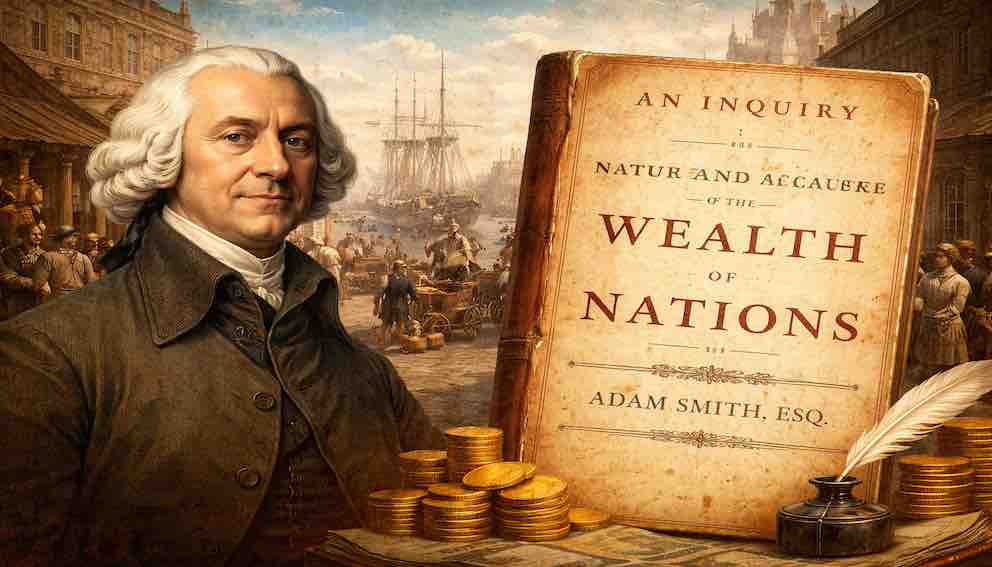
If the first book in this series, Marx's Das Kapital, provided a critical X-ray of capitalism's stresses, then Adam Smith's The Wealth of Nations is its foundational anatomy textbook. Published in 1776, it was the first systematic attempt to explain how commercial societies function, grow, and create wealth. This tutorial explores the world that shaped Smith, deciphers his core concepts—from the division of labor to the invisible hand—and reveals why his framework remains the essential operating system for understanding global finance, from hedge fund strategies to international trade policy.
Introduction: The Architect of Modern Economics
In any series on the books that shaped world finance, Adam Smith is the indispensable starting point. His An Inquiry into the Nature and Causes of the Wealth of Nations did not just describe an economy; it created the very language and analytical framework for the discipline of economics itself. While philosophers had long discussed wealth and trade, Smith was the first to construct a coherent, systematic explanation of how human productivity, voluntary exchange, and market incentives combine to drive national prosperity. For anyone in finance, his ideas are not historical relics but living tools that explain everything from portfolio theory to corporate strategy.
The Man Behind the Masterpiece: A Life of Observation
Adam Smith (1723–1790) was far more than an economist; he was a moral philosopher and a keen observer whose ideas were forged in the crucible of the Scottish Enlightenment.
Smith’s story begins in the small port town of Kirkcaldy, Scotland, where from a young age he would have witnessed bustling docks and international trade, sparking his curiosity about commerce. A brilliant student, he entered the University of Glasgow at age 14 and later studied at Oxford, though he found the intellectual atmosphere at Glasgow far more stimulating.
Returning to Glasgow as a professor of moral philosophy, Smith taught ethics, law, and the early principles of political economy. His ideas were grounded in real-world observation—through interactions with merchants, inventors, and industrializing Glasgow. Later, traveling Europe as a tutor, he debated leading intellectuals, including the French Physiocrats, who influenced his thoughts on economic liberty.
Smith spent nearly a decade writing The Wealth of Nations, finally publishing it in 1776. Ironically, the advocate of free trade spent his final years as a Commissioner of Customs in Edinburgh, collecting tariffs for the government. This combination of scholarly reflection and practical engagement lent his work depth and durability.
Core Concepts: Smith’s Framework for Wealth
Division of Labor: The Productivity Multiplier
Smith’s revolutionary insight began not with abstract theory, but on a factory floor. His iconic example of a pin factory demonstrates the power of dividing production into specialized tasks. A single worker performing all steps might make only twenty pins a day, but when the work is split into eighteen specialized tasks, ten workers could produce tens of thousands of pins daily.
This division of labor increases productivity, fosters innovation, and creates expertise.
Modern Finance Analogy: Hedge funds and investment firms exemplify this principle. Analysts specialize by sector (technology, energy, healthcare), traders focus on execution, quants build models, and portfolio managers integrate the work. This structured division of labor allows firms to process vast information and execute strategies efficiently.
The Invisible Hand: Coordination Through Self-Interest
Smith’s famous “invisible hand” concept describes how individuals pursuing their self-interest in competitive markets inadvertently benefit society.
Consider a baker, brewer, and butcher. Each aims to earn a living, yet in competing for customers, they provide quality goods at fair prices. The market coordinates this activity without a central planner.
Critical nuance: Smith never advocated raw greed. He argued the invisible hand functions only within a framework of justice, ethics, and rule of law.
Modern Finance Analogy: Exchange-Traded Funds (ETFs) are a modern manifestation. Millions of investors acting independently buy and sell shares daily. Their collective actions efficiently allocate capital, reflecting underlying value without any central guidance.
Free Trade, Markets, and Capital Accumulation
Smith attacked mercantilist policies designed to hoard gold and restrict imports. He argued that true wealth comes from production and exchange, not stockpiling precious metals.
He championed free trade, anticipating the principle of comparative advantage: nations prosper by focusing on what they produce most efficiently and trading for other goods. He also identified capital accumulation—the reinvestment of profits into tools, infrastructure, and ventures—as the essential engine of economic growth.
Modern Finance Analogy: Multinational supply chains, venture capital reinvestment, and corporate expansion strategies all reflect Smith’s insights.
The Role of Government: The Essential Facilitator
Contrary to popular “laissez-faire” caricatures, Smith was pragmatic. He argued governments had three indispensable duties:
- National Defense: Protect the nation from external threats.
- Justice and Law: Enforce contracts and protect property, ensuring market trust.
- Public Works: Provide infrastructure like roads, bridges, and education—essential for commerce but unprofitable for individuals to build.
In Smith’s view, a capable government does not compete with markets; it creates the platform on which they thrive.
What Smith Got Right: The Enduring Framework
Smith’s contributions provide enduring analytical lenses for understanding markets:
- Specialization = Prosperity: Efficiency and innovation arise from dividing tasks.
- Markets Coordinate Complexity: Prices process dispersed information better than any planner.
- Trade Multiplies Wealth: Comparative advantage underlies all global supply chains.
- Incentives Matter: Understanding self-interest explains corporate and market behavior.
Limitations and Blind Spots
Despite his brilliance, Smith was a product of his time:
- Scale of Inequality & Market Failures: He underestimated the social risks of extreme disparities and did not foresee monopolies, financial panics, or environmental costs.
- Labor Theory of Value: Useful historically, it struggles to account for services, intellectual property, and complex modern financial instruments.
- Financial Complexity: Central banking, derivatives, and electronic global markets were beyond his horizon, though modern finance builds upon his foundational principles.
Why The Wealth of Nations Became a Masterpiece
The Wealth of Nations is foundational because it integrated theory, observation, and policy into a single coherent system. Smith transformed economics from moral philosophy into a distinct field. His ideas offered a new map for policymakers and entrepreneurs navigating the unprecedented economic changes of industrializing Britain. Within his lifetime, concepts like free trade moved from radical ideas to formal British policy—a testament to the book’s transformative power.
The Principles in Practice
Instead of a table, here’s a narrative presentation of key principles with modern finance analogies:
- Division of Labor: Specialization in tasks increases output and expertise. Today, financial firms divide labor by research, trading, and portfolio management.
- Invisible Hand: Self-interest can generate collective benefit. ETFs illustrate millions of independent decisions efficiently pricing assets.
- Capital Accumulation: Reinvesting profits fuels growth. Corporations use retained earnings for innovation; venture capital recycles returns into startups.
- Comparative Advantage: Producing what is most efficient while trading for other goods enriches nations. Modern global supply chains and international investment reflect this principle.
Conclusion: The Indispensable Blueprint
Adam Smith provided the foundational blueprint for understanding market-based societies. His concepts—division of labor, the invisible hand, free trade, and capital accumulation—form the bedrock of modern economic and financial thought. For financial professionals, engaging with Smith is foundational literacy. It teaches one to analyze growth through specialization and investment, decode market movements via incentives, and evaluate policy by asking whether it enables fair and efficient markets.
While later thinkers updated his framework to address crises, inequality, and behavioral nuances, they were refining the original, enduring code that Adam Smith wrote. To understand finance, markets, and the dynamics of wealth creation, there is no starting point more essential than The Wealth of Nations.
About Swati Sharma
Lead Editor at MyEyze, Economist & Finance Research WriterSwati Sharma is an economist with a Bachelor’s degree in Economics (Honours), CIPD Level 5 certification, and an MBA, and over 18 years of experience across management consulting, investment, and technology organizations. She specializes in research-driven financial education, focusing on economics, markets, and investor behavior, with a passion for making complex financial concepts clear, accurate, and accessible to a broad audience.
Disclaimer
This article is for educational purposes only and should not be interpreted as financial advice. Readers should consult a qualified financial professional before making investment decisions. Assistance from AI-powered generative tools was taken to format and improve language flow. While we strive for accuracy, this content may contain errors or omissions and should be independently verified.