
Tutorial Categories
Last Updated: March 30, 2026 at 17:30
Antifragile: Things That Gain from Disorder
Nassim Taleb's Guide to Thriving in a World of Uncertainty and Shocks
In 2012, six years after the global financial crisis had exposed the fragility of modern finance, Nassim Nicholas Taleb published a book that would complete the intellectual project he had begun with Fooled by Randomness and The Black Swan. Antifragile introduced a concept so simple and yet so profound that it immediately entered the lexicon of investors, entrepreneurs, and policymakers. Some things, Taleb argued, are fragile: they break under stress. Some things are robust: they resist stress. But there is a third category—things that actually gain from disorder. Muscles grow stronger when exercised. Immune systems improve when challenged. Certain businesses, strategies, and even societies become more resilient when exposed to volatility, randomness, and uncertainty. The book was not merely a critique of how we think about risk; it was a complete reorientation. Instead of trying to eliminate uncertainty, we should learn to love it. Instead of building systems that resist shocks, we should build systems that thrive on them. More than a decade later, Antifragile remains essential reading for anyone who understands that the future cannot be predicted—but can be prepared for.
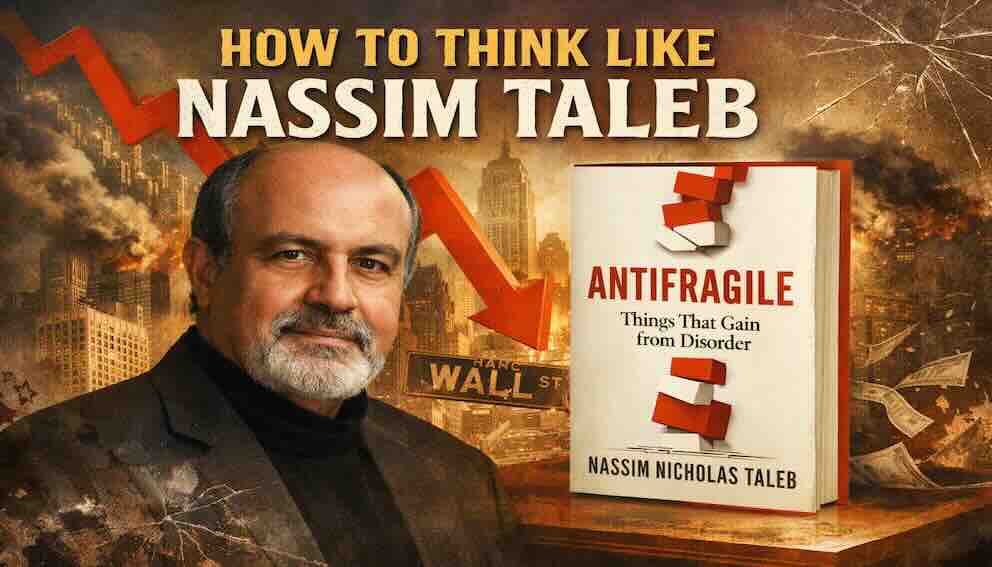
Introduction to the Book
When most people think about risk, they instinctively imagine something to be avoided. In the language of finance, risk is described as a threat—something that must be minimized through diversification, forecasting, and careful control. For decades, economic models treated volatility as the enemy of stability. The goal was to smooth out fluctuations, to eliminate surprises, to make the world predictable.
Nassim Taleb spent his career watching this approach fail.
As a derivatives trader, he had seen how the models that worked beautifully in calm markets collapsed catastrophically when markets became chaotic. As a philosopher of uncertainty, he had traced this failure to a deeper error: the assumption that stability is always desirable. In Antifragile, he invites readers to reconsider this deeply embedded belief. Instead of seeing shocks, randomness, and uncertainty as purely destructive forces, Taleb proposes a new category of systems—systems that gain from disorder.
To understand the idea, he introduces a simple but powerful framework. Some things are fragile, like a glass that shatters when dropped. Some things are robust, like a stone that resists damage. But there exists a third category—things that actually benefit from shocks. Muscles grow stronger when stressed. Immune systems become more resilient when exposed to pathogens. Markets, Taleb argues, behave in similar ways when they are allowed to adapt and evolve.
The book therefore is not merely about finance. It is about how the world works when uncertainty cannot be eliminated—which, as Taleb repeatedly reminds the reader, is almost always.
The Man Behind the Book: Nassim Taleb's Unconventional Path
To understand why Taleb wrote this book with such conviction, one must understand his unusual career.
Nassim Nicholas Taleb was born in 1960 in Amioun, Lebanon, into a prominent Greek Orthodox family with deep political roots—both grandfathers held high positions in Lebanon's government. His early years, however, were shaped by the Lebanese Civil War, an experience that exposed him to chaos and unpredictability at a very young age. Watching social systems collapse in real time left him deeply skeptical of models that assumed order and stability. The war taught him that the world could change overnight, that institutions could vanish, that everything people relied on could disappear.
He studied mathematics and philosophy in France before moving to the United States for an MBA from the Wharton School. But his real education came in the financial markets. Taleb spent years as a derivatives trader in New York and London, navigating the unpredictable waters of options trading. Unlike many traders who relied heavily on forecasting models, Taleb became famous for a very different strategy: he positioned himself to profit from rare and extreme market events.
This approach meant that he often looked wrong during calm periods. His strategies could lose small amounts of money for long stretches. His traders would complain, his investors would grow impatient, and his competitors would mock him. But when markets experienced sudden shocks—events most models failed to anticipate—his positions could generate enormous gains. He made a fortune in the 1987 crash. He profited again during the dot-com bust. He understood something that most of Wall Street did not: the very models designed to eliminate risk were actually making the system more fragile.
It was from this practical experience that Taleb developed his philosophy about uncertainty. His earlier books, particularly The Black Swan, had already challenged conventional thinking about rare events in financial markets. But Antifragile took the argument a step further: instead of simply acknowledging uncertainty, we should design systems that thrive because of it.
"Wind extinguishes a candle and energizes fire."
The Era That Produced the Book: After the Crisis
When Antifragile was published in 2012, the world was still recovering from the trauma of the Global Financial Crisis of 2008.
The crisis had exposed serious weaknesses in the global financial system in ways that Taleb's earlier work had anticipated. Banks that were considered stable collapsed almost overnight. Complex risk models failed spectacularly. Institutions that had spent decades trying to eliminate uncertainty suddenly discovered that they had actually made the system more fragile.
Consider a few examples from that era:
- Lehman Brothers had been in business for over 150 years. Its risk models suggested that the probability of failure was negligible. In September 2008, it was bankrupt.
- AIG, the insurance giant, had built a portfolio of credit default swaps that its models deemed virtually risk-free. When housing prices fell, the company required a $182 billion government bailout.
- The entire banking system had become what Taleb would call fragile: highly optimized for normal conditions, but utterly unprepared for abnormal ones.
Taleb's ideas therefore arrived at a moment when many people were already questioning the foundations of modern finance. The crisis had demonstrated, in the most dramatic way possible, that stability was not the same as resilience. A system could appear stable for years—even decades—and then collapse in a matter of days.
There were stories everywhere illustrating this fragility. Giant investment banks had relied on mathematical models that assumed market movements followed predictable distributions. These models worked well during ordinary times—but they failed catastrophically when markets behaved in extreme ways. Meanwhile, smaller traders, entrepreneurs, and decentralized market participants often proved far more adaptable. They could experiment, fail quickly, and recover. In other words, they behaved antifragilely, even if they never used that word.
Taleb's book captured this contrast perfectly.
How the Book Is Structured
Antifragile is divided into seven parts, each building on the last. Taleb begins with the philosophical foundations of the concept, introducing the triad of fragile, robust, and antifragile. He then moves through applications in economics, politics, medicine, and personal decision-making. Along the way, he draws on ancient philosophy, evolutionary biology, and his own experience in financial markets. The book gradually expands from simple examples—a glass that breaks, a muscle that strengthens—to broader critiques of modern institutions that suppress volatility while accumulating hidden risks. By the end, Taleb has constructed a complete framework for thinking about uncertainty, one that is simultaneously practical and philosophical.
The Architecture of the Book: How Taleb Builds His Argument
The Triad
Taleb introduces a simple classification: the triad of fragile, robust, and antifragile.
- Fragile systems are harmed by volatility and disorder. A wine glass, a porcelain plate, a highly leveraged bank—all are fragile. They function perfectly under ideal conditions but break when stressed.
- Robust systems are unharmed by volatility and disorder. A stone, a well-built bridge, a diversified index fund—these can withstand shocks without changing.
- Antifragile systems actually benefit from volatility and disorder. Muscles, immune systems, entrepreneurship, decentralized innovation—these grow stronger when challenged.
The central argument of the book is that we have systematically confused these categories. We have tried to make fragile systems robust by protecting them from shocks—but this only makes them more fragile in the long run. The real solution is not protection but adaptation: designing systems that learn from and improve through stress.
The Hydra and the Origins of the Concept
Taleb draws on ancient mythology to illustrate his central idea. The Lernaean Hydra, a serpent-like creature from Greek mythology, had the terrifying property that when Hercules cut off one of its heads, two grew back in its place. The Hydra was not merely robust—it was antifragile. It gained from the attack.
This myth became the inspiration for the term itself. Taleb wanted a word that captured the opposite of fragility, and "Hydra-like" was too cumbersome. He settled on "antifragile" because it was simple, intuitive, and captured the essence of things that improve under stress.
Hormesis: The Biological Foundation
Taleb grounds his argument in biology, drawing on the concept of hormesis—the phenomenon where small doses of stress make systems stronger. Examples include:
- Exercise. Muscles tear slightly during exertion and grow back stronger.
- Fasting. Short periods without food trigger cellular repair mechanisms.
- Vaccines. Exposure to weakened pathogens builds immunity.
- Learning. Mistakes strengthen understanding and memory.
The biological analogy is central to Taleb's case. If life itself evolves through stress, why should we expect financial, social, or political systems to be any different?
Via Negativa: The Power of Subtraction
One of the book's most practical insights is the principle of via negativa—the idea that improvement often comes not from adding complexity but from removing harmful elements.
In finance, this might mean eliminating leverage rather than searching endlessly for superior investment strategies. In health, it might mean avoiding processed food rather than chasing miracle supplements. In decision-making, it might mean removing bad options rather than trying to find perfect ones.
Taleb argues that we are conditioned to think in terms of addition—what can we add to make things better? But often the most powerful interventions are subtractive. Take away the fragile, and the antifragile emerges naturally.
The Lindy Effect
Another concept Taleb emphasizes throughout the book is the Lindy Effect. Named after a New York deli where comedians gathered, the idea is simple: the longer something has survived, the longer it is likely to survive.
Books that have been read for centuries are likely to be read for centuries more. Technologies that have endured for generations are likely to endure. Traditions that have persisted through upheaval have proven their robustness.
Taleb uses the Lindy Effect to argue for epistemic humility. New ideas, new models, new financial instruments—these should be treated with skepticism until they have proven themselves over time. The old ways are often wiser than we think.
The Problem with Over-Optimization
Taleb warns against designing systems that are too efficient. This is one of his most powerful insights, and it runs throughout the book.
Highly optimized systems perform extremely well under normal conditions but collapse when conditions change. A factory designed to produce exactly one product with zero waste is incredibly efficient—but if demand for that product disappears, the factory is worthless. A bank structured to maximize profits in a stable environment is incredibly profitable—but when the environment becomes unstable, it fails.
The problem is that optimization eliminates redundancy. Redundancy looks wasteful in normal times—extra capacity, spare parts, backup systems, cash reserves—but it is essential for survival in abnormal times. The antifragile system maintains redundancy precisely because it understands that normal times are not the only times.
"It is the ability to take a hit that matters, not the ability to predict the hit."
Small Failures Prevent Catastrophic Ones
One of the most counterintuitive insights in the book is that frequent small failures are essential for long-term stability.
Antifragile systems allow small failures to occur regularly. Startups fail, but the ecosystem remains healthy because innovation continues. Muscles tear slightly during exercise, but they grow back stronger. Immune systems are challenged by pathogens, but they become more resilient.
Taleb illustrates this with a simple example: restaurants. Most restaurants fail within their first few years. But the restaurant industry as a whole is remarkably robust. Why? Because failure is information. It tells entrepreneurs what doesn't work. It frees up capital and talent for better ideas. The system learns through failure.
In contrast, when governments or institutions attempt to prevent all failures, risks accumulate until a massive collapse becomes inevitable. This is what happened in the financial crisis: years of suppressing volatility and preventing small losses led to a buildup of hidden risk that eventually exploded.
The Barbell Strategy
Taleb proposes a practical approach to navigating uncertainty: the barbell strategy.
Instead of pursuing moderate risk everywhere, one should combine extreme safety with small exposures to high-risk opportunities. In finance, this might mean holding ninety percent of your assets in ultra-safe instruments like Treasury bills while allocating ten percent to highly speculative, high-upside investments.
This strategy limits downside while preserving exposure to large upside events. If the speculative investments fail, you lose only a small portion. If one of them succeeds, the gains can be enormous. The barbell avoids the dangerous middle ground—moderate risk that offers neither protection nor significant upside.
In life, the barbell strategy might mean having a stable job that pays the bills while pursuing speculative projects on the side. It means building a career that can withstand shocks while remaining open to transformative opportunities.
Skin in the Game
One of Taleb's strongest ethical arguments is the principle of skin in the game.
Decision-makers should bear the consequences of their actions. When bankers, policymakers, or executives take risks without personal exposure to losses, they create fragile systems that others must eventually pay for. The banker who makes leveraged bets with depositors' money, but faces no personal downside, has every incentive to take excessive risk. The executive who can walk away from a failed company with a golden parachute has no reason to build resilience.
Skin in the game aligns incentives. It ensures that those who make decisions also live with their consequences. It is the foundation of antifragile systems.
"Never ask anyone for their opinion, forecast, or recommendation. Just ask them what they have in their portfolio—or not in their portfolio."
Volatility Is Information
Traditional financial thinking treats volatility as something undesirable. Taleb argues the opposite: volatility is information.
Market fluctuations reveal weaknesses and inefficiencies. They tell us what is working and what is not. They force adaptation and evolution. Suppressing volatility—through excessive regulation or intervention—can allow hidden risks to accumulate.
This does not mean that all volatility is good. It means that the attempt to eliminate volatility entirely is a mistake. The goal should not be to create a world without fluctuations, but to build systems that can learn from them.
Decentralization Creates Resilience
Centralized systems often appear stable but are actually fragile. They have single points of failure. When something goes wrong, it goes wrong everywhere.
Decentralized systems, such as local markets or entrepreneurial ecosystems, allow many independent experiments to occur simultaneously. Failures remain contained, while successes spread naturally. This is why venture capital works: it funds many startups, knowing that most will fail but a few will succeed enormously.
Taleb argues that decentralization is not just a political preference but a survival strategy. In a world of uncertainty, distributed systems outperform centralized ones because they learn faster and adapt more quickly.
Optionality
Optionality means having opportunities without large obligations. It is the ability to take advantage of positive events while limiting downside exposure.
An investor who buys a call option has optionality: if the stock rises, they profit; if it falls, they lose only the premium. An entrepreneur who starts a side project has optionality: if it succeeds, they have a new business; if it fails, they still have their day job.
Antifragile systems are rich in optionality. They are structured so that they can benefit from positive surprises without being destroyed by negative ones.
Complexity Can Hide Fragility
Taleb repeatedly criticizes complicated financial models. Complexity often creates an illusion of control while masking hidden risks. Simpler systems with clear incentives and transparency tend to be more resilient.
This is not an argument against sophistication. It is an argument against the kind of complexity that obscures understanding. A system that no one fully understands is a system that cannot be trusted.
A Concrete Example: The Restaurant Industry
One of Taleb's favorite illustrations of antifragility is the restaurant industry.
Most restaurants fail within their first few years. From the perspective of an individual owner, this is catastrophic. But from the perspective of the industry as a whole, it is essential. Failure is information. It tells entrepreneurs what doesn't work. It frees up capital and talent for better ideas. The successful restaurants that emerge from this process are stronger because of all the failures that came before.
The restaurant industry is antifragile because it learns through trial and error. Each failure is a small experiment that improves the overall system. The industry as a whole gains from the volatility that destroys individual participants.
This is in stark contrast to industries that are protected from failure—banks that are too big to fail, companies that receive government bailouts, institutions that are insulated from market discipline. These systems become fragile precisely because they never experience the small failures that would make them stronger.
How the Book Was Received
When Antifragile was released in 2012, it immediately attracted attention across multiple fields. It spent weeks on bestseller lists and was translated into more than forty languages.
Economists debated its critique of modern financial models. Some praised its insights; others dismissed it as too philosophical and insufficiently rigorous. Investors discussed its implications for risk management. Entrepreneurs embraced its message about experimentation and failure.
The book also became popular among general readers because Taleb's writing style is unusual for a finance thinker. Rather than presenting dry technical arguments, he mixes philosophy, history, mathematics, and storytelling. Taleb quotes ancient thinkers like Seneca and Aristotle, discusses medieval traders, and analyzes modern financial crises—sometimes all within the same chapter. This unusual blend made the book both intellectually challenging and widely engaging.
Critics, however, noted the same issues that had surfaced with his earlier work. Taleb's rhetorical style can be abrasive. He names names. He attacks individuals he considers foolish or dishonest. Some readers find this invigorating; others find it off-putting. The substance of his arguments, though, has proven remarkably durable.
How It Changed Finance and Thinking
The influence of Antifragile can be seen in several areas of modern finance and beyond.
In risk management, it reinforced skepticism toward overly complex models. After the financial crisis, many institutions began reassessing the assumptions behind their quantitative frameworks. The idea that models can create a false sense of security became widely accepted.
In investment strategy, the concept of tail risk hedging gained prominence. Investors started paying greater attention to extreme scenarios that traditional models ignored. The barbell strategy influenced how many allocate capital.
In entrepreneurship, the book validated the startup model of rapid experimentation and failure. The idea that small failures are essential for long-term success became conventional wisdom in Silicon Valley and beyond.
In public policy, discussions of resilience versus efficiency entered mainstream discourse. The pandemic, in particular, highlighted the trade-offs between optimization and redundancy that Taleb had identified.
In personal development, the concept of antifragility resonated with anyone who had grown through adversity. The idea that stress and challenge can make us stronger was not new—but Taleb gave it a name and a framework.
What Still Stands—and What Has Been Debated
More than a decade after its publication, many of Taleb's insights remain vital, while others have been questioned.
What Still Stands
The distinction between fragile, robust, and antifragile has proven remarkably useful. It provides a framework for thinking about systems that transcends finance.
The critique of over-optimization is now widely accepted. The pandemic demonstrated the dangers of systems designed for efficiency rather than resilience.
The importance of skin in the game is increasingly recognized. The backlash against bankers and executives who profited from risky behavior reflects this principle.
The value of decentralization has been reinforced by events. From supply chains to social networks, distributed systems have shown advantages over centralized ones.
The recognition that small failures prevent catastrophic ones has influenced thinking about everything from financial regulation to innovation policy.
Via negativa has become a useful tool for decision-making. The idea that removing harmful things is often more powerful than adding beneficial ones has broad applications.
The Lindy Effect provides a helpful heuristic for evaluating ideas, technologies, and institutions.
What Has Been Debated
Some critics argue that Taleb overstates the universality of his framework. Not every domain behaves like financial markets. Antifragility is easier to identify than to design.
The practical implementation of barbell strategies can be difficult. Tail-risk hedging is expensive and can drag on returns for years. The discipline required to maintain it is rare.
The concept of antifragility can feel vague when applied to complex systems. What exactly does it mean for a society or an economy to be antifragile? The answer is not always clear.
Taleb's rhetorical style alienates some readers. His attacks on individuals, his sweeping generalizations, his refusal to engage with critics on their terms—these can obscure the substance of his arguments.
Some economists argue that antifragility is more metaphor than measurable framework. It provides insight but not prediction.
Survivorship bias remains a concern. Taleb focuses heavily on successful survivors of randomness, which can create its own distortions.
The Intellectual Influences Behind the Book
Antifragile draws on a rich tradition of philosophical and scientific thought. Taleb explicitly acknowledges several key influences:
- Seneca – The Stoic philosopher taught that resilience comes not from avoiding adversity but from preparing for it. His concept of "voluntary discomfort"—practicing poverty, hunger, and hardship—was an early form of antifragility training.
- Friedrich Nietzsche – The famous aphorism "what does not kill me makes me stronger" captures the essence of antifragility. Nietzsche understood that adversity can be a source of strength.
- Karl Popper – The philosopher of science emphasized trial and error as the engine of progress. Popper's concept of falsification—learning through failed experiments—parallels Taleb's emphasis on small failures.
- Evolutionary biology – The entire framework of natural selection is built on antifragility. Species adapt and improve through the stress of environmental pressure.
These influences are woven throughout the book, giving it intellectual depth beyond its financial applications.
Why This Book Still Matters Today
More than a decade after its publication, Antifragile continues to influence how people think about risk, uncertainty, and resilience.
In financial markets, the lessons remain urgent. The next crisis will not look like the last one. The models that worked before will fail again. The only defense is not better prediction but better design—systems that can survive whatever comes.
In business, the pace of change accelerates. Companies that optimize for the present become obsolete. Those that build antifragile cultures—that experiment, learn from failure, and adapt—are the ones that endure.
In public policy, the challenges are unprecedented. Climate change, pandemics, technological disruption—these are not problems that can be solved with more prediction. They require systems that can adapt and evolve.
In personal life, the message is both humbling and empowering. We cannot control what happens to us. But we can build lives that gain from adversity—that learn, grow, and strengthen through challenge.
The great achievement of Antifragile is not that it gives us a way to predict the unpredictable. It is that it gives us a way to live with it. In a world of uncertainty, that is the only sensible response.
"Some things benefit from shocks; they thrive and grow when exposed to volatility."
What This Book Is Not
Antifragile is not a guide to eliminating risk. It is a guide to living with it.
It is not a traditional finance book, though it speaks to finance. It is a work of philosophy, of practical wisdom, of lived experience.
It is not an easy book to summarize. Taleb's style is digressive, personal, and unconventional. He circles around his themes, returns to favorite examples, and refuses to conform to academic norms. This is deliberate. He is modeling the kind of thinking he advocates: independent, skeptical, unwilling to be confined.
A Note on Reading Taleb
Taleb is a provocative writer. He names names. He attacks sacred cows. He writes with confidence that can feel like arrogance. Some readers love this; others find it off-putting.
The advice for reading Antifragile is the same as for reading his other work: focus on the ideas, not the attitude. Taleb's provocations are a strategy—a way of breaking through the conventional thinking that he believes is dangerous. If you can look past the rhetorical style, the substance is worth engaging.
The book also rewards rereading. The arguments are dense, the examples are rich, and the implications are deep. Each reading reveals something new.
How to Recognize Fragility in Real Life
One of the most practical contributions of Antifragile is that it helps us identify fragile systems before they break. Here are some warning signs:
Heavy debt – Leverage magnifies losses in a crisis. Systems that rely on borrowed money are fragile.
No redundancy – Single points of failure are dangerous. Systems without backups, spare capacity, or reserves are fragile.
Centralized decision-making – When all decisions flow through one point, that point becomes a vulnerability. Centralized systems are fragile.
Dependence on prediction models – Systems that rely on forecasts are fragile. Models fail when conditions change.
No skin in the game – When decision-makers don't bear the consequences of their choices, they have no incentive to build resilience.
Optimization for efficiency – Systems that have eliminated all waste have no margin for error. They are fragile.
Suppression of small failures – When small problems are hidden or prevented, risks accumulate. The system becomes fragile.
Complexity without transparency – When no one understands how a system works, hidden risks accumulate. Complexity hides fragility.
Conclusion
Nassim Taleb published Antifragile in 2012, at a moment when the world was still grappling with the lessons of the financial crisis. He offered a new way of seeing: not a world to be predicted and controlled, but a world to be navigated and learned from.
The book introduced a concept so simple and yet so profound that it immediately entered the language. Antifragility—the property of systems that gain from disorder—provides a framework for thinking about everything from financial markets to personal health to political systems.
Taleb showed that the things we fear—volatility, randomness, uncertainty—are not always enemies. They can be teachers. They can be sources of strength. They can make us better.
Drawing on ancient philosophy, evolutionary biology, and his own experience in the markets, he built a case for a different way of living. Via negativa teaches us that subtraction is often more powerful than addition. Hormesis shows that small stresses make us stronger. The Lindy Effect reminds us that what has survived is likely to continue. Skin in the game ensures that those who make decisions also live with them.
That is why Antifragile still matters. Not because it gives us a way to predict the future, but because it gives us a way to prepare for it. Not because it eliminates uncertainty, but because it helps us thrive in its presence.
In a world that will always surprise us, that is the only wisdom worth having.
About Swati Sharma
Lead Editor at MyEyze, Economist & Finance Research WriterSwati Sharma is an economist with a Bachelor’s degree in Economics (Honours), CIPD Level 5 certification, and an MBA, and over 18 years of experience across management consulting, investment, and technology organizations. She specializes in research-driven financial education, focusing on economics, markets, and investor behavior, with a passion for making complex financial concepts clear, accurate, and accessible to a broad audience.
Disclaimer
This article is for educational purposes only and should not be interpreted as financial advice. Readers should consult a qualified financial professional before making investment decisions. Assistance from AI-powered generative tools was taken to format and improve language flow. While we strive for accuracy, this content may contain errors or omissions and should be independently verified.