
Tutorial Categories
Last Updated: March 30, 2026 at 17:30
The Black Swan: The Impact of the Highly Improbable
How Nassim Taleb Taught the World to Fear What It Cannot Predict
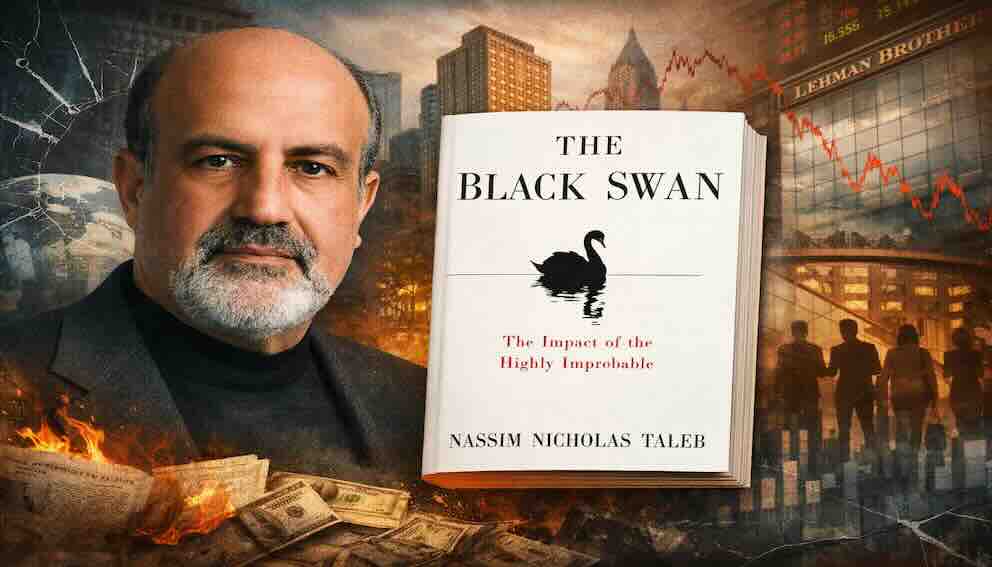
In April 2007, a former derivatives trader turned philosopher named Nassim Nicholas Taleb published a book that would forever change how we think about uncertainty, risk, and the limits of prediction. The Black Swan arrived at a moment of supreme confidence in financial markets. Volatility was low. Models seemed to work. The masters of the universe believed they had tamed risk. Taleb offered a devastating counter-argument: the things we don't know—the rare, extreme, unpredictable events—are precisely the ones that shape history. Wars, crashes, pandemics, technological breakthroughs—these are not exceptions to the rule. They are the rule. The book became an international sensation, spending months on bestseller lists and translated into dozens of languages. When the global financial crisis erupted just over a year later, Taleb's warnings seemed prophetic. But The Black Swan is not a book about predicting crises. It is a book about humility, about the limits of knowledge, about how to live in a world we cannot control.
Introduction to the Book
Imagine a turkey. Every day for a thousand days, a farmer brings it food. The turkey's confidence in the farmer grows. The world is predictable, benevolent, safe. Then comes Thanksgiving.
For the turkey, Thanksgiving is a Black Swan: an event that was entirely unexpected, yet utterly transformative. Everything the turkey believed was wrong, but it had no way of knowing that until the moment of catastrophe.
This is the central metaphor of Nassim Taleb's The Black Swan. We are all turkeys, he argues. We build our understanding of the world based on past experience, assuming that the future will resemble the present. But history is not made by the ordinary. It is made by the rare, the extreme, the unexpected—events that lie far outside our previous experience and yet reshape everything.
The book is not a work of finance in the conventional sense, though it speaks directly to how we think about markets. It is a work of philosophy, of epistemology, of practical wisdom. Taleb draws on history, mathematics, psychology, and his own years as a trader to build a case for a different way of seeing the world—one that acknowledges the limits of our knowledge and prepares us for what we cannot predict.
The Man Behind the Book: Nassim Taleb's Unconventional Path
Nassim Nicholas Taleb was born in 1960 in Amioun, Lebanon, into a prominent Greek Orthodox family with deep political roots—both grandfathers held high positions in Lebanon's government. The civil war that erupted in 1975 scattered his family and disrupted his education, forcing him to navigate a world where order could dissolve into chaos without warning. This early experience of unpredictability would shape his thinking for decades.
He attended the Grand Lycée Franco-Libanais in Beirut before continuing his education in France, earning degrees in mathematics and philosophy from the University of Paris. He then moved to the United States for an MBA from the Wharton School in 1983. Later, he would complete a PhD in management science from the University of Paris-Dauphine in 1998.
But his real education came in the financial markets. In December 1984, Taleb began working as a derivatives trader, specializing in options and hedging strategies. He spent years on trading floors in New York and London, making markets in complex instruments and managing portfolios designed to profit from volatility. He watched markets soar and crash, saw traders rise and fall, and observed firsthand how the models that everyone trusted could fail catastrophically. The 1987 crash, in which he profited handsomely, was an early lesson in the power of rare events.
Taleb was never a conventional trader. He was skeptical of the mathematical models that dominated finance, suspicious of the narratives that traders told about their success, and acutely aware of the role of luck in his own career. He began writing essays and articles that would eventually become Fooled by Randomness (2001), his first book, which explored how we mistake luck for skill.
By 2006, he had left active trading to become a full-time researcher and writer. The Black Swan was the follow-up, expanding the ideas of randomness into a broader meditation on uncertainty, prediction, and the limits of human knowledge. It made him famous, but it also made him controversial. His sharp critiques of established figures, his refusal to soften his arguments, and his willingness to call out what he saw as intellectual dishonesty earned him admirers and enemies in equal measure.
"You are not supposed to understand the world—you are supposed to survive in it."
The Era That Produced the Book: 2007 and the Illusion of Stability
To understand why The Black Swan landed with such force, you have to understand the world of 2007.
The financial markets were enjoying a period of remarkable calm. The CBOE Volatility Index (VIX), often called the "fear gauge," traded at historic lows. Stock markets were rising. The economy seemed stable. Sophisticated mathematical models, developed by the brightest minds in finance, assured everyone that risk was under control. Banks held complex portfolios of mortgage-backed securities, confident that their models had accounted for every possibility. Regulators looked at the numbers and saw safety.
This confidence was not limited to finance. In economics, the "Great Moderation" was celebrated as a triumph of policy—the end of boom-and-bust cycles. In technology, innovation seemed to follow predictable paths. In politics, the world appeared more stable than it had in decades.
Taleb looked at this confidence and saw something else. He saw the turkey. He saw systems built on assumptions that had never been tested. He saw models that ignored the very events that mattered most. He saw a world preparing for a shock it could not imagine.
The book appeared in April 2007. Fifteen months later, Lehman Brothers collapsed. The global financial system teetered on the edge of meltdown. The events that the models had declared impossible were happening. Taleb's warnings, once dismissed as alarmist, suddenly seemed prophetic.
But Taleb himself resisted this framing. He had not predicted the crisis, he insisted. That was the whole point. Black swans are unpredictable by definition. The crisis was a black swan, and anyone who claimed to have seen it coming was falling into the narrative fallacy—the tendency to create stories after the fact that make random events seem predictable.
The Architecture of the Book: How Taleb Builds His Argument
The Black Swan is structured as a journey. Taleb leads the reader through the problem, the diagnosis, and finally a way of living with uncertainty. The book is divided into four parts, each building on the last.
Part One: The Problem of Black Swans
Taleb opens with the central idea: black swans are rare, extreme, and consequential events that lie outside our normal expectations. They are unpredictable precisely because they are outside our experience. Yet they shape history more than any number of ordinary events.
Consider a few examples from history:
- World War I was a black swan. No one in 1913 predicted that a minor assassination would lead to a war that would kill millions and redraw the map of Europe.
- The rise of the internet was a black swan. In 1985, no one foresaw that a niche academic network would transform commerce, communication, and culture.
- The 1987 stock market crash was a black swan. On October 19, the Dow fell 22.6 percent in a single day—an event that standard models said should happen once in several billion years.
- The 2000 dot-com bust was a black swan for those who believed the new economy had eliminated risk.
- The SARS epidemic of 2003 was a black swan that exposed the fragility of global travel and health systems, foreshadowing the pandemic to come.
The problem is that we are psychologically ill-equipped to deal with black swans. We tell stories after the fact that make them seem predictable—"we should have seen it coming"—but this is an illusion. This is the narrative fallacy: our tendency to impose causal explanations on events that were, in fact, random and unpredictable.
"The inability to predict outliers implies the inability to predict the course of history."
Part Two: The Limits of Prediction
Having established the problem, Taleb turns to the tools we use to pretend we can solve it. He launches a devastating critique of prediction, especially in domains like economics and finance where complex systems defy easy modeling.
He introduces the concept of the ludic fallacy: the mistake of treating real-world uncertainty as if it were a game of chance with known rules and probabilities. In a casino, we know the odds. In life, we do not. Yet economists and financiers build models that assume we do.
The standard statistical toolkit, particularly the normal distribution or bell curve, is especially dangerous. This model assumes that extreme events are so rare they can be safely ignored. But in real markets, extreme events happen far more often than the bell curve predicts. The 1987 crash, the 1998 collapse of Long-Term Capital Management, the 2000 dot-com bust, the 2008 financial crisis—these were not million-to-one anomalies. They were features of a system that the models failed to capture.
Taleb's critique is not that all models are useless. It is that using the wrong model in the wrong domain creates a false sense of security. The bell curve works well in Mediocristan. It fails catastrophically in Extremistan.
Part Three: The Anatomy of a Black Swan
Taleb introduces a fundamental distinction that runs throughout the book: the difference between Mediocristan and Extremistan.
Mediocristan is the land of the ordinary. In this domain, no single observation can dramatically affect the whole. Examples include:
- Height. The tallest person in the world is not that much taller than the average. No single person can dominate the statistics.
- Weight. Same principle. A thousand people weighed together will not be thrown off by one outlier.
- Life expectancy. No single person lives so long that they distort the average.
- Car accidents. Even a catastrophic event adds only a small increment to the total.
In Mediocristan, the law of large numbers works. Averages matter. Risk can be managed with standard tools.
Extremistan is the land of the outliers. In this domain, a single observation can dominate the entire system. Examples include:
- Wealth. A tiny fraction of the population holds most of the wealth. Jeff Bezos alone has more than the bottom 50 percent of Americans combined.
- Book sales. A few blockbusters sell millions, while most books sell almost nothing.
- Financial returns. A handful of days account for most of the market's long-term gains. Miss the ten best days, and your returns collapse.
- City sizes. A few megacities dominate while thousands of small towns remain tiny.
- Pandemics. One virus can shut down the world.
The mistake we make is applying Mediocristan thinking to Extremistan problems. We assume that averages matter, that diversification works, that the future will look like the past. In Extremistan, these assumptions are lethal.
Taleb notes that many of the most important domains of modern life are in Extremistan: financial markets, technological innovation, scientific discovery, cultural success. Yet our tools and our psychology are adapted to Mediocristan. This mismatch is why we are so consistently surprised.
Part Four: Living with Black Swans
The final part of the book offers a way forward. If we cannot predict black swans, how should we live? Taleb's answer is not resignation but a different kind of wisdom.
He advocates for robustness and introduces the seed of a concept he would develop fully in his next book: antifragility. Robust systems can withstand shocks. Antifragile systems actually benefit from them. The goal is not to predict the unpredictable but to position ourselves so that we survive—and perhaps even thrive—when it happens.
In practical terms, this means:
- Avoiding excessive leverage. Debt magnifies losses in a crisis.
- Building redundancy into systems. Spare capacity is not waste; it is insurance.
- Seeking asymmetric payoffs. Look for situations where losses are limited but gains are unlimited—options, venture capital, certain kinds of entrepreneurship.
- Being skeptical of predictions and experts. Forecasters have a terrible track record, especially in Extremistan.
- Focusing on what we can control rather than what we cannot. We cannot predict black swans, but we can prepare for them.
"We are not supposed to understand the world—we are supposed to survive in it."
Key Concepts from The Black Swan
Black Swan – A rare, extreme, and consequential event that lies outside regular expectations and is unpredictable from past data. After it happens, we concoct explanations that make it seem predictable. The term has entered the language precisely because it captures something essential about our relationship with uncertainty.
The Narrative Fallacy – Our tendency to create stories after the fact that impose order on random events. These narratives make us feel that we understand, but they obscure the role of chance. Every market commentator who explains why stocks moved today is committing this fallacy.
Extremistan – Domains where a single observation can dominate the entire system. Wealth, book sales, financial returns, and pandemics are in Extremistan. A few events account for most outcomes. In Extremistan, the bell curve is not just wrong—it is dangerously misleading.
Mediocristan – Domains where no single observation can dramatically affect the whole. Height, weight, and life expectancy are in Mediocristan. Averages matter, and extremes are rare. Most of our intuition about statistics comes from Mediocristan, which is why we are so ill-equipped for Extremistan.
The Ludic Fallacy – The mistake of treating real-world uncertainty as if it were a game of chance with known rules and probabilities. In life, unlike in casinos, we don't know the odds. Yet much of finance and economics pretends we do.
The Turkey Problem – The danger of relying on past data to predict the future. The turkey's thousand days of safety tell it nothing about Thanksgiving. Every day of safety actually increases its confidence—and its vulnerability.
Robustness – The ability to withstand shocks without breaking. Robust systems survive black swans. They may not benefit, but they do not collapse.
Antifragility – The property of systems that actually benefit from volatility, randomness, and disorder. This concept is introduced here in embryonic form and developed fully in Taleb's next book, Antifragile (2012).
Epistemic Humility – The recognition that we know less than we think, and that what we don't know matters more than what we do. This is not a counsel of despair but a practical stance for navigating uncertainty.
Asymmetric Payoffs – Situations where losses are limited but gains are unlimited, or vice versa. Taleb advocates seeking positive asymmetry: bets where you can lose a little but win a lot.
How the Book Was Received
When The Black Swan first appeared in April 2007, it was greeted with a mixture of admiration and controversy. Reviewers praised Taleb's erudition, his storytelling, and his willingness to challenge sacred cows. The book was dense but accessible, philosophical but practical.
It spent months on the New York Times bestseller list and was translated into more than forty languages. It won critical acclaim and commercial success, establishing Taleb as one of the most provocative and influential thinkers of his generation.
But among academics and financial professionals, the reception was more mixed. Many economists dismissed Taleb's critique as overblown, even reckless. His attacks on established figures—including Nobel laureates—alienated some readers. His rhetorical style, which included name-calling and sweeping generalizations, struck others as unscholarly.
Then came September 2008. The collapse of Lehman Brothers, the freezing of credit markets, the unprecedented government bailouts—all of it unfolded exactly as Taleb's framework would predict. The models had failed. The experts had been wrong. The black swan had arrived.
Taleb became the Cassandra who had been proven right. He was interviewed on television, quoted in newspapers, consulted by policymakers. His book, already successful, found a new and larger audience.
Yet Taleb himself insisted on a crucial distinction. He had not predicted the crisis. That was the whole point. Black swans are unpredictable. Anyone who claimed to have seen the crisis coming was falling into the narrative fallacy. The crisis was a black swan, and the only honest response was to acknowledge that we could not have known.
What Still Stands—and What Has Been Debated
More than fifteen years after its publication, many of Taleb's insights remain vital, while others have been questioned and refined.
What Still Stands
The importance of black swans is now widely recognized. No serious discussion of risk ignores the possibility of extreme events. Central banks conduct stress tests. Regulators worry about systemic risk. Investors hedge tail risk.
The critique of normal distributions in finance is broadly accepted. Fat tails are understood as a feature of real markets, not a bug. The 2008 crisis, the 2020 pandemic, and countless smaller events have confirmed that extreme outcomes are more common than standard models predict.
The narrative fallacy is recognized as a fundamental cognitive bias. Behavioral economics has documented countless examples of our tendency to impose stories on randomness. Every time we explain why the market moved, we risk committing it.
The distinction between Extremistan and Mediocristan provides a useful framework for thinking about different domains. It helps us see why the same tools that work for insurance may fail for investing.
Epistemic humility—the recognition of what we don't know—is increasingly valued in an age of complexity and uncertainty. The arrogance of prediction has been humbled by events.
What Has Been Debated
Some critics argue that Taleb overstates his case. Not all domains are as extreme as he suggests. Skill matters in many fields, and prediction is not always futile. Weather forecasting has improved dramatically. Demography is reasonably predictable. The bell curve is not a "Great Intellectual Fraud"—it is a useful tool in the right context.
The practical prescriptions can be difficult to implement. Tail-risk hedging is expensive and can drag on returns for years between crises. Building robust systems requires trade-offs. Redundancy is costly. Taleb's advice is easier to admire than to follow.
Some of Taleb's provocations are more rhetorical than substantive. His attacks on specific individuals and institutions, while entertaining, can distract from the underlying arguments. Calling economists "empty suits" may feel good, but it doesn't advance the conversation.
Not all extreme events are true black swans. Some, like the 2008 crisis, had visible warning signs—rising housing prices, deteriorating lending standards, growing leverage. Taleb would call these gray swans: events that are rare and consequential but not entirely unpredictable. The distinction matters because it affects how we think about prevention.
The concept of antifragility, introduced here and developed later, is powerful but can be vague. What exactly does it mean for a system to benefit from volatility? The answer varies across contexts. In some cases, it means building in options. In others, it means avoiding optimization. The concept is illuminating but resists easy application.
Why This Book Still Matters Today
More than fifteen years after its publication, The Black Swan remains essential reading for anyone navigating a world of uncertainty.
In financial markets, every day investors rely on models that assume the future will resemble the past. Taleb's work is a standing reminder that this assumption is dangerous. The next crisis will not look like the last one. The risks that matter are the ones we cannot see.
In business, companies face unprecedented uncertainty—technological disruption, geopolitical shifts, pandemics, climate events. Taleb's framework encourages executives to ask not just "what is the most likely outcome?" but "what could break us, and how can we survive it?"
In public policy, the pandemic exposed the fragility of systems optimized for efficiency rather than resilience. Supply chains collapsed. Healthcare systems buckled. Governments scrambled. Taleb's work provides a language for thinking about these failures and building better systems for the future.
In science and technology, the most important breakthroughs are black swans. They emerge from unexpected places and transform fields. The discovery of penicillin, the development of CRISPR, the rise of machine learning—none were predicted, yet they reshaped the world.
In your own life, the career path you expect may not materialize. The relationships you count on may change. The assumptions you hold may be wrong. Taleb's work is an invitation to humility, to preparation, to a way of living that acknowledges uncertainty without being paralyzed by it.
The great achievement of The Black Swan is not that it gives us a way to predict the unpredictable. It is that it gives us a way to live with the fact that we cannot. In a world of increasing complexity and accelerating change, that is a gift of incalculable value.
"You are not supposed to understand the world—you are supposed to survive in it."
What This Book Is Not
The Black Swan is not a guide to predicting the future. Taleb is explicit: black swans are, by definition, unpredictable. Anyone who claims to have predicted one is falling into the narrative fallacy.
It is not a traditional finance book, though it speaks to finance. It is a work of philosophy, of epistemology, of practical wisdom.
It is not an easy book to summarize. Taleb's style is digressive, anecdotal, and personal. He circles around his themes, returns to favorite examples, and refuses to conform to academic conventions. This is deliberate. He is modeling the kind of thinking he advocates: skeptical, independent, unwilling to be confined by established categories.
A Note on Reading Taleb
Taleb is a provocative writer. He names names. He attacks sacred cows. He writes with confidence that can feel like arrogance. Some readers love this; others find it off-putting.
The advice for reading The Black Swan is to focus on the ideas, not the attitude. Taleb's provocations are a strategy—a way of breaking through the conventional thinking that he believes is dangerous. If you can look past the rhetorical style, the substance is worth engaging.
The book also rewards rereading. The arguments are dense, the examples are rich, and the implications are deep. Each reading reveals something new.
Conclusion
Nassim Taleb published The Black Swan in April 2007, at a moment when the world seemed stable and the future seemed predictable. He offered a different vision: a world shaped by rare, extreme, unpredictable events, where the things we don't know matter more than the things we do.
The book that emerged was part finance, part philosophy, part memoir, part polemic. It drew on history, mathematics, psychology, and Taleb's own years as a trader. It challenged the models that dominated finance, the narratives that shaped our understanding, and the hubris that blinded us to our own ignorance.
When the global financial crisis erupted a year later, Taleb's warnings seemed prophetic. But the book is not about prediction. It is about humility. It is about recognizing the limits of our knowledge and building systems that can survive what we cannot foresee.
That is why The Black Swan still matters. Not because it gives us a way to predict the unpredictable, but because it gives us a way to live with it. In a world of uncertainty, that is the only sensible response.
Three Practical Takeaways
1. Distinguish between Mediocristan and Extremistan. Before applying standard statistical tools, ask: is this domain dominated by averages or by extremes? If it's Extremistan—markets, innovation, wealth—don't rely on bell curves. Prepare for outliers.
2. Seek asymmetric payoffs. Look for situations where losses are limited but gains are unlimited. In investing, this means options and venture capital. In career, it means taking risks that have bounded downsides but unbounded upsides—starting a business, writing a book, learning a new skill.
3. Build robustness, not prediction. Instead of trying to forecast black swans, build systems that can survive them. Avoid excessive leverage. Maintain reserves. Diversify across truly uncorrelated risks. The goal is not to see the future but to be standing when it arrives.
About Swati Sharma
Lead Editor at MyEyze, Economist & Finance Research WriterSwati Sharma is an economist with a Bachelor’s degree in Economics (Honours), CIPD Level 5 certification, and an MBA, and over 18 years of experience across management consulting, investment, and technology organizations. She specializes in research-driven financial education, focusing on economics, markets, and investor behavior, with a passion for making complex financial concepts clear, accurate, and accessible to a broad audience.
Disclaimer
This article is for educational purposes only and should not be interpreted as financial advice. Readers should consult a qualified financial professional before making investment decisions. Assistance from AI-powered generative tools was taken to format and improve language flow. While we strive for accuracy, this content may contain errors or omissions and should be independently verified.