
Tutorial Categories
Last Updated: February 24, 2026 at 13:30
Early Warning Signs of Financial Distress — How to Detect Stress Before It Becomes Default
Financial distress rarely happens overnight; it develops quietly and invisibly within a company’s operations and finances. This tutorial uncovers the subtle early warning signals that precede default, from declining interest coverage and shrinking covenant headroom to divergences between cash flow and EBITDA. Through vivid examples and the practical FOCUS framework, we show how to distinguish temporary shocks from structural problems. Recognizing these whispers allows business owners, managers, and investors to take timely, targeted actions, preserving liquidity, confidence, and long-term viability.
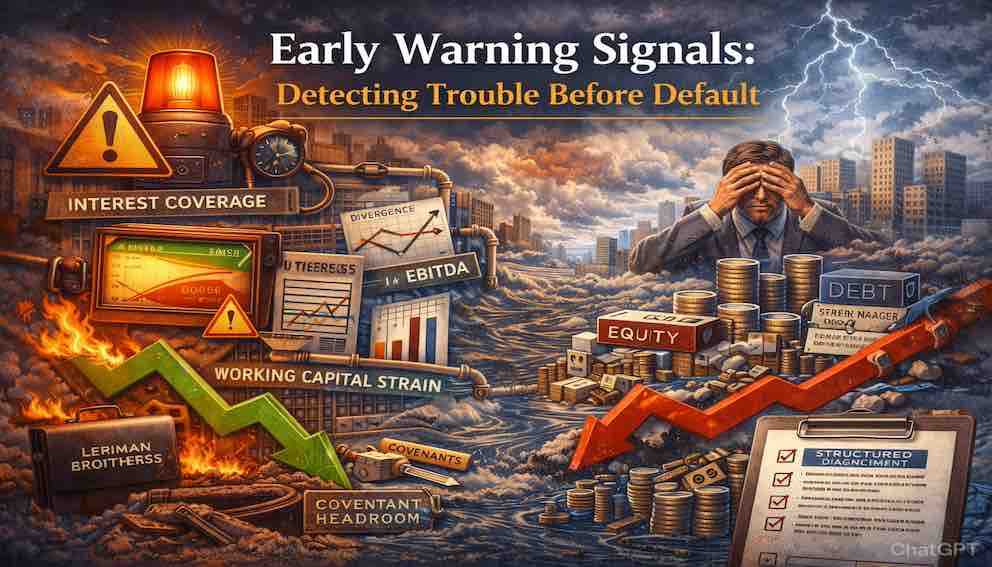
The Quiet Accumulation of Pressure
As we explored in the previous tutorial, financial distress is rarely a sudden rupture. Most firms do not fail overnight. Instead, stress accumulates gradually, quietly, in small misalignments between cash inflows, obligations, and leverage. Even profitable companies can stumble when these pressures become rigid or when confidence erodes — among creditors, suppliers, or internally within the management team.
Temporary optimism, favorable accounting treatment, or short-term borrowing often masks stress, giving the illusion of stability. Yet beneath the surface, pressure slowly accumulates, whispering through financial statements, operational performance, and human behavior. Recognizing these subtle signals before they become crises is critical for anyone involved in corporate finance, investment, or strategic management.
Returning to the Cafe
To make these concepts tangible, let us revisit the cafe owner from the previous tutorial. Her business is not in crisis — not yet. Bills are paid, staff are on payroll, and customers still visit. But small changes signal the onset of stress:
- Her supplier now demands payment within 15 days instead of the usual 30.
- A long-time corporate client delays their weekly order payments from 15 days to 45 days without explanation.
- A repair bill for a broken refrigeration unit exceeded her expectations.
- She now checks her bank balance daily instead of weekly.
These subtle changes are the early warning signals of financial stress. They are whispers, not shouts. And they are exactly what we must learn to detect.
The Nature of Early Warning Signals
Early warning signals can be grouped into financial, operational, and behavioral indicators. Observing these in combination — rather than in isolation — provides a clearer picture of stress accumulation.
1. Financial Signals
Declining Interest Coverage Ratio
The interest coverage ratio measures a company’s ability to meet interest payments from operational earnings:
A declining ratio signals growing difficulty in servicing debt, even if profits remain healthy.
- Example (Corporate): A manufacturing firm maintains stable revenue but borrows to expand production. EBIT remains at $500,000, while interest expense rises from $100,000 to $200,000. Interest coverage falls from 5.0x to 2.5x. Profitable, yes — but now vulnerable to small revenue dips.
- Example (Cafe): Rent, supplier payments, and wages act as “interest obligations.” When these costs rise relative to daily revenue, her informal coverage ratio declines.
Key Insight: Trend matters more than level. A stable 3.0x ratio is safe; a decline from 5.0x to 3.0x signals emerging stress.
Divergence Between EBITDA and Free Cash Flow
EBITDA shows operational profitability, stripping out interest, taxes, depreciation, and amortization. Free cash flow (FCF) reflects the cash actually available after working capital changes and capital expenditures.
- Corporate Example: A retailer expands aggressively. EBITDA rises, but cash flow falls as capital is tied up in new stores, inventory, and delayed receivables.
- Cafe Example: Monthly profit looks fine on paper, but the bank balance declines due to growing inventory and delayed corporate payments.
Shrinking Covenant Headroom
Debt covenants require companies to maintain certain ratios. Breaching them can trigger penalties or accelerate repayment. Shrinking cushion — or “headroom” — signals decreasing financial flexibility.
- Corporate Example: Lenders may restrict borrowing when leverage approaches covenant limits.
- Cafe Analogy: Late rent payments reduce trust with her landlord, mimicking formal covenants.
Pressure on Credit Ratings
Credit rating agencies track financial health. Downgrades, or warnings of potential downgrades, increase borrowing costs and reduce market access.
- Corporate Example: A stable firm may face rising interest rates simply because analysts detect a trend of increasing debt-to-cash flow ratios.
2. Operational Signals
Operational indicators often reveal stress before financial ratios do.
Tightening Working Capital
Delayed receivables, growing inventory, or stricter supplier terms strain cash flow.
- Cafe Example: Corporate client pays in 45 days; supplier demands 15-day payment. She is financing her own largest customer.
- Corporate Example: Logistics firm faces rising fuel costs and delayed payments. Profitable on paper, but operationally stressed.
Declining Efficiency Metrics
Productivity ratios — output per employee or per machine — can reveal inefficiencies: aging equipment, bottlenecks, disengaged workforce.
- Cafe Example: Longer wait times, fewer customers served per hour, or wasted coffee signal subtle operational decline.
- Corporate Example: Manufacturing line efficiency drops, slowly eroding cash flow.
Rising Cost of Capital for Suppliers or Vendors
Suppliers may tighten terms or demand prepayment if they sense financial stress.
- Cafe Example: Supplier shifts from 30-day to 15-day terms.
- Corporate Example: Construction vendors refuse credit, requiring cash-on-delivery.
3. Behavioral Signals
Behavioral cues are often the first hints of stress.
Management Denial or Avoidance
Leaders may rationalize shortfalls or delay reporting.
- Cafe Example: Owner downplays competition as a “temporary fad.”
- Corporate Example: CEO attributes missed revenue to market fluctuations while structural issues persist.
Strategic Conservatism or Over-Cautious Decisions
Delaying investment, hiring freezes, or cutting R&D can indicate awareness of fragility.
- Cafe Example: Menu expansion postponed.
- Corporate Example: Firm hoards cash instead of pursuing profitable growth.
Employee and Customer Reactions
High turnover, low morale, or declining customer engagement signal stress.
- Cafe Example: Top barista quits; regular customers visit less often.
- Corporate Example: Key sales staff leave due to instability.
The Critical Distinction: Level vs. Trend
A single number rarely signals distress. Trends tell the story.
- Interest coverage of 3.0x may be safe or risky depending on prior trends.
- Negative free cash flow may be seasonal or structural depending on history.
Early warning signals are movies, not snapshots. Watching the direction of travel is key.
The FOCUS Framework: A Structured Way to See What Others Miss
Early warning signals are only useful if we have a systematic way to spot them. Without structure, we risk seeing what we want to see—or missing what we are not prepared to look for.
So let us build a simple framework together. Think of it as a mental checklist, a way to ensure we are looking in all the right places. We will call it the FOCUS framework, because that is exactly what it asks of us.
F — Financial Metrics
Start with the numbers. But not just the numbers everyone looks at.
Review cash flow trends, not just profits. Profit is a story about the past. Cash flow is the movie playing right now. Watch where it is heading.
Track interest coverage over time. Is the company earning enough to comfortably pay its interest obligations? If that number is shrinking, even from a healthy starting point, pay attention.
Measure covenant headroom. How much buffer does the company have before it breaches its loan agreements? Is that buffer growing or shrinking? Lenders watch this closely. So should you.
O — Operational Reality
Numbers can hide as much as they reveal. So look at the operations beneath them.
Examine working capital cycles. How long does it take to collect from customers? How long does inventory sit before it sells? How quickly must suppliers be paid? These are not abstract accounting terms. They are the plumbing of the business.
Monitor efficiency trends. Is the company producing the same output with the same inputs? If productivity is declining, something is wrong beneath the surface.
Listen to suppliers and vendors. Are they changing their behavior? Shortening payment terms? Asking for cash on delivery? They often sense trouble before the financial statements show it.
C — Confidence Signals
Now look at the human side. This is where distress often reveals itself first.
Observe management communication. Are leaders acknowledging problems or explaining them away? Is there a pattern of rationalization—blaming the economy, the competition, the weather? Denial is a signal.
Note strategic shifts. Is the company delaying investments it should be making? Freezing hiring? Cutting research and development? These may be prudent, but they can also signal that management sees trouble ahead.
Watch employees and customers. Are the best people leaving? Are regular customers becoming less regular? They often know before the numbers show it.
U — Underlying Trend
Here is a principle worth holding onto: a single number tells you little. A direction tells you more.
Focus on trajectory rather than absolute levels. Is the metric improving, stable, or deteriorating over time?
A company with 3.0x interest coverage may be fine if it was 2.5x last year. A company with 4.0x may be in trouble if it was 6.0x eighteen months ago. The trend is the signal.
S — Structural vs Temporary
Finally, ask the most important question of all: is this problem structural or temporary?
A temporary shock—a supplier disruption, a seasonal downturn, a one-time client delay—may resolve on its own. A structural problem—a permanent shift in customer preferences, an unsustainable cost structure, a debt burden that cannot be serviced—requires fundamental change.
Use history, peer comparisons, and scenario analysis to distinguish between them. If the whole industry is struggling, the problem may be cyclical. If the company is struggling alone, look deeper.
The Cafe Under Stress: Seeing the Framework in Action
Let us return to our cafe owner and watch the FOCUS framework reveal what is happening beneath the surface.
Financial Metrics
The bank balance is declining. The owner checks it every morning now. She never used to do that. Her informal calculation of "interest coverage"—the rent, supplier payments, and wages divided by daily revenue—is shrinking. The numbers still work, but the margin is thinner.
Operational Reality
Her largest corporate client used to pay in 15 days. Now they pay in 45. Her supplier, once content with 30-day terms, now demands payment in 15. Inventory sits longer because the new competitor down the street has taken some of her lunch traffic. Each part of the working capital cycle is moving against her.
Confidence Signals
She checks the bank balance daily. She used to check weekly. She has stopped talking about the menu expansion she planned six months ago. When a friend asks about the new competitor, she says, "They are a fad. Customers will come back." The words sound confident, but the tone is different.
Underlying Trend
Every metric is moving in the wrong direction. Slowly. Quietly. But consistently. This is not a one-month fluctuation. It is a pattern.
Structural vs Temporary
Now the hard question. Is the new competitor a temporary disruption, or has the neighborhood changed permanently? Is the corporate client delaying payment because of its own cash flow problems, or because it is testing how late it can pay? The answers are not yet clear. But the framework ensures the questions are being asked.
A Quantitative View: The Numbers Behind the Story
Sometimes it helps to see the progression in numbers. Over three months, here is what the cafe's performance looks like:
January
Revenue: £10,000
EBITDA: £3,000
Free Cash Flow: £2,500
Informal Interest Coverage: 4.0x
February
Revenue: £10,500
EBITDA: £3,200
Free Cash Flow: £1,800
Informal Interest Coverage: 3.2x
March
Revenue: £10,200
EBITDA: £3,100
Free Cash Flow: £1,000
Informal Interest Coverage: 2.5x
Notice what is happening here. Revenue and EBITDA—the numbers that would appear in a headline—remain steady. Revenue is up slightly from January to February. EBITDA is stable.
But beneath the surface, free cash flow is falling. The money actually available to the owner after all the timing effects—after waiting for customers to pay, after holding inventory, after meeting obligations—has dropped from £2,500 to £1,000 in just three months.
And the informal interest coverage, that rough measure of the owner's ability to meet fixed costs, has fallen from 4.0x to 2.5x.
This is the classic divergence that signals stress. The top-line story looks fine. The underlying reality is deteriorating.
The FOCUS framework does not tell the owner what to do. But it tells her where to look. And in moments of uncertainty, knowing where to look is half the battle.
Using Early Warning Signals to Guide Intervention
Early detection is only useful if it informs action. Interventions can be prioritized as follows:
Immediate Actions:
- Improve cash collection from delayed clients.
- Renegotiate supplier terms to reduce immediate pressure.
- Reduce inventory waste and optimize operational efficiency.
Medium-Term Actions:
- Consider refinancing debt or extending covenants to restore flexibility.
- Adjust staffing or resource allocation to balance operational load.
Long-Term Actions:
- Reassess strategic plans: menu expansion, new projects, or growth initiatives.
- Develop formal monitoring processes using the FOCUS framework.
- Foster transparent communication within management and staff.
Conclusion: Seeing the Whispers Before the Shouts
Financial distress is a process, not an event. By the time a company reaches default, warning signs have often been present for months or years.
In this tutorial, we explored how to detect these signals early across financial, operational, and behavioral dimensions. Key indicators include:
- Declining interest coverage
- Divergence between EBITDA and free cash flow
- Shrinking covenant headroom
- Tightening working capital
- Subtle behavioral cues like denial or overly conservative strategies
We introduced the FOCUS framework — Financial Metrics, Operational Reality, Confidence Signals, Underlying Trend, Structural vs Temporary — to make monitoring systematic and memorable. Using narrative examples, including the cafe owner, we illustrated how even profitable businesses can experience stress if early warnings are ignored.
Most importantly, we emphasized that trend matters more than level: a single number rarely tells the whole story, but direction reveals risk.
By paying attention to these whispers, companies, investors, and creditors can act proactively and proportionally, preventing avoidable failures and preserving value.
In the next tutorials, we will explore how these early warnings escalate into liquidity pressure, and how companies can manage the narrowing gap between cash inflows and obligations.
About Swati Sharma
Lead Editor at MyEyze, Economist & Finance Research WriterSwati Sharma is an economist with a Bachelor’s degree in Economics (Honours), CIPD Level 5 certification, and an MBA, and over 18 years of experience across management consulting, investment, and technology organizations. She specializes in research-driven financial education, focusing on economics, markets, and investor behavior, with a passion for making complex financial concepts clear, accurate, and accessible to a broad audience.
Disclaimer
This article is for educational purposes only and should not be interpreted as financial advice. Readers should consult a qualified financial professional before making investment decisions. Assistance from AI-powered generative tools was taken to format and improve language flow. While we strive for accuracy, this content may contain errors or omissions and should be independently verified.