
Tutorial Categories
Last Updated: February 24, 2026 at 13:30
The Liquidity Spiral Explained — How Cash Pressures Can Turn Manageable Stress Into a Full-Blown Financial Crisis
In this tutorial, we examine the liquidity spiral—a self-reinforcing mechanism by which minor cash pressures escalate rapidly into severe financial distress. Using detailed corporate examples from manufacturing, financial institutions, and service sectors, we illustrate how delayed receivables, unplanned expenditures, and shifts in stakeholder confidence interact nonlinearly to amplify financial stress. We also explore behavioral reflexivity and feedback loops, showing why early detection, coordinated action, and timely intervention are essential to prevent cascading crises. Managers, investors, and creditors will gain a deeper understanding of liquidity-driven risk and practical strategies to mitigate it before it becomes catastrophic.
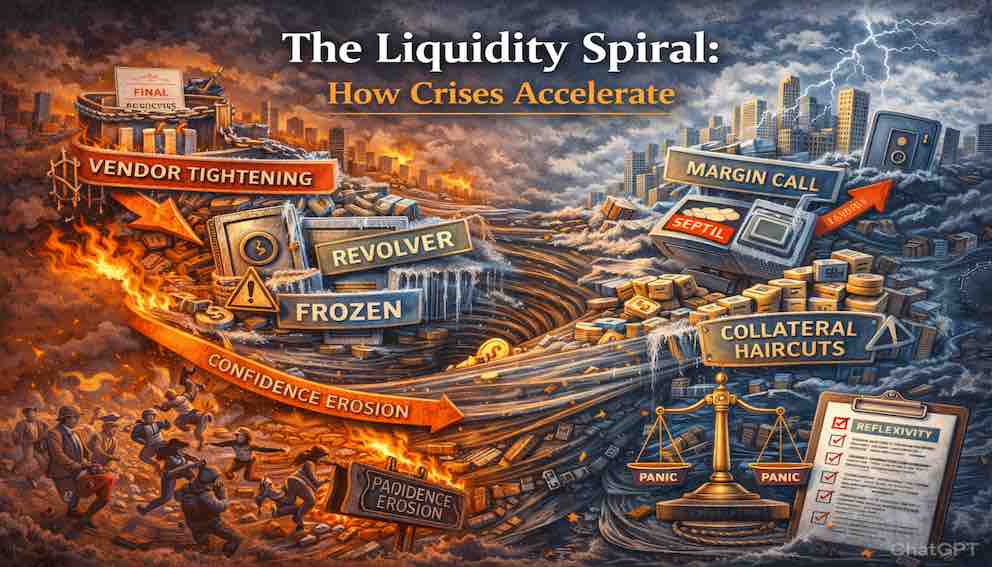
When Financial Stress Becomes Systemic
In our previous tutorial, we discussed early warning signs of financial distress, emphasizing that these indicators rarely appear as sudden shocks. They typically emerge subtly over time: declining interest coverage ratios, widening divergence between EBITDA and cash flow, tightening supplier terms, or management behaviors indicating denial or hesitation. Recognizing these signals is necessary, but insufficient. Understanding the consequences that follow is equally critical.
Financial stress does not progress in a simple, linear fashion. A single delayed receivable or a minor dip in cash reserves does not merely subtract from liquidity. Instead, these events interact with leverage, contractual obligations, and stakeholder perceptions in ways that magnify the original problem. This nonlinear escalation is the essence of a liquidity spiral.
In corporate environments, stakes are high. Temporary mismatches in receivables and payables can trigger cascading effects: operational flexibility diminishes, lenders and investors grow wary, and, if left unchecked, formal distress or default may result. Understanding the mechanics of the liquidity spiral is therefore vital for corporate managers, creditors, and investors.
Case Study: Precio Components
To illustrate these dynamics, let us follow Precio Components, an imaginary mid-sized manufacturer supplying machined parts to automotive and industrial equipment companies. The firm has been profitable for twenty years, maintains loyal clients, and employs experienced staff. However, like many manufacturers, it operates on thin margins and relies on a revolving credit facility to manage timing mismatches between paying suppliers and collecting receivables.
At the start of our study, Precio Components is stable. Its lenders are comfortable, suppliers provide standard 30-day terms, and customers pay, on average, in 45 days.
Three events occur in quick succession:
- Delayed receivable: A major automotive client extends payment from 45 days to 65 days due to its own slow sales.
- Unplanned capital expenditure: A CNC machine that runs three shifts fails unexpectedly, requiring a £400,000 replacement.
- Lender scrutiny: The company’s lender, noticing high utilization of the revolving facility, requests a meeting to review covenant headroom.
Individually, these events are manageable. Combined, they create the conditions for a liquidity spiral.
The Nonlinear Nature of Liquidity Stress
Traditional financial analysis often assumes linearity: a £500,000 shortfall one week and another £500,000 the next simply sum to £1 million of stress. Liquidity stress, however, is nonlinear. Small pressures interact with leverage, operational realities, and human behavior, producing consequences far larger than the sum of individual events.
For Precio Components:
- The delayed payment forces a heavier draw on the credit facility to cover payroll and suppliers.
- The CNC machine failure requires an additional draw.
- The revolving facility, previously at 60% utilization, now sits at 85%.
This triggers the company’s leverage covenant: debt cannot exceed 4.0x EBITDA. Lender scrutiny increases. Management begins monitoring cash balances daily and delays a supplier payment by one week to preserve flexibility. The supplier, facing its own constraints, shortens payment terms from 30 days to 15 days.
The total stress is no longer merely the £400,000 equipment cost plus the delayed receivable. It now encompasses:
- Higher debt utilization
- Lender oversight and potential covenant risk
- Reduced supplier payment flexibility
- A management team operating in defensive mode
This is nonlinearity in action: the effects multiply, not simply add.
Feedback Loops in Corporate Liquidity
At the core of the liquidity spiral are feedback loops, where one action triggers another in a self-reinforcing cycle across stakeholders.
1. Supplier Loop
When payments are delayed, suppliers adjust to protect their own liquidity. They may shorten terms, request prepayment, or reduce shipment volumes. Each adjustment increases the company’s cash pressure, making future delays more likely.
Example: Precio Components delayed a supplier payment by one week. The supplier subsequently shortened terms from 30 to 15 days, leaving the company with less time to meet obligations. In tightly managed supply chains, such as automotive or aerospace, this dynamic escalates rapidly.
2. Credit Loop
Increased borrowing or covenant testing often triggers higher interest rates, reduced credit availability, or stricter reporting. This constrains the firm’s ability to respond to additional shocks.
Example: Precio Components’ lender requested a 90-day reduction plan, not because of breach but due to approaching covenant thresholds. Borrowing capacity, previously a source of flexibility, now generates pressure. Similar dynamics affected European SMEs during the 2011–2012 banking crisis, where prior near-breaches curtailed access to credit despite otherwise solid fundamentals.
3. Confidence Loop
Perceptions matter. Signs of stress, even minor, can prompt defensive behavior from investors, lenders, and customers. Equity investors may reduce holdings; lenders may tighten covenants; customers may seek alternative suppliers. This perception-driven action feeds back into real financial stress.
Example: Precio Components’ CFO monitors cash daily instead of weekly, delays supplier payments, and projects caution in conversations. Employees notice and adjust behaviors—ordering less inventory or deferring routine tasks. These internal changes, while invisible externally, compound stress.
Flow Problems vs Stock Problems
A flow problem represents a temporary mismatch between cash inflows and outflows, often resolvable with short-term financing. A stock problem reflects a permanent reduction in financial flexibility, including depleted cash reserves, increased debt, and impaired contractual relationships.
Liquidity spirals are particularly dangerous because they convert flow problems into stock problems.
- Precio Components’ delayed client payment and equipment failure were flow problems.
- Drawing on credit increased the company’s debt stock.
- Supplier payment delay worsened terms permanently.
- Credit utilization strained the lender relationship.
- Defensive management behavior altered operational decision-making.
Even after the original events resolve, the system does not return to its prior state.
The Tipping Point
Liquidity spirals accelerate. There is a threshold when manageable stress becomes unmanageable. Before this point, interventions—loan arrangements, supplier reassurances, customer negotiations—can restore stability. After the tipping point, options narrow: lenders tighten terms, suppliers demand cash, customers reduce orders.
For Precio Components, this could occur when:
- The lender reduces the credit facility instead of requesting a plan.
- Suppliers demand cash on delivery.
- Major customers, hearing market rumours, shift orders to competitors.
The tipping point is rarely a single event; it emerges when feedback loops have tightened to the point that no single intervention can restore balance.
Real-World Corporate Examples
1. Financial Institutions – 2008 Crisis
Initial mortgage-backed security losses were manageable for a few banks. As news spread, interbank lending froze, asset sales triggered price declines, and confidence eroded. Solvent institutions faced liquidity shortages not due to fundamentals, but because perception-driven feedback loops created self-reinforcing stress.
2. Northern Rock, UK
A fundamentally sound mortgage lender faced a bank run at the institutional level, as counterparties refused to roll over funding. Liquidity evaporated despite solvency, illustrating how confidence loops can dominate actual cash positions.
3. European Mid-Sized Manufacturers
During the European sovereign debt crisis, public sector payment delays of €2 million triggered supplier term tightening, covenant reviews, and reduced credit lines. Flow problems became stock problems—minor delays led to permanent reductions in financial flexibility.
Behavioral Reflexivity: Perceptions Become Reality
George Soros’ concept of reflexivity explains that individual rational actions can collectively produce irrational outcomes:
- Suppliers tighten terms based on perceived risk, which increases actual risk.
- Investors sell shares anticipating trouble, reducing capital availability.
- Customers reduce orders or demand stricter terms, further reducing cash flow.
Each actor behaves rationally with their own information, but collectively, these actions reinforce the original stress, converting perception into reality.
Escalation Scenarios
Scenario One: Delayed Receivables
A £1 million payment arrives two weeks late. The company draws on its revolving credit line (utilization 60→80%). Lender requests a meeting; CFO delays supplier payments. Supplier shortens terms. Result: permanently tighter schedule, oversight, and defensive management.
Scenario Two: Unplanned Capital Expenditure
A CNC machine replacement of £400,000 exceeds cash reserves. Draw on credit line rises to 85%. Lender demands weekly reporting. CFO delays non-essential expenditures. Small operational inefficiencies emerge. One equipment failure triggers systemic stress.
Scenario Three: Customer Perception Shock
Rumors of financial strain cause a major client to extend payment terms. Further credit draws trigger lender reductions. Defensive management amplifies stress. Perceptions create self-fulfilling liquidity pressures.
Tools for Recognizing and Managing Liquidity Spirals
Tool One: Cash Flow Forecasting
Weekly or daily projections for at least 13 weeks help anticipate cash gaps and approach lenders proactively. Interrupts the credit loop.
Tool Two: Stress Testing
Scenario planning combining multiple stressors prevents supplier loop amplification.
Tool Three: Liquidity Buffers
Cash reserves or untapped credit absorb shocks, interrupting all loops simultaneously.
Tool Four: Stakeholder Communication
Transparent updates with lenders, suppliers, and investors prevent reflexive behavior. Interrupts the confidence loop.
Tool Five: Active Intervention
Address disruptions immediately to prevent flow problems from becoming stock problems. Includes early client calls, renegotiating terms, and monitoring credit utilization.
The Coordination Challenge
Liquidity spirals are difficult to stop because they require coordination among rational actors who do not coordinate:
- Suppliers act independently based on their risk.
- Lenders act prudently based on portfolios.
- Customers act defensively.
Individually rational actions collectively produce a liquidity spiral. Early intervention before stakeholders act is critical, as reversing post-action decisions is difficult. Once begun, spirals leave permanent marks on credit lines, supplier terms, and management behavior.
Conclusion: Understanding to Prevent
This tutorial demonstrated how minor liquidity pressures can escalate into systemic financial distress through nonlinear interactions, feedback loops, and behavioral reflexivity. Using Precio Components and historical corporate crises, we:
- Distinguished flow vs stock problems
- Identified the tipping point where manageable stress becomes unmanageable
- Examined supplier, credit, and confidence loops
- Applied reflexivity to illustrate perception-driven escalation
- Provided practical tools to prevent or interrupt the spiral
Understanding the liquidity spiral equips managers, investors, and creditors to anticipate stress, coordinate responses, and prevent minor liquidity issues from becoming full-blown crises.
About Swati Sharma
Lead Editor at MyEyze, Economist & Finance Research WriterSwati Sharma is an economist with a Bachelor’s degree in Economics (Honours), CIPD Level 5 certification, and an MBA, and over 18 years of experience across management consulting, investment, and technology organizations. She specializes in research-driven financial education, focusing on economics, markets, and investor behavior, with a passion for making complex financial concepts clear, accurate, and accessible to a broad audience.
Disclaimer
This article is for educational purposes only and should not be interpreted as financial advice. Readers should consult a qualified financial professional before making investment decisions. Assistance from AI-powered generative tools was taken to format and improve language flow. While we strive for accuracy, this content may contain errors or omissions and should be independently verified.