
Tutorial Categories
Last Updated: February 24, 2026 at 13:30
Understanding Debt Covenants and Technical Default — How Contractual Promises Shape Corporate Financial Risk
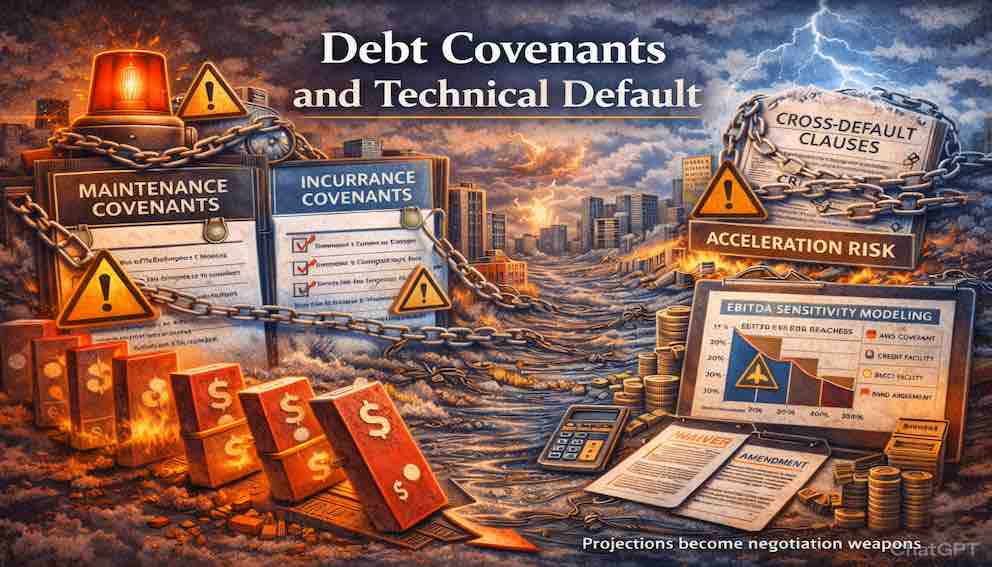
Debt covenants are contractual agreements between a borrower and lender that define obligations and limits on corporate financial behavior. This tutorial explores maintenance and incurrence covenants, cross-default clauses, and technical default implications. Learn how breaches trigger acceleration risk, how headroom buffers operate, and how waivers, amendments, and covenant compliance modeling help managers, investors, and creditors anticipate stress and make informed decisions.
Introduction: Why Debt Covenants Matter
Corporate finance operates at the intersection of market forces and contractual obligations. Companies do not simply react to revenue and cost changes—they must navigate debt covenants, which limit financial ratios, borrowing, dividends, and strategic actions.
Covenants serve two purposes:
- Early Warning: Declining ratios trigger lender engagement before crisis.
- Control Allocation: Good performance allows management discretion; deterioration shifts certain rights to lenders.
Borrowers accept covenants to reduce interest costs; lenders require them to protect downside risk. Understanding these mechanics is essential for managers, investors, and creditors.
A Note on Covenant-Lite Structures
Some loans have few or no maintenance covenants (“covenant-lite”), often in leveraged buyouts or institutional term loans. Without early warning, issues go unnoticed until payment default occurs. Flexibility comes at the cost of higher risk and limited time to negotiate when stress escalates.
Returning to Precio Components
Let us check back in with the company we have been following. A lot has happened since we last saw them.
You may recall the series of pressures that built up over a short period. First, a major automotive client delayed a payment—not indefinitely, but long enough to create a gap. Then, just as the finance team was adjusting to that, a critical piece of equipment failed. The replacement was urgent and expensive.
These two events pushed their credit facility utilization to 85 percent. That is the kind of number that catches a lender's attention. And indeed, the lender did notice. They requested a formal plan to reduce the drawn balance within 90 days.
Meanwhile, a supplier who had worked with the company for years quietly shortened payment terms from 30 days to 15. No explanation. Just a new policy. The message was clear: we are watching.
So here is where Precio Components stands today.
The company has two main loans with the same lender. The first is a £50 million term loan with a five-year maturity. The second is a £20 million revolving credit facility—essentially a flexible line of credit they can draw on and repay as needed.
Both of these loan agreements contain covenants. Those covenants, which once seemed like standard legal language in a thick document, are now very real constraints. They define what the company can and cannot do, what ratios it must maintain, what happens if it stumbles.
The CFO, Sarah, once thought of covenants as something the lawyers handled. Now she studies them. She needs to understand exactly where the company stands relative to each threshold, how much headroom remains, and what might trigger a breach.
This is not just about compliance anymore. It is about survival. Because when covenants tighten and headroom shrinks, the company loses flexibility. And in times of stress, flexibility is everything.
The Economic Logic: Why Borrowers Accept Covenants
Covenants are a trade-off: accept operational constraints for lower borrowing costs.
Think of it as insurance: the premium is flexibility; the benefit is lower rates. When stress hits, the abstract constraints become concrete.
Maintenance vs Incurrence Covenants
Maintenance Covenants
Tested continuously, typically quarterly. Examples:
- Debt-to-EBITDA ratio
- Interest coverage ratio
- Minimum net worth
Precio Components: Debt-to-EBITDA ≤ 4.0x
- Debt: £60M (term + drawn revolver)
- EBITDA: £15M
- Ratio: 4.0x → compliant, zero headroom
EBITDA decline scenario: £14.5M → ratio 4.14x → technical default, despite all payments current.
Headroom: Buffer between actual performance and covenant limit. Zero headroom means any stress triggers a breach. Monitoring continuously is essential.
Incurrence Covenants
Triggered by specific actions:
- Limiting new debt
- Restricting dividends/share buybacks
- Capping acquisitions or capex
Example: Revolver prohibits new borrowing if Debt-to-EBITDA > 3.5x
- Current: 4.0x
- Pro forma after £5M new debt: 4.33x → prohibited
Cross-Default Clauses: Domino Effects
A default on one facility triggers default on others.
Example: Term loan technical default → triggers cross-default on revolver → both facilities in default → lender can accelerate £70M.
Technical Default and Acceleration Risk
- Technical default: covenant breach, payments current
- Acceleration risk: lender can demand full repayment immediately
Even without acceleration, lenders gain leverage—fees, collateral, or amendments may be demanded. Managers must act during technical default, not after payment default.
Managing Covenant Risk: Waivers and Amendments
When a company sees a covenant breach approaching, it does not have to simply wait and hope. There are tools available. Two of the most important are waivers and amendments.
A waiver is temporary relief. Imagine a company knows it will breach a covenant at the end of the quarter. It can go to the lender beforehand and say: "We are going to be slightly out of compliance this quarter, but we have a plan to fix it. Will you waive the requirement for this period?"
If the lender agrees, the breach does not happen. The company continues operating normally. Waivers often come with conditions—maybe a fee, maybe more frequent reporting, maybe a modest increase in the interest rate. But they provide breathing room.
The key is to ask before the breach. A waiver requested after a breach is still possible, but the lender's position is stronger and the price is likely higher.
An amendment is permanent. It changes the covenant itself. For example, a lender might agree to raise the Debt-to-EBITDA limit from 4.0 times to 4.5 times. Now the company has more room to operate.
Amendments are not free. Lenders may ask for upfront fees, additional collateral, personal guarantees, or restrictions on future actions. But they can restore flexibility that has been lost as circumstances have changed.
Both tools require something many companies forget to build: a relationship with the lender that exists before trouble arrives.
Covenant Compliance Modeling: A Practical Analytical Tool
Sarah, the CFO of Precio Components, decides she cannot afford to be reactive anymore. She needs to understand exactly where the company stands and what might happen under different scenarios. So she builds a simple model.
Step 1: Establish Base Metrics
She starts with the current numbers. The term loan stands at £50 million. The revolver has £10 million drawn. Total debt is £60 million. EBITDA, based on the last twelve months, is £15 million.
The term loan covenant requires Debt-to-EBITDA to stay below 4.0 times. Sixty divided by fifteen is exactly four. Zero headroom.
The revolver has an incurrence covenant: no new borrowing if the ratio exceeds 3.5 times. At 4.0, that door is already closed.
This is the baseline. Not comfortable, but known.
Step 2: Apply EBITDA Sensitivity
Now Sarah asks: what if things get worse? She models a 10 percent decline in EBITDA. Instead of £15 million, the company earns £13.5 million.
The ratio becomes 60 divided by 13.5, which equals 4.44. That is above the 4.0 limit. A breach.
The model shows that a modest decline in earnings—the kind that could happen in any normal business cycle—would trigger a technical default.
Step 3: Model Cascade Effects
Sarah adds the cross-default clause to her model. If the term loan breaches, that default triggers the revolver as well. Suddenly, both facilities are in default. The lender has the right to accelerate £70 million.
The company does not have £70 million in cash. No one does. Acceleration would mean bankruptcy.
The model reveals that a single stress factor—a 10 percent earnings decline—could cascade into a full-blown crisis.
Step 4: Test Mitigation Options
Now Sarah uses the model to explore what might prevent that outcome.
What if the company repays £5 million of the revolver? Total debt drops to £55 million. With EBITDA at £13.5 million, the ratio becomes 55 divided by 13.5, which equals 4.07. Still a breach, but smaller.
What if the company negotiates an amendment to raise the covenant limit to 4.5 times? At 4.44, the company would be compliant. No breach.
What if they combine both actions—repay some debt and negotiate a higher limit? Now they have room. They know exactly what to ask for.
The model does not solve the problem. But it tells Sarah what the problem is, how big it could get, and what might fix it. That is information she can take to the lender.
Projections as Negotiation Tools
When Sarah meets with the lender, she does not come with empty hands. She brings her model.
Here is our base case. Here is a stress case showing what happens if EBITDA declines 10 percent. Here is the resulting covenant breach. Here is what we propose: raise the limit to 4.5 times for the next four quarters, and we will reduce revolver drawings by £5 million over six months.
She is not asking for mercy. She is presenting a plan. The lender sees that Sarah understands the numbers, has quantified the risk, and is proposing a reasonable solution.
This is the difference between a reactive approach—"We missed our covenant, please don't accelerate"—and a proactive one. The model demonstrates control, foresight, and transparency. Lenders respond to that.
Real-World Examples
This is not just theoretical. History is full of companies that failed to manage covenant risk—and some that succeeded.
During the 2008 financial crisis, many fundamentally sound companies found themselves in technical default as earnings declined. Some had cash on hand but could not refinance fast enough to avoid acceleration. They failed not because they were insolvent, but because they had not modeled the stress and engaged lenders early enough.
The collapse of Carillion in 2018 followed a different path. The company appeared compliant until an accounting restatement revealed the true position. Headroom disappeared overnight. Lenders, surprised and distrustful, refused waivers. Without waivers, debt accelerated. Without refinancing, the company collapsed.
In contrast, private equity-owned companies in leveraged buyouts model covenant headroom continuously. They run stress scenarios. They engage lenders proactively. They know that survival depends on anticipating problems before they arrive.
Practical Implications
For managers, the lesson is clear. Build a simple compliance model. Monitor headroom continuously, not just at reporting dates. Use the model to test scenarios and quantify what you need from lenders. Negotiate before you breach.
For investors, covenants reveal a company's financial flexibility. Shrinking headroom is a warning signal, even if ratios remain compliant. Cross-default clauses create interconnected risk. And covenant-lite structures, while giving companies more freedom, also remove early warning systems—investors should understand what they are not seeing.
For creditors, scenario modeling helps anticipate breaches before they happen. Waivers and amendments are opportunities to reprice risk intelligently, not just react to problems.
Conclusion: Key Takeaways
Let us gather what we have learned.
Covenants exist to allocate control and lower borrowing costs. Borrowers accept them in exchange for cheaper capital.
There are two main types. Maintenance covenants are tested continuously. They provide early warning but can trigger technical default even when payments are current. Incurrence covenants are event-driven, triggered only when the company takes specific actions.
Headroom—the buffer between actual performance and covenant limits—is dynamic. Monitoring it continuously matters more than checking compliance at reporting dates.
Cross-default clauses can turn a single breach into a cascade across multiple facilities. A problem in one loan becomes a problem in all loans.
Technical default is not the same as payment default. Technical default is a contract problem. Payment default is a cash problem. The former is a window for negotiation. The latter is a crisis.
Waivers and amendments are tools for managing covenant pressure. Waivers provide temporary relief. Amendments create permanent change. Both are easier to obtain before a breach than after.
Covenant compliance modeling transforms abstract risk into quantified exposure. It allows managers to test scenarios, plan interventions, and approach lenders with data rather than pleas.
Covenant-lite loans trade early warning for freedom. They give companies more room to operate but remove the tripwires that signal trouble. Investors and lenders in covenant-lite structures must find other ways to monitor risk.
Through Precio Components, we have seen how modeling and proactive engagement can prevent escalation, preserve options, and maintain flexibility. Sarah's model did not save the company by itself. But it gave her the information she needed to act before options disappeared.
In the next tutorial, we will explore what happens when covenant dynamics interact with broader restructuring—when stress exceeds what waivers and amendments can fix, and more fundamental change becomes necessary.
About Swati Sharma
Lead Editor at MyEyze, Economist & Finance Research WriterSwati Sharma is an economist with a Bachelor’s degree in Economics (Honours), CIPD Level 5 certification, and an MBA, and over 18 years of experience across management consulting, investment, and technology organizations. She specializes in research-driven financial education, focusing on economics, markets, and investor behavior, with a passion for making complex financial concepts clear, accurate, and accessible to a broad audience.
Disclaimer
This article is for educational purposes only and should not be interpreted as financial advice. Readers should consult a qualified financial professional before making investment decisions. Assistance from AI-powered generative tools was taken to format and improve language flow. While we strive for accuracy, this content may contain errors or omissions and should be independently verified.