
Tutorial Categories
Last Updated: February 24, 2026 at 13:30
Creditor Hierarchy and Capital Structure Conflict: Who Gets Paid First and Why It Matters
Understanding the creditor hierarchy is essential for navigating financial distress. This tutorial explains how senior, secured, and unsecured debt, subordinated obligations, trade creditors, statutory claims, and equity interact when a company cannot meet all its obligations. Using the real-world example of Precio Components and a conceptual waterfall distribution, we show how different recovery levels affect stakeholders, why conflicts arise among creditors, and how control and priority shape strategic decisions. Readers will leave with practical insights into how hierarchy and capital structure influence corporate negotiations and outcomes in distress situations.
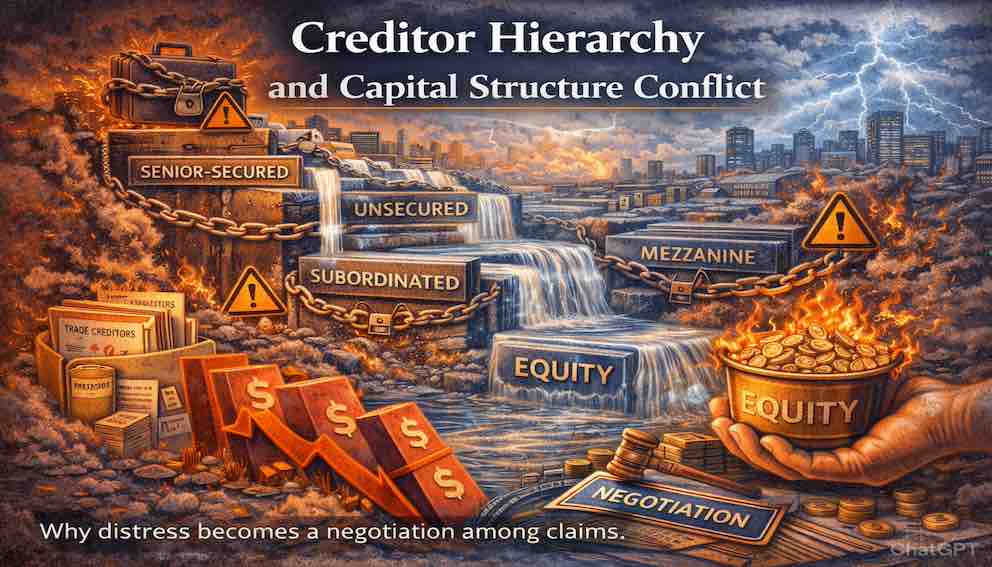
Introduction: When Financial Stress Becomes a Negotiation
It’s late on a Friday afternoon. Sarah, the CFO of Precio Components, sits at her desk reviewing the company’s cash position. The senior lender has not yet accelerated the £50 million term loan, but the company is in technical default on its senior facilities. Trade creditors are demanding quicker payment, employees are anxious about wages, and a subordinated lender is watching every move.
In this moment, Sarah realizes something critical: it is no longer just about managing cash or avoiding a covenant breach. The company is approaching genuine financial distress, and understanding who gets paid first, who has control, and how different stakeholders interact is vital.
This is where the concept of creditor hierarchy and capital structure conflict comes into play. While debt covenants define the rules of engagement in normal operations, hierarchy determines outcomes when resources are insufficient to pay all claims. It is not merely a legal ordering—it shapes negotiation dynamics, strategic decision-making, and risk for all stakeholders.
What is Creditor Hierarchy?
Creditor hierarchy, also called priority of claims, is the structured order in which a company’s obligations are satisfied when it cannot fully meet all commitments.
- Priority: Determines who receives payment first.
- Control: Determines who has decision-making power during distress.
These two dimensions are related but distinct. Senior lenders often have both priority and control through covenants, collateral, and intercreditor agreements. Trade creditors may have low legal priority but operational leverage. Equity holders may have control rights through voting or plan proposals despite being last in line to receive payment.
In simple terms: creditor hierarchy answers the question “if a company’s assets were liquidated tomorrow, who gets paid, who waits, and who might get nothing?”
Returning to Precio Components
To make these concepts more concrete, let’s examine the capital structure of Precio Components. The company has a £50 million senior term loan and a £20 million revolving credit facility, both of which rank high in priority. It also took on a £10 million subordinated loan, which is contractually junior to the senior facilities. In addition, the company owes £5 million to trade creditors, which is unsecured, and has £3 million in statutory claims for unpaid taxes and accrued wages, which hold preferential status under the law. Finally, equity investors, including the founding family and a private equity partner, occupy the residual position at the bottom of the hierarchy, receiving payment only after all other claims are satisfied.
In this scenario, Sarah, the CFO, must navigate far more than just who is owed money. She needs to understand who gets paid first, who has the power to influence decisions, and which stakeholders hold leverage that could affect the company’s operations and restructuring options.
The Separation of Priority and Control
Understanding the distinction between priority and control is crucial:
- Priority determines payment order. Senior lenders are typically first.
- Control dictates decision-making during distress, such as approving restructuring plans or blocking liquidation.
Sometimes a creditor’s control rights exceed what their priority would suggest. For instance:
- Trade creditors may refuse to ship critical components, effectively halting operations despite low legal priority.
- A court-appointed administrator or creditor committee may control a distressed company, overriding management’s authority.
Sarah must manage both: ensuring payment obligations are clear while negotiating with those who wield control.
Senior vs. Subordinated Debt: Risk, Priority, and Recovery
Senior debt is the highest-ranking debt. It generally carries lower interest rates because it is less risky and often secured by collateral.
- Precio Components’ £50M term loan and £20M revolver are senior. They have first claim on cash flows and assets.
Subordinated debt (sometimes called junior debt) ranks below senior debt. Lenders agree contractually to be paid only after senior claims are satisfied.
- Precio Components’ £10M subordinated loan explicitly states that senior lenders must be paid first.
- Subordinated lenders often behave strategically—they cannot threaten liquidation because senior claims are protected, but they may push for restructuring plans that maximize recovery.
Risk-Return Trade-off:
- Senior debt: lower risk, lower interest, more security.
- Subordinated debt: higher risk, higher interest, optionality in distress.
- Equity: residual risk, highest potential return, acts like a call option on company recovery.
Secured vs. Unsecured Debt
Secured debt is backed by collateral. If the company defaults, the lender can seize assets.
- Precio Components’ senior term loan is secured by the manufacturing facility and equipment.
Unsecured debt has no specific claim on assets. Examples include most corporate bonds and trade credit.
- Precio Components’ £5M trade payables are unsecured. Suppliers rely on company goodwill and operational continuity rather than legal claims.
Secured lenders often recover more reliably, which explains lower interest rates compared to unsecured lenders.
Statutory Claims: Taxes and Wages
Some claims are statutory, meaning the law prioritizes them over private creditors.
- Taxes: £2M unpaid
- Wages: £1M accrued
In the UK and many other jurisdictions, these claims often jump ahead of unsecured creditors and, in some cases, even certain secured claims. Managers cannot negotiate away these obligations.
Trade Credit: Operational Leverage Beyond Legal Priority
Trade creditors are suppliers extending credit in the ordinary course of business. Legally, they rank low in the hierarchy. Operationally, they wield leverage: stopping supply can halt production.
- Precio Components’ suppliers may insist on cash payments or shorten terms. Sarah must manage supplier relationships carefully despite their legal junior status.
Equity as the Residual Claimant
Equity holders are last in line. They only receive payment after all creditors are satisfied.
- Precio Components’ equity: Founding family 60%, Private Equity 40%.
- In distress, equity behaves like a call option—if recoveries exceed claims, equity benefits. If not, equity is wiped out.
Equity investors may push for aggressive growth or restructuring, seeking upside from residual claims, even at high risk.
Conceptual Waterfall Distribution: Visualizing Hierarchy
A waterfall distribution illustrates the order in which claims are satisfied:
[Statutory Claims: £3M] ← Highest priority
[Senior Secured Debt: £70M]
[Subordinated Debt: £10M]
[Trade Creditors: £5M]
[Equity: Residual]
Example Scenarios for Recovery:
£80M recovery:
- Statutory claims: £3M paid
- Senior secured: £70M paid
- Subordinated: £7M (70% recovery)
- Trade creditors & equity: £0
£75M recovery:
- Statutory: £3M
- Senior secured: £70M
- Subordinated: £2M (20% recovery)
- Trade & equity: £0
£65M recovery:
- Statutory: £3M
- Senior secured: £62M (88% recovery)
- Subordinated, trade, equity: £0
£90M recovery:
- Statutory: £3M
- Senior secured: £70M
- Subordinated: £10M
- Trade: £5M
- Equity: £2M
This framework shows why creditors with different priorities have conflicting interests in restructuring negotiations.
Intercreditor Agreements: Contracting Around Conflicts
When multiple lenders exist, intercreditor agreements define relationships:
- Who can accelerate debt
- Who can enforce against collateral
- How payments are distributed
- Whether subordinated lenders can “step into” senior rights
Precio Components’ subordinated lender cannot accelerate without senior consent. This shapes bargaining power and negotiation strategy.
Capital Structure Conflicts in Distress
Conflicts naturally arise in financial distress because different stakeholders have varying priorities, risk tolerances, and incentives. Senior lenders, for instance, are primarily focused on protecting their priority and may prefer liquidation if the company’s collateral is sufficient to recover their claims quickly. Subordinated lenders, on the other hand, are often willing to support restructuring efforts to preserve potential upside, as they rank below senior debt and may otherwise recover little or nothing.
Trade creditors face a different set of incentives. While their claims are typically unsecured, they rely on the company continuing operations to maintain ongoing business relationships, so they may accept partial recovery if it ensures future supply and ongoing commercial opportunities. Statutory claimants, such as tax authorities or employees with unpaid wages, usually demand immediate enforcement of their claims, as legal or statutory obligations take precedence and cannot easily be negotiated. Finally, equity holders are residual claimants. They are last in line for payments and often prefer to delay decisions or support restructuring in hopes of a turnaround, preserving the optionality that comes with their residual interest.
Understanding these conflicts is critical for managers, investors, and creditors alike, because the incentives of each stakeholder shape negotiation dynamics and ultimately determine the outcome of financial distress.
Practical Implications
For Managers:
Managers must be aware of their company’s creditor hierarchy well before distress occurs. It is essential to understand both who has priority in payments and who holds control or influence over key decisions. Special attention should be given to trade creditors, who, despite lower legal priority, can disrupt operations if relationships are mishandled. Proactive communication and negotiation with both senior and subordinated lenders can prevent conflicts from escalating and preserve flexibility in restructuring scenarios.
For Investors:
Investors should recognize that senior debt carries lower risk, while subordinated debt and equity offer higher risk with potential upside. Recovery prospects are shaped not just by the hierarchy but also by intercreditor agreements and statutory claims, which can alter the effective priority of certain stakeholders. Anticipating potential conflicts among creditors allows investors to better assess risk and expected recoveries in distressed situations.
For Creditors:
For creditors, the creditor hierarchy guides strategy during workouts and negotiations. Control rights—such as covenants, collateral enforcement, or intercreditor provisions—often matter as much as legal priority. Operational leverage, particularly for trade creditors, can enhance bargaining power even when claims are low in the hierarchy. Ultimately, waterfall dynamics—the structured order of payments—determine outcomes, regardless of relationships or goodwill among stakeholders.
Conclusion: Financial Distress is a Structured Negotiation
In this tutorial, we explored several key principles that shape outcomes during financial distress. We examined the creditor hierarchy, which determines how claims are ordered and satisfied, and clarified the distinction between priority and control—who gets paid versus who makes decisions. We reviewed the different types of claims, including senior, subordinated, secured, unsecured, statutory, trade, and equity. We illustrated the conceptual waterfall distribution, a visual tool to understand payment order, and highlighted the role of intercreditor agreements in shaping bargaining power. Finally, we considered capital structure conflicts, showing how differing incentives among stakeholders create negotiation tension.
Through the case of Precio Components, we saw that financial distress is not simply a cash shortage. It is a structured negotiation among stakeholders, where priority, control, and strategic incentives jointly shape outcomes. Understanding these principles equips managers to act proactively, helps investors assess risk and recovery potential, and allows creditors to navigate complex negotiations effectively.
In the next tutorial, we will explore formal restructuring processes, including mechanisms such as bankruptcy, pre-pack sales, and negotiated workouts, to understand how companies and stakeholders resolve distress when negotiation alone is insufficient.
About Swati Sharma
Lead Editor at MyEyze, Economist & Finance Research WriterSwati Sharma is an economist with a Bachelor’s degree in Economics (Honours), CIPD Level 5 certification, and an MBA, and over 18 years of experience across management consulting, investment, and technology organizations. She specializes in research-driven financial education, focusing on economics, markets, and investor behavior, with a passion for making complex financial concepts clear, accurate, and accessible to a broad audience.
Disclaimer
This article is for educational purposes only and should not be interpreted as financial advice. Readers should consult a qualified financial professional before making investment decisions. Assistance from AI-powered generative tools was taken to format and improve language flow. While we strive for accuracy, this content may contain errors or omissions and should be independently verified.