
Tutorial Categories
Last Updated: February 24, 2026 at 13:30
Understanding Refinancing Risk and the Debt Maturity Wall: How Timing Can Topple Even Solvent Companies
Refinancing risk is a crucial yet often overlooked aspect of corporate financial management that can threaten even fundamentally strong companies. In this tutorial, we explore how the timing and structure of debt obligations create vulnerabilities, introduce the debt maturity ladder as a diagnostic tool, and explain the concept of the "maturity wall" through real-world examples. We analyze both the hypothetical Precio Components and the Evergrande Group cases to show how poorly managed maturities can escalate into crises. This guide equips managers, investors, and creditors with the knowledge to anticipate refinancing challenges and implement effective strategies.
Introduction: Beyond Solvency – Why Refinancing Risk Matters
When discussing corporate finance and the stability of firms, the focus is often on solvency, profitability, and operational efficiency. These are indeed critical elements of financial health. A company that consistently generates positive cash flows, maintains strong profit margins, and meets day-to-day obligations appears financially robust.
Yet history shows us that even solvent and operationally efficient companies can experience severe financial distress if they fail to manage the timing and structure of their debt obligations. This phenomenon, which financial analysts call refinancing risk, is about whether a company can replace maturing debt when it comes due.
Refinancing risk arises when a company must roll over its existing debt or borrow new funds to repay obligations but faces challenges due to timing, market conditions, or concentrated debt maturities. Unlike credit risk, which is the probability of default due to insufficient funds, refinancing risk is fundamentally a timing and liquidity problem. A company may have enough assets and revenues to meet obligations in the long run, but if multiple debts mature simultaneously and markets are illiquid, the company may face immediate stress.
In this tutorial, we will explore refinancing risk in depth. We will explain how to read a company’s debt maturity profile, introduce the maturity ladder as a diagnostic tool, and examine real-world examples to show why timing can be as critical as financial strength.
Refinancing Risk vs Rollover Risk: Understanding the Distinction
Before diving deeper, it is useful to clarify a subtle distinction often made by practitioners:
- Refinancing risk is the risk that new debt cannot be obtained at all because capital markets are closed or the company’s creditworthiness is questioned.
- Rollover risk is the risk that new debt can be obtained, but only at worse terms—for example, higher interest rates, stricter covenants, or smaller amounts than originally borrowed.
Both risks are important. Even if a company manages to refinance, punitive terms can consume cash flow, creating distress despite surviving the maturity event. In practice, the terms are often used interchangeably, but understanding both helps highlight that refinancing is about the mismatch between debt maturity timing and available funding.
Understanding Debt Maturity Profiles
A company’s debt maturity profile is essentially a roadmap of when each obligation comes due. Examining this profile allows managers and creditors to anticipate peaks in repayment pressure and potential refinancing risk.
Debt can generally be divided into short-term and long-term obligations:
- Short-term debt includes obligations due within one year, such as trade payables, working capital loans, and commercial paper. These are inherently more sensitive to refinancing risk because the company must frequently access capital markets or bank facilities to roll them over. For instance, trade creditors that provide monthly supplies act like short-term lenders; their willingness to extend credit can significantly affect liquidity.
- Long-term debt spans multiple years, often between three to thirty years, and includes term loans, bonds, and some lease obligations. While these reduce frequent refinancing needs, they may still create refinancing stress if large tranches mature around the same period.
A well-managed debt maturity profile staggers obligations across periods, avoiding concentration and enabling the company to refinance gradually. When debt maturities are unevenly distributed, companies can face a maturity cliff, a period where repayments spike, increasing the risk of liquidity shortages even if the company is otherwise healthy.
How to Read a Maturity Ladder
The maturity ladder is a simple yet powerful tool to visualize refinancing risk. It lists all debt obligations by their due dates and shows when repayments peak.
Instead of using a table, imagine the ladder as a timeline with debt obligations stacked along it:
- Next 6 months: Ongoing trade payables
- 12–18 months: Revolving credit facility (£20M)
- 18–24 months: Senior term loan (£50M)
- 24–36 months: Subordinated loan (£10M)
From this narrative ladder, you can see that months 18–24 present a maturity cliff, where £70 million of obligations come due in a compressed window. If refinancing is unavailable, the company may face a liquidity crisis regardless of operational performance.
The ladder can be color-coded or labeled by debt type (senior, subordinated, or trade), providing a quick visual of risk concentrations.
Understanding the Maturity Wall
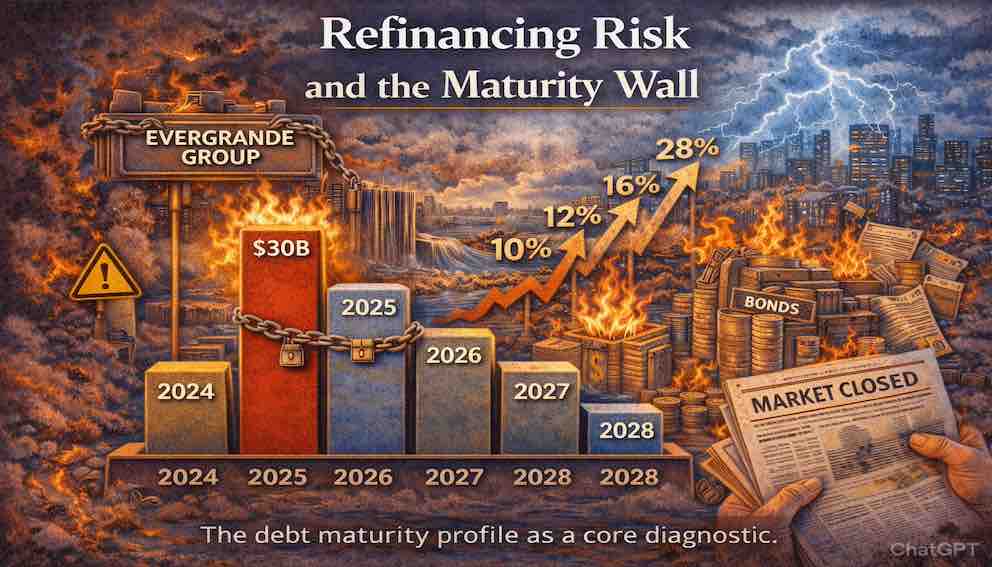
A maturity wall occurs when multiple debt obligations converge within a short period, creating extreme refinancing pressure. Conceptually, standing at a maturity wall is like standing at the edge of a cliff: all obligations demand attention simultaneously, leaving little room for maneuver.
High-yield or leveraged companies are particularly vulnerable because they often carry overlapping tranches of debt, short-term obligations, and heavy reliance on market financing. Even profitable operations cannot prevent distress if refinancing fails.
Consider Precio Components: the company faces a wall in months 18–24, requiring £70 million to be refinanced. Even if revenues rise, the timing of obligations can precipitate a crisis:
- If interest rates spike, refinancing costs can consume operating cash flow.
- If credit markets tighten, lenders may demand stricter terms or collateral.
- If performance disappoints, lenders may refuse to roll over the debt entirely.
This demonstrates that refinancing risk is not about whether the company is profitable but whether obligations align with liquidity and funding availability.
Real-World Example: Evergrande Group
The Evergrande Group, one of China’s largest real estate developers, provides a real-world illustration.
Evergrande relied heavily on bank loans, bonds, and off-balance-sheet financing to fund rapid growth. For years, the company rolled over debt without difficulty, relying on rising property prices and ongoing sales.
However, by 2020–2021:
- Regulatory restrictions (“three red lines”) limited borrowing.
- Property sales slowed as the market cooled.
- Investor confidence in the sector declined.
These factors converged to create a maturity wall. Large debts came due simultaneously, and refinancing was unavailable. Despite massive assets, including land and completed properties, Evergrande faced a liquidity crisis and defaulted on multiple obligations.
The key lesson: solvency alone does not eliminate refinancing risk. Access to liquidity at the right time is critical.
Factors Influencing Refinancing Risk
Several interrelated factors determine a company’s exposure:
Concentration of Maturities: Debt clustered in a short period increases vulnerability. Staggering maturities reduces pressure.
Market Liquidity and Credit Conditions: Even strong companies can be caught off guard if markets tighten. Investors may demand higher yields, and banks may limit lending.
Interest Rate Volatility: Rising rates increase refinancing costs. For example, refinancing £70 million at 200 basis points higher interest raises annual costs by £1.4 million—a significant burden on operating cash flow.
Covenants and Contractual Terms: Restrictive covenants, cross-default clauses, and acceleration triggers can exacerbate refinancing risk.
Secured vs Unsecured Status: Secured lenders have collateral and may refinance more willingly. Unsecured lenders may demand repayment or refuse rollover.
Company Reputation and Creditor Relations: Firms with a track record of timely repayment often find refinancing easier. Transparency and communication with lenders are assets in high-pressure situations.
Asset-Liability Matching: Long-term assets should ideally be funded with long-term debt. Funding long-term assets with short-term debt creates additional refinancing pressure.
Illustrative Scenarios: Timing Matters
Consider two hypothetical firms:
- Company A: £1B debt maturing evenly over four years (£200M in Year 1, £300M in Year 2, £250M in Year 3, £250M in Year 4). Annual cash flow is £400M, with a £150M undrawn credit facility. Even if markets tighten, gradual refinancing and cash flow buffers prevent stress.
- Company B: £1B debt with £800M maturing in a single six-month window. Annual cash flow is £300M, with no undrawn facilities. Market tightening during that window could force asset sales at distressed prices or punitive refinancing terms, risking default.
These examples demonstrate that timing and structure are as critical as cash flow and profitability.
Interaction with Creditor Hierarchy
Refinancing risk interacts with the creditor hierarchy:
- Senior secured lenders: first claim on collateral and cash flow; may extend maturities if protected.
- Subordinated lenders: riskier; may demand repayment, potentially triggering defaults.
- Trade creditors: may stop extending credit, creating operational pressure.
- Equity holders: may be diluted if refinancing requires new equity at distressed prices.
Effective management requires understanding both the timing of obligations and the likely behavior of different creditors.
Strategies to Mitigate Refinancing Risk
Stagger Debt Maturities: Spread obligations across periods to avoid cliffs. Refinancing early can extend maturities before a wall emerges.
Maintain Liquidity Buffers: Cash reserves and undrawn credit lines provide flexibility during temporary market disruptions.
Diversify Funding Sources: A mix of bank loans, bonds, and alternative financing reduces dependence on any single source.
Monitor Market Conditions: Track interest rates, credit spreads, and investor sentiment to act proactively.
Scenario Planning and Stress Testing: Model adverse events—interest rate spikes, market closures, earnings shortfalls—to understand vulnerabilities.
Strong Creditor Relations: Transparent, ongoing communication with lenders can facilitate negotiations and reduce panic-driven behavior.
Match Funding to Asset Lives: Align the maturity of debt with the expected cash generation of funded assets to minimize timing mismatches.
The Timing Paradox
The best time to address refinancing risk is before it becomes urgent. When markets are open, lenders are willing, and the company is performing well, extending maturities and building buffers is relatively easy. Waiting until a maturity wall is imminent often results in limited options, high costs, or outright denial of refinancing.
Precio Components illustrates this paradox: by beginning conversations 18 months before the wall, the CFO proactively mitigates risk rather than reacting under pressure.
Conclusion: Navigating the Timing Dimension of Corporate Finance
Refinancing risk is a nuanced but critical element of corporate financial management. Unlike solvency concerns, it is about timing, structure, and access to capital rather than the absolute level of debt or operational profitability.
In this tutorial, we explored:
- The distinction between refinancing and rollover risk
- How to construct and interpret a maturity ladder
- The concept of a maturity wall and why it threatens even solvent companies
- Real-world and hypothetical examples, including Precio Components and Evergrande
- Factors influencing refinancing risk, including market conditions, interest rates, covenants, and creditor hierarchy
- Practical strategies to mitigate risk, from staggering maturities to building liquidity buffers
- The timing paradox: address refinancing risk proactively
Through these insights, it becomes clear that financial health is not only about how much a company earns or owes but also when obligations are due and under what conditions they must be met. By mastering the timing dimension, financial managers can navigate uncertainty, protect stakeholders, and sustain long-term value creation.
In the next tutorial, we will explore how companies restructure liabilities when refinancing is no longer possible, examining both formal and informal liability management processes.
About Swati Sharma
Lead Editor at MyEyze, Economist & Finance Research WriterSwati Sharma is an economist with a Bachelor’s degree in Economics (Honours), CIPD Level 5 certification, and an MBA, and over 18 years of experience across management consulting, investment, and technology organizations. She specializes in research-driven financial education, focusing on economics, markets, and investor behavior, with a passion for making complex financial concepts clear, accurate, and accessible to a broad audience.
Disclaimer
This article is for educational purposes only and should not be interpreted as financial advice. Readers should consult a qualified financial professional before making investment decisions. Assistance from AI-powered generative tools was taken to format and improve language flow. While we strive for accuracy, this content may contain errors or omissions and should be independently verified.