
Tutorial Categories
Last Updated: February 24, 2026 at 13:30
Bankruptcy Frameworks Explained Simply — How Chapter 11 and the Insolvency Act 1986 Balance Rescue and Liquidation
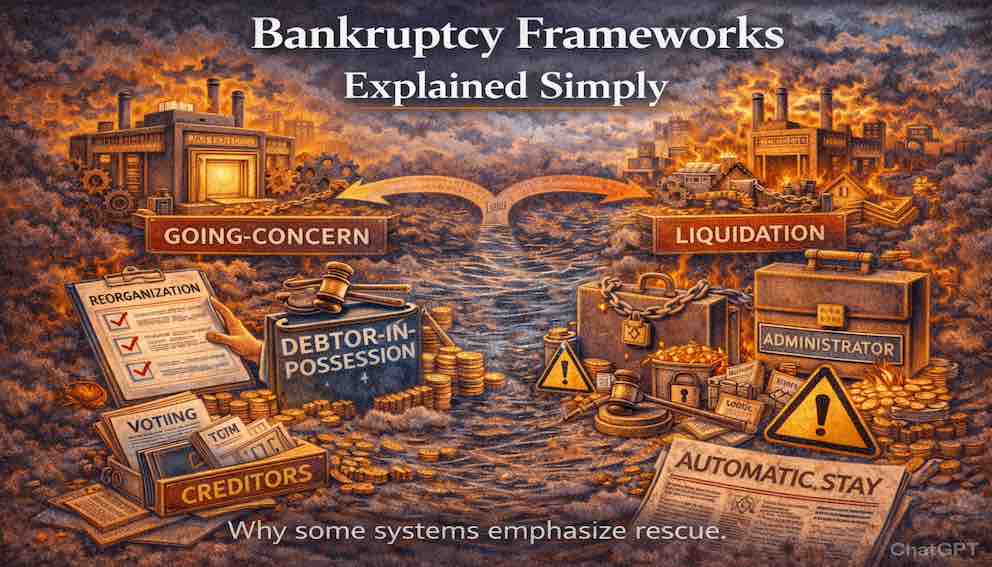
When refinancing fails and debt can no longer be rolled over, companies enter the formal world of bankruptcy law. This tutorial explains, in clear and patient language, how Chapter 11 in the United States and the Insolvency Act 1986 in the United Kingdom attempt to balance rescue and liquidation. We explore going-concern value versus liquidation value, debtor-in-possession control, administration, DIP financing, creditor voting, cramdown, and the logic of absolute priority. Rather than focusing on procedural technicalities, this guide explains the economic incentives and structural design that shape how modern bankruptcy systems preserve value under distress.
From Refinancing Failure to the Formal Legal World
In the previous tutorial, we followed Precio Components to the edge of the refinancing cliff. The company was not a failed enterprise in the operational sense. It manufactured specialized industrial components. It had customers who depended on it. Its machines functioned. Its engineers understood tolerances that competitors could not easily replicate.
The problem was timing.
A wall of debt maturities arrived precisely when capital markets tightened and lenders grew cautious. Banks that might previously have rolled over loans became defensive. Bond markets demanded higher yields. Liquidity thinned.
Refinancing failed.
At that moment, the character of the crisis changed completely. What had once been a financial negotiation became a legal problem.
When refinancing is unavailable and liquidity runs dry, companies cannot simply promise future improvement. They must either negotiate informally with creditors or enter a formal legal framework designed to deal with insolvency. Although terminology differs across jurisdictions, the underlying purpose of these frameworks is remarkably similar. They exist to manage a collective crisis in which multiple creditors, managers, employees, and shareholders hold competing claims over a business that cannot meet its obligations in full.
This is where bankruptcy law begins.
In the United States, large corporate restructurings typically take place under Chapter 11. In the United Kingdom, corporate insolvency procedures are governed by the Insolvency Act 1986, which includes administration and liquidation mechanisms.
The court procedures differ. The legal vocabulary differs. The institutional culture differs.
But the economic problem they attempt to solve is fundamentally the same.
The Core Economic Question: Is the Business Worth More Alive or Dead?
Before discussing legal design, we must slow down and understand the central economic question underlying all bankruptcy systems: is the company worth more as a going concern or in liquidation?
Imagine Precio Components continuing to operate. Machines are running. Engineers supervise production. Customers expect deliveries. Suppliers extend trade credit based on long relationships. The brand carries reputational value in niche industrial markets. The workforce understands specialized processes that cannot be easily documented.
All of this together creates something economists call organizational capital. It is not easily separable. It cannot be auctioned in neat pieces without losing value.
Suppose that as an operating business, Precio Components is worth £120 million.
Now imagine an immediate shutdown. The factory doors close. Inventory is sold at auction. Machinery is dismantled and sold second-hand. Customer contracts are terminated. Employees disperse to other firms. Intellectual property is sold piecemeal.
In that scenario, perhaps the assets collectively fetch £70 million.
The difference between £120 million and £70 million is not hypothetical. It represents the additional value that comes from keeping the business intact. That difference is going-concern value.
Liquidation value reflects what can be realized when assets are sold separately and operations cease.
Bankruptcy systems exist largely because that difference can be substantial. If liquidation destroys significant value, society benefits when law creates space to preserve the business.
But that preservation is not automatic. It depends on coordination.
The Collective Action Problem at the Heart of Bankruptcy
When Precio Components misses a debt payment, creditors begin to worry. Each lender fears being the last in line.
If one secured lender accelerates its loan and seizes collateral, others may rush to do the same. Suppliers may demand immediate payment. Equipment lessors may attempt repossession. Lawsuits may proliferate.
Individually, each creditor is acting rationally. Collectively, their actions may destroy the going-concern value that would have benefited them all.
This is a classic collective action problem.
Even if preserving the company would create more total value, no single creditor can trust the others to wait patiently. The incentive to defect is powerful. If everyone rushes to seize assets, liquidation may occur by default, even when it is economically inefficient.
Bankruptcy law intervenes to pause that destructive race.
The Automatic Stay: Freezing the Scramble
One of the most powerful conceptual tools in modern insolvency systems is the automatic stay, or moratorium.
Under Chapter 11 in the United States, once a company files for protection, creditor enforcement actions are generally paused. Lawsuits cannot proceed without court approval. Collateral cannot be seized unilaterally. Foreclosures are halted.
In UK administration under the Insolvency Act 1986, a similar moratorium effect arises once an administrator is appointed. Creditors are restricted from enforcing security or commencing proceedings without consent.
The purpose of this pause is not to protect management out of sympathy. It is to prevent a destructive scramble that would destroy going-concern value.
If Precio Components were dismantled piecemeal in the days following a missed payment, customers might flee permanently. Skilled workers might resign. The value of the enterprise could evaporate in weeks.
The automatic stay functions as a collective agreement imposed by law. It forces everyone to stop, breathe, and negotiate in a structured environment.
This transforms chaos into coordinated negotiation.
Chapter 11 and the Debtor-in-Possession Model
One of the defining characteristics of Chapter 11 is the debtor-in-possession model.
Under Chapter 11, existing management typically remains in control of day-to-day operations during the restructuring process. The company continues operating, but it does so under court supervision.
At first glance, this may appear counterintuitive. Why allow the same managers who presided over financial distress to remain in charge?
The answer lies in information and incentives.
Management understands the business in detail. They know customer preferences, supplier relationships, production bottlenecks, and market positioning. Removing them immediately could destabilize operations and reduce going-concern value.
Chapter 11 reflects a philosophical orientation toward rescue. It assumes that many distressed companies are economically viable but financially overleveraged. If debt can be restructured while operations continue, value can be preserved.
However, this design creates tension.
Shareholders sit at the bottom of the priority ladder. If liquidation occurs and creditors are not paid in full, shareholders receive nothing. In that sense, equity holders already face near-total loss once insolvency is reached.
This creates asymmetric incentives. Shareholders may support risky strategies in the hope of preserving residual value because their downside is limited but their upside remains intact. This phenomenon is sometimes described as “gambling for resurrection.”
Managers who are aligned with shareholders may be tempted to delay proceedings, propose optimistic projections, or resist necessary concessions to creditors.
Chapter 11 addresses these incentive distortions through creditor committees, court oversight, disclosure requirements, voting procedures, and the absolute priority rule, which we will examine shortly.
Structurally, however, Chapter 11 begins from the premise that management remains in control unless there is evidence of misconduct or gross incompetence.
If Precio Components filed under Chapter 11, Sarah would likely remain CFO, operating the company as debtor-in-possession while negotiating with creditors.
Debtor-in-Possession Financing: Fuel for Survival
Rescue requires liquidity.
When a company enters Chapter 11, it still needs cash to pay wages, purchase raw materials, and keep utilities running. Yet existing lenders may be unwilling to provide additional funds because their prior loans are already at risk.
Chapter 11 addresses this by permitting debtor-in-possession financing, commonly known as DIP financing.
DIP financing can be granted super-priority status, meaning that new lenders may be repaid before pre-petition secured creditors if the restructuring fails. This elevated priority reduces risk for new lenders and makes fresh capital available during distress.
Without DIP financing, many viable businesses would run out of cash during restructuring, forcing liquidation even when going-concern value exceeds liquidation value.
If Precio Components entered Chapter 11, securing DIP financing would likely be one of Sarah’s first priorities. Without it, rescue would remain theoretical.
The UK Administration Model: Shifting Control
The United Kingdom approaches insolvency with a different structural emphasis.
Under the Insolvency Act 1986, when a company enters administration, control shifts away from existing directors and into the hands of an independent insolvency practitioner known as the administrator.
The administrator’s statutory objective is to rescue the company as a going concern if possible, or otherwise to achieve a better result for creditors than immediate liquidation would provide.
This design reflects a different judgment about incentives.
The UK framework assumes that once insolvency is reached, directors’ incentives may diverge from those of creditors. By transferring control to an independent professional, the system seeks to ensure objectivity and impartial evaluation.
If Precio Components entered administration, Sarah would no longer control strategic decisions. The administrator would assess whether the business could be restructured, sold as a going concern, or wound down.
This difference is philosophical as much as procedural.
Chapter 11 trusts incumbent management, subject to oversight. UK administration substitutes independent control at an earlier stage.
Both systems aim to preserve value when possible. They simply allocate trust differently.
Precio Components in Two Parallel Worlds
To understand these structural differences more clearly, imagine Precio Components in two parallel legal universes.
In the United States under Chapter 11, Sarah remains CFO. An automatic stay halts enforcement. DIP financing of £5 million is secured from a distressed investor who receives super-priority status. A creditors’ committee forms and scrutinizes financial projections. Negotiations begin over a reorganization plan.
Sarah proposes converting £30 million of unsecured debt into equity, extending secured loan maturities, and injecting new capital. Secured lenders, largely protected by collateral, support the plan. Unsecured creditors initially resist but recognize that liquidation would yield perhaps 10 percent recovery compared to 30 percent under the plan.
After negotiation and voting, the plan is confirmed. Creditors become partial owners. The balance sheet becomes sustainable. Sarah continues leading the company.
In the United Kingdom under administration, an insolvency practitioner takes control immediately. The administrator reviews the business and concludes that it is viable but overleveraged. Rather than engaging in prolonged restructuring negotiations, the administrator arranges a sale of the business as a going concern, possibly through a pre-pack transaction.
The operating business is sold to a new company. Employees transfer. Customers continue receiving products. The old corporate shell enters liquidation, and sale proceeds are distributed to creditors according to statutory priority.
In both universes, value is preserved relative to immediate liquidation. But in one, rescue occurs through management-led reorganization. In the other, rescue may occur through administrator-led sale.
Reorganization Plans and the Redesign of Capital Structure
At the heart of rescue-oriented bankruptcy lies the reorganization plan.
A reorganization plan is not merely a revised payment schedule. It is a fundamental redesign of the capital structure.
Suppose Precio Components owes £100 million, yet sustainable future cash flows can only support £70 million of debt. No refinancing arrangement can permanently solve that mismatch. The liability structure must change.
A reorganization plan may extend maturities so that principal repayments occur later, reduce interest rates to align with projected cash flows, or convert a portion of debt into equity so that creditors become owners rather than lenders.
Through these mechanisms, the company’s obligations are brought into alignment with economic reality.
The objective is sustainability, not cosmetic relief.
Absolute Priority and the Logic of Distribution
To understand creditor voting and cramdown, we must examine the principle of absolute priority.
Imagine Precio Components in liquidation is worth £70 million. Secured creditors are owed £60 million. Unsecured creditors are owed £40 million. Shareholders hold equity.
In liquidation, secured creditors would recover first, receiving up to £60 million from collateral proceeds. That would leave £10 million for unsecured creditors, who would therefore recover 25 percent of their claims. Shareholders would receive nothing.
The absolute priority principle holds that junior claimants cannot receive value unless senior claimants are paid in full.
This rule shapes negotiations profoundly.
If a reorganization plan proposes to give shareholders value while unsecured creditors are not being paid in full, creditors will object, and courts will scrutinize fairness.
Absolute priority disciplines the process. It prevents equity from extracting value at the expense of senior creditors.
At the same time, negotiations often involve compromise. Creditors may agree to leave a small equity stake with shareholders if doing so facilitates cooperation and maximizes overall recovery. But such deviations occur within a framework defined by priority norms.
Creditor Voting and Cramdown
Because creditors hold different positions in the priority structure, they have different incentives.
Senior secured creditors may prefer quick liquidation if their collateral covers most of their claim. Junior creditors may prefer rescue because liquidation would wipe them out. Trade creditors may care about preserving a customer relationship. Shareholders may support risky rescue attempts in hope of retaining value.
Bankruptcy systems organize creditors into classes and require voting on proposed plans.
Voting exists to legitimize restructuring decisions and to ensure that similarly situated creditors are treated consistently.
But what happens if one class votes against a reasonable plan?
Chapter 11 includes a mechanism known as cramdown. If a plan meets statutory fairness requirements and respects priority principles, a court may confirm it despite dissent from a particular class.
The existence of cramdown influences negotiation behavior. Creditors understand that rejecting a fair and feasible plan may not block confirmation indefinitely. This encourages compromise.
In UK administration, voting plays a less central role because the administrator has authority to execute a sale without extensive creditor approval. However, in other UK restructuring tools such as schemes of arrangement, similar class-based voting and court approval mechanisms apply.
Why Modern Systems Emphasize Rescue
Historically, insolvency often meant liquidation. Modern systems increasingly emphasize rescue.
This shift reflects recognition that liquidation can destroy substantial economic value. When a large employer collapses, the consequences ripple through communities, supply chains, and financial systems.
Preserving going-concern value protects employment, supplier networks, and broader economic stability. It may also increase creditor recoveries relative to asset break-up.
However, rescue is not always appropriate. If a business model is fundamentally flawed or demand has permanently collapsed, liquidation may be more efficient. Keeping non-viable firms alive can trap capital and labor in unproductive uses.
Modern bankruptcy frameworks therefore attempt to balance discipline with flexibility.
Chapter 11 leans toward management-led reorganization, supported by DIP financing and structured negotiation. UK administration leans toward independent oversight and rapid sale where appropriate.
Both reflect the same economic insight: when going-concern value exceeds liquidation value, law should create space to preserve it.
Bankruptcy as Structured Negotiation
It is tempting to view bankruptcy as a purely legal procedure filled with technical filings and court hearings.
But at its core, bankruptcy is a structured negotiation framework.
Without legal structure, creditors would race to enforce claims. Managers might conceal information. Shareholders might pursue excessively risky strategies.
Bankruptcy law pauses enforcement, defines priority, requires disclosure, organizes creditors into classes, and provides mechanisms to resolve deadlock.
It transforms a chaotic multi-party conflict into a coordinated process governed by rules.
At its best, it maximizes total value and distributes losses predictably. At its worst, it can become costly and protracted. But even then, it performs a function markets alone cannot perform efficiently: coordinating collective action under distress.
Conclusion: The Deeper Logic of Bankruptcy Systems
In this tutorial, we moved from refinancing failure into the formal architecture of bankruptcy systems.
We examined the difference between going-concern value and liquidation value, and we saw why preserving an operating business can create more wealth than breaking it apart. We explored how automatic stays solve coordination problems by pausing creditor enforcement. We compared the debtor-in-possession structure of Chapter 11 with the administrator-led framework of the Insolvency Act 1986. We examined DIP financing, reorganization plans, absolute priority, creditor voting, and cramdown.
Through Precio Components in two parallel legal worlds, we saw how the same economic problem can be addressed through different institutional designs.
Most importantly, we learned that bankruptcy systems are not merely legal rituals. They are structured negotiations designed to solve collective action problems, preserve value when possible, and allocate losses according to predictable principles when preservation is impossible.
In the next tutorial, we will move deeper into restructuring mechanics. We will examine debt-for-equity swaps in greater detail, liability management transactions, and out-of-court workouts that attempt to reshape capital structures without entering formal bankruptcy. Because once the legal framework is understood, the strategic engineering of financial restructuring becomes the central question.
About Swati Sharma
Lead Editor at MyEyze, Economist & Finance Research WriterSwati Sharma is an economist with a Bachelor’s degree in Economics (Honours), CIPD Level 5 certification, and an MBA, and over 18 years of experience across management consulting, investment, and technology organizations. She specializes in research-driven financial education, focusing on economics, markets, and investor behavior, with a passion for making complex financial concepts clear, accurate, and accessible to a broad audience.
Disclaimer
This article is for educational purposes only and should not be interpreted as financial advice. Readers should consult a qualified financial professional before making investment decisions. Assistance from AI-powered generative tools was taken to format and improve language flow. While we strive for accuracy, this content may contain errors or omissions and should be independently verified.