
Tutorial Categories
Last Updated: February 24, 2026 at 13:30
Operational vs Financial Restructuring: Why Fixing the Balance Sheet Is Not Enough After Bankruptcy
When a company emerges from bankruptcy with reduced debt and improved liquidity, it may appear healthy again. Yet financial restructuring only repairs the balance sheet—it does not repair a weak competitive position, inefficient operations, or a defensive culture. This tutorial explains the essential difference between operational and financial restructuring using the continuing story of Precio Components. We explore working capital discipline, structural cost reform, divestitures, asset carve-outs, leadership change, cultural reset, governance shifts, and capital allocation choices. Sustainable recovery requires more than survival; it requires rebuilding the engine that generates returns.
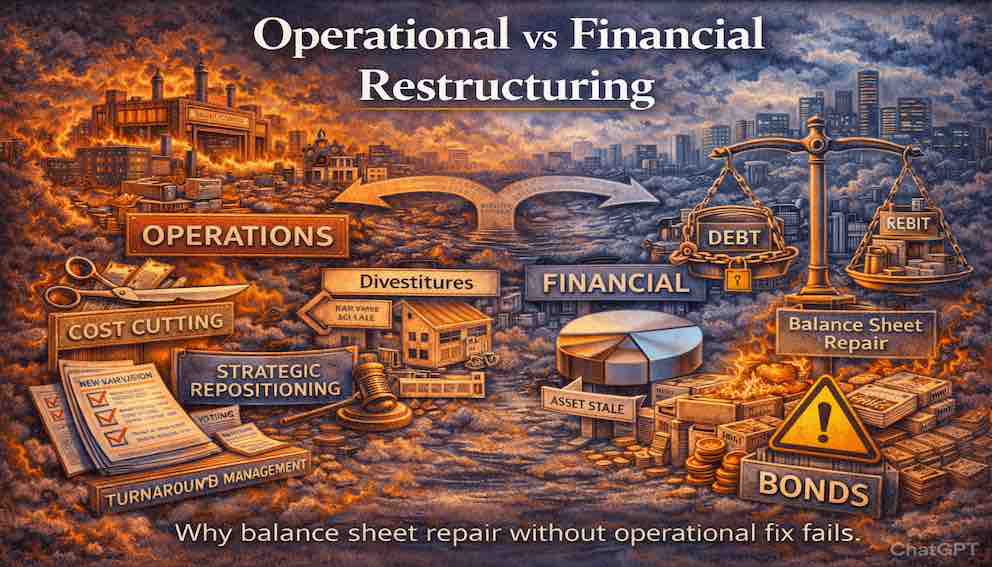
Introduction: The Morning After Bankruptcy
In the previous tutorial, we examined how structured legal systems such as Chapter 11 in the United States and the Insolvency Act 1986 in the United Kingdom allow distressed companies to renegotiate obligations rather than collapse into liquidation. We explored how debt can be reduced, maturities extended, and creditors converted into shareholders. We saw how reorganization plans function as structured bargaining processes designed to preserve going-concern value.
Now the legal process has ended.
Precio Components has emerged from Chapter 11.
Its debt has been reduced by forty percent. Interest payments are manageable. Maturities have been pushed out five years. Several bondholders now sit on the board after converting debt into equity. Liquidity has improved. The immediate threat of default has disappeared.
The balance sheet looks calmer.
But when management reviews the income statement, a different reality appears. Margins remain thin. Customers continue shifting toward lower-cost competitors. Production inefficiencies have not vanished. Innovation is limited. The organization feels cautious and bruised. Employees are relieved to have survived, but not yet confident in the future.
The legal crisis has ended.
The economic weakness has not.
This is the moment where many restructurings quietly succeed—or quietly fail again.
To understand why, we must move carefully through a distinction that sounds simple but carries enormous consequences: the difference between financial restructuring and operational restructuring.
Repairing Liabilities Versus Repairing the Business
Financial restructuring concerns the right-hand side of the balance sheet. It deals with liabilities and equity. It asks questions such as how much debt the company carries, what interest it pays, when obligations mature, and whether liquidity is sufficient to survive.
In Precio Components’ case, financial restructuring reduced leverage and bought time. It prevented insolvency. It stabilized the capital structure.
Operational restructuring concerns something entirely different. It addresses how the company actually earns money. It examines the left-hand side of the balance sheet and the income statement. It asks whether products are competitive, whether costs are efficient, whether customers perceive value, whether capital is allocated wisely, and whether the organization executes reliably.
Financial restructuring changes claims on cash flows.
Operational restructuring changes the ability to generate those cash flows in the first place.
If Precio Components continues producing undifferentiated products in markets dominated by lower-cost competitors, then reducing debt merely postpones another crisis. If its factories remain inefficient and its culture avoids accountability, improved liquidity will not create durable returns.
Financial restructuring stabilizes the patient.
Operational restructuring treats the disease.
The Illusion of Safety After Emergence
After bankruptcy, a psychological shift often occurs. Managers feel relief. Employees feel gratitude. Creditors who became shareholders feel cautiously optimistic. Liquidity is no longer collapsing. Payroll is secure. The most immediate danger has passed.
Relief, however, can produce complacency.
Precio Components’ leadership might argue that the hardest work is finished. They may prefer incremental improvements rather than structural change. They may avoid disruptive decisions that could unsettle a fragile workforce.
But bankruptcy did not occur because interest rates were slightly unfavorable. It occurred because the business model could not sustainably support the capital structure it carried.
If the underlying economics remain weak, leverage reduction alone will not create lasting strength.
The company has survived a financial heart attack. That does not mean the arteries are clear.
The First Layer of Operational Restructuring: Cash Discipline
Operational restructuring often begins not with strategy, but with discipline.
In the first ninety days after emergence, Precio Components does not immediately redesign its product portfolio. Instead, it focuses on the movement of cash through the business.
Receivables are reviewed in detail. Collection teams contact customers with overdue balances. Payment terms are clarified. Inventory levels are examined plant by plant. Excess raw materials are identified. Procurement teams renegotiate supply contracts. Weekly liquidity forecasts are implemented across divisions.
These actions may appear mundane compared with grand strategy discussions. Yet they matter profoundly. When receivables days fall and inventory turns improve, cash is released from within the business. Liquidity strengthens not because debt was forgiven, but because operations become tighter.
Working capital discipline buys time.
But it does not create competitive advantage.
Cash control is stabilization, not transformation.
Structural Cost Reform: Permanent, Not Temporary
Beyond working capital improvements lies structural cost reform. This requires more difficult decisions.
Precio Components discovers that two of its manufacturing facilities operate below efficient scale. Equipment is outdated. Labor productivity lags peers. Certain product lines generate minimal margin but consume disproportionate complexity.
Closing a facility is painful. It requires severance payments and difficult conversations with communities. Simplifying product lines risks losing some customers.
Yet structural inefficiency cannot be permanently masked by modest expense reductions. If the company carries a cost base that competitors do not share, margins will remain compressed regardless of balance sheet repair.
Structural cost reform is not about trimming travel budgets. It is about reshaping the operating footprint so that unit economics align with market reality.
Temporary cuts improve this quarter’s earnings.
Structural changes reshape future earnings.
Cost Cutting Versus Strategic Repositioning
There is a deeper distinction within operational restructuring that must be carefully understood.
Cost cutting reduces expenses within an existing strategy.
Strategic repositioning redefines where and how the company competes.
Precio Components operates in standardized industrial fasteners, a segment increasingly dominated by low-cost international manufacturers. Competitors produce similar products at thirty percent lower cost due to automation and scale advantages.
Reducing administrative overhead by five percent does not change this structural disadvantage.
Strategic repositioning requires uncomfortable questions. Should Precio shift toward specialized high-precision components where reliability and customization justify premium pricing? Should it invest in automation to narrow cost gaps? Should it exit commoditized segments entirely?
These decisions are not accounting exercises. They redefine identity.
If the company simply becomes a smaller version of its former self, it remains vulnerable. If it clarifies where it can win and commits resources accordingly, it has a chance to rebuild advantage.
Divestitures: Simplifying to Strengthen
During its strategic review, Precio Components recognizes that its consumer hardware division consumes management attention but generates low returns. It contributes revenue but not meaningful profit. It ties up working capital and distracts leadership from higher-value segments.
Selling that division generates cash, but the more important effect is clarity.
When the company attempts to operate across disparate segments, complexity increases and accountability weakens. Divestiture simplifies the narrative. Management can focus on aerospace and specialized automotive components where technical expertise matters.
Revenue declines after the sale. Yet return on invested capital improves.
This distinction is critical. Value is not created by size alone. It is created when capital earns returns above its cost.
Divestiture is therefore not retreat. It is concentration.
Asset Carve-Outs: Making Value Visible
Even within remaining divisions, hidden tensions exist.
Precio’s aerospace business includes a mature segment supplying legacy aircraft platforms and a growth segment focused on electric and urban air mobility technologies. These businesses operate under different economic logics. One emphasizes stable cash generation and cost control. The other requires investment and tolerance for uncertainty.
Keeping them combined blurs accountability. Managers struggle to balance conflicting priorities.
Creating a separate subsidiary for the growth segment clarifies both missions. It allows tailored incentives and attracts outside investment from specialists who understand emerging aerospace markets.
When performance becomes transparent, capital allocation improves.
Carve-outs do not merely rearrange reporting lines. They expose economic reality. Units that generate strong returns become visible. Units that destroy value can no longer hide behind aggregation.
Operational restructuring requires this honesty.
Turnaround Leadership: Changing the Tempo
Operational change often requires leadership change.
Precio Components’ long-serving CEO understands customers and products deeply. But his instinct is to invest and expand rather than to impose crisis discipline. The new board, influenced by former creditors, recruits a turnaround executive with manufacturing experience.
Her approach differs in tone and tempo. Weekly liquidity forecasts become mandatory. Inventory levels are reviewed personally. Capital expenditure requests require rigorous return projections. Daily operational meetings track shipments and collections.
This is not micromanagement for its own sake. It signals urgency.
Organizations that have endured bankruptcy often develop defensive habits. Managers hesitate to report bad news. Departments protect themselves. Decision-making slows.
Turnaround leadership replaces hesitation with clarity. Performance data becomes visible. Accountability becomes direct. Problems are confronted rather than deferred.
Time is not neutral in recovery. Competitors continue innovating. Customers evaluate reliability continuously. Discipline restores credibility.
Cultural Reset: Rebuilding the Organizational Mindset
Financial distress leaves psychological scars. Employees remember layoffs and uncertainty. Risk aversion becomes embedded. Innovation declines because failure feels dangerous.
Without cultural reset, operational reforms will not endure.
Precio introduces transparent performance dashboards across departments. Monthly business reviews share financial results openly. Incentive compensation shifts toward unit-level performance and return on capital rather than abstract growth metrics.
Blame-shifting is discouraged. When problems arise, leaders ask what was learned and how processes will change.
Culture shapes capital allocation. If managers fear accountability, they avoid bold but necessary investments. If information is hidden, inefficiencies persist.
Operational restructuring therefore includes invisible redesign. Incentives, decision rights, reporting transparency, and governance structures all influence behavior.
The organization must move from defensive survival mode to disciplined value creation mode.
Incentives and Governance After Creditors Become Owners
When creditors convert debt into equity, governance changes profoundly.
Former bondholders once prioritized coupon payments and downside protection. As shareholders, they now care about equity upside and return on invested capital. Board oversight intensifies. Reporting standards tighten. Capital allocation becomes central.
This shift can create tension. Managers accustomed to growth targets may now face return thresholds. Risk tolerance narrows. Every investment must justify itself economically.
Designing executive compensation becomes delicate. If bonuses reward only short-term earnings improvement, managers may underinvest in innovation. If they reward only growth, discipline erodes.
Precio ties compensation to return on invested capital, free cash flow generation, margin improvement relative to peers, and strategic milestones. The message is clear: growth without returns is insufficient.
Governance transformation reinforces operational discipline.
Capital Allocation: The Test of Renewal
Eighteen months after emergence, Precio generates positive free cash flow. The question now becomes how to deploy it.
Reducing remaining debt lowers risk but may limit growth. Reinvesting in equipment and research strengthens future earning power but carries execution uncertainty. Acquiring competitors offers scale but introduces integration risk. Returning capital to shareholders signals confidence but reduces reinvestment capacity.
These are not mechanical choices. They define identity.
Precio adopts a balanced allocation policy, reducing leverage gradually while prioritizing automation and targeted R&D. Investments are evaluated against expected returns relative to cost of capital. Projects that strengthen competitive positioning receive priority. Cosmetic expenditures are deferred.
Capital allocation discipline distinguishes survival from sustainable value creation.
Debt reduction lowers risk.
Operational investment raises return.
Value emerges only when return sustainably exceeds cost.
The Persistent Tension Between Liquidity and Competitiveness
Throughout recovery, tension remains between conserving cash and investing for the future.
Deferring maintenance may preserve liquidity temporarily but increase long-term cost. Cutting marketing may improve quarterly results but weaken customer loyalty. Avoiding R&D may protect cash but erode innovation.
Operational restructuring requires judgment. Leaders must distinguish between wasteful spending and strategic investment. Not all expenses are equal. Some preserve the engine that generates cash.
Survival without renewal is temporary.
Why Balance Sheet Repair Alone Fails
Many companies emerge from bankruptcy only to return years later. The pattern often unfolds quietly.
Debt is reduced. Liquidity improves. Initial performance stabilizes. Encouraged by short-term improvement, management becomes less disciplined. Investment decisions drift. Leverage gradually increases. Competitive weaknesses remain unresolved. A cyclical downturn exposes fragility again.
Financial restructuring resets the clock.
Operational weakness restarts it.
If Precio Components had stopped at debt reduction, customer attrition would have continued. Margins would have remained compressed. Over time, leverage might have crept upward again in pursuit of growth. Another downturn could have triggered renewed distress.
Survival and value creation are not the same.
A company survives by avoiding collapse.
It creates value by generating durable returns above its cost of capital.
Operational restructuring confronts the economic roots of distress rather than its financial symptoms.
From Stabilization to Strength
Two years after emergence, Precio Components is smaller but stronger. Non-core divisions have been divested. Growth segments operate with clearer accountability. Structural costs have fallen. Automation has improved productivity. Return on invested capital has risen meaningfully above its pre-bankruptcy level. Free cash flow is consistent rather than fragile.
The balance sheet repair bought time.
Operational restructuring used that time wisely.
The company did not merely survive. It redesigned how it competes, allocates capital, and governs itself.
Conclusion: Stabilization Is Not a Cure
In this tutorial, we have moved one layer deeper than bankruptcy mechanics. We have distinguished between repairing liabilities and repairing the business itself. We examined working capital discipline, structural cost reform, strategic repositioning, divestitures, asset carve-outs, turnaround leadership, cultural reset, governance shifts, and capital allocation choices.
Through the continuing story of Precio Components, we observed that emerging from bankruptcy does not mark the end of crisis. It marks the beginning of transformation. Financial restructuring stabilizes liquidity and reduces risk, but it does not automatically create competitive strength.
Financial restructuring stabilizes the patient.
Operational restructuring cures the disease.
The true measure of success is not exit from bankruptcy court. It is the creation of a business capable of earning sustainable returns without relying on excessive leverage.
In the next tutorial, we will examine advanced post-distress dynamics. We will explore how activist investors, private equity firms, and distressed asset specialists accelerate operational change and governance reform. We will consider how capital injections, incentive redesign, and strategic discipline can transform fragile recoveries into durable value creation—or, if misapplied, lead to repeated cycles of distress.
Survival provides permission to rebuild.
Value creation requires the courage to redesign.
About Swati Sharma
Lead Editor at MyEyze, Economist & Finance Research WriterSwati Sharma is an economist with a Bachelor’s degree in Economics (Honours), CIPD Level 5 certification, and an MBA, and over 18 years of experience across management consulting, investment, and technology organizations. She specializes in research-driven financial education, focusing on economics, markets, and investor behavior, with a passion for making complex financial concepts clear, accurate, and accessible to a broad audience.
Disclaimer
This article is for educational purposes only and should not be interpreted as financial advice. Readers should consult a qualified financial professional before making investment decisions. Assistance from AI-powered generative tools was taken to format and improve language flow. While we strive for accuracy, this content may contain errors or omissions and should be independently verified.