
Tutorial Categories
Last Updated: February 24, 2026 at 13:30
Debt Restructuring in Financial Crises: Maturity Extensions, Principal Haircuts, and Debt-for-Equity Conversions
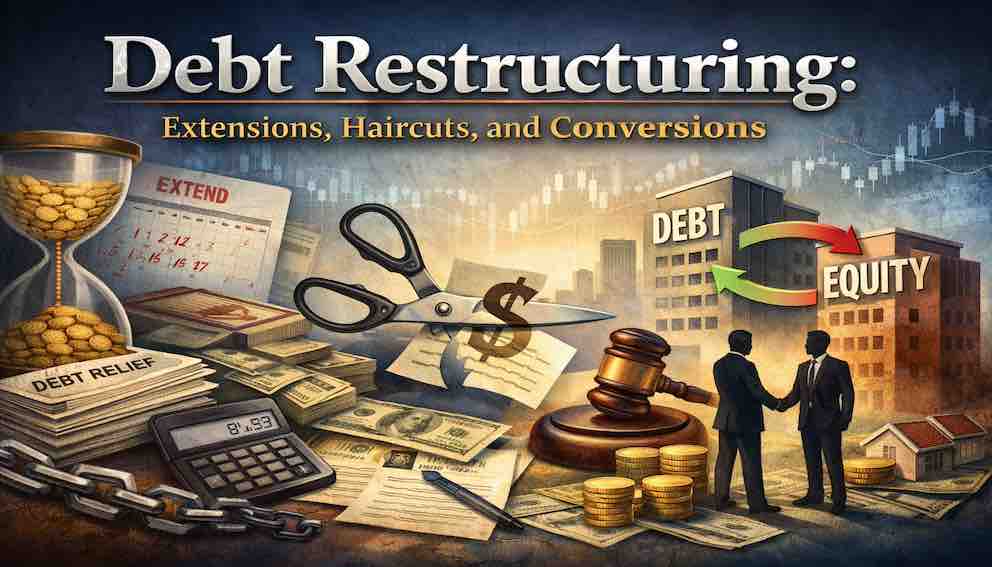
Debt restructuring is the process of renegotiating a company’s obligations to restore financial stability while balancing the interests of creditors, shareholders, and the business itself. In this tutorial, we explain, step by step, the main tools of restructuring—maturity extensions, interest deferrals, principal haircuts, and debt-for-equity swaps—through the example of Precio Components. Readers will understand how losses are reallocated rather than eliminated, why different creditor classes have conflicting incentives, and how dilution changes ownership in distressed companies. By following these insights, you will see how capital structures are rewritten in financial crises and why operational credibility is central to successful restructuring.
Introduction: The Moment Before Emergence
Precio Components had been navigating Chapter 11 for five months. The automatic stay had frozen all creditor actions, giving the management team some breathing room. Maria, the new CEO brought in during operational restructuring, had already begun turning the company around. Unprofitable product lines were discontinued, inventories reduced, and working capital improved.
Yet none of these operational gains would matter if the capital structure remained unsustainable. The company’s obligations totaled around €105 million: a €50 million term loan to senior secured banks, €20 million drawn on a revolving credit facility, €30 million in unsecured bond debt, and €5 million in trade payables. Realistic cash flow projections suggested that Precio Components could sustainably service only €60 million in total debt. The remaining €45 million represented unavoidable losses.
Over the following weeks, CFO Sarah and CEO Maria would sit across from bankers, bondholder representatives, and lawyers. The discussions would be tense, sometimes uncomfortable, because the core question was unavoidable: who would bear these losses, and how would the company emerge with a viable capital structure?
Debt restructuring, in essence, is the process of reallocating losses among stakeholders. It does not make losses disappear; it decides who takes them.
What Debt Restructuring Actually Is
Debt restructuring is not about avoiding loss. It is about adjusting obligations so that a financially distressed company can continue operating while distributing unavoidable losses in a structured and negotiated manner.
For Precio Components, this meant that before restructuring, the company owed €105 million but could realistically repay only €60 million. The €45 million gap did not vanish—it had to be borne by creditors and, in some cases, shareholders. Debt restructuring provides the framework to allocate these losses efficiently while preserving the company’s ability to generate future cash flow.
Two broad types of restructuring exist: consensual and non-consensual. In consensual restructurings, creditors and the company reach agreement voluntarily. Often, dissenting creditors are small or paid off to achieve unanimity. In non-consensual cases, some creditors resist, and legal mechanisms, such as cramdowns in Chapter 11, are necessary to impose the plan. Precio Components was pursuing a consensual path, but all participants knew the court could intervene if negotiations failed.
Maturity Extensions: Buying Time Without Reducing Principal
Maturity extensions are a common tool in debt restructuring. The concept is simple: creditors agree to postpone the repayment date of debt, buying the company time to stabilize operations without reducing the principal owed.
For Precio Components, senior bank lenders agreed to extend the €50 million term loan by three years. This meant that the company’s immediate cash flow no longer had to cover large principal repayments, freeing funds for operations and operational improvements. Sarah explained to the board: “We’re not reducing what we owe. We’re just buying breathing room so Maria’s operational changes can take effect.”
Maturity extensions are particularly effective in cyclical downturns, where liquidity constraints are temporary. They are less effective in structural decline, because extending payment does not reduce the underlying obligation. If operational improvements fail or cash generation remains weak, default is merely delayed. This is why the credibility of operational plans is central: time is valuable only if the company has a realistic path to sustainability.
Interest Deferrals: Shifting Obligations Forward
Debt obligations consist not only of principal but also of interest. Interest deferrals allow companies to postpone cash interest payments temporarily. In some cases, unpaid interest is added to principal through Payment-in-Kind (PIK) arrangements, increasing the overall debt balance over time.
For Precio Components, bondholders agreed to defer €3 million in interest annually for two years. This meant the company avoided immediate cash outflows, but the deferred interest was added to the principal, effectively growing the debt. Maria asked, “So we’re not paying interest now, but we’ll owe more later?” Sarah replied, “Exactly. It’s a trade-off. We preserve cash today, but the debt grows. If operations improve, we can manage the larger balance. If not, we risk a bigger problem.”
The key lesson is that deferrals shift the burden forward—they do not eliminate obligations. Creditors accept this because it increases the likelihood of eventual repayment, but it also introduces risk if operational plans underperform. Negotiations over interest deferrals hinge on credible cash flow projections and realistic operational assumptions.
Principal Haircuts: Immediate Balance Sheet Relief
When it becomes clear that obligations cannot be met even with extensions and deferrals, principal haircuts provide immediate relief. A haircut reduces the nominal amount owed, sharing losses between the company and its creditors.
Precio Components owed €30 million to unsecured bondholders. Negotiations led to a 25% haircut, reducing the debt to €22.5 million. Chen, the bondholder representative, explained: “If we hold out for full payment, we might get ten cents on the euro in liquidation. Accepting a haircut now gives us a chance to recover seventy-five percent in a viable company.”
Haircuts are often unavoidable in severe distress. They reduce debt burden, improve solvency ratios, and align remaining obligations with realistic cash flow. Unsecured creditors, having no collateral, are particularly sensitive to this, as haircuts might be the only path to meaningful recovery.
Debt-for-Equity Swaps: Creditors Become Owners
In addition to reducing principal, companies may convert debt into equity, turning creditors into shareholders. This mechanism dilutes or even eliminates legacy shareholders’ stakes.
For Precio Components, a portion of bond debt was exchanged for equity. Suppose bondholders agreed to convert €20 million of debt at a negotiated valuation of €40 million. They received 50% of the company’s post-restructuring shares. If further debt conversions occurred, original shareholders’ ownership could shrink to near zero, depending on the agreed valuation.
The process is not purely mathematical; it is inherently tied to negotiation. Creditors prefer lower valuations to gain more equity for their claims, while shareholders prefer higher valuations to preserve ownership. For Precio Components, the final valuation was negotiated at €40 million—a compromise between the bondholders’ €30 million estimate and management’s €50 million projection.
Dilution and Governance Effects
Even partial conversion can significantly affect control. In Precio Components’ case, the founding family, originally holding 60% of the company, saw its stake fall to less than 20%. While they retained some ownership, operational and strategic control shifted, and creditor representatives now had a voice in governance.
This demonstrates a critical point: equity dilution not only reallocates financial losses but also transfers decision-making influence. In distressed restructurings, this governance shift aligns incentives—creditors-turned-shareholders have a direct interest in operational success.
Incentives of Secured vs Unsecured Creditors
Stakeholder incentives vary according to seniority and collateral. Secured creditors hold claims against specific assets and often prefer preservation over conversion, especially if collateral is valuable. Precio Components’ senior bank lenders had claims on factory and equipment. They could recover a substantial portion of their loan in liquidation, but they also recognized that a going-concern restructuring might maximize recovery.
Unsecured creditors, in contrast, had no collateral. Their expected recovery in liquidation was low, making equity participation through debt-for-equity swaps attractive. Chen, representing bondholders, explained: “In liquidation, we get ten percent. With restructuring and equity, we have upside.”
These contrasting incentives drive negotiation dynamics. Secured creditors resist excessive dilution for unsecured creditors, while unsecured creditors push for equity participation to capture potential upside. Understanding these incentives is key to grasping why restructurings often involve compromise and trade-offs.
Priming and DIP Financing: Shifting Bargaining Power
Priming, typically through Debtor-in-Possession (DIP) financing, introduces additional complexity. DIP loans take priority over existing debt, giving lenders first claim on assets if the company fails. This priority makes DIP financing attractive to distressed debt funds and shifts bargaining power toward new lenders.
Precio Components considered DIP financing early but secured sufficient cooperation from existing creditors to avoid it. Had DIP financing been necessary, it would have altered creditor incentives and potentially required more aggressive loss reallocation.
Liquidity vs Solvency: A Central Distinction
Every restructuring tool operates along the axis of liquidity versus solvency.
- Liquidity tools: Maturity extensions and interest deferrals address immediate cash needs, buying time without reducing obligations.
- Solvency tools: Principal haircuts and debt-for-equity swaps reduce obligations or convert them into instruments aligned with long-term viability.
The distinction is crucial: time bought through liquidity tools only matters if operational repair is credible. Without meaningful improvement in cash flow and profitability, these tools merely delay insolvency.
Conceptual Summary
Debt restructuring is the careful orchestration of tools to reallocate losses while preserving operational viability.
- Maturity extensions: Buy time without reducing principal.
- Interest deferrals: Shift cash burdens forward, sometimes via PIK interest.
- Principal haircuts: Provide immediate solvency relief by sharing losses.
- Debt-for-equity swaps: Convert creditors into owners, diluting legacy shareholders.
- Valuation: Negotiated, not calculated, it determines ownership and loss allocation.
- Secured vs unsecured incentives: Shape preferences for preservation versus conversion.
- Liquidity vs solvency: Determines which tools address timing versus structural problems.
For Precio Components, these instruments stabilized the balance sheet, aligned creditor incentives with operational success, and allowed the company to emerge with a sustainable capital structure. Original owners absorbed losses through dilution, unsecured creditors shared losses, and secured creditors preserved recovery potential.
Conclusion: Losses Are Reallocated, Not Eliminated
Debt restructuring reallocates losses—it does not erase them. For Precio Components, the €45 million gap between what the company owed and what it could realistically repay was borne by shareholders through dilution, by unsecured creditors through haircuts, and partially by secured creditors through modified payment schedules. All parties accepted these outcomes because liquidation was the alternative.
The next tutorial will explore advanced restructuring dynamics: valuation disputes, cramdowns, activist creditor strategies, and private equity involvement in distressed capital structures. These dynamics determine how negotiations unfold when multiple stakeholders with conflicting incentives collide, and they influence both ownership and operational recovery. Precio Components’ journey will continue as we examine these strategic interactions in detail.
About Swati Sharma
Lead Editor at MyEyze, Economist & Finance Research WriterSwati Sharma is an economist with a Bachelor’s degree in Economics (Honours), CIPD Level 5 certification, and an MBA, and over 18 years of experience across management consulting, investment, and technology organizations. She specializes in research-driven financial education, focusing on economics, markets, and investor behavior, with a passion for making complex financial concepts clear, accurate, and accessible to a broad audience.
Disclaimer
This article is for educational purposes only and should not be interpreted as financial advice. Readers should consult a qualified financial professional before making investment decisions. Assistance from AI-powered generative tools was taken to format and improve language flow. While we strive for accuracy, this content may contain errors or omissions and should be independently verified.