
Tutorial Categories
Last Updated: January 31, 2026 at 19:30
Capital Allocation in Decline: When Ending the Business Is the Most Rational Decision - Corporate Finance Series
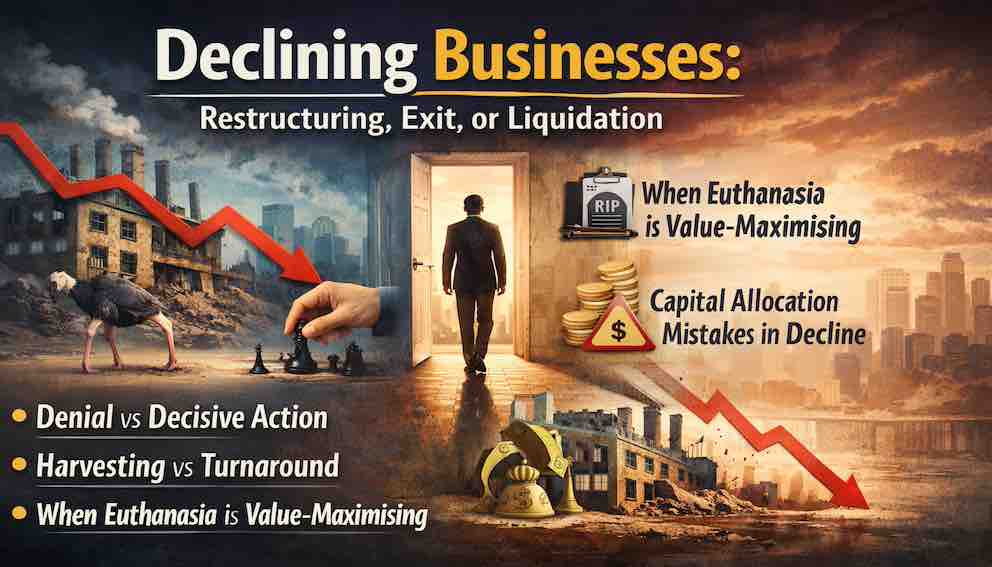
This tutorial tackles the most psychologically difficult phase of corporate finance: managing a business in irreversible decline. We introduce the "Decline Decision Matrix," a rigorous framework to move from denial to disciplined action. You will learn to diagnose structural decline and evaluate four rational paths: harvesting cash, attempting a turnaround, strategic exit, or liquidation. Using contrasts like Blockbuster's failure versus Netflix's reinvention, we show why the courage to stop investing is often the highest-value decision. This tutorial also explains why rational frameworks fail—unpacking the human and incentive barriers that make these calls so hard in real companies.
Introduction: The Unavoidable Final Stage
Every corporate lifecycle, no matter how glorious, has a final chapter. Our series has charted the journey: from the fragile optionality of the startup, through the scaling calculus of growth, to the mature stewardship of returning capital. Now, we arrive at the phase that tests management's character most severely: structural decline.
Decline is not a moral failure. It is an economic reality. Technologies obsolesce, consumer tastes shift, and regulatory landscapes transform. The horse-drawn carriage did not fail due to poor management after the automobile arrived. What separates value preservation from catastrophic destruction is not whether decline happens, but how leadership responds when the evidence becomes clear.
This phase strips away the comforting narratives of growth. Here, capital allocation is not about ambition, but about courageous honesty. Its goal shifts from creation to preservation—saving as much capital as possible from a dwindling enterprise to be redeployed elsewhere. This tutorial provides the framework for that final, vital act of stewardship.
The Critical First Step: Diagnosing Structural Decline
The single most common—and costly—error is confusing a cyclical downturn with structural decline. Misdiagnosis leads to the fatal trap of investing in a recovery that will never come.
- A Cyclical Downturn is a temporary drop in demand. The business model remains intact; patience and holding power are rewarded. (Example: A homebuilder in a recession).
- Structural Decline is a permanent erosion of the core business economics. The market is shrinking, substitutes are winning, and the competitive moat is draining. Time is an enemy. (Example: A DVD rental chain after the advent of streaming).
The Diagnosis: A Checklist to Counteract Denial
Move from gut feeling to evidence. Answer these questions:
- Has total market demand shrunk >5% annually for three or more consecutive years?
- Have substitute products or services captured >20% of the market?
- Are key, rational competitors permanently exiting the industry?
- Is our core competitive advantage (brand, cost, network) irreversibly eroded?
If you answer "yes" to multiple questions, you are likely in structural decline. Admitting this is not defeatism; it is the first step toward rational strategy.
Example: The Newspaper in 2010
A newspaper CEO in 2010 might blame a "cyclical ad slump." Our checklist reveals the truth:
- Market Demand: Print circulation down 7% annually for 5+ years.
- Substitute: Digital news and classifieds (Craigslist) have captured over 30% of ad revenue.
- Competitor Exit: Dozens of local papers have already closed.
- Moat Erosion: The monopoly on local information and ads is gone.
Diagnosis: Structural Decline. This forces the conversation away from "waiting for a rebound" and toward the four strategic paths in the Decision Matrix.
The Decline Decision Matrix: Your Strategic Roadmap
Once structural decline is diagnosed, sentiment must be replaced with system. The Decline Decision Matrix provides a disciplined process for choosing the highest-value path.
The process is a two-step funnel:
- Diagnose: Is it structural? (Use the checklist above).
- Decide: Given it's structural, which of the four rational paths is optimal? Evaluate them using the financial logic below.
| Strategic Path | When to Choose It | The Financial "Go" Signal | The "Stop" Signal |
| Harvest | The business is a "Cash Cow"—it generates strong, stable Free Cash Flow (FCF), but cannot be revived. | FCF Yield > Cost of Capital. Milking the asset itself creates value. | FCF turns negative or volatile. The cow has run dry. |
| Turnaround | Decline is caused by internal, fixable problems (e.g., bad ops, poor product) in a stable or growing market. | A credible plan shows post-investment ROIC > WACC within a defined period (e.g., 3 years). | The core market continues to shrink >5% annually despite internal fixes. |
| Exit (Sell) | The asset has greater value to a different owner (e.g., a strategic buyer, a PE firm) than it does to you. | Sale Price > Liquidation Value + Present Value of Harvested Cash Flows. | No credible bids emerge. The market confirms its low value. |
| Liquidate | The business generates negligible or negative FCF, and no Harvest, Turnaround, or Exit path is viable. | Liquidation Value > Present Value of continuing operations (which is often negative). | N/A. This is the terminal, value-preserving decision. |
This matrix forces objective analysis. The emotional desire for a "turnaround" must pass the brutal test of market growth and credible ROI.
Why Rational Frameworks Fail in Real Companies
Even with a perfect framework, these decisions are brutally hard. The barriers are not analytical, but human. Understanding them is crucial to overcoming them.
- Executive Identity & Sunk Costs: Leaders are often the architects of the business. Admitting decline feels like a personal failure. This leads to the "sunk cost fallacy"—throwing good money after bad to justify past decisions and preserve legacy.
- Job Preservation & Political Pressure: Entire management teams, divisions, and communities rely on the business. Shutting it down means eliminating jobs and inviting public backlash. Boards face immense pressure to "find another way," often leading to costly delays.
- The Illusion of Optionality: In decline, managers often cling to "strategic options" or "wait-and-see" approaches. This is usually a disguised form of denial. In structural decline, option value decays rapidly; delay itself destroys the capital you're trying to preserve.
A framework provides the logic, but leadership must supply the courage to act on it against these powerful headwinds.
Case Study: Blockbuster vs. Netflix – Denial vs. Reinvention
The same technological wave hit two companies. Their application of the Decision Matrix—and their willingness to confront human barriers—led to opposite destinies.
Blockbuster: The Failure of Denial & a Doomed Turnaround
- Diagnosis & Human Failure: Management dismissed Netflix as a niche. Executives were emotionally and financially tied to the vast store network (sunk costs). They diagnosed a cyclical challenge, failing the structural checklist.
- Decision: Chose a Turnaround path (Blockbuster Online, no late fees). This violated the Matrix: they attempted a costly fix within a structurally declining market (physical rental).
- Result: Liquidation via bankruptcy. Value Annihilated.
Netflix: The Courage of Honest Diagnosis & Strategic Reinvention
- Diagnosis: Leadership accepted that the DVD-by-mail model, though profitable, faced structural limits versus streaming.
- Decision & Distinction: They executed a two-phase strategy that clarifies a key point:
- Controlled Harvest: Milked the declining DVD business for cash.
- Strategic Reinvention: Used that cash to fund a complete exit from the old business model and entry into a new one: streaming. This was not a turnaround (fixing the old), but a capital reallocation into a growing market.
- Result: Dominance in a new industry. Value Magnified.
The lesson: A "turnaround" fights a shrinking tide. A "reinvention" rides a new wave. The Matrix forces you to see the difference, and courage allows you to act on it.
Harvesting: Managing the "Cash Cow" Before It Melts
Harvesting is active, disciplined management to maximize cash extraction. It involves reducing reinvestment to essentials, cutting costs, and pricing for margin.
Example: IBM's Masterclass
IBM harvested its legacy hardware/services for decades, extracting massive FCF to fund its strategic exit/reinvention into hybrid cloud and AI (e.g., acquiring Red Hat).
The Critical Monitor & A Warning
Harvesting is only valid while FCF is strong. Leaders must track it vigilantly. The moment FCF turns negative, the asset is a "melting ice cube," not a cash cow.
A Failed Harvest: The Department Store
Many traditional department stores in the 2010s tried to harvest—cutting staff, maintenance, and inventory quality to preserve profits. They failed to monitor the accelerating decay of their competitive position. Customer experience eroded, foot traffic plummeted, and FCF eventually collapsed. By waiting too long to exit, their stores had little value left to sell. They harvested until the asset was worthless, confusing short-term profit with long-term value preservation.
The Liquidation Decision: A Rule and a Reality
The liquidation rule is mathematically clean:
If Liquidation Value > Present Value of Future Cash Flows from Continuing Operations, then Liquidate.
The Gritty Reality
While the rule is simple, execution is hard. Delay is the enemy of liquidation value. Physical assets deteriorate, intellectual property expires, and a motivated buyer today may disappear tomorrow. The "option" to liquidate next year is often far less valuable than assumed; assets decay faster than managers' optimistic forecasts. Legal closures, environmental liabilities, and employee settlements can shrink net proceeds. Therefore, when the math points to liquidation, speed and resolution maximize the capital preserved for redeployment.
Example: The Obsolete Factory
A family factory for a dying technology breaks even.
- Present Value of Future Operations: ~$0 (a slow fade to zero).
- Liquidation Value (Today): Land and machinery worth $5 million.
- Decision: Liquidate Value ($5M) > Going Concern Value ($0). Shutting down now rescues $5M in capital. Waiting three years might see machinery value halve and a recession cut land value, turning a $5M rescue into a $2.5M salvage operation.
A Final Distinction: Business Decline vs. Corporate Decline
A critical lens for large organizations is that a company can be in decline even if one of its businesses is not, and vice versa. Capital allocation in a conglomerate or multi-division firm is about portfolio management, not emotional loyalty.
The "Decline Decision Matrix" should be applied at the business unit level. A healthy corporate parent must have the courage to diagnose and manage decline in a single division with the same discipline as if it were a standalone company, harvesting or exiting it to feed capital to healthier, growing segments. This is the ultimate expression of stewardship: allocating capital without sentimentality across the entire corporate portfolio.
Conclusion: Courage as the Ultimate Competitive Advantage
Managing decline is the ultimate test of a leader's stewardship. It requires the humility to accept reality, the analytical rigor to run the Matrix, and the courage to act against powerful human and organizational barriers.
Across the corporate lifecycle, the core virtue of the capital allocator evolves:
- Startup: Respect for Optionality
- Growth: Obsession with Discipline
- Maturity: Humility to Return Capital
- Decline: Courage to Let Go
In a business world rife with denial, the team that can execute this final stage with clear-eyed discipline gains a rare advantage: the ability to rescue and redeploy capital that others would willingly burn. They prove that knowing how to end a venture well is not an act of failure, but the final, definitive act of value creation.
About Swati Sharma
Lead Editor at MyEyze, Economist & Finance Research WriterSwati Sharma is an economist with a Bachelor’s degree in Economics (Honours), CIPD Level 5 certification, and an MBA, and over 18 years of experience across management consulting, investment, and technology organizations. She specializes in research-driven financial education, focusing on economics, markets, and investor behavior, with a passion for making complex financial concepts clear, accurate, and accessible to a broad audience.
Disclaimer
This article is for educational purposes only and should not be interpreted as financial advice. Readers should consult a qualified financial professional before making investment decisions. Assistance from AI-powered generative tools was taken to format and improve language flow. While we strive for accuracy, this content may contain errors or omissions and should be independently verified.