
Tutorial Categories
Last Updated: January 31, 2026 at 19:30
Capital Allocation Failures: Lessons from History and a Diagnostic Toolkit - Corporate Finance Series
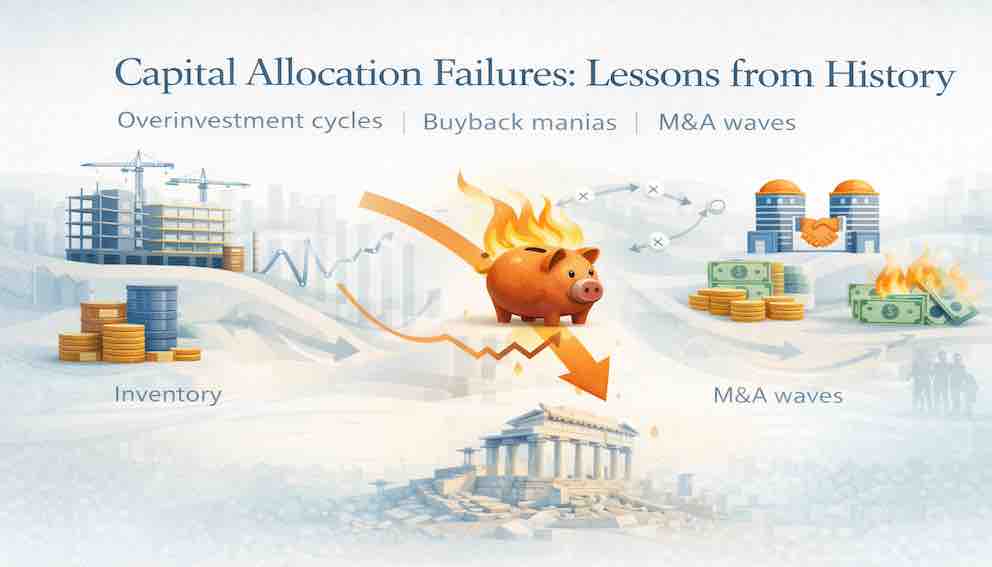
Capital allocation is the ultimate test of corporate stewardship, yet history reveals a persistent cycle of intelligent failure. This tutorial explores the recurring patterns of overinvestment, misguided buybacks, and value-destroying M&A through a practical diagnostic framework. We dissect strategic drift, incentive misalignment, and market myopia, using in-depth stories from the railroad mania, GE's buyback spiral, and the AOL-Time Warner catastrophe. By connecting these failures to core corporate finance principles, you will learn to build organizational safeguards that protect long-term value from the powerful, predictable forces that lead even smart companies astray.
Introduction: The Paradox of Intelligent Failure
Throughout this series, we have built a discipline for capital allocation. We learned to turn working capital into an internal funding engine, to evaluate cross-border investments with a rigorous hurdle rate, and to hedge risks to protect core operations. This toolkit is designed for one purpose: to deploy scarce capital where it creates the highest long-term, risk-adjusted return.
Yet, a paradox confronts us. History is a graveyard of brilliant companies that possessed these very tools but still made catastrophic allocation errors. They poured billions into projects with no hope of profit, bought back stock at the peak, and merged with disastrous consequences. The failure was not intellectual. It was systemic.
This tutorial explores this paradox. We move beyond the "what" of failure to the "why," examining the recurring themes that corrupt decision-making. By studying these episodes as a coherent body of knowledge, we can build processes to inoculate our own organizations against them. This is not just history; it is a diagnostic toolkit for preventing value destruction.
The Diagnostic Framework: Three Syndromes of Failure
When major capital decisions fail, the root cause usually fits into one of three syndromes. These syndromes are not mutually exclusive; they often reinforce each other, creating a perfect storm of value destruction.
1. Strategic Drift: When Narrative Replaces Economics
This occurs when a compelling story—"dominant market share," "technological inevitability," "synergy"—becomes so powerful that it overrides cold, numerical analysis of risk and return. Capital is allocated to the idea of the business, not its unit economics.
2. Incentive Misalignment: When Metrics Incentivize Destruction
Here, the formal or informal reward systems for executives (bonuses, stock grants, promotion) are tied to metrics that can be gamed in the short term at the expense of the long term—such as Earnings Per Share (EPS) or quarterly revenue growth. This turns capital allocation into a performance theatre.
3. Market Myopia: Confusing the Cycle for the Trend
In this syndrome, management mistakes a favorable macroeconomic environment—cheap debt, frothy equity valuations, high sector sentiment—for a permanent improvement in their business's fundamentals. They make decisions that only make sense at the peak of the cycle.
Let's apply this diagnostic framework to history's most instructive episodes, connecting each failure back to the core principles we've established in this series.
Failure 1: The Overinvestment Cycle – The Siren Song of "Growth"
The Pattern: Companies, fueled by optimism and capital, invest aggressively in capacity far beyond sustainable demand. The capital discipline we applied to working capital—matching investment closely to operational need—is abandoned in pursuit of top-line dominance.
Historical Episode: The U.S. Railroad Mania (1870s-1890s)
This was a textbook case of Strategic Drift and Market Myopia. The narrative of "manifest destiny" and continental unification was electrifying. Financiers like Jay Gould and Cornelius Vanderbilt were celebrated as visionaries. In boardrooms and prospectuses, the metric of success became track miles laid, not profit per mile. Capital flooded in, often financing parallel lines between the same cities.
Imagine the management meetings: engineers presented glorious maps of expansion, while financiers boasted of the limitless appetite of European bond markets. The discipline of calculating risk-adjusted returns on each new spur line—a direct application of our capital budgeting principles—was lost in the grandeur of the project. The assumption was that demand would forever rise to meet supply. When it didn't, the result was catastrophic overcapacity, brutal price wars, bankruptcies like that of the Philadelphia and Reading Railroad, and a consolidation wave that wiped out entire fortunes. Capital wasn't allocated; it was incinerated in a battle for a narrative.
Historical Episode: The Dot-Com Bubble (1990s)
A century later, the same syndromes reappeared in digital clothing. The Strategic Drift was the "new economy" dogma, which held that traditional metrics like profitability were obsolete. The story was about eyeballs, "first-mover advantage," and network effects. This led to a profound misallocation.
Consider Webvan. It raised over $800 million and embarked on a nationwide rollout of automated warehouses before proving its model in a single city. Its capital allocation was the opposite of the disciplined, staged investment we advocate. It was a massive, upfront bet on a story of revolutionary change in grocery shopping, with scant evidence of customer willingness to pay for it. The cash burn was staggering. Similarly, Pets.com spent lavishly on Super Bowl ads to build a brand for a low-margin product (pet food) with punishing shipping costs. The capital was allocated to marketing narrative, not a viable business model. When the cycle turned—the Market Myopia of assuming endless venture funding evaporated—these companies collapsed almost overnight.
Diagnostic Checklist: Are You in an Overinvestment Cycle?
- Is the investment rationale driven more by an industry narrative ("everyone is doing it," "this is the future") than by granular, discounted cash flow models?
- Are we using capital to build capacity ahead of proven, profitable demand, or are we hoping demand will materialize?
- Have we confused a period of easy capital (low interest rates, bullish investors) with a permanent shift in our business's underlying economics?
Failure 2: The Buyback Mania – Sacrificing the Future for a EPS Illusion
The Pattern: Companies return massive amounts of capital to shareholders via buybacks, often at market peaks, instead of reinvesting in the business's long-term health. This is a classic failure of Incentive Misalignment and Market Myopia.
Case Study: General Electric's Two-Decade Unraveling (2000-2018)
GE's story is a masterclass in how incentives can systematically distort capital allocation. For decades, GE was the gold standard of management. Yet, under CEO Jeff Immelt and his predecessor Jack Welch, a profound Incentive Misalignment took root. Executive compensation was intensely linked to hitting quarterly EPS targets.
Share buybacks became the perfect tool to "manage" this metric. By reducing the number of shares outstanding, buybacks mechanically boost EPS, even if net income is flat. From 2005 to 2017, GE spent over $100 billion on buybacks. Imagine the capital allocation trade-off made in real-time: a proposal to fund a multi-year, risky R&D project in next-generation power turbines would be weighed against the certainty of a 2-cent EPS boost from a buyback. The latter often won.
This was compounded by Market Myopia. Much of this spending occurred when GE's stock traded at a premium, a classic error of buying high. The money used wasn't "excess" cash; it was often debt, raised in a low-interest-rate environment that was mistaken for a permanent state. The consequence? GE's crown jewel industrial businesses—power, aviation, healthcare—were systematically underfunded. When the 2008 crisis hit and later when the energy market shifted, GE was a hollowed-out version of its former self, burdened by debt and lacking innovation. The buybacks didn't create value; they transferred wealth from the company's future competitive strength to past shareholders.
Diagnostic Checklist: Is This a Value-Destroying Buyback?
- Is the primary stated rationale to "boost EPS" or "return excess cash," rather than a conviction that the stock is profoundly undervalued?
- Has management rigorously compared the buyback to alternative internal investments (e.g., R&D, capex, strategic M&A) using our hurdle rate framework?
- Are we buying our stock after a long period of price appreciation and during a time of readily available, cheap debt?
Failure 3: The M&A Illusion – When Synergy Math Obscures Catastrophe
The Pattern: Acquisition waves driven by strategic narratives where the promised synergies are cultural or operational—precisely the kind most difficult to realize. This represents Strategic Drift in its most expensive form.
Case Study: AOL-Time Warner – The $99 Billion Culture Clash (2000)
This merger, valued at $165 billion, was the zenith of the "convergence" narrative: old media content would marry new internet distribution. The Strategic Drift was breathtaking. In the due diligence room, bankers' models showed glorious revenue synergies from cross-promotion. But the human and operational reality was ignored.
The timeline is telling. The deal was conceived and executed in a frenzy of dot-com optimism. Steve Case of AOL and Gerald Levin of Time Warner were hailed as visionaries. But after the deal closed, the integration was a disaster. AOL's fast-moving, promotional "internet time" culture violently clashed with Time Warner's deliberate, creative, and hierarchical culture. Employees despised each other. Promised collaborations stalled. Meanwhile, the dial-up internet business that was AOL's cash cow collapsed with the advent of broadband. The financial result? Within two years, the company wrote off $99 billion in goodwill—an almost unimaginable destruction of capital. The sophisticated risk-adjusted return models from our finance toolkit were discarded in favor of a grand, fatally flawed strategic story.
Case Study: Bayer-Monsanto – Underestimating Unhedgeable Risk (2018)
This $63 billion deal to create an agricultural titan shows a failure to apply the international finance and risk management principles we've studied. Bayer's rationale focused on financial and R&D synergies. However, they catastrophically underestimated a non-core, unhedgeable risk: litigation liability.
In their cross-border investment analysis, did they adequately stress-test for the scenario where Monsanto's flagship product, Roundup, faced a tidal wave of cancer lawsuits? The evidence suggests they viewed it as a manageable, remote contingency. This was a fatal error in risk assessment. The acquisition loaded Bayer with debt just as this liability materialized, leading to a plummeting stock price, credit downgrades, and a crisis of solvency. They allocated capital to an asset while mispricing its largest embedded risk—the exact opposite of the disciplined hedging and structuring we advocate for global operations.
Diagnostic Checklist: Is This M&A Deal Drifting Toward Illusion?
- Is the deal's value heavily reliant on "soft" synergies (revenue growth, technology transfer, culture) versus "hard" synergies (cost cuts from overlapping headcount, facilities)?
- Have we conducted a true "pre-mortem," forcing the team to envision how this deal could fail in 3 years, especially due to cultural integration or unforeseen external shocks?
- In a cross-border deal, have we applied a country risk premium and fully assessed unhedgeable political, legal, and reputational risks?
The Systemic Enablers: Governance and the Culture of Conformity
Our diagnostic framework explains the mechanisms of failure. But why do these patterns persist? Two systemic enablers allow them to flourish:
- Board Governance Failure: In many of these cases, boards of directors—tasked with oversight—became cheerleaders. They lacked the industry expertise or the courage to challenge a charismatic CEO armed with a bullish narrative and slick PowerPoint slides. At GE, the board approved billions in buybacks without demanding a formal review of the long-term opportunity cost to R&D.
- The Culture of "Yes": In boom times, dissent is stigmatized. The analyst who questions the scalability of the webvan model, the engineer who doubts the timeline for a new product, the CFO who warns about peak-cycle valuations—they are labeled as pessimists, not team players. This cultural conformity is the fertile soil in which Strategic Drift takes root.
Conclusion: Building an Anti-Fragile Allocation Process
The lesson from history is not to avoid risk, but to build an organization whose processes are designed to expose and challenge these failure syndromes before capital is committed.
Your Blueprint for Disciplined Allocation:
- Institutionalize the Devil's Advocate: For every major capital request, mandate a formal, resourced alternative analysis that must argue against it, focusing squarely on Strategic Drift, Incentive distortions, and Cycle timing.
- Reform Incentive Structures: Decouple executive compensation from short-term stock price and EPS. Instead, tie a significant portion of long-term incentives to the realized Return on Invested Capital (ROIC) of the specific projects or divisions they oversee over a 5+ year period.
- Conduct Mandatory "Pre-Mortems": Before final approval, require the deal team to write the history of the project's failure three years hence. This forces explicit, uncomfortable consideration of the risks our diagnostic framework highlights.
Capital allocation is the ultimate reflection of a company's character and intelligence. By studying failures not as random tragedies but as predictable outcomes of broken systems, we gain the power to repair our own. We integrate the lessons from working capital efficiency, cross-border hurdle rates, and risk hedging into a holistic defense against value destruction. The goal is to create an organization where capital is not just allocated, but stewarded—turning the painful lessons of the past into your most durable source of future advantage.
About Swati Sharma
Lead Editor at MyEyze, Economist & Finance Research WriterSwati Sharma is an economist with a Bachelor’s degree in Economics (Honours), CIPD Level 5 certification, and an MBA, and over 18 years of experience across management consulting, investment, and technology organizations. She specializes in research-driven financial education, focusing on economics, markets, and investor behavior, with a passion for making complex financial concepts clear, accurate, and accessible to a broad audience.
Disclaimer
This article is for educational purposes only and should not be interpreted as financial advice. Readers should consult a qualified financial professional before making investment decisions. Assistance from AI-powered generative tools was taken to format and improve language flow. While we strive for accuracy, this content may contain errors or omissions and should be independently verified.