
Tutorial Categories
Last Updated: January 31, 2026 at 19:30
Corporate Finance in a High-Interest-Rate World: The Strategic Pivot from Growth to Resilience - Corporate Finance Series
Rising interest rates reset the rules of corporate strategy. This tutorial provides a "High-Rate Strategic Pivot" framework for shifting from growth-at-all-costs to capital resilience. We explain how rising WACC acts as a filter for investment decisions, how to manage refinancing risk on floating-rate debt, and how to triage capital expenditure and R&D. Learn actionable strategies for debt management, cash flow defense, and opportunistic M&A, using lessons from the Volcker era to the post-2022 hikes. A must-read for managers navigating capital allocation in a high-rate environment.
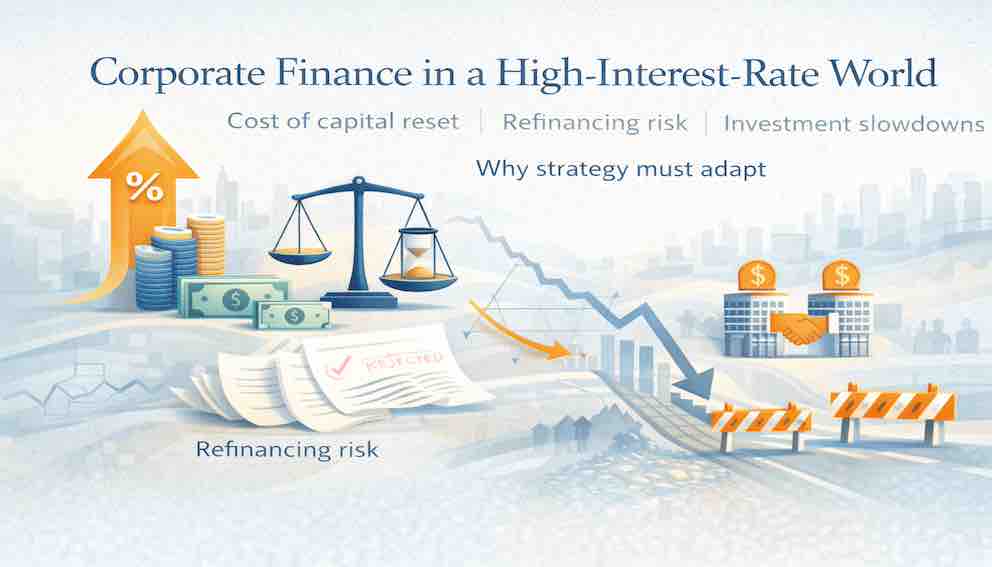
Introduction: The End of "Free" Capital
For over a decade, corporate finance operated with artificially cheap capital. The dominant strategy was growth fueled by leverage—a theme across our tutorials on M&A, private equity, and global expansion. Low rates made debt easy, inflated valuations, and allowed marginal projects to clear low hurdle rates.
That era has ended. Rising interest rates are a systemic shock that rewrites the capital allocation playbook. The cost of capital is no longer a gentle benchmark; it becomes a brutal filter. Debt transforms from a strategic tool into a potential trap. This tutorial provides a framework for navigating this new reality, shifting from a mindset of growth optimization to one of capital preservation and resilient value creation.
The Core Mechanism: The WACC Filter in Action
The weighted average cost of capital (WACC) is the minimum return a company must earn. Its increase is the primary channel through which high rates reshape corporate strategy.
A Numeric Illustration of the Shock:
Consider a firm, "StableCorp," with a capital structure of 40% debt, 60% equity before rates rise.
- Old World (Low Rates): Cost of Debt = 3%, Cost of Equity = 9%, Tax Rate = 25%.
- WACC = (0.6 * 9%) + (0.4 * 3% * (1-0.25)) = 5.4% + 0.9% = 6.3%
- New World (Rates Rise): Cost of Debt jumps to 7%, Cost of Equity rises to 12% (as investors demand higher returns).
- New WACC = (0.6 * 12%) + (0.4 * 7% * (1-0.25)) = 7.2% + 2.1% = 9.3%
The Strategic Consequence: The NPV Guillotine
A $10 million project with expected annual cash flows of $1.1 million for 15 years had an NPV of +$1.4 million at a 6.3% discount rate. At the new 9.3% WACC, its NPV plummets to -$0.5 million. It has gone from value-creating to value-destroying without its own cash flows changing. This WACC Filter necessitates a ruthless reassessment of all planned investments.
The High-Rate Strategic Pivot: A Four-Quadrant Framework
Navigating this requires a deliberate shift across four strategic dimensions:
| From (Low-Rate World) | To (High-Rate World) |
| 1. Growth at Scale | 1. Selective, High-ROIC Growth |
| 2. Leverage as a Tool | 2. Debt as a Risk to be Managed |
| 3. Pursuing Market Share | 3. Defending Core Profitability |
| 4. Valuations Based on Narrative | 4. Valuations Based on Cash Flow |
Priority 1: Debt Management – From Leverage to Liquidity Crisis Avoidance
In a high-rate world, the balance sheet is your primary strategic asset—or liability. The most immediate danger is refinancing risk, particularly for:
- Floating-Rate Debt: Loans tied to benchmarks like SOFR or Prime.
- Short-Term Commercial Paper: Relied on by many firms for daily liquidity.
- Near-Term Bond Maturities: Debt issued in the low-rate era now coming due.
Case Study: The Refinancing Wall
A retail chain issued $500 million in 5-year bonds at 3.5% in 2021. In 2026, it must refinance. If new debt costs 7.5%, its annual interest expense jumps from $17.5M to $37.5M—a $20M annual cash drain that could erase its profit margin. This isn't just higher cost; it's a solvency risk if cash flow can't cover it.
The Strategic Playbook:
- Extend Maturities Immediately: Issue longer-term debt now, even at a higher rate, to push the refinancing cliff beyond the expected high-rate cycle.
- Fix Your Rates: Use interest rate swaps to convert all variable-rate debt to fixed, capping your exposure.
- Asset Sales for Debt Paydown: Sell non-core, capital-intensive assets. The goal isn't peak valuation but rapid deleveraging. This is applied capital allocation discipline: shrinking the balance sheet to survive.
Priority 2: Investment Triage – Killing the "Zombies" and Protecting the Core
Capital expenditure (capex) and R&D budgets must undergo immediate, ruthless triage. This is where corporate psychology often fails: CEOs, conditioned for growth, cut the wrong things first.
The Flawed Instinct vs. The Strategic Triage:
- The Flawed Instinct: Cut R&D and marketing first—the "discretionary" items. This sacrifices the future for short-term cash, a fatal error.
- The Strategic Triage (The Three-Bucket System):
- Bucket A (Protect): Projects with returns > WACC + 3%. These are rare, non-negotiable competitive advantages (e.g., a pharmaceutical company's Phase 3 drug trial). Fund fully.
- Bucket B (Pause/Rescope): Projects with returns ~ WACC. These are paused. Can they be made capital-light? Done in phases? Example: A factory expansion might be redesigned for modular, pay-as-you-grow construction.
- Bucket C (Terminate): "Zombie projects" with returns < WACC. These are value-destroying under the new regime. This often includes marginal geographic expansions, me-too product lines, and vanity projects that only made sense with cheap capital. Killing them frees cash and management focus.
Why R&D Cuts Are a Trap: High-rate environments reward innovation that improves capital efficiency, not necessarily scale. Cutting all R&D eliminates your ability to create the high-ROIC projects that will thrive. The key is to redirect R&D from speculative "moonshots" to projects that directly improve the profitability or efficiency of the core business.
Priority 3: Strategic Repositioning – The Cash Flow Defense
With growth constrained, strategy pivots to maximizing and defending cash flow from the core.
- Assert Pricing Power: In a high-rate world, competitors are also cash-strapped, making destructive price wars less likely. It may be the optimal time for a disciplined price increase.
- The Working Capital Siege: This is where our prior tutorial on working capital management becomes a survival tool. Aggressively:
- Reduce Days Sales Outstanding (DSO): Tighten credit terms, incentivize early payment.
- Optimize Days Inventory Outstanding (DIO): Move to just-in-time models.
- Every dollar freed from working capital is a dollar that doesn't need to be borrowed at 8%.
- SG&A Scrutiny: Eliminate the "good times" bloat in overhead. This is not across-the-board cuts, but surgically removing low-value administrative and operational complexity.
Priority 4: Opportunistic Advantage – The Discipline of the Predator
High rates create chaos, and chaos creates opportunity for those with strong balance sheets.
- Talent Acquisition: Hire elite talent shed by over-leveraged competitors.
- Distressed M&A: This is not for large, leveraged bets. It is for small, cash-funded, bolt-on acquisitions of distressed competitors or strategic assets at a fraction of their former price. The discipline is extreme: only buy what integrates seamlessly into your core to improve its economics.
- Gaining Market Share: By maintaining investment in Bucket A projects while competitors retrench, you can gain share permanently.
Historical & Contemporary Parallels:
- The Volcker Shock (1980s): U.S. automakers like Chrysler, littered with Bucket C projects, faced collapse. They survived only by government bailouts and terminating nearly all new investment—a stark lesson in triage.
- The Post-2022 Hike Environment: Many tech and growth companies that relied on cheap debt for cash-burn growth (e.g., unprofitable SaaS firms, SPACs) faced a "profitability reckoning." Firms like Meta pivoted aggressively, cutting non-core metaverse investments (Bucket C) while focusing AI spending on core advertising efficiency (Bucket A), leading to a dramatic recovery in cash flow and stock price.
Conclusion: Forging Resilience
A high-interest-rate environment is the ultimate stress test of corporate discipline. It separates companies built on financial engineering from those built on durable economic advantages.
The imperative is to execute the pivot: manage debt as your primary risk, triage investments with brutal honesty, defend core cash flows, and act with disciplined opportunism. This is a return to fundamental finance principles.
By applying this framework, you do more than survive. You use the crisis to strengthen your competitive architecture. When rates eventually fall, your company will not simply resume the old leveraged growth playbook. It will have graduated to a more sophisticated, resilient model of capital allocation, ready to create value with the wisdom forged in a harder world.
About Swati Sharma
Lead Editor at MyEyze, Economist & Finance Research WriterSwati Sharma is an economist with a Bachelor’s degree in Economics (Honours), CIPD Level 5 certification, and an MBA, and over 18 years of experience across management consulting, investment, and technology organizations. She specializes in research-driven financial education, focusing on economics, markets, and investor behavior, with a passion for making complex financial concepts clear, accurate, and accessible to a broad audience.
Disclaimer
This article is for educational purposes only and should not be interpreted as financial advice. Readers should consult a qualified financial professional before making investment decisions. Assistance from AI-powered generative tools was taken to format and improve language flow. While we strive for accuracy, this content may contain errors or omissions and should be independently verified.