
Tutorial Categories
Last Updated: January 31, 2026 at 19:30
Capital Allocation: The Central Art of Corporate Finance - Corporate Finance Series
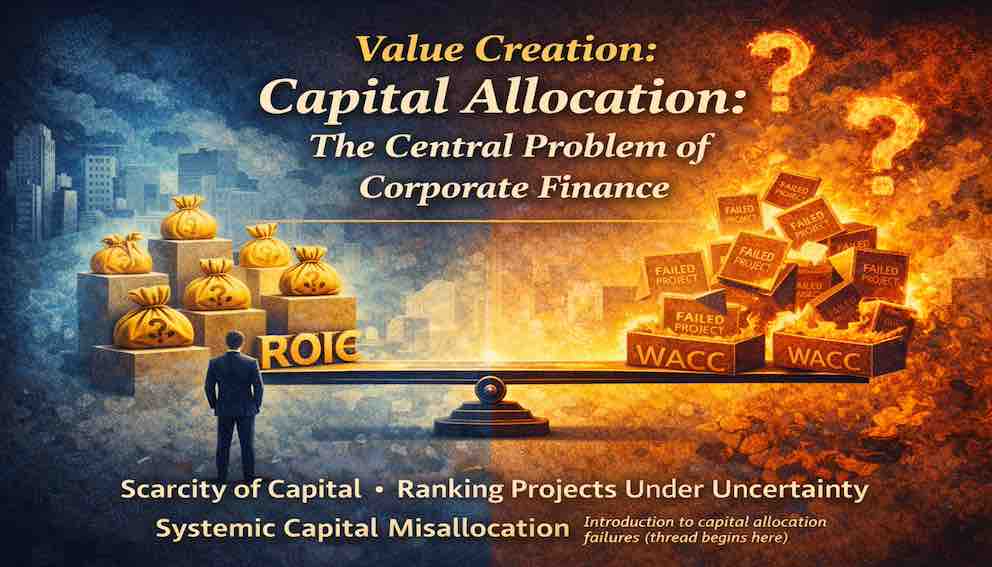
Capital allocation is the single most important process in corporate finance—the art of deploying scarce resources among infinite competing needs. In this tutorial, we move beyond the ROIC vs. WACC framework to explore the challenging realities of choosing between "good" projects, dealing with strategic intangibles, and navigating the organizational politics that distort rational decision-making. Through real-world examples and structured frameworks, we examine why capital misallocation is pervasive and how disciplined managers create portfolios of investments that maximize long-term value, not just project-level returns. You will learn to build a capital allocation system that resorts to numbers for discipline but never confuses a spreadsheet for strategy.
Introduction: From Measurement to Choice
You now have the ultimate measuring stick: Economic Profit = (ROIC - WACC) × Invested Capital. This tells you whether a project, division, or company is creating value. But finance becomes truly strategic when you face the brutal reality of scarcity: you cannot fund every value-creating project. Your capital is limited by cash flow, debt capacity, and investor patience. The central challenge of corporate leadership is therefore choice—ranking, sequencing, and selecting which opportunities to pursue when all cannot be funded.
This is capital allocation. It’s where finance meets strategy, human bias, and organizational design. Getting it right is what separates exceptional firms from the rest.
The Three Levels of Capital Allocation: A Strategic Hierarchy
Capital allocation isn't one decision; it's a hierarchy of increasingly consequential choices.
Level 1: Project Selection (The "What")
- The Question: "Should we build this factory, launch this product, or run this ad campaign?"
- The Tool: Discounted Cash Flow (DCF) and the RONIC vs. WACC hurdle. (RONIC = Return on New Invested Capital, the projected return specific to the proposed project.)
- The Trap: The "false positive" project that passes the DCF hurdle with optimistic assumptions but has no strategic moat.
Level 2: Portfolio Optimization (The "Mix")
- The Question: "Given our $500M budget, what's the optimal combination of these 20 qualifying projects to maximize total firm value and strategic resilience?"
- The Challenge: Projects aren't independent. They compete for managerial attention, supply chains, and market positioning. You must consider correlation, sequencing, and strategic optionality.
- Example: A tech company must choose between deepening its lead in a core market (high RONIC, low growth) or attacking a new, riskier adjacent market (lower near-term RONIC, high optionality). The right answer isn't in a spreadsheet; it's in the strategy.
Level 3: The Meta-Allocation (The "Business of the Business")
- The Question: "Should we reinvest in the business, acquire others, return cash to shareholders, or pay down debt?" This is the highest-order choice.
- The Framework: The Capital Allocation Dashboard.
Reinvestment: Do our internal opportunities yield RONIC > WACC with an acceptable risk profile?
Acquisitions: Can we buy growth or capability at a price where the target's ROIC (post-synergy) exceeds our cost of capital?
Return to Shareholders: If (1) and (2) are lacking, are buybacks or dividends the best use of cash?
Strengthen the Balance Sheet: Is reducing financial risk (lowering WACC) the highest-value move in this environment?
The Reality of Scarcity: Ranking Projects When All Are "Good"
Your capital budget is $100M. You have five projects, each requiring $50M, all with RONIC > WACC. You cannot fund them all. How do you choose?
Step 1: Move Beyond the Hurdle Rate. The RONIC Spread (RONIC - WACC) becomes critical. A project with a 22% RONIC (12% spread over a 10% WACC) is more valuable than one with a 15% RONIC (5% spread).
Step 2: Introduce Strategic Filters. Rank projects using a matrix like the one below. This moves the discussion from "does it pass?" to "which one is best for us?"
| Project | RONIC | Capital Needed | Strategic Fit | Risk | Time to Payback |
| A: New Product | 24% | $50M | High | High | 5 years |
| B: Cost Automation | 18% | $20M | Medium | Low | 2 years |
| C: Market Expansion | 20% | $50M | High | Medium | 4 years |
Analysis: You might choose Project B + Project C over Project A alone. Why? B frees up capital quickly (2-year payback) and de-risks the portfolio, allowing you to fund C. Chasing the highest-return project (A) alone could exhaust your budget on a single, risky bet.
Step 3: Consider Strategic Optionality. Some projects create "options" for future growth. This requires a real options mindset. A $5M investment in an experimental R&D lab may have a low, uncertain RONIC today, but it grants the valuable option to launch a $500M product line in five years if the technology matures. You're not just buying a project; you're buying strategic flexibility.
The Inevitability of Bias: Why Good Companies Make Bad Decisions
Capital misallocation is rarely about stupidity. It's about systemic bias.
- The Sunk Cost Fallacy & Escalation of Commitment: "We've already spent $100M, we can't stop now." Throwing good money after bad is the most common capital destroyer.
- Empire Building: Managers are rewarded for the size of their empire (headcount, budget), not the quality of its returns. This leads to overinvestment and low-ROIC growth.
- Inertia & Copycat Investing: "Our competitors are doing it, so we must." This leads to industry-wide overcapacity and value destruction (see: airline price wars, telecom spectrum auctions).
- Incentive Misalignment: As noted earlier, paying bonuses on revenue growth or budget utilization guarantees capital will flow to low-return projects.
- Optimism Bias & Sponsor Hype: Project champions are inherently optimistic. Without an independent, skeptical review process (a "Capital Allocation Office" or a CFO with veto power), forecasts are systematically inflated.
The Antidote is Process: The CEO's most important financial role is to install a bias-resistant capital allocation process. This includes: standardized templates for project proposals, mandatory "pre-mortems" (imagining why a project failed), requiring a "devil's advocate" review, and tying managerial compensation to the project's realized ROIC years later, not its launch.
Case Study: The Strategic Intangible – When Numbers Aren't Enough
Consider Delta Airlines in 2021. It faces two post-pandemic investment options:
- Option 1 (Tangible): Buy 10 new fuel-efficient aircraft. DCF shows a solid 12% RONIC vs. an 8% WACC. Clear value creation.
- Option 2 (Intangible): Invest $1B to permanently raise all employee wages by 20% and overhaul training. The "return" is unquantifiable: lower turnover, better customer service, stronger brand.
A purely numerical framework kills Option 2. But what if Option 2 fundamentally improves the employee experience, leading to better operations and customer loyalty, which over a decade drives a sustained 2-percentage-point increase in the company's overall ROIC? The value created could dwarf the new airplanes.
The Lesson: The hardest capital allocation decisions involve intangible investments in culture, brand, quality, and people. They require a leap of faith anchored in strategic logic, not spreadsheet precision. The discipline lies in being explicit about the hypothesized link between the intangible investment and future tangible ROIC improvement, and then tracking leading indicators to see if the hypothesis is playing out.
Building a Disciplined Capital Allocation System: The Manager's Checklist
- Define the Pie: Start with how much capital is truly available (free cash flow + prudent debt capacity).
- Demand a Hurdle: All projects must be justified with a DCF and clear RONIC > WACC.
- Rank by Spread & Strategic Score: Use a matrix (as in Section 2) to rank qualified projects.
- Model Portfolio Interactions: Don't approve projects in isolation. Stress-test the entire portfolio under different economic scenarios.
- Build in Accountability: Tie capital approvals to post-audit reviews. Managers must report back on actual vs. projected ROIC.
- Preserve Dry Powder: Never allocate 100% of the capital budget. Hold a "strategic reserve" for unexpected opportunities or downturns.
- The CEO as Chief Allocation Officer: The final sign-off must sit at the very top, ensuring choices align with the overarching strategic narrative, not divisional politics.
Conclusion: The Art of Choice Under Uncertainty
Capital allocation is the ultimate manifestation of managerial judgment. The frameworks of ROIC and WACC provide the essential grammar, but the story is written through choices made in the fog of uncertainty, under pressure, and in the face of tempting biases.
Disciplined capital allocators understand that their goal is not to find the single perfect project, but to curate a portfolio of initiatives that, in aggregate, maximizes the firm's long-term value and strategic optionality. They respect numbers but are not ruled by them. They know that sometimes the highest-return investment is buying back a deeply undervalued stock, and sometimes it's betting on an unproven team with a transformative idea.
Ultimately, this disciplined choice determines whether a company compounds capital into sustainable growth and enduring shareholder wealth, or whether it merely consumes it. Capital allocation isn't a corporate finance topic—it is the core act of leadership.
About Swati Sharma
Lead Editor at MyEyze, Economist & Finance Research WriterSwati Sharma is an economist with a Bachelor’s degree in Economics (Honours), CIPD Level 5 certification, and an MBA, and over 18 years of experience across management consulting, investment, and technology organizations. She specializes in research-driven financial education, focusing on economics, markets, and investor behavior, with a passion for making complex financial concepts clear, accurate, and accessible to a broad audience.
Disclaimer
This article is for educational purposes only and should not be interpreted as financial advice. Readers should consult a qualified financial professional before making investment decisions. Assistance from AI-powered generative tools was taken to format and improve language flow. While we strive for accuracy, this content may contain errors or omissions and should be independently verified.