
Tutorial Categories
Last Updated: January 31, 2026 at 19:30
Corporate Governance and Capital Allocation: How Oversight, Incentives, and Board Structures Shape Financial Success - Corporate Finance Series
Capital allocation frameworks are useless without the human system to enforce them. This tutorial examines corporate governance as the operating system for value creation, translating financial theory into disciplined action. We dissect how boards, activist investors, and compensation designs directly determine where capital flows, using examples from public markets to venture capital. You will learn to see governance not as a compliance checklist, but as a dynamic set of mechanisms that can lower your cost of capital, prevent value destruction, and turn strategic vision into financial reality.
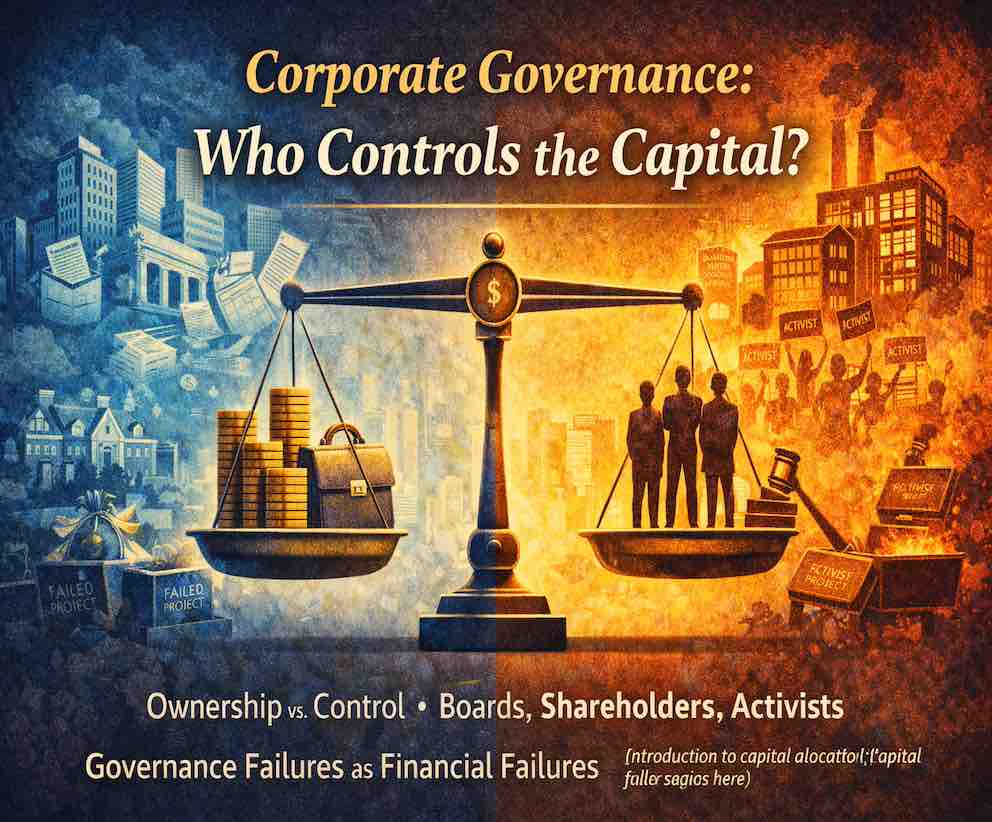
Introduction: The Missing Link Between Plan and Execution
You now possess the definitive capital allocation filter: RONIC > WACC. But who ensures this rule is followed when a charismatic CEO champions a pet project? Who has the power to stop a division head from empire-building? The answer lies not in a spreadsheet, but in the governance ecosystem—the formal and informal structures that decide who gets to spend the company’s money and how they are held accountable.
Governance is the enforcement mechanism for financial discipline. Without it, even the best frameworks are mere suggestions.
The Principal-Agent Problem: The Root of All Misallocation
The core challenge is the separation of ownership (shareholders) and control (management). This creates misaligned incentives:
- The Owner's Goal: Maximize long-term risk-adjusted value (Economic Profit).
- The Manager's Possible Goals: Maximize personal compensation, power (empire building), prestige, or avoid career risk.
Example: The "Confident" CEO.
A CEO's legacy is tied to a large, transformative acquisition. The internal finance team's DCF shows the target's ROIC will be 7%, below the company's 9% WACC. The CEO, believing in "strategic synergies," pressures the team to adjust growth assumptions until the model spits out an 11% ROIC. Without strong governance, this deal gets approved. The board must be the circuit breaker.
The Board of Directors: The Capital Allocation Committee
The board is not a ceremonial body; it is the supreme capital allocation committee. Its effectiveness depends on three traits:
- Independence: Directors must be free from personal or financial ties to the CEO to offer objective challenge.
- Financial Literacy: They must be able to dissect a DCF model, understand WACC drivers, and debate ROIC projections.
- Strategic Grit: Willingness to say "no" to the CEO and "why" to management proposals.
The Board's Practical Tool: The Capital Allocation Dashboard.
An effective board doesn't review projects ad hoc. It oversees a live dashboard:
- Portfolio Review: Tracking ROIC vs. WACC for each major division.
- Project Pipeline: Ranking proposed projects by RONIC spread and strategic fit.
- Post-Audit Tracker: Comparing actual ROIC of past projects to their promised ROIC. This creates accountability.
Example: The Failed Board vs. The Effective Board.
- Failed Board (Toy Story Syndrome): "We trust our visionary CEO." They approve the dubious acquisition. Value is destroyed.
- Effective Board: They mandate a "pre-mortem" for the deal: "Assume this acquisition fails in three years. What were the most likely causes?" This surfaces the optimistic assumptions, leading to a rejection or a radically revised, lower-price offer.
Shareholders: The External Governors
Shareholders are not passive. They govern through two channels: Voice and Exit.
| Mechanism | How It Works | Impact on Capital Allocation |
| Voice (Activist Investors) | Engages directly with board/CEO to demand strategic change. | Forces reallocation: divest low-ROIC units, initiate buybacks, halt low-return projects. |
| Exit (Selling Shares) | Selling drives down stock price, increasing cost of equity & WACC. | Makes future projects harder to justify, pressures management to change course. |
Example: The Activist's Prescription.
Company XYZ trades below intrinsic value. It hoards cash and invests in marginal projects with 8% RONIC (WACC = 10%). An activist campaigns for a massive share buyback, arguing the stock is a 15%+ return investment. The board, feeling pressure, agrees. Capital is reallocated from low-return internal projects to a high-return repurchase of equity—a direct governance-driven reallocation.
Incentive Design: The Software of Governance
Compensation is the code that runs the manager's decision-making algorithm. Flawed code guarantees flawed outputs.
The Good, The Bad, and The Ugly:
- Bad: Bonus tied to Revenue Growth → Invest in low-margin, capital-intensive sales.
- Bad: Bonus tied to EPS → Cut R&D, leverage up for buybacks.
- Good: Bonus tied to ROIC or Economic Profit → Seek high-return projects, optimize asset efficiency.
- Best: Long-term equity vesting (3-5 years) based on Total Shareholder Return vs. Peers → Aligns manager's horizon with the owner's.
Golden Rule: You get what you pay for. A board that approves short-term EPS bonuses is formally instructing management to destroy long-term value.
The Governance Lifespan: From Startup to Conglomerate
Governance isn't one-size-fits-all; it evolves with the firm's lifecycle and ownership.
- Venture-Backed Startup: Governance is the term sheet. Investor board seats, milestone-based financing, and liquidation preferences are governance tools to ensure scarce cash is allocated to achieving product-market fit, not founder perks.
- Public Company (Dispersed Ownership): Governance is the board committee structure (Audit, Compensation) and engagement with institutional shareholders. The goal is to balance oversight with entrepreneurial speed.
- Family-Controlled or Dual-Class Firm: Governance is the conflict between controlling and minority shareholders. The risk is capital being allocated for family prestige or control (e.g., overpaying for a sports team) rather than value.
Example: Meta's Dual-Class Structure.
Mark Zuckerberg controls voting power disproportionate to his economic ownership. This allows him to allocate vast capital to long-term, high-risk bets like the Metaverse with little board restraint. This is neither "good" nor "bad" governance in a vacuum—it's a structural choice that centralizes capital allocation authority, for better (bold innovation) or worse (persistent investment in value-destroying projects).
The Ultimate Financial Impact: Governance and the Cost of Capital
This is the most powerful link. Governance quality is a direct input into risk perception.
Strong Governance → Lower perceived agency and operational risk → Lower equity risk premium & cheaper debt → Lower WACC.
Weak Governance → Higher perceived risk → Investors demand higher returns → Higher WACC.
Result: Two identical companies with identical projects. The one with better governance has a lower WACC (e.g., 7% vs. 9%). More projects clear its hurdle rate, it can outbid rivals for assets, and it creates a sustainable competitive advantage in capital access. This is why governance ratings affect credit ratings.
Conclusion: Building Your Governance Advantage
Corporate governance is not about compliance. It is the command and control system for value creation. To build a governance system that allocates capital effectively:
- Empower Your Board: Staff it with independent, financially literate directors. Give them a Capital Allocation Dashboard.
- Rewrite the Incentive Code: Tie compensation directly to long-term ROIC and shareholder returns.
- Respect Shareholder Voice: See engaged investors as a source of discipline, not a nuisance.
- Know Your Structure: Understand how your ownership model (public, private, family) shapes your allocation biases.
In the end, capital follows power. Governance defines where the power lies and the rules for its use. Master it, and you master the flow of capital itself.
About Swati Sharma
Lead Editor at MyEyze, Economist & Finance Research WriterSwati Sharma is an economist with a Bachelor’s degree in Economics (Honours), CIPD Level 5 certification, and an MBA, and over 18 years of experience across management consulting, investment, and technology organizations. She specializes in research-driven financial education, focusing on economics, markets, and investor behavior, with a passion for making complex financial concepts clear, accurate, and accessible to a broad audience.
Disclaimer
This article is for educational purposes only and should not be interpreted as financial advice. Readers should consult a qualified financial professional before making investment decisions. Assistance from AI-powered generative tools was taken to format and improve language flow. While we strive for accuracy, this content may contain errors or omissions and should be independently verified.