
Tutorial Categories
Last Updated: January 31, 2026 at 19:30
Mastering Growth-Stage Finance to Scale Value, Not Just Revenue - Corporate Finance Series
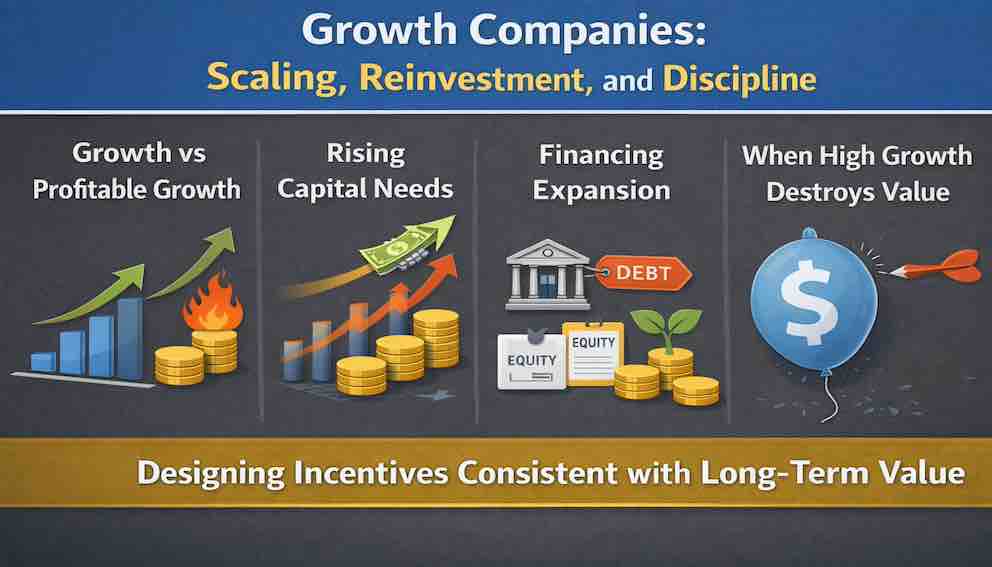
Scaling a startup is where ambition meets reality. This tutorial moves beyond early-stage financing to solve the core growth-stage dilemma: how to expand rapidly without destroying the value you've built. We introduce the "Scaling Calculus"—a practical framework balancing growth rate, capital efficiency, and founder control. You'll learn to distinguish value-creating growth from value-destroying expansion, master the strategic use of equity and debt, and apply disciplined reinvestment rules. Through contrasting case studies, we show how applying this evolved calculus transforms scaling from a cash-burn race into a systematic process of building a durable, valuable company.
Introduction: The Evolution from Discovery to Execution
The early-stage venture, as we defined it, is a portfolio of strategic options. The "Founder's Calculus" was a tool for trading equity to purchase these options—the right to test, learn, and pivot. The mindset was exploratory and iterative, focused on validating a core hypothesis with small, staged bets.
The growth stage demands an evolution of this calculus. The fundamental question shifts from "Could this work?" to "How do we make what works, work profitably at scale?" The mindset must become systematic and measured. You are no longer just buying options; you are now deciding which validated options to exercise at full scale and how to fund that exercise without jeopardizing the value you've proven exists. This tutorial provides the framework for that evolved decision-making.
The First Principle: Not All Growth is Valuable
The most perilous assumption in scaling is that revenue growth equals value creation. It does not. Value is only created when a company earns a Return on Invested Capital (ROIC) that exceeds its Weighted Average Cost of Capital (WACC).
A Practical Metrics Example: "BrewCraft SaaS"
Let's make this concrete. Imagine "BrewCraft SaaS," a company selling software to craft breweries.
- Invested Capital: $2 million (from seed funding spent on tech and team).
- Annual Net Operating Profit (NOPAT): $300,000.
- ROIC Calculation: NOPAT / Invested Capital = $300k / $2M = 15%.
- WACC Estimate: Considering the risk, its investors demand a 12% return.
- Value Creation Spread: ROIC (15%) - WACC (12%) = +3%. BrewCraft is creating value.
This gives us a central mental model: The Sustainable Growth Rate (SGR).
SGR = Reinvestment Rate × ROIC
- Reinvestment Rate: The percentage of profits plowed back in (e.g., BrewCraft reinvests 60% of its $300k profit, or $180k).
- ROIC: The return on that reinvestment (15%).
- BrewCraft's SGR: 60% × 15% = 9%. This is the growth rate it can fund profitably from its own business model without deteriorating returns.
The Founder's Dilemma: You can juice short-term growth by increasing the Reinvestment Rate (burning cash) or chasing growth that lowers ROIC (like deep discounting). Both destroy long-term value. The Calculus is about aligning growth with this sustainable engine.
Case Study: BlitzScale vs. TortoiseLogic
Consider two SaaS companies at the same $5M ARR mark:
| Metric | BlitzScale Inc. | TortoiseLogic Ltd. |
| Growth Strategy | "Land grab" – maximize customer count. | "Efficiency engine" – grow within profitable unit economics. |
| Customer CAC | $300 | $100 |
| Customer LTV | $400 | $500 |
| LTV:CAC Ratio | 1.3:1 | 5:1 |
| Implied ROIC | Low/Negative (Spend > Return) | High (Efficient spend generates strong returns) |
| Growth Rate | 120% annually | 50% annually |
| Long-Term Trajectory | Requires constant cash infusions; hits a wall. | Funds more of its own growth; becomes sustainably profitable. |
The Calculus: BlitzScale is trading permanent equity for unprofitable growth. TortoiseLogic is building a compoundable enterprise. The choice is between the appearance of speed and the architecture of durability.
The Capital Stack: Choosing the Right Tool for the Job
Financing expansion is a strategic choice. Each capital instrument has a different cost and fits a specific type of growth initiative in your Scaling Calculus.
| Capital Type | Best For Funding... | Cost to Founder | Scaling Calculus Rule |
| Venture Equity | Long-term, high-uncertainty bets that can dramatically increase future ROIC (e.g., R&D for a new product line). | High (Dilution): Selling a permanent slice of future value. | Use only for initiatives that will fundamentally improve your business model's economics, not just extend the runway. |
| Venture Debt | Short-term, lower-risk growth with predictable returns (e.g., equipment for a proven production process). | Medium (Cash Flow Risk): Fixed repayments strain liquidity if growth stalls. | Use when the certain return from a specific asset comfortably exceeds the debt's cost, preserving equity. |
| Internal Cash Flow | Scaling the proven, core business model (e.g., hiring more sales reps for a tested sales process). | Low (Opportunity Cost): The cheapest capital, but limited. | The ultimate goal. Funding growth from profits signals your ROIC is high and your model is truly scalable. |
Connective Example: TortoiseLogic's Capital Journey
- Series A (Equity): Raises $5M. Calculus: Uses this high-cost capital not for generic marketing, but to build a proprietary data engine that lowers its CAC—directly improving core ROIC.
- Growth Phase (Venture Debt): Takes on $2M in debt. Calculus: Uses this lower-cost capital to extend runway and hit profitability targets without further dilution, banking on predictable returns.
- Scale Phase (Internal Cash Flow): Funds new initiatives from monthly revenue. Calculus: It has achieved a self-funding scale engine.
Reinvestment & Optionality: The Margin of Safety and Growth Options
Every major growth initiative—a new market, product line, or channel—should be viewed through two lenses: as an investment requiring a margin of safety and as a real option on future returns.
The Margin of Safety: Stress-Test Before You Invest
- Build a base-case model (e.g., launching in a new city shows 16% ROIC).
- Apply stress tests: +30% CAC, -20% pricing, 2x longer launch.
- Ask: "Does the ROIC still exceed our WACC under stress?" If not, you lack a margin of safety.
Explicit Optionality: Treating Initiatives as Call Options
A full-scale launch is exercising a call option. The premium is the cost of the launch. The smarter strategy is often to first buy a cheaper option to gain the right, but not the obligation, to launch later.
Example: The Food Delivery App's European Option
An app dominant in London wants to expand to Berlin. The full launch costs €2M.
- Weak Model: "Build a model. If ROIC > WACC, commit €2M."
- Strong Calculus (Real Options): "First, we buy a cheaper call option. We spend €200k (10% of full cost) on a three-month pilot with a limited team and targeted marketing. This pilot gives us real data on CAC, conversion, and competition. If the data confirms our model, we exercise the option and deploy the remaining €1.8M with confidence. If the data is poor, we abandon the expansion, having lost only €200k instead of €2M."
This approach systematically converts growth uncertainty into managed risk.
The One Metric That Matters (OMTM): Unit Economic Profit
In the growth stage, aggregate metrics hide the truth. The vital signal is Unit Economic Profit (UEP).
UEP = (Customer Lifetime Value - Customer Acquisition Cost)
- UEP > 0: You create value with each customer.
- UEP < 0: You destroy it. Faster growth accelerates value destruction.
Applying the OMTM: The "Brand" TV Campaign
The board wants a glossy TV campaign for "brand awareness" to boost growth. The disciplined leader applies the Scaling Calculus: "What is the forecasted impact on our Unit Economic Profit?"
If the campaign attracts low-intent customers at high CAC, lowering UEP, it's a value-destroying proposal—regardless of the buzz. The capital is better deployed in a measurable channel that improves UEP.
Maintaining Control: Governance as a Scaling Tool
As capital enters, governance dictates your operational freedom. A board aligned on UEP and long-term value will support disciplined scaling. A board obsessed only with top-line growth will pressure you toward the BlitzScale path. Negotiate for sensible approval thresholds that allow you to test and learn (to purchase those real options) without constant permission.
Conclusion: Building the Value Compounder
The growth stage is the process of building a value compounder—a business where each round of growth makes the next round easier and more valuable. Mastering the Scaling Calculus means internalizing that:
- Value > Growth: Revenue is a means to durable, high-ROIC scale.
- Capital is Strategic: Match your financing to the risk/return profile of each initiative.
- Discipline is Freedom: Margins of safety and a focus on UEP enable bold, rational scaling.
- Optionality Evolves: From buying options to survive, to using options to de-risk scale.
By applying this framework, you transition from a founder navigating uncertainty to a CEO architecting an enduring institution. You learn to scale not just your operations, but your enduring worth.
About Swati Sharma
Lead Editor at MyEyze, Economist & Finance Research WriterSwati Sharma is an economist with a Bachelor’s degree in Economics (Honours), CIPD Level 5 certification, and an MBA, and over 18 years of experience across management consulting, investment, and technology organizations. She specializes in research-driven financial education, focusing on economics, markets, and investor behavior, with a passion for making complex financial concepts clear, accurate, and accessible to a broad audience.
Disclaimer
This article is for educational purposes only and should not be interpreted as financial advice. Readers should consult a qualified financial professional before making investment decisions. Assistance from AI-powered generative tools was taken to format and improve language flow. While we strive for accuracy, this content may contain errors or omissions and should be independently verified.