
Tutorial Categories
Last Updated: January 31, 2026 at 19:30
Mastering Start-Up Funding, Venture Valuation, and Equity Dilution Strategies - Corporate Finance Series
Financing a start-up requires a fundamental shift from corporate finance logic. This tutorial introduces the "Founder's Calculus": the continuous trade-off between using equity to fund growth and preserving ownership of future value. We reframe the start-up as a portfolio of strategic call options, where valuation is the price of that portfolio, dilution is its cost, and real options theory is the decision-making toolkit. Through a connected case study, you will learn how founders can navigate funding rounds not as isolated transactions, but as iterative bets that systematically convert uncertainty into valuable, executable strategies while managing risk.
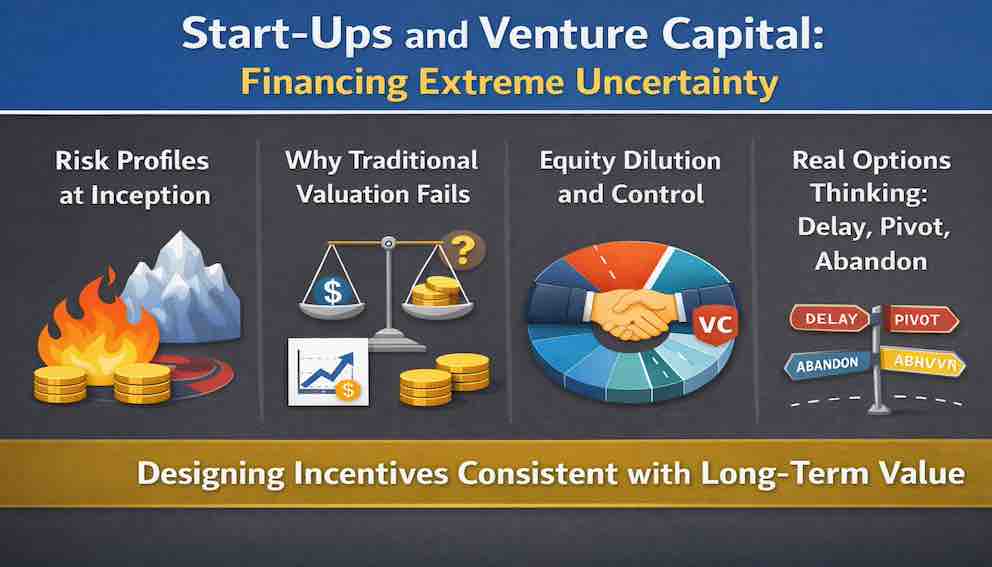
Introduction: From Managing Value to Building Optionality
In established corporations, the core financial challenge is the efficient allocation of capital to maximize the value of predictable cash flows. Executive incentives and governance exist to ensure managers act as good stewards of that capital, as we explored in previous tutorials.
A start-up faces the opposite problem: it begins with no capital and no cash flows, but with an abundance of uncertainty and potential. Therefore, the central task of start-up finance is not capital allocation, but option construction—using limited resources to systematically buy the right to pursue valuable future paths without the obligation to follow them. The founder's equity is not just ownership of a company; it is a share in a dynamic portfolio of these future strategic options.
This shift in mindset defines the Founder's Calculus: every financing decision is an integrated calculation of how much of your option portfolio you must sell (dilution) to fund the creation of new, more valuable options (growth, pivots, survival). The governance lessons from corporate finance—oversight, incentives, and accountability—reappear here in the structure of term sheets, board rights, and vesting schedules, which govern how these options are controlled and exercised.
Venture Valuation: You're Not Valuing a Company, You're Pricing an Option
Traditional discounted cash flow (DCF) analysis fails with start-ups because it requires stable, forecastable cash flows. A pre-revenue start-up has none. Trying to force a DCF leads to fantasy forecasts built on arbitrary assumptions.
The accurate framework is option pricing. A start-up's value derives not from current earnings, but from the right, but not the obligation, to capture a large future market if key uncertainties resolve favorably. Its value increases with:
- Volatility (σ): The uncertainty and size of the potential market. A bigger, less predictable market creates more valuable options.
- Time to Expiry (T): The runway—how long you have (your cash) to reach key milestones before the opportunity expires.
- Strike Price (K): The future capital required to capture the opportunity (e.g., the cost of scaling).
- Underlying Asset Value (S): The potential value of the business if it succeeds.
Example: The Pre-Revenue Biotech
A biotech firm with a novel drug discovery platform has no revenue. A DCF would be nonsense. An investor values it at $20 million. What are they buying? They are pricing a call option on the future value of the platform. The high volatility (will the science work?) and enormous potential underlying asset value (a multi-billion dollar drug market) create option value, even with a current price of zero. The pre-money valuation is the market's consensus price for this specific bundle of future rights.
Equity Dilution Strategies: The Cost of Strategic Options
When you raise capital, you are not "selling part of your company" in a static sense. You are selling call options on your future option portfolio to investors. The cash you receive is the premium. Dilution is the cost.
The critical question in the Founder's Calculus is: "Does the capital I'm raising purchase new options that are worth more than the slice of the portfolio I'm selling?"
Example: The Seed Round Trade-Off
A founder owns 100% of a start-up valued (option-priced) at $4 million pre-money. She raises a $1 million seed round.
- Post-Money Valuation: $5 million.
- Founder's New Ownership: 80% ($4M / $5M). Dilution: 20%.
- The Calculus: Did she sell 20% of all future value? Yes. In return, the $1 million premium buys the crucial option to build a MVP and achieve product-market fit. Without this cash, the company's core option—to become a real business—expires worthless. The trade is rational: 20% of a valueless idea for 80% of a funded venture with a live option.
Founders should not seek to minimize dilution, but to optimize the option-for-equity exchange. Bad dilution sells options cheaply for non-transformative cash. Good dilution sells a slice to fund a leap in the value of the remaining portfolio.
Real Options: Your Toolkit for Navigating Uncertainty and Risk
Real options theory provides the structured framework for executing the Founder's Calculus. It treats every investment of time and capital as purchasing a new option or exercising an existing one. Critically, this framework is not just about capturing upside; it is a formal system for managing downside risk by limiting exposure at each stage.
| Real Option Type | Start-Up Application | Core Benefit |
| Option to Delay | Wait for more market data or tech maturity before a full-scale launch. | Preserves capital; avoids committing before uncertainty is reduced. |
| Option to Expand | After a successful pilot, invest heavily to scale. | Captures proven upside; funds growth only after de-risking. |
| Option to Abandon | Shut down a failing product line or pivot strategy. | Cuts losses; prevents throwing good money after bad. |
| Option to Switch | Pivot from a B2B to a B2C model based on user feedback. | Salvages and redirects value from learning. |
This framework turns uncertainty from a threat into a source of value. By staging investments (e.g., seed round → Series A), you are consciously paying a series of premiums to keep your most valuable options alive, gather information, and limit total capital exposure if the project fails.
Mini-Case: The Pivot as a Risk-Managed Exchange
A company builds a complex analytics tool for marketers (Option A). After a low-cost beta launch (staged funding to limit risk), users love one simple visualization feature but ignore the complex suite. The company can now exercise its exchange option with minimal sunk cost: abandon the complex tool and pivot to build a standalone product around the visualization feature (Option B). The real options framework allowed them to fail fast, cheaply, and transform that failure into a new, more promising direction.
Governance, Incentives, and Control: The Rules of the Option Game
As in corporate finance, the design of the system determines outcomes. In start-ups, the term sheet and shareholder agreement are the governance documents that define how the option portfolio is controlled. Key clauses directly impact the Founder's Calculus:
- Board Composition: Determines who holds the voting power to exercise major options like a pivot, an acquisition offer, or a new funding round. Losing board control can mean losing the ability to steer the portfolio.
- Liquidation Preferences: Define the order of payouts if the company is sold. A "2x non-participating preference" means investors get double their money back before founders see a dime, dramatically altering the value of the founder's option in downside scenarios.
- Vesting Schedules: The classic incentive tool. A founder's equity typically vests over 4 years to align the founder's option to stay with the investor's option on the company's success. It ensures the person building the portfolio has "skin in the game" over the long term.
Governance Takeaway: Negotiating these terms is not legal minutiae; it is the process of designing the control and incentive systems that will determine whether you, as the founder, remain the primary decision-maker over your strategic option portfolio.
Connected Case Study: FlowSafe Tech and the Iterative Calculus
Let's follow founder Alex and FlowSafe Tech, which has a patent for a new water filter membrane, through three funding rounds. Watch how valuation, dilution, governance, and real options interact at each stage.
Stage 1: Seed Round – Pricing the Initial Option Portfolio
- The Option Portfolio: Option to develop a lab prototype; Option to seek regulatory testing; Option to license to manufacturers.
- The Deal: An angel investor prices this portfolio at a $2.5M pre-money valuation. Alex raises $500K.
- Governance: Simple terms: Alex keeps board control, standard 4-year vesting on his founder shares.
- The Calculus:
- Dilution Cost: Sells 16.7% of the company.
- Option Purchased: The capital funds the prototype, transforming the "license" option from a vague idea into a tangible asset.
- Founder's Take: "I traded 16.7% of a dream for 83.3% of a company with a working prototype and a live path to market."
Stage 2: Series A – Exercising the Pivot Option
- New Reality: The prototype works, but large manufacturers are slow. Pilot data shows stunning efficiency for home coffee machines.
- The New Option: Pivot to develop a premium consumer filter cartridge.
- The Deal: A VC offers $5M at a $15M pre-money valuation. The value jumped because the successful prototype reduced technical volatility.
- Governance: VC gets a board seat. A 1x liquidation preference is added.
- The Calculus:
- Cumulative Dilution: Alex now owns 62.5%.
- Trade: Sold another 20.8% of the company. The $5M is the premium paid to exercise the pivot option. The value of Alex's remaining stake has multiplied, but the new governance terms mean shared control and defined downside protection for the VC.
Stage 3: Series B – Abandoning to Amplify
- New Reality: The consumer product is successful but faces brutal margin competition. A major appliance maker offers a lucrative, exclusive licensing deal but demands Windward stop direct sales.
- The Strategic Choice: Exercise the abandonment option on the hardware business to capture the high-value licensing option.
- The Deal: A strategic investor leads a $20M round at an $80M pre-money valuation.
- The Calculus: While dilution continues, the fundamental option portfolio has been radically upgraded from a struggling hardware play to a capital-light, high-margin licensing business. The board, now including the strategic investor, approves the pivot—governance facilitating a major option exercise.
Conclusion: Mastering the Calculus
Start-up finance is the art of constructing, pricing, and trading strategic optionality under extreme uncertainty. To master it:
- Adopt the Option Mindset: See your venture as a dynamic portfolio, not a static projection.
- Run the Integrated Calculus: Never consider dilution or valuation in isolation. Always ask: "What more valuable option does this capital let me buy or exercise, and what control does it cost?"
- Use Real Options as Your Guidebook: Frame every strategic decision as the exercise of a real option. It transforms uncertainty from a source of fear into a source of strategic value and a tool for risk management.
- Govern Your Option Ledger: Your cap table and term sheet dictate who gets paid and who decides when options pay off. Manage them with the same rigor as your product roadmap.
By internalizing the Founder's Calculus, you move from being a passive participant in financing events to being the architect of your venture's strategic future, using capital and governance precisely to convert the right uncertainties into concrete, lasting value.
About Swati Sharma
Lead Editor at MyEyze, Economist & Finance Research WriterSwati Sharma is an economist with a Bachelor’s degree in Economics (Honours), CIPD Level 5 certification, and an MBA, and over 18 years of experience across management consulting, investment, and technology organizations. She specializes in research-driven financial education, focusing on economics, markets, and investor behavior, with a passion for making complex financial concepts clear, accurate, and accessible to a broad audience.
Disclaimer
This article is for educational purposes only and should not be interpreted as financial advice. Readers should consult a qualified financial professional before making investment decisions. Assistance from AI-powered generative tools was taken to format and improve language flow. While we strive for accuracy, this content may contain errors or omissions and should be independently verified.