
Tutorial Categories
Last Updated: February 26, 2026 at 10:30
Partnering with the Business: How FP&A Teams Influence Commercial Decisions Without Blocking Them
In this tutorial, learners will discover how finance professionals can move beyond traditional analysis and reporting to actively partner with business teams in making better commercial decisions. It explores techniques for reviewing sales hiring plans, evaluating marketing ROI, and challenging spending assumptions in a constructive manner. Using practical examples, scenario boxes, and real conversations, learners will see how to balance support and skepticism, maintain credibility, and build trust. Participants will understand that influencing decisions is about improving outcomes, not vetoing ideas, aligning capital with strategy, and enabling the business to achieve measurable results.
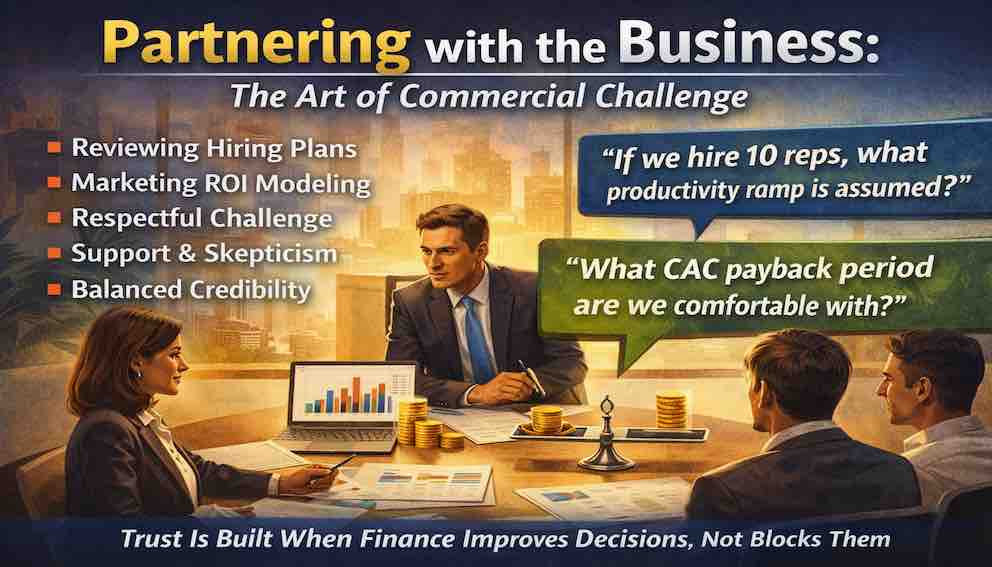
Introduction: From Capital Allocation to Commercial Influence
Sarah, the Financial Planning & Analysis lead, walks into the sales director's office. The atmosphere is tense. Last week, the sales leader submitted a request to hire ten new account executives, noting: “Urgent—need approval to hit Q4 targets.”
Sarah’s initial reaction, shaped by years of observing overoptimistic plans, was skepticism. Ten new hires. Each costing £120,000 in salary and benefits. A six-month ramp-up period before they become fully productive. The math felt aggressive.
But instead of sending a rejection, she asked for a meeting. Now she sits across from the sales director, who clearly expects conflict.
"I know you're going to tell me we can't afford this," he says.
Sarah pauses. This moment will determine whether she is perceived as a partner or an obstacle.
In modern finance, mastery of capital allocation is critical. It involves analyzing opportunities, prioritizing investments, and recommending where resources should go to maximize return. Sarah has done that work before—she knows how to evaluate a proposal, model its returns, and recommend yes or no.
The journey does not end there. Once finance professionals can translate analysis into actionable recommendations, the next frontier is moving closer to the business. This is the art of commercial challenge: supporting daily operational choices while asking tough questions that ensure resources are used effectively.
"I’m not here to say no," Sarah says. "I’m here to help us make this work. Can we walk through the assumptions together?"
The tension in the room eases, and the conversation begins.
The Story of the Finance Team That Only Said No
Sarah remembers a company early in her career where the finance team had a reputation for rejecting requests. Hire someone? No. Launch a marketing campaign? No. Invest in equipment? No.
They prided themselves on fiscal discipline, thinking they were protecting the company. In reality, business leaders stopped bringing ideas to finance. Initiatives were hidden or executed without approval. Decisions happened in the dark. Resources were allocated inefficiently.
"Finance thought they were being responsible," Sarah reflects. "But they were being irrelevant. They had no influence because they had no relationship."
The lesson is clear: saying no is easy and safe. It does not improve decisions. The goal of commercial challenge is not to block decisions but to enable better ones.
Understanding the Role: Support and Challenge
Sarah explains her philosophy to new team members:
"At its core, our role in commercial challenge balances two things: support and challenge. They seem opposite, but they’re complementary."
Providing Support
Finance professionals are often viewed as gatekeepers. If that’s all they do, tension is inevitable. Support comes in several forms:
- Providing insights that business leaders don’t have access to
- Offering realistic forecasts to guide planning
- Modeling outcomes of proposed investments to see the range of possibilities
- Clarifying financial implications so trade-offs are understood
For example, if marketing wants to launch a campaign, finance can model ROI under various scenarios, showing which approach aligns best with strategic objectives. Support is not yes or no—it’s helping the business see more clearly.
Challenging Assumptions
Equally important is the ability to challenge spending assumptions, hiring plans, or project prioritization in a respectful, constructive way. This does not mean obstruction or automatic rejection. It means asking probing questions that uncover hidden risks, inefficiencies, or unrealistic expectations.
Questions might include:
- What evidence supports this growth forecast?
- How will incremental headcount impact operating margin if revenue falls short?
- Have we accounted for historical ramp-up times?
"Support and challenge are two sides of the same coin," Sarah explains. "If you only support, you’re a cheerleader, not a partner. If you only challenge, you’re a blocker, not a partner. The art is doing both."
Reviewing Sales Hiring Plans: A Finance Perspective
Back in the sales office, Sarah opens her notebook.
"Walk me through the plan," she says.
Step 1: Understanding the Plan
The sales director explains the proposal: hire five new account executives to achieve a 20% revenue increase next year. Each rep is expected to generate £500,000 annually. Total cost per rep is £100,000.
Sarah asks: “What’s the basis for the £500,000 per rep assumption?”
The director cites historical performance and a high-growth segment. Sarah then explores the ramp-up period: six months to reach full productivity.
"So in year one, we pay full cost but only get partial revenue?"
"Correct."
Step 2: Modeling Impact – Making the Economics Clear
Sarah doesn’t open a spreadsheet. She starts by translating the plan into simple economics.
“Let me restate what this means financially,” she says. “Just so we’re aligned.”
Five hires at £100,000 each means £500,000 of additional fixed cost the moment the decision is made. That cost is incurred regardless of how quickly revenue arrives.
Next, she focuses on timing.
“You mentioned a six-month ramp-up,” she says. “So in year one, we shouldn’t assume a full year of revenue.”
Instead of £500,000 per rep, a more realistic year-one assumption is about £250,000 per rep. Across five hires, that’s £1.25 million of incremental revenue.
“But revenue isn’t profit,” Sarah adds. “What matters is contribution.”
At a 40 percent gross margin, that £1.25 million produces £500,000 of contribution.
She pauses.
“That exactly matches the cost of the hires. So in the base case, everything has to go right just to break even in year one.”
Then she introduces risk.
“If revenue is 20 percent lower than planned, contribution drops to about £400,000, while costs stay at £500,000. That’s a £100,000 shortfall.”
“And if ramp-up takes longer than six months, the gap widens further.”
She looks up.
“The plan can work,” she says. “But it’s sensitive. Small changes in assumptions move the outcome quickly. That doesn’t mean we shouldn’t hire—but it does mean we should think carefully about how much we commit upfront.”
The sales director nods. The discussion has shifted from approval to design.
Step 3: Constructive Questions
"Here’s what I’m seeing," Sarah says. "The plan could work, but there’s downside risk. What if we hire three reps now, learn what works, and hire two more in six months?"
The sales director considers. They agree to a phased approach: reduce risk, preserve upside, and embed learning.
"The goal wasn’t to block hiring," Sarah reflects. "The goal was to make the hiring better."
Modeling Marketing ROI: Influencing Investment Decisions
Later, Sarah meets with the marketing director, who is proposing a £200,000 social media campaign. Rather than reacting to the size of the spend, Sarah focuses first on understanding what the investment is meant to achieve and how success should be measured.
Step 1: Understanding Objectives
Sarah begins by clarifying the objective of the campaign. This is not about brand awareness or engagement; the goal is customer acquisition. That distinction matters, because it determines how the return should be evaluated.
They review historical performance together. Previous campaigns have generated customers at an average cost of £50 per acquisition. Roughly 10 percent of leads convert into paying customers, and the average customer generates £1,000 of lifetime value over time.
By grounding the discussion in observed data rather than aspirations, Sarah ensures that the analysis starts from reality, not optimism.
Step 2: Quantifying ROI – Exploring Scenarios
Instead of presenting a single forecast, Sarah walks through a range of possible outcomes to show how sensitive the return is to changes in assumptions.
In an optimistic scenario, stronger performance lowers the cost per acquisition to £40, increases the number of leads to 5,000, and improves conversion to 12 percent. That results in 600 new customers and £600,000 of lifetime value, producing a very attractive return on the £200,000 investment.
In the base case, performance matches historical averages. Cost per acquisition remains at £50, 4,000 leads are generated, and 10 percent convert into customers. That yields 400 customers and £400,000 of lifetime value, which still represents a solid return.
In a pessimistic scenario, conditions worsen slightly. Cost per acquisition rises to £60, fewer leads are generated, and conversion drops to 8 percent. Even then, the campaign produces approximately 267 customers and £267,000 of lifetime value, meaning the investment remains positive, though far less compelling.
“Even in the downside case, we’re still creating value,” Sarah observes. “That’s encouraging. But it also tells us that performance matters a lot.”
She then shifts the conversation from approval to design.
“Rather than committing the full £200,000 upfront,” she asks, “could we start with a smaller test, learn which messages and channels perform best, and then scale what works?”
The marketing director agrees. They decide on a £50,000 pilot, with clear metrics and a review point before deploying the remaining budget. The campaign is not blocked; it is improved through learning and risk control.
Challenging Spending Assumptions: The Subtle Art
A few days later, the IT director submits a request for £500,000 to purchase new software, justified by expected efficiency gains. Sarah approaches this conversation with the same mindset: not approval or rejection, but understanding first.
Step 1: Context
The IT director explains that the software is expected to save approximately 20 percent of the team’s time by automating manual processes. Given that the team’s annual cost base is around £2 million, this implies potential savings of £400,000 per year.
The software requires a £500,000 upfront investment, plus £50,000 in annual maintenance. If the efficiency gains are fully realized immediately, the payback period would be a little over a year.
“That sounds promising,” Sarah says. “But let’s explore how dependent that outcome is on execution.”
Step 2: Scenario Analysis – Understanding Risk
Sarah outlines several possible outcomes to make the uncertainty visible.
If the full 20 percent efficiency gain is achieved, the annual savings comfortably justify the investment. If only half the efficiency materializes, savings drop to £200,000 per year, stretching the payback period to roughly two and a half years. If the efficiency gains fail to materialize at all, the company absorbs the full cost with no offsetting benefit.
They then discuss what must go right for the savings to appear: effective training, redesigned processes, system integration, and widespread user adoption. Each dependency introduces risk and potential delay.
Step 3: Constructive Inquiry
Rather than concluding the discussion, Sarah reframes it.
“What if we piloted the software in one department for £100,000,” she suggests, “measured actual efficiency gains over six months, and then decided on a full rollout based on evidence?”
The IT director notes that the vendor offers a 15 percent discount—about £75,000—if the full purchase is made immediately. Sarah compares that saving to the potential downside: a failed full rollout would still cost £425,000, while a failed pilot would cap the loss at £100,000.
Seen in that light, the trade-off becomes clear. They agree that a phased pilot preserves learning, limits downside risk, and still leaves room to negotiate commercial terms later.
Once again, finance does not block the initiative. It reshapes it into a more resilient, better-informed decision.
Skills That Make Commercial Challenge Work
Analytical Rigor
Analytical rigor means carefully modeling outcomes, testing assumptions, and making risks explicit so decisions are based on how the business actually behaves rather than on optimism or instinct.
Communication
Communication is the ability to present insights in a constructive, non-confrontational way, so analysis invites discussion and reflection instead of triggering defensiveness or resistance.
Empathy
Empathy allows finance to understand the pressures, incentives, and constraints business leaders face, which makes challenges feel supportive rather than judgmental.
Credibility
Credibility is built over time when finance is seen as improving decisions and outcomes, not blocking ideas, which ensures that its questions are taken seriously.
Scenario Thinking
Scenario thinking prepares the organization for multiple possible outcomes, helping leaders make informed choices under uncertainty instead of relying on a single forecast.
“These skills matter as much as technical expertise,” Sarah notes, “because analysis only matters if it leads to action.”
Real Conversations: Framing Challenges Constructively
Sales:
"Can we look at historical ramp-up periods and expected revenue to ensure projections are realistic? What if market conditions shift?"
Marketing:
"Can we run scenario analysis to compare approaches and expected ROI? This helps maximize impact without overspending."
IT Spend:
"Can we test a phased deployment to measure efficiency gains? Understanding dependencies helps us evaluate risk and impact."
These questions engage ideas, not dismiss them, creating trust and collaboration.
The Difference Between Partner and Gatekeeper
- Gatekeeper: success measured by how many decisions are blocked. Safe, but irrelevant.
- Partner: success measured by improved decisions. Engages, shares risk, builds trust, and influence.
Sarah’s team is now trusted. Business leaders seek input early to strengthen proposals. Conversations are collaborative, assumptions challenged constructively, plans refined.
Conclusion: From Insight to Influence
This tutorial explored how finance professionals move from capital allocation to active commercial partnership. We learned:
- How to balance support and challenge in hiring, marketing, and spending decisions
- How scenario thinking and phased approaches reduce risk and improve outcomes
- How real conversations and constructive questioning build trust
- How analytical rigor, communication, empathy, credibility, and scenario thinking enable effective influence
Finance is not a gatekeeper that blocks decisions. It is a partner that improves them, ensuring resources are allocated strategically, investments are optimized, and business outcomes are strengthened through collaborative, disciplined analysis.
Sarah sits at her desk, ready for tomorrow’s meetings with product, operations, and finance. Each conversation is an opportunity to partner—and each improved decision reinforces the value of finance as a trusted business ally.
About Swati Sharma
Lead Editor at MyEyze, Economist & Finance Research WriterSwati Sharma is an economist with a Bachelor’s degree in Economics (Honours), CIPD Level 5 certification, and an MBA, and over 18 years of experience across management consulting, investment, and technology organizations. She specializes in research-driven financial education, focusing on economics, markets, and investor behavior, with a passion for making complex financial concepts clear, accurate, and accessible to a broad audience.
Disclaimer
This article is for educational purposes only and should not be interpreted as financial advice. Readers should consult a qualified financial professional before making investment decisions. Assistance from AI-powered generative tools was taken to format and improve language flow. While we strive for accuracy, this content may contain errors or omissions and should be independently verified.