
Tutorial Categories
Last Updated: February 5, 2026 at 14:30
The Growth Imperative: Sustainable vs. Speculative Growth - Fundamental Analysis Series
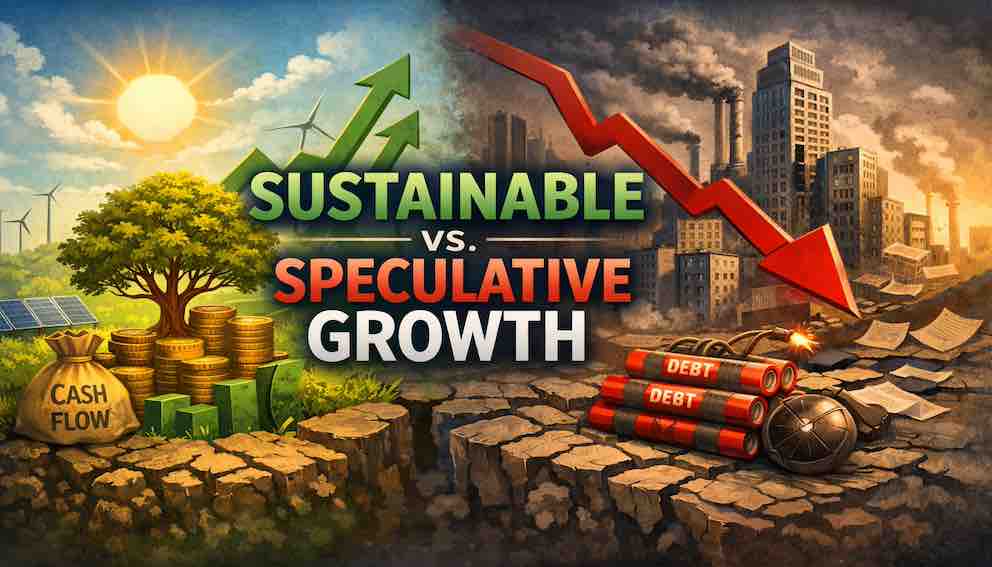
Growth is celebrated in the investing world, but not all growth is created equal. This tutorial explores the difference between sustainable growth, which creates lasting value, and speculative growth, which can be risky and fleeting. We examine the drivers of growth such as reinvestment, cash generation, and return on invested capital, while highlighting red flags like debt-fueled expansion and aggressive accounting assumptions. Through practical examples and historical perspective, readers will learn how to evaluate whether a company’s growth can truly compound wealth over the long term.
Introduction: Growth as Fuel, Not Fireworks
In investing, growth is often presented in a dramatic way. Fast-rising revenue numbers and bold expansion plans attract attention and excitement. This kind of growth looks impressive on the surface and is easy to celebrate. But for a long-term owner, impressive appearances are not what matter most. The most valuable growth is often quiet and unremarkable, because it steadily improves the business’s ability to generate cash and become more valuable over time. Our journey has taken us from financial health to profitability to cash reality. Now, we apply that discipline to the most seductive metric of all: growth.
The critical lesson is this: Growth is only valuable if it increases the intrinsic value of the business. A company can double its revenue by selling every product at a loss, but that destroys value. True, sustainable growth makes a business more valuable tomorrow than it is today. To spot the difference, we must look beyond the growth rate and examine its source, cost, and quality.
The Two Engines of Growth: Capital Efficiency vs. Capital Intensity
Before judging growth, you must understand the engine producing it. Businesses fall on a spectrum defined by their capital intensity—the amount of money they must invest to generate a dollar of sales.
Capital-Light Businesses (The Efficient Engine)
- Examples: Software-as-a-Service (SaaS), online marketplaces, consulting firms.
- How They Grow: They scale with minimal incremental investment. Adding a new software user or facilitating another transaction requires little extra cost. Their growth is often high-margin and cash-generative from the start.
- The Owner's Advantage: These businesses can fund expansion from their own cash flow. Growth is efficient and tends to be more resilient, as it isn't hostage to large debt payments or constant capital raises.
Capital-Intensive Businesses (The Heavy Engine)
- Examples: Semiconductor manufacturing, airlines, automobile companies.
- How They Grow: They require massive upfront investment in factories, equipment, or fleets just to add capacity. This growth consumes enormous cash.
- The Owner's Challenge: For growth to be sustainable here, it must generate returns that handsomely exceed the high cost of the capital invested. A misstep in forecasting demand can lead to underutilized assets and destroyed value. Their growth is inherently riskier.
The Key Insight: A 10% growth rate means something entirely different for a SaaS company than for an airline. Your first question should always be: "What kind of engine is driving this growth, and what does it cost to run?"
The Pillars of Sustainable Growth: A Three-Part Test
Sustainable growth isn't defined by speed. It's defined by the presence of three reinforcing pillars. Think of it as a checklist for quality.
Pillar 1: Growth Funded by Its Own Cash
The highest-quality growth is self-funded. A business that generates strong, predictable Free Cash Flow (FCF) uses its own profits to expand. This creates a virtuous cycle: operations fuel growth, which improves operations, generating more cash.
- The Litmus Test: Look at the Cash Flow Statement over 5+ years. Is "Cash Flow from Operations" robust and growing? Is the company's "Cash Flow from Investing" (like building new stores) funded by this operational cash, or is it reliant on constant borrowing or stock sales ("Cash Flow from Financing")?
- The Red Flag: "Growth" that requires perpetual infusions of external capital is a warning. It suggests the core business model may not be viable on its own.
Pillar 2: Growth Validated by High Returns (ROIC)
Growth is worthless if the money spent to achieve it earns a poor return. Return on Invested Capital (ROIC) is your guide. It measures the profit generated from each dollar tied up in the business.
- The Incremental ROIC Test: The most powerful analysis looks at new projects. Is the return on the latest dollar invested (the new factory, the R&D project) as high or higher than the company's historical average? Declining incremental ROIC means growth is becoming less efficient and potentially value-destructive.
- The Benchmark: Sustainable growth requires ROIC to be consistently above the company's cost of capital. If it's below, the company is shrinking value even as it grows in size.
Pillar 3: Growth Guided by Rational Capital Allocation
This is the human element. Even with cash and high-ROIC projects, management can fail. Capital allocation is the art of choosing where to deploy cash: reinvesting, acquiring other companies, paying dividends, or buying back shares.
- The Owner's Question: Is management reinvesting cash only in projects that clear a high return hurdle? Or are they expanding empire for ego's sake, making overpriced acquisitions, or letting cash stagnate?
- A Sign of Greatness: The most shareholder-friendly management teams return excess cash (beyond what's needed for high-ROIC projects) through dividends and buybacks, trusting owners to reinvest it themselves.
The Hallmarks of Speculative Growth: Recognizing the Illusion
In contrast to the sustainable model, speculative growth prioritizes appearance over economics. It’s the fireworks display. Watch for these clear warning signs:
- The Debt-Fueled Mirage: Explosive growth funded by soaring debt levels. This works until interest rates rise or sales dip, then it collapses under its own weight.
- Cash-Free Revenue: Soaring sales on the income statement, but flat or declining cash flow from operations. This often means revenue is being booked before cash is collected (ballooning receivables) or cash is trapped in unsold inventory.
- The "One-Time Charge" Habit: Frequently adjusting earnings with "one-time" costs to make underlying growth look smoother or stronger than it is.
- Capex without Returns: Sky-high capital expenditures (CapEx) that fail to lift revenues or profits proportionally—a sign of inefficient investment.
Practical Analysis: Building Your Growth Audit
Theory is essential, but application is power. Here is how you can analyze any company's growth story.
Step 1: Establish Context with Capital Intensity
First, classify the business. Is it capital-light (software, services) or capital-intensive (manufacturing, utilities)? This sets your expectation for how much cash its growth should consume.
Step 2: Chart the 5+ Year Narrative
Don't look at a single year. Plot these key metrics on a simple timeline or in a spreadsheet for at least five years:
- Revenue Growth
- Free Cash Flow Growth
- Return on Invested Capital (ROIC)
- Debt Levels
Look for the story: Do cash and profits grow in harmony with revenue? Or do they diverge? A sustainable grower shows aligned, upward-trending lines. A speculative grower shows revenue shooting up while cash flow lags and ROIC dips.
Step 3: Benchmark Against the Tribe
Isolation is the enemy of good analysis. Compare the company's growth efficiency to its direct peers.
- Is its Revenue-to-Capex ratio higher? (This measures how much sales it gets from each dollar of investment).
- Is its ROIC consistently superior?
- Does it require less debt to achieve similar growth?
A company growing faster and more efficiently than its competitors is likely gaining a real advantage. One growing faster but much less efficiently is likely taking dangerous shortcuts.
A Tale of Two Growers: Applied Analysis
Let's translate this into a direct comparison. Imagine two tech companies.
"FlowSoft" (The Sustainable Compounder)
- Business Model: Enterprise software (Capital-Light).
- 5-Year Story: Steady 18% annual revenue growth. Free Cash Flow margins are high and expanding. ROIC has risen from 25% to 30%. It has no debt. It uses excess cash for strategic, small acquisitions and share buybacks.
- The Owner's Verdict: This engine is running smoothly. Growth is efficient, self-funded, and creating more value per dollar invested over time. This is a compounding machine.
"BurnFast Inc." (The Speculative Expander)
- Business Model: Hardware-enabled tech (Capital-Intensive).
- 5-Year Story: Volatile 35% annual revenue growth. Free Cash Flow is negative and worsening. ROIC has crashed from 12% to 4%. Debt has tripled. "One-time" restructuring charges appear every year.
- The Owner's Verdict: This engine is overheating. Growth is being bought with debt and is yielding poor returns. The impressive revenue headline hides a deteriorating business. This is a value-destroying venture.
Conclusion: Choosing the Right Fuel
Growth analysis is the art of distinguishing fuel from fireworks. Sustainable growth—characterized by self-funding cash, high returns on capital, and rational allocation—is the quiet, potent fuel that drives decades of compounding.
As an owner, your most important task is to ignore the noise of hype and apply this disciplined, three-part test. Look for the businesses where growth is a consequence of a superb economic model, not its only goal. In doing so, you align yourself with managements who are builders, not promoters, and with companies designed to last.
Think Like an Owner: Pick two companies in the same industry—one praised for fast growth, another considered stable. Sketch their 5-year trend for just Revenue and Free Cash Flow. Do the lines move together? Or does one show a glaring gap? This simple exercise is the first step in seeing the true quality of growth.
About Swati Sharma
Lead Editor at MyEyze, Economist & Finance Research WriterSwati Sharma is an economist with a Bachelor’s degree in Economics (Honours), CIPD Level 5 certification, and an MBA, and over 18 years of experience across management consulting, investment, and technology organizations. She specializes in research-driven financial education, focusing on economics, markets, and investor behavior, with a passion for making complex financial concepts clear, accurate, and accessible to a broad audience.
Disclaimer
This article is for educational purposes only and should not be interpreted as financial advice. Readers should consult a qualified financial professional before making investment decisions. Assistance from AI-powered generative tools was taken to format and improve language flow. While we strive for accuracy, this content may contain errors or omissions and should be independently verified.