Tutorial Categories
Last Updated: February 5, 2026 at 16:30
The Competitive Landscape: Industry Analysis & Economic Moats - Fundamental Analysis Series
This tutorial explores how a company’s position within its industry determines its ability to earn and protect profits for decades. You will learn to evaluate industry structure, identify durable competitive advantages (economic moats), and connect these qualitative strengths to financial results like pricing power, stable margins, and high ROIC. Through clear mental models and practical examples, you’ll gain a framework to distinguish businesses that are merely successful today from those that are defensibly profitable for the long haul. The goal is to move beyond numbers and see the structural foundations of enduring value.
Introduction: The Final Piece of the Puzzle
Our journey has equipped you with powerful tools: how to read financials, assess health, measure profitability, verify cash flows, and evaluate growth quality. But these tools measure a business’s current performance. A critical question remains: Will this performance last?
Imagine finding a company with soaring profits, pristine cash flow, and exceptional returns on capital. It seems perfect. But what if it operates in an industry where competitors can easily copy its products and undercut its prices? Those magnificent profits would be a temporary mirage, soon competed away.
This is where industry analysis and economic moats become essential. They are the framework for assessing durability. A moat protects the fruits of all the internal excellence we've studied—the high ROIC, the sustainable growth, the strong cash flow—ensuring they can compound for decades, not just quarters. Investing without understanding a company's competitive position is like building a castle on sand.
If you are coming across the term moat for the first time: it describes a company's competitive advantage.
Part 1: The Battlefield—Analyzing Industry Structure
Before judging a single company, you must understand the battleground it competes on. Is it a peaceful, profitable kingdom or a brutal warzone? The most effective way to map this terrain is using Porter’s Five Forces.
Think of any industry through these five lenses:
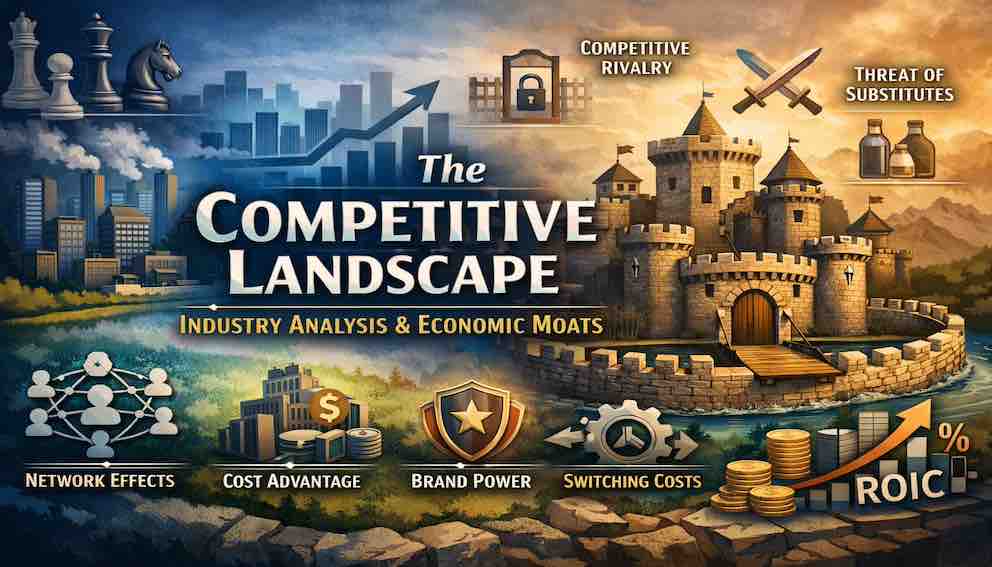
- Rivalry Among Existing Competitors: Is it a cutthroat price war (airlines, telecoms) or a genteel competition (luxury brands)?
- Threat of New Entrants: How easy is it for a new player to join the fight? High barriers (regulatory licenses, billion-dollar factories) protect the incumbents.
- Bargaining Power of Suppliers: Can the companies that supply raw materials or components easily raise prices? A mining company supplying a critical metal has immense power.
- Bargaining Power of Buyers: Can customers easily demand lower prices or switch? A single government buyer has huge power; an individual buying a candy bar has very little.
- Threat of Substitute Products/Services: Could a completely different product meet the same need? (e.g., videoconferencing substitutes for business travel).
The Investor’s Takeaway: Industries where these five forces are intense are economic warzones. They tend to produce low, unstable returns on capital. Industries where the forces are muted are economic castles, often allowing for sustained high profitability. Your first job is to classify the battlefield.
Part 2: The Castle Walls—The Four Types of Economic Moats
A favorable industry is the kingdom, but a company’s moat is the specific, formidable wall around its castle. These are structural, identifiable advantages that allow a business to defend its profits. They typically fall into four categories.
Moat Type 1: Network Effects—The Power of the Crowd
This moat exists when a product becomes more valuable as more people use it, creating a self-reinforcing cycle.
- Example in Action: Think of a social media platform or a payment network like Visa. The platform is useful because your friends are there; the payment network is accepted because everyone uses it. A competitor would need to move an entire crowd at once, which is nearly impossible.
- Financial Fingerprint: Look for sky-high user engagement, extremely low customer churn, and revenue that scales effortlessly with minimal extra cost. Market share is often dominant and static.
Moat Type 2: Cost Advantage—The Unbeatable Price
This is the ability to produce and deliver a good or service at a sustainably lower cost than anyone else.
- Example in Action: Consider Costco or a dominant low-cost airline. Through sheer scale, unique processes, or privileged access to resources, they can offer prices competitors can't match without losing money.
- Financial Fingerprint: The clearest sign is consistently higher gross margins than industry peers. Alternatively, you might see a company maintain solid profitability while being the undisputed low-price leader in its market.
Moat Type 3: Intangible Assets—The Invisible Fortress
This moat is built on assets you can’t touch but are incredibly valuable: powerful brands, patents, or regulatory licenses.
- Example in Action: Coca-Cola’s brand commands loyalty and allows for premium pricing. A pharmaceutical company’s patents grant a temporary monopoly on a life-saving drug.
- Financial Fingerprint: This manifests as pricing power (the ability to charge more for a similar product), high returns on capital in a competitive industry, and significant investment in R&D or brand-building on the balance sheet.
Moat Type 4: Switching Costs—The "Too Much Trouble" Trap
This moat exists when it is painfully difficult, expensive, or risky for a customer to switch to a competitor.
- Example in Action: Adobe’s Creative Cloud for designers or Oracle’s database software for large enterprises. Switching would mean retraining staff, migrating data, and risking business disruption—a cost far outweighing any potential savings.
- Financial Fingerprint: Search for exceptionally high customer retention rates, predictable recurring revenue streams, and long-term contracts. These businesses have customers who are essentially "locked in."
Part 3: Connecting Moats to Money—The Financial Proof & The Compounding Engine
More importantly, these financial signals reveal the compounding engine at work. A strong moat does more than protect today's profits; it ensures that the high ROIC and strong free cash flow we learned to value can be reinvested back into the business at similarly high rates for years to come. Without a moat, high ROIC attracts competition, which drives returns down. With a moat, a company can reinvest its cash flows to compound value, turning internal efficiency into lasting owner wealth.
When you suspect a moat, look for this proof:
- Pricing Power & Stable/Expanding Margins: Can the company raise prices without losing customers? In tough times, do its gross and operating margins hold firm or even improve relative to peers? This is a direct sign of a defensive advantage.
- High & Consistent Return on Invested Capital (ROIC): This is the ultimate test. A moat allows a company to earn high returns on its capital for a long time. Look for ROIC that is not just high, but stable or rising over a 10-year period. This consistency is the hallmark of a protected business.
- Durable Market Share & Customer Loyalty: Does the company maintain or grow its share of the market over an economic cycle? Are customer retention rates exceptionally high?
The Critical Step: Benchmark Against the Tribe
Never evaluate a moat in isolation. You must compare the company’s key metrics—margins, ROIC, growth—to its direct peers. A company that consistently outperforms its competitors in a stable industry likely has a moat. One whose fortunes rise and fall with the industry cycle probably does not.
Part 4: The Durability Test—Will the Moat Hold?
The hardest part of moat analysis is assessing its sustainability. History is littered with "unassailable" competitive advantages that were eroded. As an analyst, you must stress-test the moat by asking:
- Could Technology Disrupt It? (e.g., Streaming video eroded the moat of cable TV companies built on infrastructure and content licensing).
- Could Customer Preferences Change? (e.g., A beloved brand can fall out of fashion).
- Could Regulation Change or Global Competition Emerge? (e.g., Trade agreements or deregulation can lower barriers to entry overnight).
- Is the Advantage Truly Structural or Just Temporary Operational Excellence? (Excellent management is not a moat; it can leave or be copied).
A moat is only as good as its ability to withstand the tests of time and change.
Putting It All Together: A Practical Case Study
Let’s apply the full framework to a clear example.
The Company: The Vanguard Group (the asset manager)
- Industry Analysis (The Battlefield): Asset management is competitive, but threat of new entrants is moderate (building trust takes time), and buyer (investor) power is high (they can move money easily). However, Vanguard operates in a specific niche.
- The Suspected Moat: Unscaleable Cost Advantage. Vanguard’s unique mutual ownership structure allows it to operate at cost, passing savings to investors in the form of the lowest fees in the industry.
- Financial Proof & Benchmarking:
- Pricing Power: It has reverse pricing power—it lowers fees, crushing competitors' margins.
- ROIC & Margins: While its margins are thin, its scale is immense and growing, and its market share consistently increases as it wins the price war.
- Vs. Peers: Compare its fee ratios and fund flows to those of Fidelity or BlackRock. Vanguard’s structural cost advantage is evident and persistent.
- Durability Test: Is the moat sustainable? Likely yes. The ownership model is hard to replicate, and the cost advantage is self-reinforcing: lower fees attract more assets, increasing scale and enabling even lower fees. Technology or regulation could change the game, but the core structural advantage is deep.
Conclusion: The Owner’s Mindset—Seeking Durability
Investing is the long-term pursuit of compounding wealth. For compounding to work, profits must be recurring, defensible, and reinvestible. Industry and moat analysis are the tools that move us from evaluating "a good business" to identifying "a good business that is likely to stay good for the next 20 years."
Think like an owner, not a trader: If you were told you had to own this business and could not sell it for two decades, how would you feel? Would you be confident that its profits are protected? Or would you lie awake at night worrying about competitors, new technologies, and fickle customers?
Your goal is to find companies with wide moats in favorable industries, verify their strength in the financials, and have a reasoned view on their durability. When you do, you have found a true partner for the long-term journey of ownership—a business built not just for success, but for longevity.
Think Like an Owner: Look at a product you use that would be very hard to replace (your smartphone’s operating system? Your primary bank account?). Now, think of a product you could switch away from instantly (a brand of paper towels? A gas station?). The friction you feel—or don’t feel—in switching is a direct reflection of the presence or absence of an economic moat. Start noticing this friction in your daily life.
About Swati Sharma
Lead Editor at MyEyze, Economist & Finance Research WriterSwati Sharma is an economist with a Bachelor’s degree in Economics (Honours), CIPD Level 5 certification, and an MBA, and over 18 years of experience across management consulting, investment, and technology organizations. She specializes in research-driven financial education, focusing on economics, markets, and investor behavior, with a passion for making complex financial concepts clear, accurate, and accessible to a broad audience.
Disclaimer
This article is for educational purposes only and should not be interpreted as financial advice. Readers should consult a qualified financial professional before making investment decisions. Assistance from AI-powered generative tools was taken to format and improve language flow. While we strive for accuracy, this content may contain errors or omissions and should be independently verified.