
Tutorial Categories
Last Updated: January 31, 2026 at 19:30
Your Financial Crystal Ball (That's Not Magic): A Practical Guide to Investment Calculators - Introduction to Investing
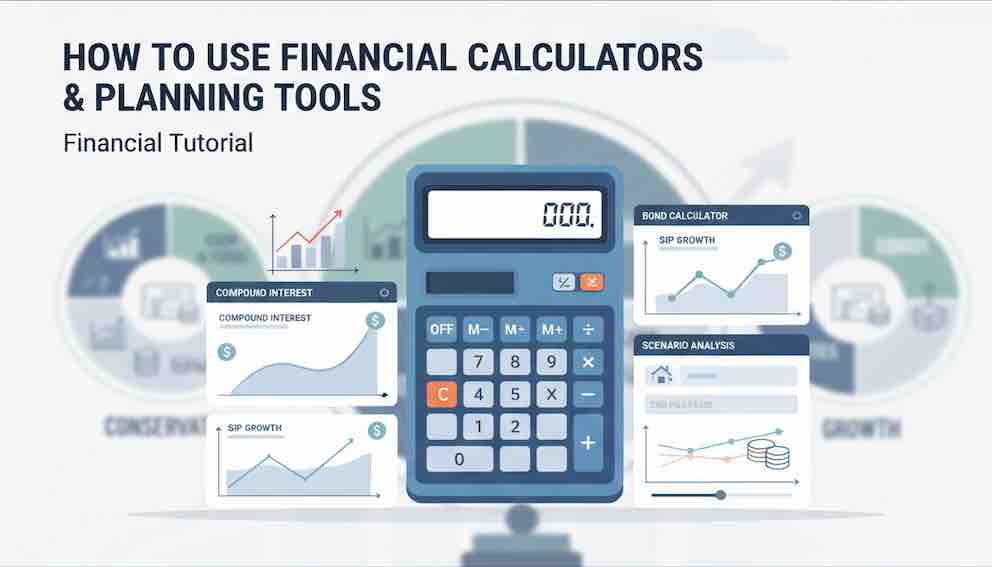
Investment calculators don't predict the future—they map the power of your decisions. This guide shows you how to use free online tools to answer real questions: "How much do I need to save for a house deposit?" or "Can I retire at 60?" We'll walk through compound interest, SIP, and retirement calculators with real-number examples, teach you vital scenario analysis, and reveal what these tools can and cannot do. Stop guessing and start planning with clarity.
Introduction: From "Someday" to a Plan
You know how to invest. But a crucial question remains: "How much do I need, and by when, to reach my goal?"
This is where investment calculators transform anxiety into action. They are not magic crystal balls. Think of them as financial GPS systems. You input your destination (goal) and your starting point, and they show you the route and how long it will take based on your speed (rate of return). If you change the speed, the ETA changes.
A Critical First Rule: Calculators are for money you can leave invested. Your emergency fund and cash for needs within the next 1-3 years should not be part of this calculation. They belong in safe, accessible savings.
This tutorial will make you fluent in using these GPS tools. We'll follow Sam, 28, who wants to build a £25,000 house deposit in 5 years and understand his retirement prospects. By the end, you'll run the same calculations for your own goals.
Part 1: The Engine Room – The Compound Interest Calculator
This is the most important calculator. It answers: "What will my lump sum grow to over time?"
The Core Insight: Compounding is growth on growth. It's not linear; it's exponential. Time is its fuel.
Sam's Question: "I have £5,000 saved. If I invest it for my house deposit, what could it be worth?"
- He opens a compound interest calculator.
- Inputs:
- Initial Investment: £5,000
- Monthly Contribution: £0 (for now)
- Annual Interest Rate: 5% (a real, or after-inflation, return estimate. If he assumes 7% market growth and 2% inflation, he uses 5% to think in today's purchasing power).
- Time Period: 5 years
- Output: ≈ £6,381
The "Aha!" Experiment – The Cost of Delay:
Sam changes one input: Time Period to 10 years.
- New Output: ≈ £8,144
- The lesson: His money didn't just grow by another £1,763. The second 5 years added more value because of compounding. Delay is incredibly expensive.
Part 2: The Discipline Machine – The SIP / Regular Savings Calculator
Most of us save monthly, not in one lump sum. This calculator answers: "What will my regular monthly investments grow to?"
The Core Insight: This is Dollar-Cost Averaging (DCA) automated. It builds wealth through consistency, not timing.
Sam's Question: "To reach £25,000 (in today's money) in 5 years, how much do I need to save each month?"
- He opens a SIP calculator.
- Inputs:
- Monthly Investment: ? (This is what we solve for!)
- Expected Annual Return: 5% (again, a real return)
- Time Period: 5 years
- He works backwards: He inputs different monthly amounts until the "Future Value" output nears £25,000.
- The Answer: ≈ £367 per month.
Sam's New Plan: Invest his £5,000 lump sum + £367/month. The calculator shows this combination could reach his £25,000 target. The calculator didn't give him a guarantee; it gave him a credible, disciplined plan.
The Critical Adjustments: Fees & The "Real" Return
Before trusting the output, Sam makes two vital adjustments:
- Fees: He expects to pay ~0.5% in fund and platform fees. He reduces his assumed return from 5% to 4.5%. His required monthly contribution now jumps to £385. This shows how fees silently but powerfully erode outcomes.
- The Return Assumption Implies a Portfolio: A 5% real return doesn't come from a savings account. It implies a portfolio with significant stock exposure and the volatility that comes with it. Sam must be comfortable with that journey's ups and downs to stick to the plan.
Part 3: The Long Game – The Retirement Calculator
This is a more advanced version of the SIP calculator that often includes inflation. It answers: "Will I have enough to retire?"
The Core Insight: Retirement planning is about purchasing power, not just a big number. You must account for inflation eating away at your savings. It also highlights path risk—the order of good and bad returns matters, especially as you near retirement.
Sam's Question: "If I save £300 a month until I'm 65, what might I have?"
- He opens a retirement calculator.
- Inputs:
- Current Age: 28
- Retirement Age: 65
- Monthly Contribution: £300
- Current Savings: £0
- Expected Annual Return: 7% (nominal, pre-inflation)
- Expected Inflation: 3%
- Output (in Today's Purchasing Power): ≈ £450,000
- (The nominal value will be much higher, but £450,000 is what it might feel like in today's money).
The Critical Step: Scenario Analysis
Sam doesn't stop. He runs two more scenarios:
- The "Pessimistic" Scenario (5% return, 3% inflation): Future Value ≈ £300,000.
- The "Optimistic" Scenario (9% return, 3% inflation): Future Value ≈ £675,000.
The Real Lesson: His future is a range, not a number. This tells him his plan is resilient—even in a low-return world, he builds a substantial pot. If he wants to ensure the upper end, he can plan to increase contributions over time.
The Tax & Account Reality: Sam knows this calculation assumes all growth is tax-free. To make it real, he must use tax-advantaged accounts (like a UK SIPP or ISA) to protect his returns. The right calculator result combined with the wrong account can still lead to disappointment.
Part 4: The Stability Tool – Bond & Fixed Income Calculators
These help you understand the loan you're making. The key output is Yield to Maturity (YTM) – your total annual return if you hold the bond to term.
Core Insight: Bond prices move opposite to interest rates. A calculator shows you this sensitivity, which is part of the volatility that gets smoothed out in long-term equity calculators.
Example: A bond calculator can show that a 10-year bond's price will fall significantly if interest rates rise 2%. This isn't a reason to avoid bonds; it's a reason to match the bond's duration to when you need the money. For a goal in 2 years, use a 2-year bond, not a 10-year bond.
Part 5: Your 30-Minute Financial Planning Sprint
Ready to do this for yourself? Here is your action plan. Use free calculators from reputable sources like Monevator (UK), Bankrate, or your pension provider's website.
Step 1: Define Your Liquid Goal. (e.g., £30,000 deposit in 6 years). Keep emergency funds separate.
Step 2: Run the Compound Interest Calc.
* Input any existing savings.
* Use a real return (e.g., 4-6% for long-term stocks minus inflation).
* See the power of time.
Step 3: Run the SIP/Regular Savings Calc.
* Solve for the monthly amount needed to bridge the gap to your goal.
* Adjust for fees: Reduce your return assumption by your total estimated costs (fund + platform fees).
Step 4: Run the Scenario Analysis.
* Re-run both calculators with a 2% lower return. This is your "stress test." Does your plan still work? Does the implied volatility of the portfolio match your emotional tolerance?
Step 5: Document, Account, & Review.
* Write down your target monthly investment, your real-return assumption, and the account type you'll use (ISA, SIPP, etc.).
* Revisit this once a year. Update your savings amount and adjust only if your goal or timeline changes.
Conclusion: The Calculator as a Coach, Not a Prophet
You now possess one of the most underrated skills in investing: the ability to turn a dream into a measurable, stress-tested plan.
- What Calculators DO: They make the invisible power of time, consistency, fees, and inflation visible. They provide a logical framework for your decisions.
- What Calculators DO NOT DO: They smooth over volatility, path risk, and tax drag. They cannot choose an asset allocation for you or predict your behaviour during a crash.
The Ultimate Test: A plan that looks perfect in a calculator but causes you to panic and sell during a market decline is a failed plan. The best calculator output is one you can emotionally live with through every season of the market.
Use these tools not to find certainty, but to build a confident, flexible, and fee-aware plan that can survive the uncertainty of real life. That’s how you move from being a passive saver to an active architect of your future.
About Swati Sharma
Lead Editor at MyEyze, Economist & Finance Research WriterSwati Sharma is an economist with a Bachelor’s degree in Economics (Honours), CIPD Level 5 certification, and an MBA, and over 18 years of experience across management consulting, investment, and technology organizations. She specializes in research-driven financial education, focusing on economics, markets, and investor behavior, with a passion for making complex financial concepts clear, accurate, and accessible to a broad audience.
Disclaimer
This article is for educational purposes only and should not be interpreted as financial advice. Readers should consult a qualified financial professional before making investment decisions. Assistance from AI-powered generative tools was taken to format and improve language flow. While we strive for accuracy, this content may contain errors or omissions and should be independently verified.