
Tutorial Categories
Last Updated: January 31, 2026 at 19:30
Putting It All Together: How to Create Your First Investing Plan with Confidence and Clarity - Introduction to Investing
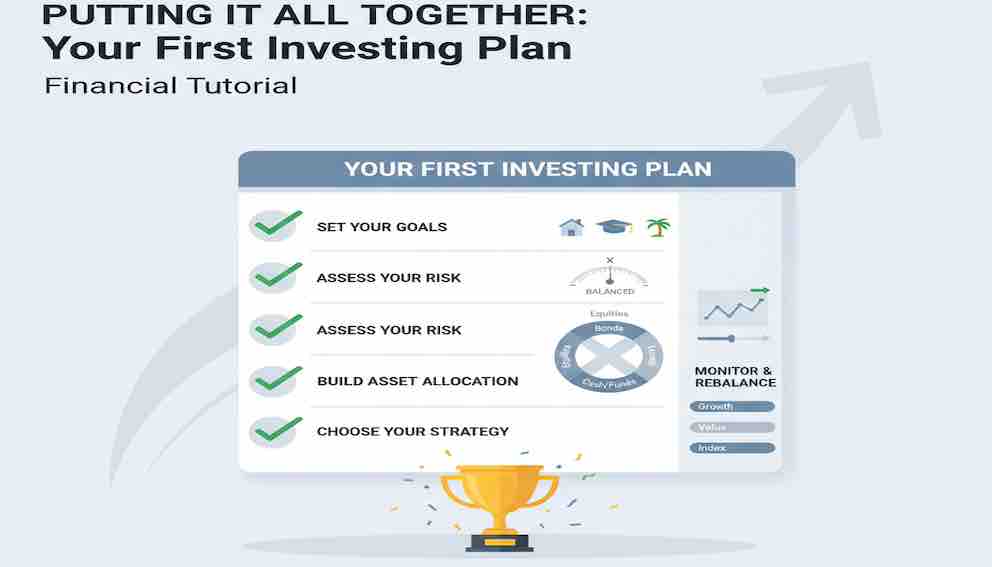
Knowledge is power, but a plan is action. This final tutorial guides you in creating your "Personal Investing Constitution"—a single document that captures your goals, strategy, and rules of conduct. We'll synthesize every lesson from the series into a step-by-step template, complete with examples. By writing, signing, and committing to this constitution, you transform from a learner into a disciplined, confident investor, ready for the long journey ahead.
Introduction: The Moment of Transformation
You've completed your training. You understand markets, psychology, risk, and tools. Now, you stand at the threshold. On one side is the theoretical world of "learning about investing." On the other is the practical world of being an investor.
Crossing this threshold requires one deliberate act: Creating your Personal Investing Constitution.
This is not just a plan; it's your foundational law. It's the document you will consult when markets are euphoric or panicked, when you're tempted to chase trends or abandon ship. It turns abstract knowledge into personal rules. Today, you will write yours.
Your Mission: Set aside 45 minutes. Get a notebook, a fresh document, or print the template below. This is your ceremony.
Part 1: The Preamble – Stating Your "Why"
Every constitution begins with first principles. This is your core purpose. It connects your money to your life.
- From Tutorial 1 (Foundation) & 5 (Goals): "I invest to build long-term security and freedom, not for short-term speculation. My invested money is for my future self and is separate from my emergency fund."
- Your Turn: Complete this sentence: "I am investing because…"
Example: "...I want to build a fund that gives me choices and security in my 50s and beyond."
Example: "...to grow my wealth steadily so I can one day work because I want to, not because I have to."
Part 2: Article I – The Bill of Rights (Your Goals)
This defines what you are building. Be specific, but not restrictive.
- From Tutorial 5 (Goals) & 14 (Calculators): *"My primary long-term goal is to build a retirement fund. Using a calculator, my target is to have the equivalent of £500,000 in today's money by age 65."*
- Your Turn: Write your Primary Goal. Include a horizon and a target (in today's purchasing power). Format: "Goal: [What]. Horizon: [When]. Target (in today's money): [Amount]."
Part 3: Article II – The Risk Tolerance Amendment
This documents your emotional limits, not your aspirations. Honesty here prevents future treason against your own plan.
- From Tutorial 4 (Psychology) & 9 (Diversification): *"I have a moderate risk tolerance. I understand markets will fall, but a peak-to-trough decline of more than 25% would cause me significant stress. Therefore, my portfolio must be constructed to limit volatility."*
- Your Turn: Write your Risk Tolerance Statement. Use this test: "If my portfolio lost ____% in a year, I would likely make an emotional decision to change my plan." Fill in the blank. That percentage defines your tolerance.
Part 4: Article III – The Framework of Government (Your Asset Allocation)
This is the core operational rule. It's the application of everything you learned about diversification.
- From Tutorial 6 (Toolkit) & 9 (Diversification): *"My asset allocation is 70% Global Equities (for growth) and 30% Global Bonds (for stability). This aligns with my moderate risk tolerance and long-term goal."*. Your Turn: Declare Your Allocation. Keep it simple. Format: "My allocation is: [ ]% Global Stock Index Fund / ETF | [ ]% Global Bond Index Fund / ETF."
Part 5: Article IV – The Taxation & Account Charter
This ensures your strategy is executed efficiently. The right investments in the wrong account can ruin the best plan.
- From Tutorial 5 (Accounts) & 14 (Calculators): "All investments will be held within tax-advantaged wrappers to maximise compounding. My primary account is a Stocks and Shares ISA. For retirement-specific funds, I will use a SIPP."
- Your Turn: State Your Account Strategy. Example: "I will implement my plan within my Stocks and Shares ISA. I will maximise my annual ISA allowance before using a General Investment Account."
Part 6: Article V – The Laws of Conduct (Contributions & Behaviour)
These are the execution rules. They automate discipline and outlaw emotion.
Section 1: The Contribution Law
- "I will invest £300 on the 5th of every month via automated direct debit. This amount will be reviewed annually with any salary increase."
Section 2: The Monitoring & Rebalancing Law
- *"I will review my portfolio once per year, on my birthday. I will rebalance back to my 70/30 allocation only if the drift exceeds 5% (e.g., if equities grow to >75% or <65%)."*
Section 3: The Amendment Clause
- "This Constitution can only be amended during a scheduled annual review, never in reaction to market news or short-term performance. Changes require written justification aligned with a change in life circumstances, not market forecasts."
Section 4: The Emergency Powers Clause (Most Important)
- *"In the event of a market decline (>20%), I am expressly forbidden from selling investments, pausing contributions, or altering this Constitution. I will re-read the Preamble and remember that my plan was designed for this."*
Your Turn: Write Your Laws. Use the same format.
Part 7: Seeing It In Action – Sam's Completed Constitution
Sam's Personal Investing Constitution
- Preamble: I invest to build long-term financial independence and choice.
- Article I – Goal: Build a retirement fund. Horizon: 37 years (Age 28 to 65). Target: £500,000 (in today's money).
- Article II – Risk Tolerance: I have a moderate tolerance. A loss of >30% would challenge my discipline.
- Article III – Asset Allocation: 70% Global Stock ETF (VWRL) | 30% Global Bond ETF (VAGP).
- Article IV – Accounts: Implemented within my Stocks and Shares ISA.
- Article V – Laws of Conduct:
- Contribute: £300/month via standing order on the 1st.
- Review/Rebalance: Annually in January. Rebalance at 5% drift.
- Amend: Only during an annual review.
- In a Crisis: I will not sell. I will continue contributions.
Signed,
Sam
Date: [Today's Date]
Conclusion: You Are Now an Investor
By writing, signing, and dating your Constitution, you have performed the essential act. You are no longer a student of investing. You are an investor.
You have a system that:
- Automates good decisions (through regular contributions).
- Eliminates emotional choices (with pre-written crisis rules).
- Manages risk (through a defined allocation).
- Focuses on controllables (savings rate, costs, behaviour).
File this document where you can find it. Your future self, during a moment of doubt or fear, will thank your present self for this clarity.
This Constitution is your anchor. The markets will provide the wind and the waves—some will push you forward, some will batter you. Your job is not to control the sea, but to ensure your ship is sound and your course is set. You have now done that.
Congratulations. Your journey is no longer about learning to invest. It is about living your plan.
About Swati Sharma
Lead Editor at MyEyze, Economist & Finance Research WriterSwati Sharma is an economist with a Bachelor’s degree in Economics (Honours), CIPD Level 5 certification, and an MBA, and over 18 years of experience across management consulting, investment, and technology organizations. She specializes in research-driven financial education, focusing on economics, markets, and investor behavior, with a passion for making complex financial concepts clear, accurate, and accessible to a broad audience.
Disclaimer
This article is for educational purposes only and should not be interpreted as financial advice. Readers should consult a qualified financial professional before making investment decisions. Assistance from AI-powered generative tools was taken to format and improve language flow. While we strive for accuracy, this content may contain errors or omissions and should be independently verified.