
Tutorial Categories
Last Updated: January 31, 2026 at 19:30
How to Start Investing: Your First Steps to a Confident Portfolio - Introduction to Investing Series
Ready to start investing but unsure where to begin? This step-by-step guide cuts through the overwhelm. Learn how to define your financial goals, honestly assess your risk tolerance, and choose the right investment accounts (ISAs, pensions, etc.). We break down how to minimize costly fees and provide a simple starter portfolio recipe. With clear examples and actionable steps, this tutorial will help you build your personalized investment blueprint and make your first investment with confidence.
Introduction: From Overwhelm to Action – Building Your Investment Blueprint
You understand why to invest and how markets work. Now comes the most empowering part: actually starting. But where do you put your first £500?
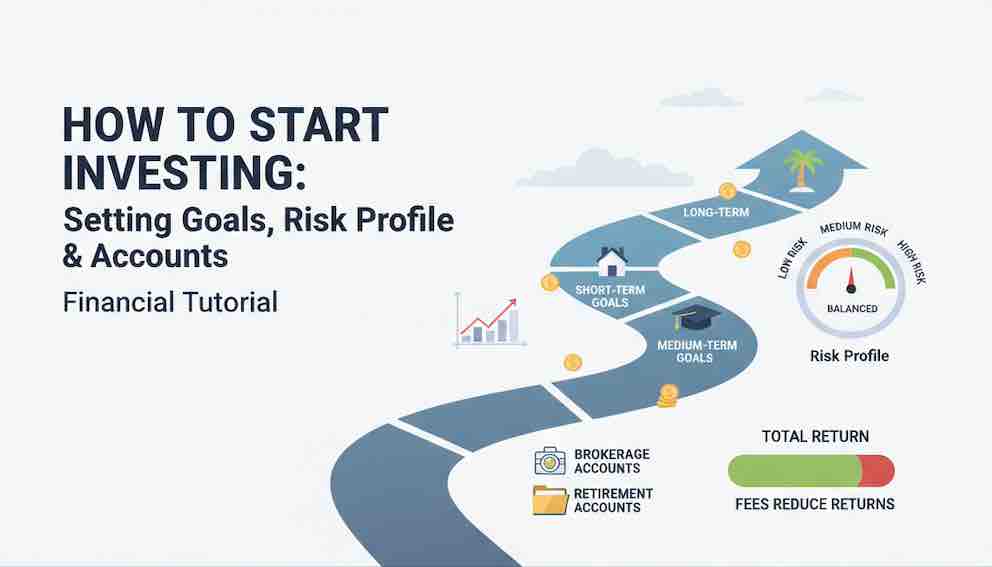
The secret is to not jump straight to picking stocks. Instead, you need a Personal Investment Blueprint. This isn't a complex financial plan; it's a one-page guide that answers four questions:
- What am I investing for? (Goals)
- How much risk can I actually handle? (Tolerance)
- Where should I hold my investments? (Accounts)
- What should I actually buy? (Strategy & Costs)
Let's build this blueprint together, following Maya, a 28-year-old graphic designer with £5,000 to start and a steady income.
Step 1: Define Your "Why" – Categorize Your Financial Goals
Your goals dictate everything. We'll sort them by time horizon, as each requires a different strategy. The key principle: Your timeline determines how much volatility (price swings) you can afford to absorb.
Short-Term Goals (0-3 Years): The "Safe Parking" Zone
- Examples: Emergency fund, holiday, car down payment, next year's tuition.
- The Rule: This is not investment money. The risk of short-term loss is too high. Use high-interest savings accounts, Cash ISAs, or premium bonds. Capital preservation is paramount.
- Maya's Goal: "I need to finish my £3,000 emergency fund. That money stays in my savings account."
Medium-Term Goals (3-10 Years): The "Balanced Growth" Zone
- Examples: House deposit, wedding, starting a business.
- The Strategy: You can accept moderate volatility for higher growth potential. A diversified portfolio of bonds and stocks (e.g., a "60/40" fund) is common. The longer the horizon within this range, the more market fluctuation you can consider.
- Maya's Goal: "I want £25,000 for a house deposit in ~7 years. This will be my first investment pot and needs a balanced approach."
Long-Term Goals (10+ Years): The "Growth Engine" Zone
- Examples: Retirement, financial independence, a child's university fund (if they're young).
- The Strategy: Time is your superpower, allowing you to withstand significant short-term volatility for higher potential long-term returns. Stock-heavy investments (like global index funds) are standard here.
- Maya's Goal: "Retirement. I'm 28, so I have a 35+ year horizon. This is for aggressive growth, and I won't panic over market drops."
Your Action: Write down your top 1-2 goals for each time horizon. Be specific with the amount and year.
Step 2: Discover Your Real Risk Tolerance – The "Sleep at Night" Test
Risk tolerance isn't about how brave you are; it's about how much volatility you can endure without making a panicked, costly mistake. It's defined by your timeline (from Step 1) and your personality.
Forget "Conservative/Moderate/Aggressive." Ask yourself:
- The 20% Drop Test: If your £5,000 portfolio dropped to £4,000 in a month, would you: a) Lose sleep and consider selling? b) Feel uneasy but check your plan? c) See it as a buying opportunity?
- The Time Commitment: Can you commit to not touching this money for the timeline of your goal, even during bad news?
- Maya's Reflection: "For my house fund (7 years), a 20% drop would scare me. I need moderate risk. For my retirement (35+ years), I know drops will happen and recover, so I can be aggressive."
A Simple Rule of Thumb: Your age can be a starting point for the bond percentage in your long-term portfolio (e.g., 28 years old = ~28% in bonds, 72% in stocks). Adjust this based on your personal comfort from the test above. For medium-term goals, lean more conservative than this rule suggests.
Step 3: Choose Your Investment "Vehicle" – Understanding Accounts
The "what" you buy (stocks, funds) is separate from the "where" you hold it (the account type). Choosing the right account is a powerful tax and strategy decision.
For UK Investors (The ISA & Pension Framework):
- Stocks and Shares ISA: Your go-to, flexible workhorse.
- Tax Benefit: All growth and income is tax-free. No capital gains or dividend tax.
- Key Features: £20,000 annual contribution limit. Withdraw anytime, tax-free.
- Best For: Medium and Long-term goals. Maya's house fund and retirement savings should start here.
- Self-Invested Personal Pension (SIPP): Your retirement turbocharger.
- Tax Benefit: Government adds 25% basic tax relief to your contributions. Higher-rate taxpayers claim more. Growth is tax-free.
- Key Features: Locked until age 55 (rising to 57). Provides a retirement pot alongside your workplace pension.
- Best For: Long-term retirement savings where you won't need the money until access age. Maya should use this for her most aggressive, long-term retirement investing.
- General Investment Account (GIA): The unlimited, taxable option.
- Tax Benefit: None. Subject to dividend and capital gains tax.
- Key Features: No contribution limits. Fully flexible.
- Best For: Once you've maxed your ISA (£20k), or for very short-term goals where an ISA's flexibility isn't needed.
Maya's Account Choice: "I'll open a Stocks and Shares ISA for my £5,000. I'll use it first for my medium-term house fund. As I save more, I'll also start a SIPP for my ultra-long-term retirement money to get the tax boost."
Step 4: Demystify All Fees – The Silent Return Killers
A 1% fee doesn't sound like much. But over decades, it's a fortune. Your blueprint must be cost-aware. Fees come in several forms:
The Major Fees:
- Platform/Account Fee: What your broker/app charges to hold your investments. Often 0.15%-0.45% per year. Some charge a flat monthly fee.
- Fund Expense Ratio (OER): The annual fee of the ETF or fund you buy. For index funds, aim for under 0.25%.
Other Costs to Be Aware Of:
- Trading Fees: While many platforms offer free trading, some still charge per transaction.
- Advisory Fees: If you use a financial advisor, they may charge a percentage of your portfolio (e.g., 1% per year).
- Early Exit/Penalty Fees: Some funds (like certain investment trusts) and products (like some pensions) have fees for selling early.
The Devastating Math of a 1% Fee:
Imagine two funds returning 7% before fees.
- Low-Cost Fund (0.2% fee): Net return ~6.8%. £10,000 becomes £76,123 in 30 years.
- High-Cost Fund (1.5% fee): Net return ~5.5%. £10,000 becomes £49,840 in 30 years.
- The 1.3% fee difference cost you over £26,000.
The Power of Compounding Contributions: Remember, it's not just about your starting lump sum. Even modest, regular contributions grow massively over time. £100 invested monthly at a 6% return becomes over £100,000 in 30 years.
Your Action: Choose a low-cost platform (compare on sites like Monevator) and build your portfolio with low-cost index funds or ETFs. Scrutinize all potential fees before you commit.
Step 5: Your First Portfolio – A Simple, Diversified Starter Recipe
You have your goals, risk profile, account, and a fee-conscious mindset. Now, what to buy? Keep it simple and globally diversified to reduce the risk of being overexposed to any single country's economy.
The Core Principle: Diversification through Global Funds. You are not buying a company; you are buying a slice of the entire global economy. This is done via a low-cost, globally diversified index fund or ETF.
Starter Portfolios Based on Risk Profile (to be held in your ISA/SIPP):
- Cautious Starter (Low Risk/Volatility): 70% Global Bond Index Fund + 30% Global Stock Index Fund.
- Balanced Starter (Medium Risk/Volatility): 50% Global Bond Index Fund + 50% Global Stock Index Fund.
- Growth Starter (High Risk/Volatility): 20% Global Bond Index Fund + 80% Global Stock Index Fund.
Maya's First Investment: "My house fund has a 7-year horizon and medium risk. I'll start with the Balanced Starter recipe in my new ISA. I'll buy one ETF that tracks global stocks (like VWRL or SWDA) for diversification and one that tracks global bonds. That's it. My portfolio is instantly diversified and set."
How to Execute:
- Open your chosen account (ISA/SIPP) with a low-cost platform.
- Set up a direct debit to automate monthly contributions—harnessing the power of compounding from day one.
- Make your first purchase(s) of the fund(s) in your chosen "recipe."
- Then, leave it alone. Let automation, diversification, and compounding work.
Conclusion & Key Takeaways: Your Blueprint is Complete
Starting is the hardest part, but you've now broken it down into a manageable, personal plan. You are no longer staring at a confusing app; you are executing a strategy you understand.
Your Investment Blueprint Checklist:
✅ Goals Defined: Sorted by timeline, with appropriate volatility strategies for each.
✅ Risk Understood: You've taken the "sleep test" and know your true comfort zone with market swings.
✅ Account Chosen: You've selected the right tax-efficient "vehicle" (ISA for flexibility, SIPP for long-term retirement).
✅ Fee-Conscious: You're committed to low-cost platforms and funds and are aware of all potential costs.
✅ Simple, Diversified Strategy: You have a global starter recipe, avoiding the complexity and risk of stock-picking.
The Final Step is Action: Open that account this week. Make that first transfer. The momentum you start today is more valuable than finding the "perfect" investment tomorrow. Your future self will thank you for the clarity, confidence, and compounded growth you've set in motion with this blueprint.
About Swati Sharma
Lead Editor at MyEyze, Economist & Finance Research WriterSwati Sharma is an economist with a Bachelor’s degree in Economics (Honours), CIPD Level 5 certification, and an MBA, and over 18 years of experience across management consulting, investment, and technology organizations. She specializes in research-driven financial education, focusing on economics, markets, and investor behavior, with a passion for making complex financial concepts clear, accurate, and accessible to a broad audience.
Disclaimer
This article is for educational purposes only and should not be interpreted as financial advice. Readers should consult a qualified financial professional before making investment decisions. Assistance from AI-powered generative tools was taken to format and improve language flow. While we strive for accuracy, this content may contain errors or omissions and should be independently verified.