Tutorial Categories
Last Updated: January 31, 2026 at 19:30
Your Investment Toolkit: Stocks, Bonds, ETFs, and Funds Explained - Introduction to Investing Series
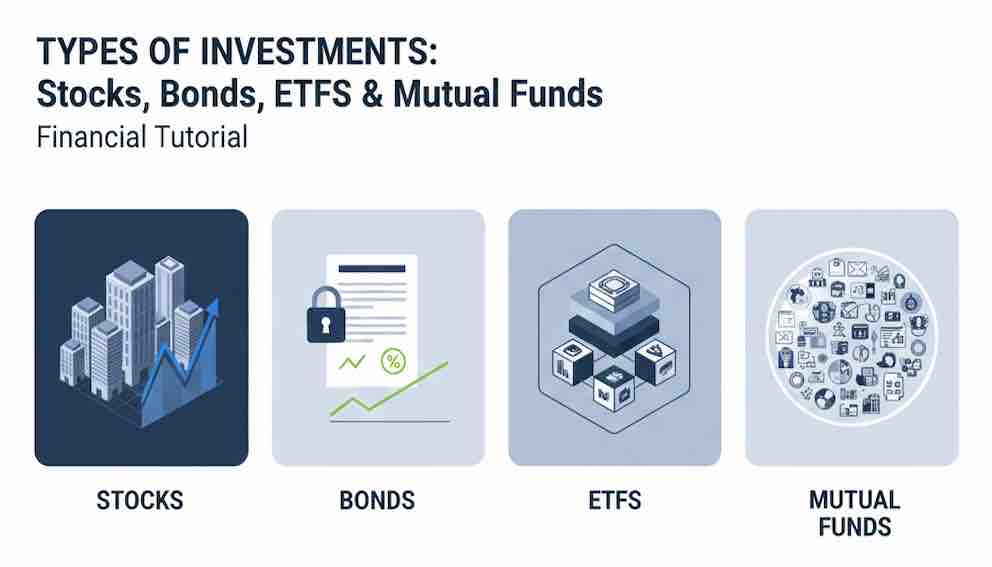
Confused by investment jargon? This clear guide breaks down the four essential building blocks: Stocks (ownership), Bonds (loans), ETFs, and Mutual Funds. Learn how each works, its unique role in a portfolio, and the pros and cons for beginners. With relatable examples and a simple framework, you'll know how to start combining these tools to build a diversified portfolio that matches your goals.
Introduction: Building Your Financial House
Imagine you're building a house. You wouldn't use only glass, or only concrete. You'd choose different materials for different jobs: a sturdy frame, a solid foundation, pre-made walls for efficiency.
Investing is similar. Your portfolio is your financial house, and you have four main types of materials to build it with:
- Stocks – The growth engine, like the timber frame.
- Bonds – The stabilising foundation.
- ETFs & Mutual Funds – The pre-fabricated, diversified wall panels.
This tutorial will explain each "material"—what it is, what it does, and where it fits. By the end, you'll be ready to start assembling a structure that's right for you.
Part 1: Stocks – Becoming a Business Owner
What it is: When you buy a stock (or share), you buy a tiny slice of ownership in a public company. You become a part-owner.
How it works – The Coffee Shop Analogy:
You and 9 friends buy your local coffee shop for £10,000, so you each own 10% (£1,000). This is "going private." If the shop becomes wildly popular, its value might rise to £20,000. Your 10% is now worth £2,000. If the shop makes a profit, you might also get a portion as a dividend.
In the stock market, it's the same, but you're buying slices of companies like Apple or Tesco through an exchange.
The Role in Your Portfolio: GROWTH. Over the long term, company ownership has historically provided the highest returns.
Key Traits for Beginners:
- Potential: High long-term growth.
- Risk: High short-term volatility (prices jump around). Your £1,000 could be £800 or £1,200 next month. The main risk is company-specific—if that one business fails.
- Liquidity: High. You can generally buy or sell shares of major companies instantly on an exchange.
- For You If: You have a long timeline (5+ years) and can tolerate ups and downs for potential higher rewards.
Beginner Tip: The risk of owning a single stock is high. This is why diversification (owning many companies) is essential, which leads us to ETFs and funds.
Part 2: Bonds – Becoming a Lender
What it is: When you buy a bond, you're not an owner; you're a lender. You loan money to a government or company. In return, they promise to pay you regular interest and give your money back on a set date.
How it works – The IOU:
Your friend needs £1,000 for a car and gives you an IOU: "I will pay you £30 each year for 5 years, then return your £1,000." That's a bond. Governments (UK Gilts, US Treasuries) and companies (corporate bonds) issue them.
The Role in Your Portfolio: STABILITY & INCOME. Bonds provide predictable payments and usually fluctuate less than stocks. When stocks fall, bonds often hold steady or rise, cushioning your portfolio.
Key Traits for Beginners:
- Potential: Lower, more predictable returns (the interest income).
- Risk: Lower volatility than stocks. Primary risks are the issuer defaulting (credit risk) or rising interest rates making your bond less valuable (interest rate risk).
- Liquidity: Varies. Government bonds are highly liquid. Some corporate or niche bonds can be harder to sell quickly without a price concession.
- For You If: You need income, are nearing a financial goal, or want to reduce your portfolio's overall rollercoaster ride.
Tax Note: Interest earned from bonds is typically subject to income tax, though some (like UK Gilts) have unique tax treatments.
Part 3: ETFs & Mutual Funds – The Instant Diversification Kits
Buying individual stocks and bonds is like making a house brick-by-brick. ETFs (Exchange-Traded Funds) and Mutual Funds are like buying pre-assembled walls—they bundle hundreds or thousands of bricks (stocks/bonds) into a single, easy package. They are the primary tool for achieving diversification, which is the best defence against the risk of any single investment failing.
What they are: Pools of money from many investors used to buy a diversified collection of assets according to a specific theme (e.g., "All US Stocks," "Green Energy Companies," "Global Government Bonds").
The Critical Difference: Passive (ETF) vs. Active (Mutual Fund) Management
ETFs – The Passive, Low-Cost Trackers:
- The Goal: Mirror a market index (like the FTSE 100). The fund is on autopilot.
- Trading: Bought/sold like a stock on an exchange, anytime during the day. High liquidity.
- Cost: Very low fees (typically 0.07%-0.20% per year) because no manager is picking stocks.
- Analogy: A robot that perfectly replicates the recipe of "The 100 Largest UK Companies."
Mutual Funds – The Actively Managed Portfolio:
- The Goal: Beat the market. A professional manager actively picks stocks/bonds they think will win.
- Trading: Bought/sold directly from the fund company once per day at a price set after markets close. Lower liquidity.
- Cost: Higher fees (typically 0.50%-1.5%+ per year) to pay for the manager's expertise.
- Analogy: A celebrity chef who creates a unique, custom menu trying to be better than the standard recipe.
The Role in Your Portfolio: EFFICIENT DIVERSIFICATION. They are the easiest, fastest way for a beginner to own a piece of the entire market, not just one or two companies, thereby mitigating single-stock risk.
Key Traits for Beginners:
- For You If (ETF): You want simple, low-cost, transparent market exposure with high liquidity. This is the default recommendation for most beginners starting out.
- For You If (Mutual Fund): You believe in a specific manager's strategy and are willing to pay higher fees for the potential of beating the market (knowing most fail to do so over time).
Tax Note: Both ETFs and funds can generate dividends and capital gains, which may have tax implications depending on your account type (e.g., ISA vs. General Account).
Part 4: How to Combine Them – Your First Portfolio Blueprints
Now, how do these materials come together? Here are two simple starter blueprints, following our house metaphor.
Blueprint A: The "Simple & Steady" Starter (Using ETFs)
- Foundation (Stability): 40% Global Bond ETF
- Frame (Growth): 60% Global Stock ETF
- Why it works: With just two funds, you own thousands of global companies and bonds. It's diversified, ultra-low-cost, and easy to manage. Perfect for a beginner's core portfolio.
Blueprint B: The "Hands-On Hybrid" (Mixing Tools)
- Foundation: 30% Government Bond ETF (For stability)
- Frame: 50% Global Stock ETF (For core growth)
- Custom Arch: 15% A few Individual Stocks (Companies you deeply believe in and have researched)
- Specialist Room: 5% A Thematic Mutual Fund (e.g., an actively managed technology fund)
- Why it works: It keeps a diversified, low-cost core but allows for targeted, hands-on investing in areas of interest. Requires more knowledge and monitoring.
Your First Best Step: For 99% of beginners, Blueprint A is the perfect place to start. It captures global growth, provides stability, and lets you learn without the complexity or high risk of stock-picking.
Conclusion & Your Action Plan: Choose Your Tools
You no longer need to see investments as a blur of confusing terms. You have a clear toolkit:
- Stocks are for ownership and growth (higher risk/reward).
- Bonds are for lending and stability (lower risk/return).
- ETFs are for low-cost, passive diversification.
- Mutual Funds are for active, professional management (for a higher fee).
Your Starter Decision Roadmap:
- Start with your goal (from Tutorial 5). Long-term? Lean on Stocks/ETFs. Short-term? Lean on Bonds/Cash.
- Choose your style: Want simplicity, low cost, and high liquidity? Use ETFs. Want to delegate picking and pay for it? Consider Mutual Funds.
- Build your core first: A simple, diversified ETF portfolio (like Blueprint A) is the most reliable foundation. You can always add individual stocks or active funds later as you learn.
- Be tax-aware: Remember that returns from these investments may be taxed. Using tax-advantaged accounts like a Stocks and Shares ISA is a powerful way to grow your money more efficiently.
Remember, a great house isn't built from one perfect material, but from the right combination for the job. Your portfolio is the same. Start with a simple, strong core, and build from there with understanding and confidence.
About Swati Sharma
Lead Editor at MyEyze, Economist & Finance Research WriterSwati Sharma is an economist with a Bachelor’s degree in Economics (Honours), CIPD Level 5 certification, and an MBA, and over 18 years of experience across management consulting, investment, and technology organizations. She specializes in research-driven financial education, focusing on economics, markets, and investor behavior, with a passion for making complex financial concepts clear, accurate, and accessible to a broad audience.
Disclaimer
This article is for educational purposes only and should not be interpreted as financial advice. Readers should consult a qualified financial professional before making investment decisions. Assistance from AI-powered generative tools was taken to format and improve language flow. While we strive for accuracy, this content may contain errors or omissions and should be independently verified.