
Tutorial Categories
Last Updated: February 9, 2026 at 18:30
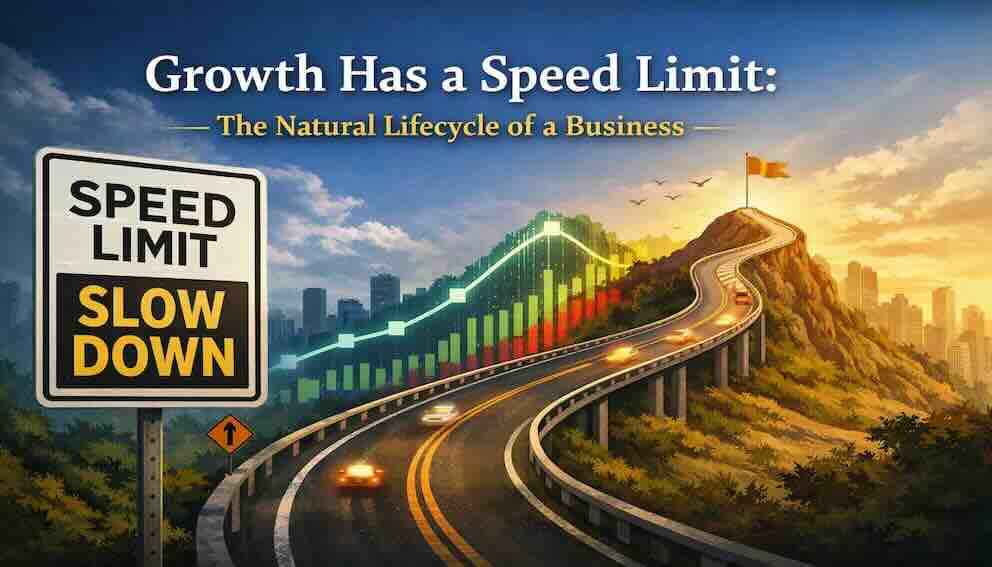
Growth Has a Speed Limit: The Natural Lifecycle of a Business
Every growth story has a natural arc. This tutorial explains the inevitable forces that slow even the most promising companies, moving beyond the excitement of early success to a clear-eyed view of business maturity. We explore how the simple mathematics of scale, the exhaustion of easy customers, the inevitable arrival of competition, and the hard ceiling of market saturation act as governing speed limits. More importantly, we distinguish between a company slowing down and an investment failing, showing how disciplined capital allocation can sustain returns long after explosive growth has passed. By understanding this universal lifecycle, investors can set realistic expectations, avoid overpaying for unsustainable momentum, and build portfolios that respect the long-term rhythms of business success.
Introduction: The Allure of the Unbroken Line
The most seductive chart in investing is the one that climbs from the bottom-left corner to the top-right in a smooth, steep, and seemingly relentless line. It tells a story of triumph, inevitability, and boundless potential. When we see a company’s revenue growing at 40% or 50% a year, it triggers a powerful instinct in our minds: to extend the line. We imagine the future as a simple, larger-scale version of the recent past, a logical extrapolation of success.
In the beginning, this vision feels justified. A startup with a transformative idea operates in a green field. The easiest, most eager customers—the “low-hanging fruit”—adopt quickly. Competitors are caught flat-footed. Growth feels not just achievable, but almost effortless, driven by the sheer force of a good idea meeting an unmet need. This phase can feel magical, creating a dangerous illusion: that the company has discovered a way to defy gravity, to grow at an accelerating pace forever.
This tutorial is about confronting that illusion with clarity, not cynicism. The deceleration of high growth is not a story of failure. It is the story of a company maturing, of transitioning from seizing territory to wisely governing it. By understanding the universal forces that act as a speed limit—forces of mathematics, market dynamics, and human behavior—we can replace euphoric extrapolation with sober analysis. This knowledge is the key to separating wonderful businesses from dangerously priced stocks, and to building investment strategies that endure across the full lifecycle of a company.
The First Governor: The Unforgiving Math of Large Numbers
The most fundamental limit on growth is not strategic error, but simple arithmetic. Growth rates are percentages, and the burden of a percentage becomes exponentially heavier as the base number expands.
Imagine a company, “Apex Software,” that achieves $20 million in revenue in its first year. To grow 50% in Year Two, it must generate $10 million in new sales—a demanding but plausible target for a hot product in a growing market. Now, fast forward. Apex is a success, a market leader with $2 billion in revenue. To grow at that same 50% rate now, it must find $1 billion in new sales within a single year.
This is the Law of Large Numbers in its most practical form. Each percentage point of growth on a larger base represents a Herculean absolute effort. It requires conquering not just new customers, but often entirely new continents or industries. The challenge transforms from one of product innovation to one of logistical enormity: managing global supply chains, scaling thousand-person teams, and navigating complex regulations. The company is no longer a speedboat; it is an aircraft carrier, requiring immense energy to change direction or add speed. This mathematical reality ensures that high-percentage growth is, by definition, a temporary condition of youth.
The Funnel Narrows: From Early Adopters to the Skeptical Masses
A company’s early explosive growth is fueled by its most receptive audience. These early adopters are enthusiasts who seek out new solutions, understand complex value propositions, and tolerate imperfections. Acquiring them is efficient and relatively cheap; they are the low-hanging fruit.
However, this fertile segment is finite. To maintain its growth rate, the company must then appeal to the early and late majority—the pragmatic, price-sensitive, and often skeptical bulk of the market. These customers are content with existing options. Persuading them requires heavier discounts, broader advertising, longer sales cycles, and more customer support. The metric that captures this shift is the rising Customer Acquisition Cost (CAC). What was once a efficient growth engine begins to sputter, requiring more fuel (capital) to produce the same thrust (new customers).
This is the universal adoption curve, visible from smartphones to streaming services. The first wave of users signs up in a frenzy; the next wave must be carefully, expensively coaxed. The funnel narrows, acting as a natural brake on the growth rate simply because each new convert is harder-won than the last.
Success Attracts a Crowd: The Inevitability of Competition
Profitable, high-growth markets are vacuums that nature—in the form of capital and ambition—ab-hors. A company proving a new market is viable does not operate in secrecy for long. It sends a signal flare to every entrepreneur, venture capitalist, and established rival.
Initially, a pioneer like Netflix in streaming enjoys a near-monopoly. But validation attracts fast followers (copycats), well-funded incumbents (like Disney entering streaming), and disruptive startups. This competitive swarm changes the game:
- Price Becomes a Weapon: The ability to raise prices, a key lever for revenue growth, evaporates. Companies often must compete on price, sacrificing profit margins to hold market share.
- Talent and Attention Get Expensive: The war for engineers and marketers escalates salaries. Winning customer attention requires ever-larger marketing budgets.
- The Innovation Tax: Resources must be diverted from pure growth to defensive R&D—not to break new ground, but to keep pace with features rivals are launching.
Competition doesn’t need to “win” to slow growth. Its mere presence divides the market, increases costs, and forces a company to fight on multiple fronts. The extraordinary growth of a monopolist naturally moderates to the very good growth of a leader in a crowded field.
The Visible Horizon: The Finite Reality of Any Market
Every market has a ceiling, a Total Addressable Market (TAM). In the early days, capturing 1% of a vast market feels like limitless potential. But as market share climbs to 10%, then 30%, the landscape changes. The remaining customers are either fiercely loyal to competitors, located in hard-to-serve regions, or simply resistant to change.
Market saturation is the point where finding a new customer is harder than getting more value from an existing one. Consider Meta (Facebook). Its explosive user growth in developed markets plateaued years ago. Its growth narrative then depended on penetrating emerging markets (with lower monetization) and increasing revenue per user in its core markets—a different, more challenging kind of growth.
Saturation is not failure; it is the destination of success. It marks the transition from a growth company to a mature enterprise. The critical investor error is paying a premium valuation—based on hyper-growth assumptions—for a company that is quietly entering this new, more sedate phase.
The Macro Backdrop: The Economic Weather for Growth
A company’s growth arc is not plotted in a vacuum; it is shaped by the prevailing economic climate. Macroeconomic regimes can act as a tailwind or a headwind, temporarily masking or accelerating the natural limits we’ve discussed.
- The Era of Cheap Capital: For over a decade following the 2008 crisis, historically low interest rates created an environment where capital was abundant and cheap. This allowed growth companies to raise vast sums to fund expansion, acquire rivals, and sustain losses far longer than fundamentals might have justified. It extended growth narratives and inflated valuations.
- The Shift to Tight Money: When central banks raise rates to fight inflation, as seen in the 2020s, that tailwind vanishes. Capital becomes expensive. Profitability and cash flow become urgent priorities overnight. Growth plans are shelved, and companies whose models relied on perpetual cheap funding are exposed. This macro shift doesn’t change a company’s long-term destiny, but it can brutally accelerate the timeline, forcing a reckoning with growth limits much sooner.
Acknowledging this is not about predicting interest rates, but about humility. It reminds us that the “speed limit” on growth can be temporarily raised or lowered by forces entirely outside a CEO’s control.
The Long Shot: When Innovation Resets the Clock
While deceleration is the rule, history offers spectacular exceptions—the rare companies that manage to reset their growth S-curve entirely. This is not merely extending the old curve, but launching a new, steeper one from a much higher base.
Apple is the canonical example. By the early 2000s, its growth as a computer maker had matured. The launch of the iPod created a new curve. But the true reset was the iPhone in 2007, which catapulted Apple from a niche tech player into a global consumer electronics and services empire, launching a decade of hyper-growth from a massive new foundation.
This feat is extraordinarily rare. It requires:
- A Truly Paradigm-Shifting Innovation: Not an iteration, but a category-defining new product or business (like Amazon Web Services).
- Execution at a Colossal Scale: Leveraging the company’s existing resources without being strangled by its existing culture.
- Timing and Luck.
For every Apple or Microsoft (with Azure), there are dozens of giants like Cisco or Intel that remain massively profitable but firmly in the mature phase of their original S-curve. As an investor, it is prudent to admire these resets in hindsight but to assign a very low probability to any given company achieving one in the future. Hope is not a strategy.
The Investor’s Trap: When a Great Business Becomes a Bad Investment
This brings us to the most common and costly error: confusing a wonderful, slowing business with a wonderful, overpriced stock. The stock market is a machine that prices future expectations. When a company is growing at 40%, the market often prices it as if 25-30% growth will persist for a decade.
The trap springs not when growth stops, but when it moderates. If Apex Software’s growth slows from 40% to a healthy 15%, the business is still thriving. But if its stock was priced for 30%, the result is a painful valuation multiple compression. The stock can stagnate or fall for years as the company “grows into” its inflated price. The underlying enterprise succeeds, but the investor suffers.
The critical lesson: Business quality and investment quality are assessed differently. The first is about products, management, and moats. The second is about the price you pay relative to realistic future outcomes.
The Path to Maturity: Slower Growth, Different Returns
This leads to a vital, often-missed nuance: Slower company growth does not automatically mean poorer investor returns. It means the driver of returns changes.
A hyper-growth company creates value by reinvesting all its cash back into seizing market share. A mature, slower-growing company generates abundant free cash flow. This cash can then be allocated to create shareholder value in other powerful ways:
- Dividends: Providing direct, recurring income.
- Share Buybacks: Reducing the share count, increasing ownership for remaining shareholders.
- Strategic Acquisitions: Buying growth or capabilities.
- Debt Reduction: Strengthening the balance sheet.
A company growing earnings at 8% per year, while simultaneously buying back 2% of its shares and paying a 3% dividend, can deliver double-digit total returns to shareholders. This is the model of a mature compounder like Johnson & Johnson or Procter & Gamble. Their stories aren’t about hockey-stick charts; they’re about steady, durable wealth creation through superior capital allocation. The investor’s task shifts from identifying the next growth rocket to identifying the best capital allocators.
A Framework for Disciplined Growth Investing
How can an investor apply this understanding? The goal is not to avoid growth companies, but to analyze them with a lifecycle lens.
- Map the S-Curve: Ask honestly: Where is this company on its adoption curve? Is it still capturing low-hanging fruit, or is it pushing into saturated, competitive territory?
- Stress-Test the TAM: Be skeptical of vast, theoretical market sizes. Focus on the Serviceable Obtainable Market (SOM)—the share the company can realistically win in the next 5-7 years.
- Model Gradual Deceleration: In your financial model, build in a logical, annual deceleration of the growth rate. Never extrapolate the last three years into the next ten.
- Demand a Margin of Safety: The loftier the growth assumptions baked into the stock price, the larger the risk of multiple compression. Your valuation must provide a buffer for things to go reasonably well, not perfectly.
- Watch the Behavioral Biases: Name your own demons. Are you succumbing to:
- Extrapolation Bias (assuming the trend is forever)?
- Recency Bias (overweighting the most exciting data)?
- Narrative Bias (falling in love with the story over the numbers)?
- Confirmation Bias (seeking only information that supports your bullish thesis)?
Conclusion: The Long View
Understanding that growth has a speed limit is an exercise in realism that liberates an investor from the frenzy of chasing the next big thing. It teaches us that businesses, like organisms, have natural lifecycles of youth, growth, maturity, and renewal.
This knowledge allows us to appreciate each phase for what it offers. We can seek the explosive potential of a company on the steep part of its S-curve, but with eyes wide open to the limits ahead. We can also recognize and value the profound, compounding power of a mature enterprise that has learned to wisely steward its resources.
Most importantly, it inoculates us against the most dangerous idea in investing: that “this time is different.” History’s lesson is that the laws of mathematics, competition, and market saturation are enduring. By respecting these laws, we ground our decisions not in the temporary stories of the moment, but in the timeless rhythms of how companies—and ultimately, how capital—grows and compounds over the long term. This is the foundation of patience, discipline, and enduring success.
About Swati Sharma
Lead Editor at MyEyze, Economist & Finance Research WriterSwati Sharma is an economist with a Bachelor’s degree in Economics (Honours), CIPD Level 5 certification, and an MBA, and over 18 years of experience across management consulting, investment, and technology organizations. She specializes in research-driven financial education, focusing on economics, markets, and investor behavior, with a passion for making complex financial concepts clear, accurate, and accessible to a broad audience.
Disclaimer
This article is for educational purposes only and should not be interpreted as financial advice. Readers should consult a qualified financial professional before making investment decisions. Assistance from AI-powered generative tools was taken to format and improve language flow. While we strive for accuracy, this content may contain errors or omissions and should be independently verified.