
Tutorial Categories
Last Updated: February 9, 2026 at 18:30
Mean Reversion in Investing: Why Extreme Success Rarely Lasts Forever
In the world of investing, periods of extraordinary success often feel like they will last forever. A company dominates its industry for a decade, a technology sector seems to redefine the economy, or a market delivers returns that feel like a new normal. Mean reversion is the quiet force that explains why these golden ages rarely persist. It is not a law of failure, but a principle of normalization—the tendency for exceptional performance, whether spectacularly good or disastrously bad, to gradually return toward long-term averages. This tutorial explores mean reversion not as abstract theory, but as a practical reality visible in companies, sectors, and entire markets. By understanding why past winners so often become future disappointments, and learning to distinguish normal correction from permanent decline, investors can build more realistic expectations and make decisions grounded in economic reality rather than recent excitement.
Introduction: The Seduction of the Straight Line
Human psychology is wired for pattern recognition. When we see a line chart moving steadily upward for years—be it a company's profits, a sector's stock performance, or a national market index—our minds subtly begin to project that line forward indefinitely. We start to believe the exceptional has become ordinary. This cognitive bias, known as extrapolation, is one of the most common and costly mistakes in investing. It leads us to pour money into what has already worked brilliantly, often at the precise moment when the conditions for that success are fading.
Consider the experience of an investor in the late 1990s watching the NASDAQ index. For five years, technology stocks had delivered returns that dwarfed every other sector. The narrative was compelling: the internet was changing everything, traditional valuation metrics were obsolete, and a new economic paradigm was born. To bet against that rising line felt not just pessimistic, but foolish. Yet, the very force that makes such runs possible—a confluence of innovation, capital, and euphoria—contains the seeds of its own moderation.
Mean reversion is the concept that helps us understand this moderation. It is the statistical and economic tendency for extreme outcomes to move back toward a historical average over time. In finance, it manifests as the slow, often imperceptible gravitational pull that brings high growth rates, elevated profit margins, and inflated valuations back to earth. This tutorial will walk through this concept step by step. We will see how it operates at the level of a single business, within a hot industry, and across whole economies. The goal is not to promote cynicism, but to cultivate a wiser, more durable optimism—one that respects cycles and prepares for the inevitable return to the mean.
Understanding Mean Reversion: The Pendulum and the Pool
To grasp mean reversion, it helps to move away from finance momentarily and consider two simple analogies: a pendulum and a swimming pool.
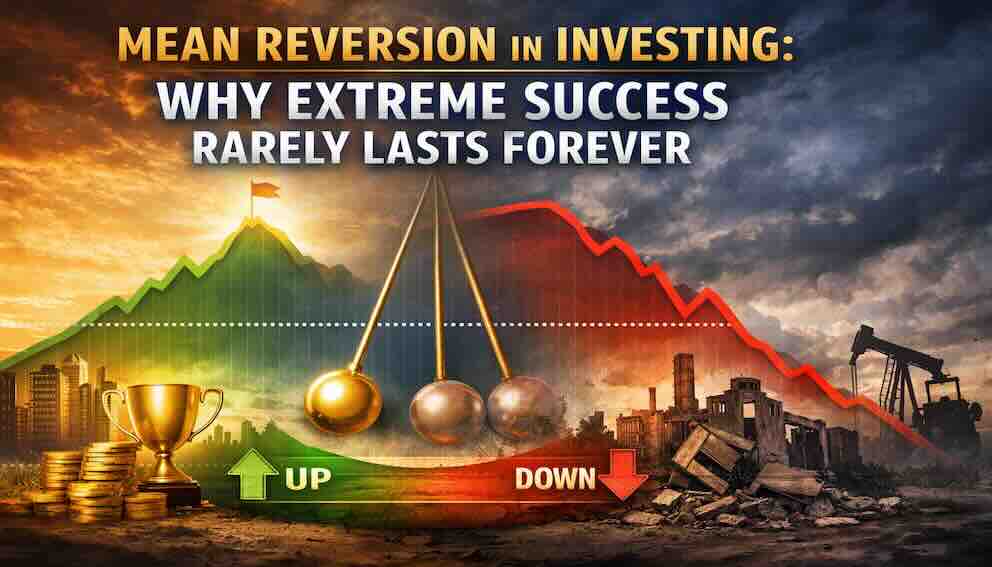
The Pendulum: Imagine a clock's pendulum resting at its center point (the mean). If you pull it to one extreme and release it, it will swing back through the center and toward the opposite extreme, eventually settling back in the middle. The force pulling it back is gravity. In markets, the "gravity" is a combination of competition, valuation, and economic reality.
The Swimming Pool: Think of a company's return on capital as the water level in a pool. A massive, sustained success is like pouring a huge volume of water into one end. The water level at that end spikes dramatically. But water seeks its own level. Over time, it will spread out until the surface is even again. This "spreading out" happens through competition—other companies see the high returns and jump in, new entrants arrive, and customers push for lower prices—until profitability equilibrates across the industry.
Mean reversion, therefore, is not a story of things "going wrong." It is a story of exceptional conditions normalizing. A student who gets a 98% on a test after a lifetime of 75% averages didn't suddenly become a genius; they benefited from a perfect alignment of preparation and questions. The next test will likely see a result closer to their true average. Similarly, a company might enjoy a perfect storm of low interest rates, soaring demand, and weak competition. Maintaining that storm indefinitely is virtually impossible. The return to a more sustainable level of performance is mean reversion in action.
The Critical Distinction: Business Performance vs. Investment Returns
Before we explore specific examples, we must separate two concepts that often get blurred: the mean reversion of business fundamentals and the mean reversion of investment returns. Understanding this distinction is crucial to avoiding a common misinterpretation.
Mean Reversion in Fundamentals refers to business metrics like sales growth, profit margins, and return on capital. These tend to normalize due to competition, saturation, and the law of large numbers. A company growing at 40% annually will almost certainly see that rate slow as its market matures.
Mean Reversion in Investment Returns refers to stock price performance. This is powerfully influenced by the starting valuation—the price you pay for those future fundamentals. This is where the investor's experience diverges from the company's reality.
A company can deliver solid, improving business results for a decade while its stock delivers poor or flat returns. How? If investors paid an extremely high price (a sky-high price-to-earnings ratio) at the peak of optimism, then even good growth can be disappointing relative to those lofty expectations. The stock's return "reverts" as the valuation multiple slowly compresses back to normal levels.
Conversely, a mediocre business purchased at a deeply depressed price—perhaps during a crisis or period of extreme pessimism—can deliver excellent investment returns as sentiment and valuation simply normalize to "average" levels.
The key insight: You are paid as an investor based on the relationship between the price you pay and the fundamentals you receive, not on business quality alone. Mean reversion in stock returns is often more about the reversion of irrational valuations than the reversion of business excellence.
Mean Reversion in Individual Companies: The Burden of High Expectations
Let's follow the journey of a hypothetical, but very real-seeming, company: "AlphaTech." AlphaTech invents a revolutionary battery that lasts twice as long as competitors' products. For five years, it experiences explosive growth: 40% annual sales increases, profit margins of 30%, and a stock price that rises 500%. The story is fantastic, the management is competent, and the products are beloved. An investor looking at this track record might reasonably assume this is the new normal.
But beneath the surface, forces are aligning to pull AlphaTech back toward the mean:
- The Competition Response: AlphaTech's fat margins are a beacon to every engineer and venture capitalist in the world. Startups emerge. Established giants redirect R&D budgets. Within a few years, "good enough" alternatives appear at lower prices.
- The Customer Response: Early adopters paid a premium. The mass market is more price-sensitive. To maintain growth, AlphaTech must lower prices, sacrificing margin.
- The Law of Large Numbers: Growing 40% on a $100 million base requires $40 million in new sales. Growing 40% on a $2 billion base requires $800 million in new sales. Finding that much new demand is exponentially harder.
- Valuation Gravity: During its hot streak, investors priced AlphaTech as if 40% growth would continue for a decade. The stock traded at 60 times earnings. For the stock to keep rising, AlphaTech must not just grow, but astonish. When growth moderates to a still-impressive 15%, the stock stagnates or falls as the valuation (the P/E ratio) compresses back toward 25.
This is the cruel math of mean reversion for individual companies. The business can be thriving, respected, and profitable, yet still be a poor investment if you bought at the peak of inflated expectations. The disappointment isn't in the company's performance, but in the gap between the expectations baked into the price and the reality of a normalizing, competitive world.
Mean Reversion at the Sector Level: The Boom and Bust of Capital
Zooming out, mean reversion plays out dramatically across entire industries. Sectors like biotechnology, clean energy, or cloud computing periodically capture the imagination of the investment world. Capital floods in. This is not a passive process; it is an active, self-reinforcing, and ultimately self-defeating cycle.
Phase 1: The Virtuous Cycle (The Boom). A genuine innovation sparks growth. Early companies profit. Investors pour money in, funding expansion and new ventures. Stock prices rise, making it cheap for those companies to raise more capital to grow even faster. Success breeds success... for a time.
Phase 2: The Capital Tide (The Overinvestment). Here, success sows the seeds of its own moderation. Abundant, cheap capital leads to overinvestment. Every company builds excess capacity. Too many firms chase the same customers. Wages for specialized talent are bid up. Regulatory scrutiny increases. While the sector's total revenue might keep growing, profitability (return on capital) begins its inevitable slide back toward the mean. The economic water level is spreading across the pool.
Phase 3: The Sentiment Shift (The Bust). Investor psychology, which amplified the boom, now accelerates the correction. As growth rates slow from "spectacular" to "very good," the narrative sours. The same analysts who preached a new paradigm now highlight risks. Capital becomes scarce. Weaker players fail or are acquired. The sector falls out of favor and underperforms for years, often until sentiment is so poor that valuations again offer a margin of safety.
The history of U.S. railroads in the 19th century, Japanese equities in the 1980s, and telecoms in the late 1990s are textbook examples. Each was a transformative, "can't-lose" sector that attracted a tidal wave of capital, leading to overcapacity, brutal competition, and massive wealth destruction for those who bought at the peak. The sector didn't die (railroads are still crucial), but the returns on capital invested at the euphoric peak reverted violently to—and often far below—the mean.
The Unseen Filter: Survivorship Bias and the Limits of Reversion
When we study financial history, we must remember that we are looking at a filtered record. We see the companies and sectors that survived long enough to experience mean reversion. This creates a subtle distortion called survivorship bias.
We remember and study the Ciscos and Microsofts of the Dot-com era—companies whose valuations soared and then reverted but whose businesses endured. We easily forget the countless startups—the Pets.coms and Webvans—that vanished entirely. For them, there was no "reversion to the mean"; there was simply failure and disappearance.
This matters because it reminds us that mean reversion is a probabilistic tendency of systems, not a guaranteed outcome for every participant. In a hot sector, some companies will see their performance normalize, others will be acquired, and many will fail. The system's overall returns revert, but the individual fates vary wildly.
This underscores the importance of focusing on companies with durable advantages, strong balance sheets, and adaptable management—qualities that increase the odds of surviving the down-cycle and participating in the next up-cycle, rather than being erased from the sample altogether.
The Patient Force: Understanding the Time Horizon of Mean Reversion
One of the most frustrating aspects of mean reversion is its stubborn refusal to operate on a convenient schedule. It is not a short-term trading signal. Its power is revealed over years and decades, not weeks or months.
In the short term (1-3 years), momentum and sentiment often dominate. A hot stock can get hotter, and an undervalued one can become more undervalued. Attempting to "trade" mean reversion based on a quarter or even a year of data is a recipe for frustration and loss. The economist John Maynard Keynes famously quipped, "The market can remain irrational longer than you can remain solvent," warning against betting too aggressively against a trend.
Mean reversion works slowly because it requires the underlying economic and competitive forces to play out. It takes time for new competitors to engineer products, for customers to change habits, and for investor psychology to shift from greed to fear or vice versa. Many investors who correctly identify an extreme fail because their time horizon is too short; they give up before the gravitational pull of the mean finally asserts itself.
Therefore, applying the concept successfully requires a long-term mindset. It is a framework for setting realistic expectations over a full market cycle (5-10 years), not a tool for timing the next correction.
When the Rule Bends: Exceptions to Mean Reversion
While mean reversion is a powerful tendency, it is not an iron law. Some businesses and models seem to defy it for remarkably long periods. Recognizing these exceptions helps us apply the concept with nuance rather than dogma.
Mean reversion can be muted or delayed in:
- Winner-Take-Most Markets: In businesses with strong network effects (social media, payment platforms) or high switching costs (enterprise software), the leading company can sustain superior returns for decades as its advantage compounds.
- Exceptional Franchises: Companies with uniquely powerful brands, regulatory licenses, or cultural embeddedness (think of certain luxury goods or confectionery companies) can maintain above-average profitability across generations.
- Perpetual Reinvention: Rare management teams that systematically reinvest to disrupt their own business before competitors can, in effect, create a series of new growth cycles, appearing to "reset" the mean.
However, even in these cases, valuation still matters profoundly. An exceptional business bought at an exceptional price can still be a poor investment. The reversion may occur not in the company's profit margins, but in the investor's return as the valuation premium fades. The lesson is not to ignore mean reversion, but to understand which elements of it (fundamentals vs. valuation) are most relevant to each specific situation.
Applying the Concept: A Framework for Thoughtful Investing
Understanding mean reversion is not about developing a formula, but about cultivating a mindset that influences how you build and manage a portfolio. Here is a conceptual framework for applying these insights.
1. Cultivate Realistic Expectations: When evaluating any investment, consciously ask: "Am I extrapolating recent success? Is this level of growth or profitability sustainable against competition and time?" Anchor your estimates to long-term industry averages, not short-term streaks.
2. Respect Valuation as Your Safety Margin: The price you pay is your single greatest lever against mean reversion in returns. Buying at a reasonable or low valuation provides a buffer if growth slows. Buying at a high valuation leaves no room for error.
3. Embrace the Discipline of Rebalancing: This is a mechanical way to harness mean reversion. By periodically selling a portion of what has done well (and likely become a larger, more expensive part of your portfolio) and buying what has lagged, you systematically "sell high and buy low" across your assets. It forces you to counteract extrapolation.
4. Diversify Across Cycles: Avoid over-concentrating in the currently celebrated sector or style. A portfolio spread across different industries, geographies, and market capitalizations is more likely to have some components benefiting from mean reversion upward while others normalize downward, creating smoother long-term results.
5. Seek Quality in Unloved Areas: Instead of chasing past winners, use the concept to guide your search. Look for solid companies in out-of-favor industries where pessimism has pushed prices below reasonable value. You're not betting on a return to spectacular growth, but on a normalization of sentiment and valuation.
Conclusion: The Wisdom of the Cycle
Mean reversion teaches a lesson in financial humility. It reminds us that in competitive systems, extraordinary outcomes are just that—extraordinary. They are deviations from a norm sustained by temporary alignments of favorable conditions. The wise investor learns to recognize these deviations, not with the intent of precise timing, but with the goal of maintaining balanced expectations.
We have seen how this force operates on multiple levels: in the compression of a single company's valuation, in the capital cycle that cools a hot sector, and in the long-term anchor that economic reality provides for entire markets. We've also explored its limits—how survivorship bias filters our view, how time tests our patience, and how exceptional models can bend the rule.
Ultimately, embracing mean reversion is not about predicting the next downturn. It is about building a durable strategy that doesn't require perpetual excellence to succeed. It encourages us to value margin of safety over momentum, patience over excitement, and cyclical wisdom over linear extrapolation. By making peace with the fact that all things regress toward the mean, we free ourselves from chasing the exceptional and can focus instead on the sustainable—which, in the long journey of investing, is the most exceptional strategy of all.
About Swati Sharma
Lead Editor at MyEyze, Economist & Finance Research WriterSwati Sharma is an economist with a Bachelor’s degree in Economics (Honours), CIPD Level 5 certification, and an MBA, and over 18 years of experience across management consulting, investment, and technology organizations. She specializes in research-driven financial education, focusing on economics, markets, and investor behavior, with a passion for making complex financial concepts clear, accurate, and accessible to a broad audience.
Disclaimer
This article is for educational purposes only and should not be interpreted as financial advice. Readers should consult a qualified financial professional before making investment decisions. Assistance from AI-powered generative tools was taken to format and improve language flow. While we strive for accuracy, this content may contain errors or omissions and should be independently verified.