
Tutorial Categories
Last Updated: February 19, 2026 at 10:30
Investment vs Speculation: Key Differences Explained — How to Tell What You're Really Doing
Many people believe they are investing when, in reality, they are speculating without realizing it. This tutorial explores the deep and often misunderstood difference between investment and speculation by examining intent versus outcome, time horizon, and the role of uncertainty. You will learn why speculation can feel responsible and intelligent even when it is not, and how emotions, stories, and market excitement blur the line between the two. Through practical examples and everyday language, this lesson helps you build a clearer mental framework for deciding how to deploy your money wisely.
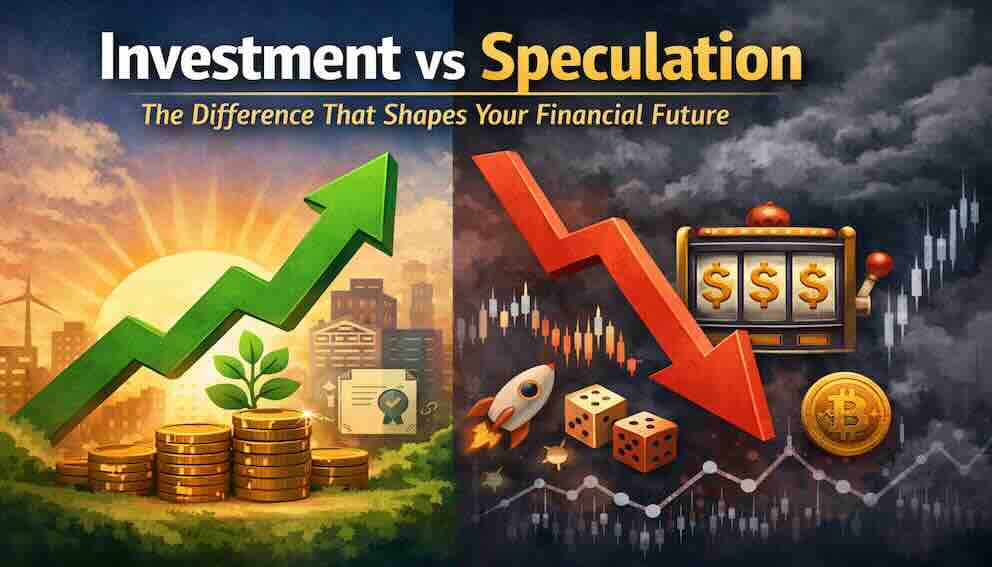
One of the most important ideas in all of personal finance is also one of the most commonly misunderstood: the difference between investing and speculating. Many people assume that if money is placed into stocks, cryptocurrencies, real estate, or businesses, then it must automatically count as investing. The reality is far more nuanced, and misunderstanding this distinction can quietly sabotage long-term financial goals.
This confusion does not happen because people are careless or unintelligent. It happens because speculation often disguises itself as investing. It uses similar language, similar tools, and sometimes even similar assets. Both involve putting money at risk with the hope of future gain. Both can occasionally produce positive outcomes. Both can involve research, charts, news, and confident explanations. On the surface, they can look nearly identical.
In early 2026, with margin debt at record levels exceeding $1.2 trillion and leveraged products widely accessible, the line between investing and speculating feels blurrier than ever for everyday investors. Understanding the difference is no longer an abstract intellectual exercise—it is a practical necessity.
However, beneath that surface lies a fundamental difference in philosophy, intention, and structure. That difference influences how you respond to risk, how you behave during market stress, and whether your financial life compounds steadily or lurches unpredictably.
Understanding this distinction is not about shaming certain strategies or declaring one approach morally superior. It is about clarity. When you know whether you are investing or speculating, you can align your expectations, your behavior, and your emotional resilience accordingly. Without this clarity, you are far more likely to experience disappointment, frustration, and costly mistakes.
Defining the Two Paths
What Investment Really Means
Investment, at its core, is the act of committing capital to assets that are expected to generate value over time through their productive capacity.
That sentence may sound formal, so let us translate it into everyday language.
When you invest, you are purchasing something because you believe it will produce income, growth, or usefulness that persists across many years. You are not primarily relying on finding someone else who will pay you more tomorrow. Instead, you are relying on the underlying asset itself to create value.
A classic explanation comes from Benjamin Graham, who described an investment operation in The Intelligent Investor as one that, "upon thorough analysis, promises safety of principal and an adequate return. Operations not meeting these requirements are speculative."
This definition emphasizes three important ideas:
- The decision is based on analysis, not excitement.
- There is a focus on protecting capital.
- Returns are expected to be reasonable, not extraordinary.
Investment is therefore slow, methodical, and often boring. It involves accepting that progress happens gradually and that wealth is built through patience rather than dramatic wins.
Examples of investment include:
- Buying shares in profitable companies that generate consistent earnings.
- Purchasing a rental property that produces steady cash flow.
- Owning diversified index funds that represent broad economic growth.
- Investing in a business where you understand how money is made.
In all these cases, the investor expects value to emerge from the asset's ability to produce income or grow its intrinsic worth over time.
What Speculation Really Means
Speculation, by contrast, is the act of committing capital primarily because you believe someone else will pay you more for the asset in the near future.
The difference may appear subtle, but it is profound.
When you speculate, your success depends largely on price movement rather than on the asset's ability to generate ongoing value. You are not buying because the asset produces income or has a durable business model. You are buying because you believe price will rise.
Speculation is inherently focused on timing. You must be correct not only about direction, but also about when other participants will agree with you.
Examples of speculation include:
- Buying a stock solely because it has been rising rapidly.
- Purchasing cryptocurrency primarily because you hope to sell it later at a higher price.
- Trading short-term price patterns based on technical indicators.
- Chasing hype-driven sectors because they are "hot."
Speculation is not automatically wrong or evil. It simply operates under a different set of assumptions. The danger arises when speculation is mistaken for investment, because this leads to mismatched expectations and emotional decisions.
The Three Great Divides
Intent vs Outcome—Why Results Don't Define the Category
One of the most misunderstood aspects of investing and speculation is the belief that outcomes define the category. Many people assume that if they made money, they must have been investing. If they lost money, they must have been speculating.
This belief is incorrect.
Intent determines whether an action is investment or speculation. Outcome does not.
A person can speculate and make a fortune. A person can invest prudently and still experience losses. The classification depends on why the asset was purchased and what was expected to produce returns.
Imagine two individuals buying the same stock.
Person A purchases the stock after studying the company's financial statements, understanding its competitive advantages, and believing the business will grow steadily over many years.
Person B purchases the stock because it has doubled in price recently and social media predicts another doubling soon.
Both individuals own the same asset. Yet Person A is investing, while Person B is speculating.
Even if Person B makes more money in the short term, the activity remains speculation because it was driven by price expectation rather than business value.
This distinction matters because it influences behavior during adversity. Investors expect volatility and are prepared to hold through downturns because their thesis rests on long-term fundamentals. Speculators are far more likely to panic or chase new trends because their thesis is tied to momentum.
Why Time Horizon Changes Everything
Time horizon is one of the clearest dividing lines between investment and speculation.
Investment operates on a long-term horizon measured in years and decades. Speculation operates on a short-term horizon measured in days, weeks, or months.
Long time horizons allow the power of compounding to work. They also allow businesses to grow, adapt, and recover from setbacks. When you invest with a long horizon, temporary price fluctuations become background noise rather than existential threats.
Short time horizons, however, magnify uncertainty. In the short run, prices are influenced by emotion, headlines, rumors, and crowd psychology. These forces are unpredictable and often irrational.
Consider a simple example.
If you buy a well-established company and plan to hold it for twenty years, you are betting that human productivity, innovation, and consumption will continue in some form. That is a broad and historically supported assumption.
If you buy the same company and plan to sell it next week, you are betting on how millions of other participants will feel in a very short window. That is a far more fragile assumption.
Long horizons transform randomness into probability. Short horizons transform probability into randomness.
In other words, investing tries to build something over time. Speculation tries to catch something at the right moment.
The Nature of Uncertainty—Known Risk vs Unknown Risk
All financial activity involves risk. The difference lies in how much of that risk is measurable and understandable.
Investment deals primarily with known risks. These include:
- Economic cycles.
- Competitive pressures.
- Regulatory changes.
- Technological disruption.
These risks can be studied, modeled, and at least partially anticipated. They cannot be eliminated, but they can be diversified and managed.
Speculation deals primarily with unknown risks. These include:
- Sudden sentiment shifts.
- Viral narratives.
- Liquidity evaporations.
- Unpredictable regulatory reactions.
These risks are difficult to quantify because they arise from collective psychology rather than underlying economics.
To illustrate, imagine buying farmland.
The known risks include weather variability, crop prices, and maintenance costs. These are uncertainties, but they are grounded in physical reality.
Now imagine buying a meme stock because it is trending on social media.
The primary risk is whether attention continues. Attention is not a stable or predictable resource. It can disappear overnight.
This difference in uncertainty profiles explains why investing aims for modest, consistent returns, while speculation often promises extraordinary gains but carries a high probability of severe loss.
Cash Flow vs Capital Gains—A Deeper Lens
One of the most clarifying lenses for distinguishing investment from speculation is to ask: What does this asset produce while I own it?
Investment-oriented assets typically generate something tangible:
- Stocks can pay dividends or represent growing earnings that may eventually be distributed.
- Bonds pay regular interest.
- Real estate produces rental income.
- A business generates profits that can be reinvested or taken as income.
Speculation-oriented assets, by contrast, produce nothing while you hold them. Their entire appeal rests on the hope that someone else will later pay more. Examples include:
- Non-dividend growth stocks bought purely for appreciation.
- Cryptocurrencies with no underlying revenue model.
- Collectibles and art purchased solely for resale.
- Commodities held without any productive use.
This is not to say that capital gains are inherently bad. Even genuine investments can appreciate in price. The difference lies in whether the investment could sustain you without ever selling it. A rental property could. A diversified stock portfolio could, through dividends and retained earnings. A Bitcoin bought at $90,000 cannot—it produces nothing and depends entirely on finding a buyer at $100,000.
Capital gains are not the problem. Relying exclusively on them moves an activity closer to speculation.
Control vs Prediction—Another Powerful Lens
Another way to distinguish investment from speculation is to ask: Am I trying to control outcomes or predict them?
Investing emphasizes control over factors within your reach:
- Diversification to reduce company-specific risk.
- Keeping costs low.
- Maintaining a long time horizon.
- Selecting assets with durable qualities.
Speculation emphasizes prediction of forces outside your control:
- Where prices will be next month.
- What the crowd will do next.
- When a trend will reverse.
- How a news event will be interpreted.
This distinction helps explain why even highly intelligent people fail at speculation. Prediction is hard. Control, where possible, is more reliable.
Why Speculation Masquerades as Investment
Familiar Language
Speculation often borrows the vocabulary of investing. Words like "fundamentals," "long-term vision," and "disruption" are frequently used to justify speculative positions, even when no serious analysis exists.
Using investment language gives speculation an appearance of legitimacy.
Information Overload
The internet provides endless charts, opinions, and pseudo-analysis. This abundance creates the impression that deep research is occurring, even when most of the information is recycled or shallow.
Reading many articles does not automatically translate into understanding.
Occasional Big Winners
Speculation periodically produces dramatic success stories. These stories are heavily publicized because they are exciting. Failures, which are far more common, receive little attention.
This selective visibility distorts perception and makes speculation appear more reliable than it actually is.
Consider the cryptocurrency boom of 2021. Stories of ordinary people becoming millionaires circulated widely. The far larger number of investors who lost money were rarely discussed. This imbalance shapes how new participants perceive risk.
More recently, in 2024 and 2025, many small-cap AI stocks soared on excitement about "the next big disruption," even when revenues were minimal or unproven. That was classic speculation. Meanwhile, patient buyers of established dividend-paying companies during the 2022–2023 drawdowns focused on cash flows and durable moats—classic investment.
Emotional Rewards
Speculation triggers powerful emotional responses: excitement, anticipation, and hope. These feelings can be mistaken for conviction.
Investment, by contrast, often feels dull. There are no constant adrenaline spikes. This dullness can be misinterpreted as inefficiency.
Humans are naturally drawn to stimulation, which gives speculation an advantage in perceived attractiveness.
The Trap of Identity
Many people struggle with the investment-speculation distinction because they adopt identities tied to their activities:
- "I'm a trader."
- "I'm a crypto investor."
- "I'm a stock picker."
These identities lock behavior. Once you see yourself as a certain kind of market participant, questioning that identity feels like questioning yourself.
The healthier approach is to anchor identity not to tactics, but to goals. You are not a "trader" or "investor" in the abstract. You are a person trying to build financial security. The question is not what to call yourself, but whether your current activity serves that goal.
Process Thinking vs Event Thinking
Investing is a process.
Speculation is often event-driven.
Event thinking focuses on specific moments:
- Earnings announcements.
- Product launches.
- ETF approvals.
- Influencer endorsements.
- Regulatory decisions.
Process thinking focuses on ongoing behaviors:
- Regular contributions regardless of news.
- Periodic rebalancing.
- Holding through cycles.
- Controlling costs.
- Letting earnings compound.
Process thinkers understand that no single event determines long-term success. Event thinkers chase catalysts and often find themselves buying enthusiasm and selling despair.
The Danger of Borrowed Money
When speculation meets leverage, uncertainty multiplies dramatically.
Borrowing to speculate removes the one cushion that might otherwise protect you: time. A leveraged position cannot afford to wait. It must be right quickly, or it will be forcibly closed.
Many of the most devastating losses in market history occurred not because the underlying idea was terrible, but because leverage forced liquidation at exactly the wrong moment. This is why the combination of speculation and borrowed money is so lethal.
If you choose to speculate—and many do—at minimum, do so with capital you can lose entirely. Never borrow to speculate. That path leads far more often to ruin than to riches.
Practical Tools for Self-Diagnosis
A Simple Test to Identify What You Are Doing
If you ever feel uncertain about whether you are investing or speculating, ask yourself a few honest questions:
- Would I still want to own this asset if markets were closed for five years?
- Can I explain how this asset generates value without referencing price?
- Am I more focused on business performance or on recent price movement?
- Would I be comfortable if this investment never doubled but steadily produced modest returns?
- What does this asset produce while I own it?
If your answers emphasize value creation, durability, and patience, you are likely investing.
If your answers emphasize price appreciation, timing, and excitement, you are likely speculating.
Neither answer is inherently immoral. The problem arises only when you believe you are investing while behaving like a speculator.
The Housing Example
Consider two people purchasing homes.
Person A buys a house they can comfortably afford, in a neighborhood with stable employment and strong demand. They plan to live there long-term and value the shelter, stability, and lifestyle benefits. Appreciation is a secondary consideration.
Person B buys a house at the edge of their budget in a rapidly rising market, planning to sell quickly for a profit.
Both are exposed to housing prices. Yet Person A is primarily investing in utility and stability, while Person B is speculating on price movement.
If prices stagnate for ten years, Person A still benefits from living in the home. Person B faces financial strain.
The difference lies in reliance on price appreciation versus reliance on underlying usefulness.
The Crypto Parallel
A similar distinction applies to cryptocurrency.
Someone who buys Bitcoin because they have studied its properties, believe in its long-term potential as a decentralized store of value, and plan to hold for a decade is closer to investing.
Someone who buys the same asset because it is trending on social media and they hope to sell next week for a quick profit is speculating.
The asset is identical. The intent is not.
Survivorship Bias—Why We See Only the Winners
One reason speculation remains so seductive is that we see only the survivors. The winners are celebrated. The losers disappear from view.
This is called survivorship bias. It distorts perception by hiding the thousands who tried similar strategies and quietly failed.
For every trader who turned $10,000 into a million, there are countless others who lost everything. Their stories are not told. Their charts are not shared. They simply exit the game, leaving the stage to those who succeeded.
When you see a speculative success, remind yourself that you are observing a highly selected outcome. The underlying strategy may be far more dangerous than the success story suggests.
The Role of Legendary Investors
The philosophies of long-term investing have been popularized by figures such as Warren Buffett, who has repeatedly emphasized owning businesses rather than trading stocks.
His approach centers on buying high-quality companies at reasonable prices and holding them for extremely long periods. Buffett once said, "If you aren't willing to own a stock for ten years, don't even think about owning it for ten minutes." This philosophy rejects the idea that constant action leads to superior results.
While not everyone can replicate such extraordinary success, the underlying principles remain widely applicable: focus on value, think long-term, and avoid unnecessary complexity.
Section Eighteen: Living with Both
It is possible to allocate different portions of capital to investing and speculation, provided you are honest with yourself about which is which.
Some people maintain a core investment portfolio for long-term goals and a much smaller speculative allocation for experimentation.
The key is clear labeling and strict boundaries.
If you choose a small speculative allocation—for example, 5% to 10% of your portfolio—treat it as play money. Money you can afford to lose entirely without emotional or financial damage.
When speculative capital is mentally framed as entertainment or high-risk capital, its potential loss does not threaten financial security. Problems arise when essential long-term money is placed into speculative strategies under the belief that they are safe investments.
Clarity protects both your finances and your peace of mind.
A Framework for Decision-Making
When considering any financial commitment, run it through this simple framework:
When considering any financial commitment, run it through these questions. They take only moments to ask but can prevent years of regret.
Does this asset produce income or value independent of price?
If yes, you are in likely investment territory.
Can I hold this through a multi-year downturn without panic?
If yes, you have an investment mindset.
Am I buying primarily because others are buying?
If yes, consider this a speculation warning.
Would I still own this if I could not sell it for five years?
If yes, you pass an important investment test.
Am I trying to control outcomes or predict them?
Control suggests investment. Prediction suggests speculation.
What does this asset produce while I own it?
If the answer is nothing, you are relying entirely on price.
Conclusion: The Power of Knowing the Difference
We have explored the essential difference between investment and speculation by examining intent versus outcome, time horizon, and the nature of uncertainty. We have added new lenses: cash flow versus capital gains, control versus prediction, process versus event thinking, and the hidden danger of identity.
We have seen that investing is grounded in analysis, long-term value creation, and the productive capacity of assets. Speculation is grounded in price expectations, timing, and market psychology.
We have learned that outcomes do not define the category. A profitable speculation does not become an investment, and a losing investment does not become speculation. The distinction lives in the mind of the person making the decision.
We have also examined why speculation so often mimics investing—borrowing its language, riding its emotional rewards, and benefiting from selective success stories that hide far more frequent failures.
Most importantly, we have established that clarity is power. When you know whether you are investing or speculating, you can align your expectations, your behavior, and your emotional responses accordingly. You can stop expecting long-term results from short-term bets. You can stop panicking when speculation sours and stop becoming overconfident when it temporarily rewards you.
Investment and speculation are not moral categories. They are simply different ways of engaging with financial markets. The danger lies not in choosing one over the other, but in confusing them. That confusion leads to mismatched expectations, emotional whipsaws, and decisions that undermine rather than build lasting wealth.
In the long run, the quiet discipline of true investing—patient, analytical, and grounded in value creation—is far more likely to shape a stable and fulfilling financial future than the noisy allure of speculation. Understanding that difference is not just an intellectual exercise. It is one of the most practical and protective skills an investor can develop.
About Swati Sharma
Lead Editor at MyEyze, Economist & Finance Research WriterSwati Sharma is an economist with a Bachelor’s degree in Economics (Honours), CIPD Level 5 certification, and an MBA, and over 18 years of experience across management consulting, investment, and technology organizations. She specializes in research-driven financial education, focusing on economics, markets, and investor behavior, with a passion for making complex financial concepts clear, accurate, and accessible to a broad audience.
Disclaimer
This article is for educational purposes only and should not be interpreted as financial advice. Readers should consult a qualified financial professional before making investment decisions. Assistance from AI-powered generative tools was taken to format and improve language flow. While we strive for accuracy, this content may contain errors or omissions and should be independently verified.