
Tutorial Categories
Last Updated: February 19, 2026 at 10:30
Intelligent Investing: The Complete Philosophy of Benjamin Graham
In 1929, Benjamin Graham was a thirty-five-year-old Wall Street success story. By 1932, he had lost everything. This near-death experience did not crush him—it forged him. Out of the ashes of the Great Depression emerged a philosophy designed not for getting rich quickly, but for never being destroyed again. This tutorial follows Graham's complete intellectual journey: the principles he developed, the failures that refined him, the students who carried his work forward, and the timeless framework that continues to protect intelligent investors nearly a century later. You will learn not only what Graham taught, but why his system endures in markets radically different from his own.
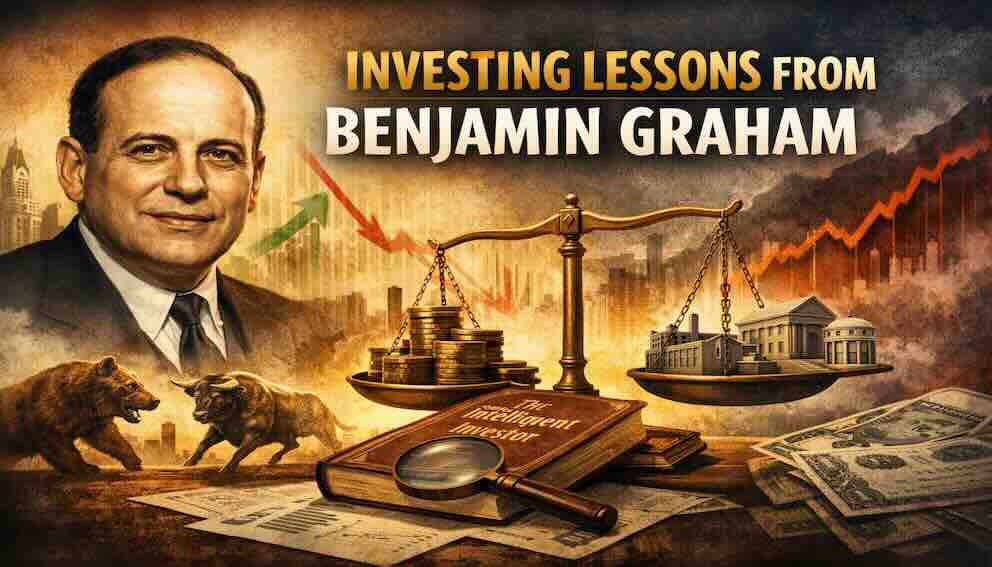
This tutorial is the second in a paired exploration of value investing. The first, The Margin of Safety Explained, examined Graham's most famous principle in depth. This tutorial steps back to look at the full canvas: the man himself, the complete system he built, the failures that refined him, and the students who carried his work forward. Together, they offer both depth and breadth. If you have read the first tutorial, you will find familiar ideas here—but framed within the larger story of a life's work. If you are new to Graham, this tutorial provides the complete foundation.
Introduction: Why Study the Man Behind the Idea
Investing advice is everywhere today. Thousands of books, millions of blog posts, and an endless stream of social media opinions all claim to know the secret. In this noise, it is easy to forget that the most durable ideas were not invented by algorithms or discovered in chat rooms. They were forged by human beings who lived through real disasters and spent decades refining their thinking.
Benjamin Graham was such a human being.
He did not sit in an ivory tower devising abstract theories. He managed money through the Great Depression. He watched his own portfolio collapse. He made mistakes that cost him and his clients dearly. And from those experiences, he built something rare: a complete philosophy of investing that has outlasted every market fad of the last century.
This tutorial is a journey through Graham's entire intellectual world—the principles he taught, the evolution of his thinking, the failures that reshaped him, and the legacy he passed to students like Warren Buffett. By understanding the full architecture of his philosophy, you gain more than tools. You gain a mindset.
The Forging (1884–1934)
The Boy Who Learned Young
Benjamin Graham was born Benjamin Grossbaum in London in 1884. His family moved to New York when he was one year old. His father died when Benjamin was nine, plunging the family into poverty. His mother borrowed money to invest in the stock market, only to lose everything in the panic of 1907. Young Benjamin watched his family's desperation unfold because of speculation.
He graduated from Columbia University at age twenty, despite having to work constantly to support his family. He was offered teaching positions in English, mathematics, and philosophy, but chose Wall Street instead. He started as a messenger boy at Newburger, Henderson & Loeb, earning twelve dollars per week. Within months, he was analyzing bonds. Within years, he was a partner.
By his early thirties, Graham had built a reputation as one of Wall Street's sharpest minds. He wrote research reports that partners relied on. He managed money for wealthy families. He seemed destined for a lifetime of success.
The Crash That Changed Everything
Then came 1929.
Graham saw the same mania that had ruined his mother years earlier. He was not blind to it. In fact, he was cautious enough that his fund had taken defensive positions entering the crash. But caution was not enough. The market did not simply decline; it disintegrated.
By 1932, Graham's fund had lost seventy percent of its value. He had not just lost his clients' money—he had lost his own. He was so financially devastated that he took a teaching position at Columbia simply to have a steady salary. He worked for years to repay clients who had trusted him.
This experience marked him permanently.
Here is what Graham learned in those dark years:
Markets can become completely irrational. They do not merely overreact; they can lose all connection to reality.
Popular opinion offers no protection. The crowd was euphoric in 1929 and catatonic in 1932. Following the crowd led to ruin at both extremes.
Even careful analysis can fail. Graham had been more cautious than most. It was not enough.
Survival must come before profit. The first duty of an investor is not to make money, but to avoid permanent loss.
These lessons became the foundation of everything that followed.
The Birth of a Philosophy
In 1934, Graham published Security Analysis with David Dodd. It was not a book for the general public; it was a textbook for professionals. It laid out a disciplined approach to evaluating securities based on tangible evidence rather than speculation.
In 1949, he published The Intelligent Investor, written for ordinary people. It distilled his philosophy into language anyone could understand. It introduced the world to Mr. Market, the margin of safety, and the distinction between investing and speculation.
These two books became the canon of value investing. They remain in print today, continuously read by new generations.
But to understand them fully, we must understand them not as standalone texts, but as expressions of a living philosophy that evolved across decades.
Graham's early life and the trauma of the Depression forged his fundamental commitment: investing must be built for survival first. The books that followed were not abstract theories, but practical systems designed to prevent the disasters he had witnessed and experienced.
The Cathedral—Graham's Complete Philosophy
Graham did not offer a single trick or formula. He built a cathedral—a complete system of interconnected ideas. Each principle supports the others. Remove one, and the structure weakens.
Pillar One: Mr. Market (The Emotional Servant)
Graham knew that investors needed a way to understand market prices without being controlled by them. He created the allegory of Mr. Market.
Imagine you own a small business. Every day, a man named Mr. Market shows up at your door. He is emotionally unstable. Some days he is overwhelmingly optimistic, offering to buy your share of the business for an absurdly high price because he sees a glorious future. On other days, he is deeply pessimistic, depressed by the news, and offers to sell you his share for a panic-stricken, rock-bottom price.
Here is the crucial point: Mr. Market does not care what you do. He shows up every day, rain or shine, making his offer. You are free to agree with him, or you are free to ignore him entirely. His purpose is not to inform you of the true value of your business. His purpose is to serve you—to offer you a price.
This simple allegory reframes the entire investing experience. The market is not a guide. It is not a judge. It is a servant with severe mood swings. Your job is to decide when to take his offer and when to laugh him off your porch.
Pillar Two: Intrinsic Value (The Anchor)
If Mr. Market's price is just a fickle opinion, then what is the true value of a business? Graham called this intrinsic value.
Intrinsic value is not a precise number. It is a reasonable range based on conservative analysis of:
- Assets and liabilities
- Earnings history (preferably a full business cycle)
- Financial stability
- The ability to pay debts
Graham understood that intrinsic value changes slowly, while market prices change constantly. The gap between the two creates opportunity.
When price falls far below intrinsic value, the investor with cash can act. When price rises far above intrinsic value, the investor can sell or simply wait.
Pillar Three: The Margin of Safety (The Shield)
This is Graham's most famous idea, and it deserves its place. The margin of safety is the difference between price and conservative intrinsic value.
If a business is worth $100 per share based on cautious analysis, buying at $60 creates a $40 cushion. This cushion protects against:
- Analytical mistakes (maybe it's only worth $80)
- Bad luck (a recession, a new competitor)
- Mr. Market's deeper depressions
The margin of safety does not guarantee profits. It guarantees that you can survive being wrong. And survival, as Graham learned in the 1930s, is everything.
Pillar Four: Quantitative Discipline (The Numbers)
Graham trusted numbers more than stories. A compelling narrative could seduce anyone into overpaying. But the cold facts of a balance sheet were harder to manipulate.
He developed specific quantitative screens:
- Low price relative to earnings (P/E below market average)
- Low price relative to book value (P/B often below 1.5)
- Strong current ratio (current assets comfortably exceeding current liabilities)
- Low debt
- Long history of earnings (at least a decade)
These screens removed emotion from the process. A stock either passed or failed. This mechanical approach created consistency.
One of Graham's favorite quantitative opportunities was the net-net: a stock trading below its net current asset value (current assets minus all liabilities). This meant you were effectively buying the business for less than its cash in the bank, getting everything else for free. Strict net-nets are rarer in today’s more efficient markets, but the principle survives: demand a large discount to conservatively estimated value, whether through assets, earnings power, or cash flows.
A famous example was the Northern Pipeline Company in the 1920s. Years earlier, the company had built a network of pipelines to transport oil. By the time Graham discovered it, those operations were largely finished, but the company still sat on a massive hoard of cash and bonds accumulated from its profitable past—money it no longer needed for its business.
Yet the stock traded on the market for roughly $65 per share. Graham dug into the financial statements and discovered something remarkable: the cash and bonds alone were worth about $95 per share. In other words, an investor could buy the stock for $65 and immediately own $95 worth of liquid assets, getting the entire pipeline business for free.
Graham began buying shares and urged management to return the excess cash to shareholders, where it belonged. Management resisted at first, but Graham persisted. Eventually, the company relented and distributed the cash—more than $110 per share in total. Graham walked away with a substantial profit.
This became a perfect early demonstration of Graham's philosophy in action: a pure quantitative bargain, where the numbers alone revealed hidden value, combined with modest activism to unlock what was already mathematically obvious.
Pillar Five: Portfolio Thinking (The Probability Approach)
Here is where many investors misunderstand Graham. He did not expect to be right on every stock. He did not believe he could predict which specific bargains would work.
He thought probabilistically.
Graham typically held fifty to one hundred positions, each with relatively equal weighting. Why? Because he knew that in any large basket of deeply discounted stocks, some would go bankrupt. Some would languish forever. But enough would recover and deliver strong returns that the overall portfolio would prosper.
A shipbuilder does not know which specific planks will face the worst storms. He builds the entire hull strong.
This is statistical investing, not predictive investing. The edge exists at the portfolio level, not the individual stock level. Graham could accept individual failures calmly because the math of cheapness combined with diversification worked over time.
Pillar Six: Selling Discipline (The Inventory Mindset)
Graham did not buy stocks with the intention of holding them forever. He treated them like inventory.
His rule was simple: hold until the price approaches intrinsic value, then sell and reinvest in the next bargain. Once the margin of safety closed, the purpose of holding was fulfilled.
He knew this meant he might occasionally sell a stock that later became a giant—like selling a seedling redwood for firewood. But he accepted that. His goal was not maximum possible gain from any single investment. It was consistent, reliable profits across a portfolio.
Pillar Seven: Modest Activism (The Gentle Push)
Sometimes value needed help emerging. Graham would use his position as a shareholder to push for change—but his approach was far from modern corporate raiders. He did not seek control. He did not wage hostile campaigns. He looked for obvious catalysts: excess cash that could be distributed, assets that could be sold, a liquidation that would unlock value. He pressured management politely but persistently to take actions that were clearly in shareholders' interests.
The Northern Pipeline example showed exactly how this worked. Graham did not demand control of the company or threaten its management. He simply accumulated shares, presented the mathematical case, and organized other shareholders to support him. When management resisted, he persisted—not with hostility, but with the quiet weight of evidence and collective ownership. Eventually, the numbers won.
This was activism with a light touch, focused on realizing value that the numbers already showed.
Pillar Eight: The Distinction Between Defensive and Enterprising Investors
This final pillar may be Graham's most underappreciated contribution. He recognized that not all investors are the same.
The defensive investor wants simplicity. This person has a career, a family, and no desire to spend evenings studying balance sheets. For this investor, Graham recommended a low-effort path: diversified index funds, or a portfolio of large, conservative companies with long dividend histories. The goal is not to outperform, but to avoid big mistakes.
The enterprising investor is willing to work. This person finds satisfaction in analysis and accepts that more effort is required. For this investor, Graham laid out the full toolkit: quantitative screens, net-net hunting, activism, portfolio discipline.
Graham's gift was giving both types permission to invest their own way. The defensive investor need not feel inadequate for choosing simplicity. The enterprising investor need not feel guilty for doing the work.
These eight pillars form a complete system: an understanding of markets (Mr. Market), a method of valuation (intrinsic value), a protective principle (margin of safety), a disciplined process (quantitative screens), a portfolio approach (probability thinking), an exit strategy (selling discipline), a tool for unlocking value (modest activism), and a recognition of different investor needs (defensive vs. enterprising). Together, they create a philosophy that addresses the full investment lifecycle.
The Crucible—Failures That Refined Him
Graham's system was not born fully formed. It evolved through failures that taught him what the numbers alone could not reveal.
The Penn Central Disaster
Graham's fund made a significant investment in the Penn Central Transportation Company. By the numbers—low P/E, price below book value—it was a classic bargain.
But the numbers lied.
Penn Central's reported earnings masked a grim reality: massive deferred maintenance on its rail lines, a fleet of outdated equipment, and crushing regulatory burdens that made its core business model untenable. Its book value looked attractive, but much of it was tied up in illiquid or obsolete assets—rail yards, old locomotives—that were impossible to realize in a liquidation.
The company went bankrupt in 1970, in what was then the largest corporate failure in U.S. history. Graham lost money.
The lesson was profound: cheapness alone is not enough. The underlying business must have a reason to survive. Numbers can lie if the business itself is structurally broken.
This failure forced a qualitative awakening. Graham began demanding not just statistical cheapness, but evidence of:
- Earnings stability (consistent history)
- Financial strength (real, tangible assets)
- A sound underlying business (not terminally ill)
The Cigar Butt Philosophy
Before Penn Central, Graham had popularized the metaphor of the cigar butt: a stock found on the street, soggy and discarded, but still containing "one free puff." You could pick it up, get that one last puff of profit, and move on. This approach worked for years.
But Penn Central taught Graham a painful lesson: some cigar butts were not merely discarded—they were poisoned. The one free puff might be your last.
The refinement of his thinking did not abandon the cigar butt approach entirely. It added a crucial preliminary question: before examining the price, first ask whether the business itself is fundamentally sound. Some companies are cheap for a reason that no discount can overcome. The filter moved upstream—from "is it cheap?" to "is it viable?" Only after confirming viability did valuation matter.
This shift—from purely quantitative to qualitatively-informed quantitative—became the bridge between Graham's early methods and the evolved approach later practiced by his most famous student. The quantitative screens remained, but they were now paired with judgment about whether a bargain represented a temporarily out-of-favor company or a permanently broken one. Graham's system was not destroyed by its failures. It was improved by them.
The Legacy—Students Who Carried the Torch
Graham taught at Columbia Business School for decades. His most famous student arrived in 1950: a young man from Omaha named Warren Buffett.
Buffett's Apprenticeship
Buffett had read The Intelligent Investor as a teenager and was transformed. He came to Columbia specifically to study with Graham. He absorbed the system completely—the quantitative screens, the margin of safety, the Mr. Market allegory, the portfolio discipline.
After graduation, Buffett offered to work for Graham's firm for free. Graham initially refused, then relented. Buffett spent two years absorbing every detail of how Graham operated.
When Graham retired and closed his partnership, Buffett returned to Omaha and launched his own investment partnerships, applying Graham's methods.
The Evolution
Buffett did not merely copy Graham. He built upon him.
The early Buffett partnerships were pure Graham: hunting for net-nets, buying cigar butts, selling when values were realized. But Buffett added something Graham had only begun to explore in his later years: an emphasis on business quality.
Buffett's partner, Charlie Munger, pushed this evolution. "Forget what you know about buying fair businesses at wonderful prices," Munger told him. "Instead, buy wonderful businesses at fair prices."
This became Buffett's signature approach. He still demanded a margin of safety, but he found it in durable competitive advantages and excellent management rather than exclusively in statistical discounts. He was willing to pay higher prices for businesses that could compound for decades.
The Intellectual Lineage
The lineage is clear:
Graham taught the foundation: margin of safety, Mr. Market, quantitative discipline.
Buffett added the layer: business quality, economic moats, long-term holding.
Munger provided the philosophical rigor: the latticework of mental models, the emphasis on avoiding stupidity rather than seeking brilliance.
Today's value investors trace their intellectual ancestry directly to Graham. Some remain closer to his original methods, hunting for statistical bargains in less-followed markets. Others follow Buffett's evolved approach, seeking wonderful businesses at reasonable prices. Both can claim Graham as their intellectual father.
The Choice—Defensive vs. Enterprising Revisited
This distinction deserves expansion because it is where Graham meets the reader where they actually are.
The Defensive Investor's Path
If you have neither the time nor the desire to analyze individual companies, Graham's message is liberating: you do not have to.
The defensive investor:
- Invests regularly through dollar-cost averaging
- Uses low-cost index funds or a portfolio of large, established companies
- Ignores short-term market noise
- Focuses on avoiding mistakes rather than seeking brilliance
- Rebalances occasionally but otherwise does nothing
This path has proven remarkably effective. Most professional active managers fail to beat simple index funds over long periods. The defensive investor captures market returns with minimal effort and minimal fees.
Graham would approve entirely. His goal was never to make everyone into an enterprising investor. His goal was to help every investor avoid self-destruction.
The Enterprising Investor's Path
If you are willing to do the work, the enterprising path offers the potential for market-beating returns—but only with genuine discipline.
The enterprising investor:
- Studies businesses in depth
- Runs quantitative screens to find candidates
- Evaluates management and competitive position
- Demands a margin of safety in every purchase
- Diversifies across many positions
- Sells when value is realized
- Accepts that some investments will fail
This path requires emotional stability as much as analytical skill. The enterprising investor must be able to buy when others are panicking and sell when others are euphoric.
The Honest Self-Assessment
Graham's great wisdom was asking readers to honestly assess themselves before choosing a path. The defensive path is not inferior; it is appropriate for most people. The enterprising path is not superior; it is simply different, requiring more work and carrying different risks.
A librarian does not give the same reading list to every patron. Graham gave different advice to different investors.
The Relevance—Why Graham Still Matters in 2026
We must ask the honest question: In an age of artificial intelligence, high-frequency trading, and cryptocurrencies, does a man who died in 1976 still have anything to teach us?
The answer rests on a simple observation: technology has changed, but human nature has not.
The Permanent Features of Human Psychology
People still panic when prices fall. They still chase excitement when prices rise. They still overpay for stories and underweight boring facts.
Mr. Market is as emotionally unstable today as he was in 1929. He is simply faster.
Consider the contrast between Graham's approach and modern speculation culture:
Graham asked: What are this company's assets?
Modern hype asks: What is the story?
Graham asked: What are its actual earnings?
Modern hype asks: What might it become?
Graham asked: What is its history of survival?
Modern hype asks: How popular is it online?
Graham asked: What could go wrong?
Modern hype asks: How high can it go?
One framework seeks evidence; the other seeks excitement. One asks what exists; the other asks what might be imagined. Yet the same psychological forces that drove the 1929 mania drive meme stocks today. The names change; the behavior does not.
The 2026 Market Environment
As of early 2026, we have lived through a remarkable period. The 2010s saw growth stocks outperform value dramatically, leading many to declare value investing dead. Then 2022 brought a sharp rotation, and the following years have seen value strategies regain relevance.
What does Graham teach us about navigating such shifts?
First, do not abandon your discipline because it is temporarily out of favor. Graham's principles worked over decades, not quarters. Those who abandoned value in 2020 missed the recovery.
Second, margin of safety matters most when optimism is highest. In today's environment, with artificial intelligence stocks capturing imaginations and cryptocurrencies fluctuating wildly, the discipline of asking "what is this actually worth?" remains the best protection against permanent loss.
Third, the search for net-nets has evolved. True net-nets are rare in developed markets, but the principle survives. Investors now find them in:
- Smaller international markets
- Special situations (spin-offs, bankruptcies)
- Companies temporarily despised by the market
- Arbitrage opportunities
The forms change; the mathematics do not.
Graham's View of Investing as a Business
One of Graham's most powerful ideas is often overlooked: investing should be treated as a business, not entertainment.
A real business:
- Keeps records
- Follows disciplined processes
- Does not change approach based on emotion
- Measures results honestly
- Focuses on long-term survival
Graham's checklists, screens, selling rules, and diversification requirements are exactly what any serious business would demand: repeatable procedures designed to produce reliable outcomes.
If you would not run a business by making emotional decisions based on rumors, why would you run your portfolio that way?
Conclusion: The Quiet Power of Rationality
Benjamin Graham’s greatest contribution was not a formula or a clever technique. It was a way of thinking about markets and about human nature.
He understood that markets are not perfectly rational machines, but emotional crowds that swing endlessly between fear and greed. Instead of trying to outsmart this behavior, Graham chose a humbler and more durable path. He assumed he would sometimes be wrong. He assumed the future would remain uncertain. Then he built a system designed to survive those realities.
At its core, Graham’s philosophy is an argument for self-control. It asks investors to slow down, to demand evidence, and to care more about safety than excitement. It treats investing not as a stage for brilliance, but as a serious, methodical activity where survival comes first.
The margin of safety is therefore more than a financial concept. It is a psychological shield. It creates distance from panic, space from impulse, and the ability to remain rational when others are not.
This is why Graham still matters.
Markets evolve. Technology changes. Stories change. But human behavior does not. People will always overpay for hope in good times and sell in despair during bad times.
Graham’s legacy is a reminder that lasting success does not come from predicting the future. It comes from positioning yourself so that you do not need to.
In that sense, he did not teach people how to beat the market.
He taught them how to outlast it.
About Swati Sharma
Lead Editor at MyEyze, Economist & Finance Research WriterSwati Sharma is an economist with a Bachelor’s degree in Economics (Honours), CIPD Level 5 certification, and an MBA, and over 18 years of experience across management consulting, investment, and technology organizations. She specializes in research-driven financial education, focusing on economics, markets, and investor behavior, with a passion for making complex financial concepts clear, accurate, and accessible to a broad audience.
Disclaimer
This article is for educational purposes only and should not be interpreted as financial advice. Readers should consult a qualified financial professional before making investment decisions. Assistance from AI-powered generative tools was taken to format and improve language flow. While we strive for accuracy, this content may contain errors or omissions and should be independently verified.