
Tutorial Categories
Last Updated: September 2, 2026 at 17:30
Bubbles and Busts Will Keep Happening — Don’t Get Pulled In: Understanding Market Bubbles, Crashes, and Investor Behavior
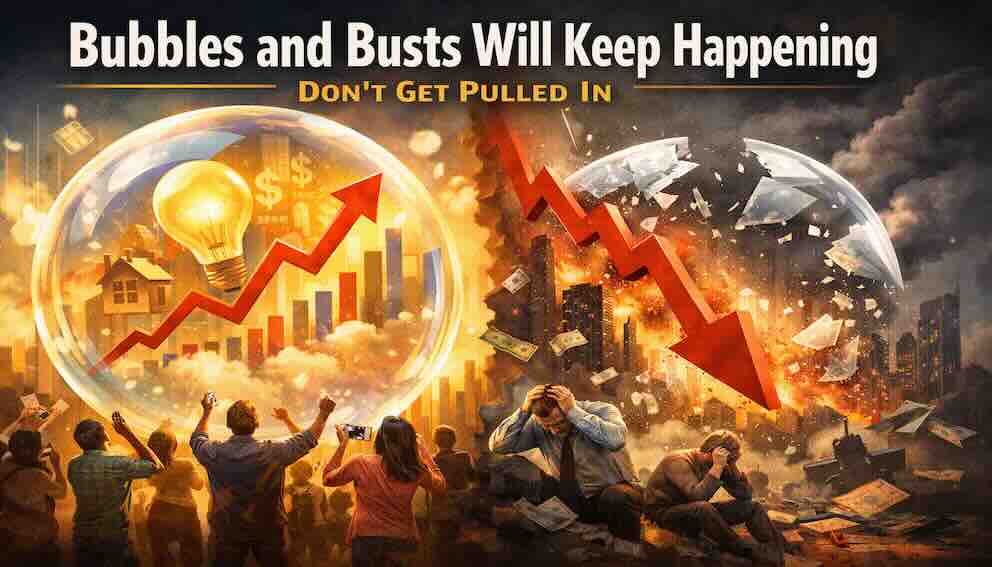
Market bubbles and their painful collapses are not random accidents or the result of mere greed. They are recurring episodes in financial history, inevitable patterns that emerge when human psychology—our innate tendencies toward hope, fear, and social imitation—intersects with the mechanics of markets. This tutorial explains the predictable lifecycle of a bubble: how it begins with a kernel of genuine truth, grows through a self-reinforcing cycle of excitement and envy, and ultimately deflates, often trapping those who arrived last. We will walk through famous historical examples, from tulips to technology stocks, to see how the same story replays in different costumes. The goal is not to help you time the market, but to give you the perspective to recognize the signs of speculative fever in yourself and in the world around you, so you can make calm decisions rather than emotional ones.
Introduction: The Eternal Return of Irrational Exuberance
Financial markets, at their core, are not simply calculators of value. They are vast, pulsating arenas of human judgment, collective storytelling, and emotion. If they were governed solely by cold rationality, the sharp peaks and valleys that characterize economic history would be smoothed into gentle hills. Yet, for as long as there have been markets for assets—be they shares in a sailing voyage, parcels of land, or digital tokens—there have been periods where prices detach violently from any reasonable anchor before crashing back to earth. This persistence suggests that the root cause lies not in the assets themselves, but in us.
Consider the Dutch Tulip Mania of the 1630s. To the modern observer, it seems absurd that the price of a single tulip bulb could exceed the cost of a luxurious Amsterdam home. But for a merchant in Haarlem at the time, the rising prices were a visible, tangible fact. His neighbours were getting rich. The bulbs were beautiful and novel. A compelling story about limited supply and unending demand from the French elite made perfect sense. The pain of watching others prosper while you stood aside became sharper with each passing day. This same psychological cocktail—a genuine innovation, observed social proof, the fear of missing out, and a narrative that justifies excess—has been mixed again and again.
The railway mania of the 1840s, the Roaring Twenties stock boom, the Japanese asset bubble of the 1980s, the Dot-com frenzy of the late 1990s, and the Global Financial Crisis of 2008: each had its own unique trigger, be it steam technology, postwar optimism, corporate ascendancy, the internet, or complex financial engineering. Yet their trajectories were eerily similar. They all began with a transformative truth, were fuelled by easy money and widespread participation, matured under the mantra that “this time is different,” and ended in a crisis of confidence that destroyed paper fortunes. To understand this cycle is to inoculate oneself, at least partially, against its most destructive effects.
The Lifecycle of a Bubble: From Innovation to Delusion
A bubble does not burst into existence fully formed. It evolves through distinct, psychologically driven phases, a process we can trace through its historical incarnations.
Phase 1: The Displacement – A Kernel of Truth
Every major bubble begins with a legitimate, exciting change that alters profit expectations. In the 1920s, it was the electrification of homes and the birth of mass consumer advertising and automobiles. In the 1990s, it was the undeniable, world-altering potential of the internet. These were not fantasies. They were real technological revolutions that created new industries and millionaires. Early investors, often those with specialized knowledge or high risk tolerance, are rewarded handsomely. Their success is the first chapter in a new story of wealth creation.
Phase 2: The Boom – Prices Feed a Story, The Story Feeds Prices
As early successes become gossip and then news, attention shifts from the fundamental value of the innovation to the observed fact of rising prices. This is a critical pivot. In the South Sea Bubble of 1720, the compelling story was about exclusive trading rights in the New World. In the Dot-com bubble, it was about “page views” and “first-mover advantage.” The specific asset becomes less important than its potential for appreciation. More participants enter, not to own a share in a future stream of dividends, but to own a lottery ticket they believe they can sell to someone else tomorrow at a higher price. The economist Hyman Minsky called this stage “speculative finance,” where buying is done primarily to resell.
Phase 3: Euphoria – The Suspension of Disbelief
Here, the bubble reaches its zenith of public participation and narrative excess. Caution is ridiculed as old-fashioned. In the 1850s, during the British railway mania, prospectuses for new lines promised returns from traffic that would have required every man, woman, and child in England to take multiple trips daily. In 1999, companies that added “.com” to their name saw their stock prices double overnight, regardless of their business model. Traditional metrics like price-to-earnings ratios are declared obsolete. Sir Isaac Newton, after losing a fortune in the South Sea Bubble, lamented, “I can calculate the motions of heavenly bodies, but not the madness of people.” This phase is marked by widespread leverage—people borrowing heavily to invest—because past success makes risk seem like an illusion.
Phase 4: The Critical Stage – The Smart Money Exits
While the public is still euphoric, the most savvy investors—those who entered early—begin quietly selling. They are not trying to time the top perfectly, but to capture their profits while liquidity is high. The market may continue to rise for months after they leave, making them appear foolish in the short term. This slow distribution of assets from informed hands to emotional hands is like kindling being stacked around a fire.
Phase 5: The Bust – Revulsion and Capitulation
The end is often triggered by a seemingly minor event: a respected company misses earnings, a central bank raises interest rates slightly, or a few prominent voices express doubt. In 2007, it was the collapse of two Bear Stearns hedge funds heavily invested in subprime mortgages. Because the market’s foundation has become pure confidence, the first crack can spread rapidly. The narrative flips from “this can only go up” to “this will never stop going down.” Fear of losing replaces fear of missing out. The forced selling by those who used leverage accelerates the decline in a violent, self-feeding spiral. The bubble deflates, often falling faster than it rose.
The Fuel in the Engine: The Role of Money and Credit
While human psychology provides the spark for a bubble, it is the availability of cheap money and easy credit that provides the oxygen for it to grow to dangerous proportions. Bubbles rarely inflate in environments of tight, expensive capital. Understanding this monetary dimension is crucial, as it explains why speculative frenzies emerge at specific historical moments, not randomly.
Low Interest Rates and the Search for Yield
When central banks keep interest rates low for extended periods, as seen in the early 2000s or the post-2008 era, safe investments like government bonds offer meager returns. This creates what investors call a “search for yield.” Capital, inherently restless, flows away from safe harbors and into riskier assets like stocks, real estate, or emerging technologies. The low cost of borrowing also makes leveraging a speculative position seem rational. Why not take a loan at 3% to buy an asset you believe is rising 20% per year?
Abundant Liquidity and Financial Innovation
Periods preceding major bubbles are often characterized by financial innovation that creates new forms of credit. In the 1920s, it was the widespread adoption of buying stocks “on margin” (with borrowed money). In the 2000s, it was the complex securitization of mortgages into products that appeared safer than they were. This expansion of credit increases the amount of money chasing assets, driving prices higher in a feedback loop: rising prices justify more borrowing, and more borrowing fuels higher prices.
The Illusion of Permanence
This environment of easy money does more than just facilitate speculation; it warps perception. When credit is abundant and defaults are rare, risk appears to have been engineered away. The 2008 crisis was preceded by a widespread belief that sophisticated financial instruments had dispersed risk so thoroughly that a systemic collapse was impossible. The monetary conditions create a backdrop where the bubble’s narrative—“this time is different”—feels financially, and not just psychologically, plausible.
The Slow Unraveling: Why Crashes Feel Sudden But Are Often Gradual
Ernest Hemingway famously wrote about bankruptcy happening “gradually, then suddenly.” This captures perfectly the deceptive nature of a bubble’s end. The “sudden” crash that dominates headlines is usually preceded by a “gradual” phase of eroding foundations that most participants ignore or explain away.
The Plateau of Complacency
After the peak of euphoria, markets often enter a prolonged period of sideways or choppy movement. Prices stop their meteoric rise but do not collapse. This is the plateau. During the Dot-com bubble, the NASDAQ index peaked in March 2000, then traded in a volatile, high range for months before its true collapse began later that year. Investors interpret this not as danger, but as a “healthy consolidation.” The passage of time without a crash becomes, paradoxically, the very thing that lulls them into a false sense of security. It feels like the new, high level is stable and normal.
The Normalization of Red Flags
In this phase, warning signs appear but are rationalized. An overvalued company reports disappointing earnings, and the market shrugs: “It’s just one quarter.” A respected investor issues a warning and is dismissed as a permabear. A economic indicator weakens slightly: “It’s a mid-cycle slowdown.” Each piece of negative news is treated as an isolated event, not as part of a deteriorating pattern. The collective narrative bends but does not break, absorbing contradictions until it can no longer hold.
The Sudden Fracture
The transition from gradual to sudden is not triggered by a new piece of information, but by a critical mass of participants simultaneously realizing that the narrative has failed. Confidence, which had been slowly leaking, evaporates all at once. The 2008 Lehman Brothers bankruptcy wasn’t the first sign of trouble in housing; it was the moment the slow leak became a burst pipe. The market’s memory, which had been remarkably short during the boom, suddenly becomes very long, focusing intensely on every weakness that had been ignored. Liquidity—the easy ability to buy and sell—vanishes, and prices gap down violently to a level where buyers finally re-emerge.
The Deeper Cost: Opportunity, Time, and Psychological Scars
The most visible damage from a bubble is the evaporation of paper wealth. However, the true cost is often deeper, more personal, and longer-lasting, measured in lost opportunities and psychological wounds that can impair financial judgment for years.
The Theft of Time and Compounding
Consider an investor who bought into the Nikkei 225 at the peak of Japan’s bubble in December 1989. On paper, they might have broken even in nominal terms roughly 30 years later. But in real, inflation-adjusted terms, they suffered a massive loss. More critically, they suffered an incalculable opportunity cost. The capital tied up for decades in a stagnant investment was denied the chance to compound elsewhere. Thirty years of potential growth in a global portfolio were sacrificed. This is the silent, mathematical tragedy of bubbles: they don’t just take your money; they steal your most precious financial asset—time.
The Aftermath: The Crisis of Confidence
The psychological damage can be even more paralyzing. An investor burned by the 2000 tech crash may have sworn off stocks entirely, missing the entire subsequent bull market. Someone scarred by 2008 may have held cash for a decade, haunted by the memory of loss. This reaction—to abandon the arena after a trauma—is emotionally understandable but financially devastating. It locks in losses and prevents participation in the eventual recovery. The bubble thus claims two victims: the first during the crash, and the second during the long, quiet bull market that the traumatized investor is too afraid to join.
A Lost Generation of Risk-Taking
On a societal level, a severe bust can dampen productive risk-taking for a generation. Entrepreneurs may struggle to find funding, and individuals may prioritize paying down debt over investing in new ventures. The collective memory of the crash creates a pervasive risk aversion that, while prudent in the immediate aftermath, can stifle innovation and growth long after the economy has technically recovered.
How to Anchor Yourself: From Insight to Behavior
Understanding bubbles is an intellectual exercise; resisting them is a behavioral one. The following principles are not a guarantee against loss, but a framework to help you maintain your balance when those around you are losing theirs.
1. Interrogate the Source of Returns
Constantly ask: “What is paying me?” Is it the internal cash flow of the asset—like a company’s profits paid as dividends, or a property’s rent? Or is it purely the hope that someone else will pay more later? The former is an investment in productivity; the latter is a speculation on psychology. During the 1999 bubble, many speculators could not name a single product sold by the companies whose stocks they owned. They were buying symbols, not businesses. Anchor yourself to cash flow.
2. Watch the Language, Not Just the Numbers
Narratives dominate bubbles. Develop an ear for the tell-tale phrases: “It’s different this time,” “Traditional metrics don’t apply,” “We’re in a new paradigm.” When skepticism is met with dismissal or mockery (“You just don’t get it”), treat it as a red flag. Healthy markets tolerate doubt; euphoric markets cannot afford it.
3. Respect the Role of Liquidity and Leverage
Be acutely aware of the monetary environment. In times of extremely low interest rates and easy credit, exercise heightened caution. Ask yourself: “Am I being pushed into risk because safe returns are unpalatable?” Furthermore, avoid using excessive leverage. It amplifies gains on the way up but can force you to sell at the worst possible moment on the way down, transforming a paper loss into a permanent one.
4. Practice the Discipline of Non-Participation
This is perhaps the hardest rule. It means being willing to watch others get rich and to have no position in the hottest asset of the day. During the 2017 Bitcoin mania, disciplined investors faced constant social pressure and fear of missing out. Yet, non-participation is a valid and often wise strategy. You do not need to have an opinion on every speculative trend. Your goal is not to catch every wave, but to avoid being wiped out by a tsunami.
5. Plan for the “Gradually” Phase
Since crashes feel sudden but develop gradually, use the plateau phase wisely. This is not the time to “buy the dip” believing the old highs will swiftly return. It is a time for sober reassessment, reduction of risk, and strengthening of your financial position—paying down debt, building cash reserves, and rebalancing your portfolio toward quality. This prepares you not to predict the “sudden” moment, but to survive it.
Conclusion: Humility in the Face of the Cycle
In this tutorial, we have journeyed through the inevitable lifecycle of market bubbles, from the initial spark of innovation to the final ashes of collapse. We have seen that these are not failures of information, but failures of psychology—spectacles where our innate drives for social belonging, status, and hope override our capacity for dispassionate judgment. The historical examples, from tulip bulbs to mortgage-backed securities, are not quaint anecdotes; they are concrete evidence of a repetitive human script.
We have also explored the critical, often understated, role of easy money in fueling these manias, and the deceptive, gradual erosion that precedes a sudden crash. Most importantly, we have considered the profound long-term costs—the stolen time, the lost compounding, and the psychological scars that can alter a lifetime of financial decision-making.
The central lesson is not that markets are irrational traps to be avoided, but that they are mirrors, reflecting our best and worst impulses back at us. The “this time is different” fallacy will always be persuasive because we are wired to believe our own era is unique. The fear of missing out will always feel more urgent than the abstract fear of losing money.
Therefore, a final, crucial point must be made with humility: understanding bubbles does not make you immune to them. Some of history’s most brilliant minds, from Isaac Newton to modern hedge fund managers, have been caught in speculative frenzies. Knowledge is not a vaccine; it is merely a flashlight in a fog. It helps you see the path a little more clearly, but the emotional pull to follow the crowd remains powerful.
Your task, then, is not to achieve perfect foresight or to boast that you saw the crash coming. It is to cultivate a disciplined self-awareness. By respecting history, questioning intoxicating narratives, prioritizing durable value over fleeting momentum, and, above all, accepting that missing out is a necessary and wise part of the journey, you can navigate these eternal storms.
Bubbles and busts will keep happening because we keep being human. The cycle is in the market, but the choice to step off the rollercoaster—to anchor yourself to principles when others are adrift in emotion—remains yours. That choice is the foundation of not just investing success, but of financial resilience and peace of mind.
About Swati Sharma
Lead Editor at MyEyze, Economist & Finance Research WriterSwati Sharma is an economist with a Bachelor’s degree in Economics (Honours), CIPD Level 5 certification, and an MBA, and over 18 years of experience across management consulting, investment, and technology organizations. She specializes in research-driven financial education, focusing on economics, markets, and investor behavior, with a passion for making complex financial concepts clear, accurate, and accessible to a broad audience.
Disclaimer
This article is for educational purposes only and should not be interpreted as financial advice. Readers should consult a qualified financial professional before making investment decisions. Assistance from AI-powered generative tools was taken to format and improve language flow. While we strive for accuracy, this content may contain errors or omissions and should be independently verified.