Tutorial Categories
Last Updated: April 17, 2026 at 10:30
What Is Macroeconomics? How the Economic Environment Shapes Jobs, Prices, and Everyday Life
A Beginner-Friendly Guide to Growth, Inflation, and the Big Picture of the Economy
Macroeconomics is the branch of economics that studies how entire economies function, focusing on issues like growth, inflation, and unemployment. This tutorial explains the scope of macroeconomics in simple, everyday language, helping you understand how big-picture economic decisions affect your life. You will learn the key differences between macroeconomics and microeconomics, along with real-world examples such as government policies and global economic crises. The tutorial also highlights why macroeconomics matters for policymakers, businesses, and financial markets. By the end, you will have a clear and practical understanding of how economies operate on a large scale.
Introduction: Understanding the Big Picture of an Economy
Let us begin with a story.
Imagine you live in a small seaside town. For years, this town has prospered because of its busy port. Ships arrive from distant places, unloading goods that are stored in warehouses along the waterfront. Dockworkers hurry between vessels. The local café is always crowded with traders and sailors. You work at the port, and life is predictable. You know your neighbors. You know your income. You know, roughly, what the future holds.
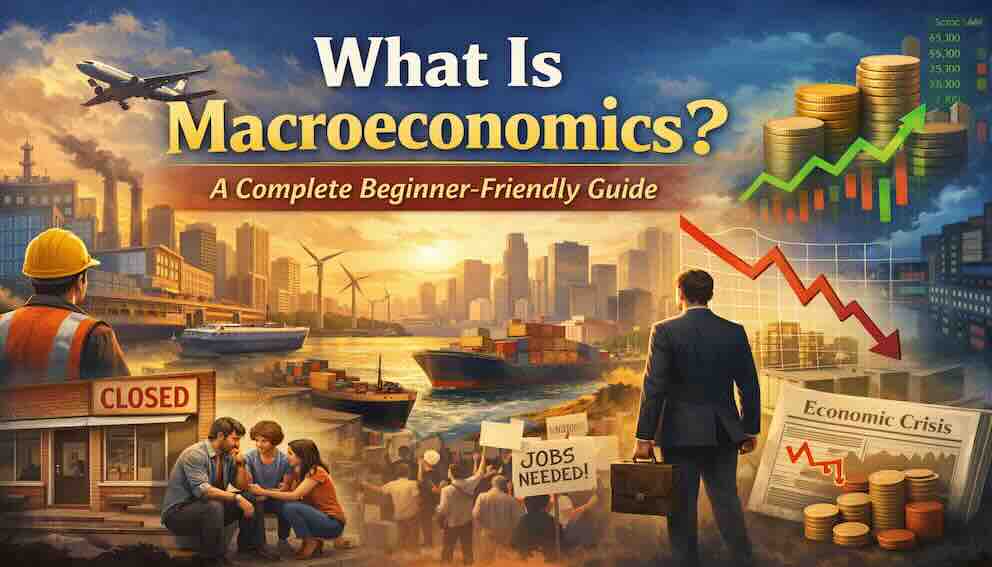
Then, one year, a global shipping crisis hits. The ships stop coming. The port grows quiet. The café owner, noticing a steady decline in customers, reduces her hours. The warehouse workers are laid off. Soon, even the bike shop that relied on the port workers for business closes its doors. Employment in the town begins to fall, and the local economy slows down as fewer people have income to spend.
This is macroeconomics. It is not about an individual worker’s effort or a single business decision like adjusting the price of coffee. It is about large, interconnected forces—such as international trade flows, shifts in global demand, and economic disruptions—that influence entire communities at the same time and shape the overall direction of economic activity.
When most people hear the word "economics," they think of money, prices, or perhaps the stock market. But macroeconomics is something broader and, in many ways, more personal. It is the study of the environment in which all our individual economic lives unfold. Anyone who wants to understand their financial world must understand macroeconomics.
To see this clearly, imagine looking at a city from a helicopter. You are not focusing on one single house or one street. Instead, you are observing traffic patterns, construction activity, the flow of people moving from one district to another. You see the whole city functioning as a single, living organism. Macroeconomics works the same way, except instead of a city, it studies entire countries or even the global economy.
This tutorial will take you up in that helicopter. We will explore the landscape of macroeconomics together, using real events and everyday experiences to show you how the big picture shapes your life.
The Central Insight: What Holds This All Together
Before we dive into the individual topics, let us take a moment to understand what holds them all together. At its core, macroeconomics is the study of balance—the constant, fragile balancing act that every economy performs.
It is the balance between spending and output: if we spend more than we produce, prices rise; if we produce more than we can sell, people lose jobs.
It is the balance between growth and stability: we want the economy to expand, but if it expands too quickly, it can overheat, leading to inflation and eventual collapse.
It is the balance between short-term relief and long-term sustainability: a government can stimulate the economy today by spending heavily, but that debt must eventually be managed.
And it is the balance between efficiency and resilience: an economy that is perfectly efficient—with every business operating at minimum cost—may have no slack to absorb a sudden shock, like a pandemic or a financial crisis.
Every question in macroeconomics, every policy debate, every moment of economic anxiety or optimism, revolves around these balances. Keep this idea in your mind as we walk through the topics that follow. You will see that macroeconomics is not a collection of isolated facts, but a discipline of managing competing forces.
The Scope of Macroeconomics: What Does It Study?
Macroeconomics focuses on a group of broad, connected areas that together explain how an economy is performing. These areas are not isolated from one another. Instead, they move together in ways that can be observed in everyday life.
To understand this more clearly, think about what happens in a large city over time. There are periods when new businesses open, construction projects increase, jobs become easier to find, and people spend more. At other times, shops close, hiring slows down, and people become more cautious with their money. These changes are not random. They reflect deeper movements in the economy that macroeconomics tries to study and explain.
Each topic within macroeconomics—such as production, prices, employment, and growth—captures one part of this larger picture. Looking at all of them together helps us understand whether an economy is expanding, slowing down, or facing deeper challenges.
1. National Income and Economic Output
One of the first questions macroeconomics asks is simple but important: how much is an economy producing? This is measured using Gross Domestic Product, or GDP, which represents the total value of goods and services produced within a country over a period of time.
Consider the United States in the years following World War II. Factories that had once produced military equipment shifted to making cars, appliances, and consumer goods. Soldiers returned home, families formed, and demand for housing increased rapidly. Entire suburbs were built, highways expanded, and businesses grew. The level of production across the economy rose significantly, and this increase was visible in people’s daily lives through higher incomes and greater access to goods and services.
This idea becomes clearer when we think about familiar surroundings. In a city where businesses are opening, cranes are visible on construction sites, and employers are actively hiring, economic output is increasing. In another situation, where shops are shutting down, job opportunities are limited, and people begin relocating in search of work, output is declining. GDP captures this broader shift in economic activity.
However, total production does not reveal everything about an economy. In the 2000s, China experienced rapid economic expansion, building infrastructure and modern cities at an extraordinary pace. At the same time, economists examined whether this growth was evenly shared across regions and whether it could continue without creating environmental strain. This shows that macroeconomics looks not only at how much is produced, but also at how that production is distributed and sustained over time.
2. Inflation and Price Stability: Why Prices Change Over Time
After understanding how much an economy produces, the next step is to examine what happens to prices. Inflation refers to the general increase in prices over time, and it directly affects how far income can stretch.
A clear historical example comes from the United Kingdom during the 1970s. Prices rose steadily throughout the decade. Everyday items such as milk became significantly more expensive within a relatively short period. Although wages increased, they did not always keep pace with rising costs. This created a situation where people found it harder to maintain their standard of living, even if they were earning more in nominal terms.
Inflation can also be observed in more recent experiences. Many households have noticed that grocery bills have increased over time, even when buying the same items. Rent payments may rise each year, while salaries adjust more slowly. Fuel prices can change noticeably within months, affecting transportation costs and household budgets. These are everyday examples of inflation in action.
The early 2020s provide another illustration. Disruptions in global supply chains affected the availability of goods. In the United States, the price of lumber increased sharply, raising construction costs. During the same period, shortages of computer chips affected car production, which led to higher prices in the used car market. These changes were not limited to a single industry; they spread across different sectors of the economy.
Macroeconomics studies inflation because it influences savings, spending, and long-term planning. When prices rise quickly, it becomes more difficult for households and businesses to make financial decisions with confidence. When inflation remains very low or turns negative, spending can slow down, which affects overall economic activity. Japan’s experience over several decades shows how persistently low inflation can be associated with slow growth and cautious consumer behavior.
3. Unemployment: The Human Side of Economic Change
Now that we understand output and prices, let us consider the people behind those numbers. Macroeconomics also examines employment conditions across an entire economy. The unemployment rate measures the percentage of people who are willing to work but are unable to find jobs. It also carries a human cost that extends beyond lost income to include social dislocation, health problems, and a loss of purpose.
The global financial crisis of 2008–2009 illustrates how unemployment can rise rapidly during periods of economic stress. In Spain, the collapse of the housing market led to a sharp decline in construction activity. As projects stopped, workers lost their jobs, and unemployment rose to very high levels. Younger workers were especially affected, and many moved abroad in search of opportunities. The broader economic downturn translated into widespread changes in people’s lives.
Unemployment can also develop gradually. In some regions, a single industry may dominate the local economy. If that industry declines or shuts down, workers may find that their skills are no longer in demand. This type of situation has been seen in former industrial and mining towns, where employment opportunities become limited over time. The adjustment process can take years, requiring new industries, training programs, and changes in the local economy.
Macroeconomics helps explain both short-term increases in unemployment during recessions and longer-term changes that reshape entire regions. It provides a framework for understanding why employment conditions change and what kinds of policies might support recovery.
4. Economic Growth: Expanding Opportunities Over Time
From unemployment, we naturally turn to its opposite: growth. Economic growth refers to the increase in the production of goods and services over time. It is closely linked to improvements in living standards, as it allows economies to generate more income and create more opportunities.
South Korea offers a clear example of long-term economic growth. In the 1960s, it was a relatively low-income country with limited industrial development. Over several decades, it invested in education, manufacturing, and technology. Companies grew, exports increased, and the economy expanded steadily. By the early 21st century, South Korea had become one of the world’s leading economies in technology and innovation.
Growth affects daily life in gradual but meaningful ways. As businesses expand, they hire more workers. Increased demand for labour can lead to higher wages. Governments may collect more tax revenue, which can be used to improve infrastructure, healthcare, and education. New industries create opportunities for entrepreneurship and innovation.
At the same time, growth raises important questions. In some cases, the benefits of growth are not evenly distributed across the population. Environmental concerns also become more significant, particularly when growth depends on resource-intensive industries. These considerations are now central to macroeconomic discussions, as countries seek ways to balance expansion with sustainability.
5. Government Policies: How Economies Are Managed
Finally, we come to the question of what we can do about all of this. Macroeconomics studies how governments and central banks influence economic activity. These institutions use policies to respond to changes in growth, inflation, and employment. There are two main categories.
Fiscal policy involves decisions about government spending and taxation. For example, during the pandemic in 2020, the UK government introduced the “Eat Out to Help Out” scheme to support restaurants and encourage consumer spending. By reducing the cost of dining out, the policy helped bring customers back into the hospitality sector and supported businesses during a difficult period.
Monetary policy focuses on interest rates and the supply of money in the economy. When central banks lower interest rates, borrowing becomes less expensive. This can encourage businesses to invest and households to spend. During the financial crisis of 2008 and again in 2020, central banks reduced interest rates significantly to support economic activity.
Governments and central banks use these approaches to respond to changing economic conditions. Their decisions influence borrowing costs, spending patterns, and overall economic momentum. While outcomes can vary depending on the situation, these policies play an important role in shaping how economies adjust to challenges and opportunities over time.
Key Questions in Macroeconomics
Now that we have surveyed the landscape, let us turn to the questions that macroeconomists spend their careers trying to answer. These are the puzzles that shape policy and debate.
How Do Economies Grow?
Why are some countries rich and others poor? Why did the Industrial Revolution begin in Britain in the 18th century and not somewhere else?
One answer lies in productivity. Countries that invest in education, infrastructure, and technology create the conditions for workers to produce more with the same amount of effort. In the years following its independence in 1991, Estonia began investing heavily in digital infrastructure, creating a platform for rapid growth. Today, it is one of the most digitally advanced economies in the world, with services like e-residency and digital voting that attract talent and investment from across the globe.
Another answer lies in institutions. Countries with stable legal systems, protection of property rights, and low levels of corruption tend to grow faster because businesses feel confident investing for the long term. The contrast between North Korea and South Korea, two countries that shared the same history and culture until the 1950s, shows how different institutions and policies can lead to vastly different economic outcomes.
Why Does Inflation Occur?
Inflation can occur for several reasons, but two main theories dominate macroeconomic thinking.
The first is demand-pull inflation. This occurs when too much money is chasing too few goods. Imagine a popular new video game console is released before the holidays. If there are only a limited number available, but millions of people want to buy one, prices will rise. On a national scale, if a government prints large amounts of money or if consumer confidence surges, spending can outpace the economy's capacity to produce, leading to rising prices.
The second is cost-push inflation. This occurs when the cost of producing goods rises, and businesses pass those costs on to consumers. The oil shocks of the 1970s are the classic example. When OPEC restricted oil supply, the price of crude oil quadrupled overnight. Since oil is used in almost every industry—from transportation to plastics to heating—the cost of nearly everything went up. This type of inflation is particularly painful because it happens alongside economic stagnation, a combination economists call "stagflation."
What Causes Unemployment?
Unemployment is not a single phenomenon; it has different causes, and understanding these causes is key to solving it.
Cyclical unemployment occurs when there is a recession. As the economy contracts, businesses lay off workers. This is what happened in the United States in 2008, when the financial crisis led to the loss of over 8 million jobs. The solution, in theory, is to stimulate the economy to bring back demand.
Structural unemployment is more persistent. It occurs when there is a mismatch between the skills workers have and the skills employers need. The decline of coal mining in the United Kingdom offers a poignant example. As the country shifted away from fossil fuels and towards other industries, coal mining communities faced unemployment that lasted for generations. The mines were not coming back, and the skills that had supported families for a century were no longer in demand. Solving structural unemployment requires retraining, education, and often, a painful process of economic transition.
Two Lenses: Microeconomics and Macroeconomics
At this point, it is helpful to distinguish macroeconomics from its close relative, microeconomics. They are not opposed; they are two lenses for looking at the same landscape.
Microeconomics focuses on individual units: consumers, firms, and specific markets. It studies how a person decides to spend their paycheck, or how a company decides how many workers to hire. If you are curious about why a coffee shop in Seattle charges $4 for a latte while a similar shop in a small town charges $3, you are asking a microeconomic question.
Macroeconomics, as we have seen, looks at the economy as a whole. It studies aggregate variables: total output, the average price level across the entire economy, and total national employment.
A simple analogy can help. If you are watching a forest, microeconomics is the study of individual trees—how they grow, how they compete for sunlight, how they respond to disease. Macroeconomics is the study of the forest itself—its overall density, the rate at which it is expanding or contracting, the patterns of growth and decay across the entire landscape.
The two perspectives are complementary. You cannot understand the forest without understanding the trees, and you cannot fully understand the trees without understanding the forest. For example, a recession seen in macroeconomic data—falling GDP, rising unemployment—is the result of millions of microeconomic decisions: firms cutting hours, households spending less, banks tightening lending standards. Understanding both levels gives you a complete picture.
Real-World Examples of Macroeconomic Decisions
Macroeconomics is not just a theoretical subject; it is lived experience. Let us walk through a few moments in recent history where macroeconomic decisions shaped the lives of millions.
Government Stimulus During Economic Crises
In March 2020, as the COVID-19 pandemic swept across the world, governments faced an unprecedented challenge. To slow the spread of the virus, they ordered businesses to close and citizens to stay home. The economy, by design, was being put into a medically induced coma.
In response, governments around the world rolled out massive stimulus packages. The CARES Act, passed in March 2020, was one of the largest fiscal stimulus packages in US history—a $2.2 trillion relief package that sent direct payments to individuals, expanded unemployment benefits, and provided loans to small businesses. The goal was simple: to prevent a temporary shutdown from turning into a prolonged depression by ensuring that people could still pay their bills and businesses could still meet payroll.
This was macroeconomics in action. It was a recognition that when private demand collapses, the government can act as the "spender of last resort" to keep the economy from spiraling downward.
Interest Rate Changes
Central banks are the guardians of macroeconomic stability, and their primary tool is the interest rate. When a central bank raises or lowers rates, it sends a signal through the entire financial system.
Consider the actions of the European Central Bank (ECB) during the eurozone debt crisis of the early 2010s. Countries like Greece, Ireland, and Portugal faced soaring borrowing costs, threatening to push them into default. Mario Draghi, then president of the ECB, made a famous pledge in 2012: "Within our mandate, the ECB is ready to do whatever it takes to preserve the euro. And believe me, it will be enough."
This single statement, a piece of macroeconomic communication, calmed markets. Borrowing costs for struggling countries fell, and the crisis began to ease. The ECB did not have to spend unlimited amounts of money; it just had to credibly signal its intention to act. This example shows how central bank policy is not just about numbers, but about managing expectations and confidence.
Tax Policy Adjustments
Governments also use tax policy to influence economic behavior. In 2008, as the financial crisis unfolded, the Chinese government launched a massive stimulus package of its own, estimated at roughly 4 trillion renminbi (equivalent to about 12–13 percent of China's GDP at the time). It invested heavily in infrastructure—building highways, high-speed rail lines, and entire new cities.
This was a fiscal policy decision with long-term macroeconomic implications. By investing in infrastructure, China was not just stimulating demand in the short term; it was also increasing the country's productive capacity for the future. The result was a period of rapid growth that transformed China into the world's second-largest economy.
Why Macroeconomics Matters for Policy and Markets
Macroeconomics plays a crucial role in shaping policies and influencing financial markets. It is the language in which policymakers think and the framework that investors use to navigate uncertainty.
Guiding Government Decisions
Governments rely on macroeconomic analysis to make informed decisions. Without a clear understanding of macroeconomic conditions, policies can backfire. In the 1970s, many governments tried to fight unemployment by increasing spending, not realizing that the problem was not a lack of demand but a supply shock caused by rising oil prices. The result was higher inflation without lower unemployment—stagflation. Macroeconomics provides the diagnostic tools to avoid such mistakes.
Influencing Financial Markets
Investors are students of macroeconomics whether they realize it or not. Every time the US Federal Reserve announces an interest rate decision, markets move. When inflation data is released, bond yields jump. When employment figures come out, stock prices react.
Consider the bond market, where governments and companies borrow money. Bond prices are highly sensitive to expectations about inflation and interest rates. If investors believe inflation will rise, they demand higher yields to compensate, which pushes bond prices down. Understanding macroeconomics is essential for anyone who wants to understand why their investments rise and fall.
Impact on Everyday Life
Finally, macroeconomics affects everyday life in ways that are often invisible until something goes wrong. When inflation rises faster than wages, families struggle to afford groceries. When unemployment spikes, job security vanishes. When interest rates rise, mortgage payments become more expensive.
In a very real sense, macroeconomics is the economic environment that surrounds us all. We cannot control it as individuals, but we can understand it, prepare for it, and make better decisions because of that understanding. Knowing whether the economy is in a recession or a boom, whether inflation is rising or falling, whether interest rates are likely to increase or decrease—these insights help individuals make wiser choices about their careers, their savings, and their investments.
Conclusion
Macroeconomics, at its core, is not just a collection of topics like GDP, inflation, or unemployment. It is a way of understanding how an entire economic system moves, adjusts, and responds over time. It invites us to look beyond individual events and recognise the patterns that connect them. A rise in prices is not an isolated occurrence. A slowdown in hiring is not a random coincidence. These are signals—parts of a larger process unfolding across the economy.
What makes macroeconomics powerful is its ability to reveal these connections. When production increases, it influences employment. When employment changes, it affects income and spending. When spending shifts, it shapes business decisions and future investment. Each part feeds into the next, creating a continuous cycle that defines the direction of an economy. Understanding this interconnected movement allows us to make sense of changes that might otherwise seem sudden or confusing.
It also changes how we interpret everyday experiences. A higher grocery bill, fewer job openings, or rising interest rates are no longer isolated frustrations. They become part of a broader economic environment that is constantly evolving. Macroeconomics provides the language and structure to interpret these changes with clarity rather than uncertainty.
At a deeper level, macroeconomics is about scale. It is about recognising that millions of individual decisions—by households, businesses, and governments—combine to create outcomes that no single person controls. These outcomes can shape opportunities, limit choices, and redefine what is possible for entire communities. Seeing the economy in this way shifts the perspective from isolated actions to shared conditions.
In the end, learning macroeconomics is not simply about understanding an academic subject. It is about developing a way of thinking—a way of observing the world that looks for connections, patterns, and underlying forces.
This is the first step in a journey that will deepen your understanding of how the world works—and your place within it.
About Swati Sharma
Lead Editor at MyEyze, Economist & Finance Research WriterSwati Sharma is an economist with a Bachelor’s degree in Economics (Honours), CIPD Level 5 certification, and an MBA, and over 18 years of experience across management consulting, investment, and technology organizations. She specializes in research-driven financial education, focusing on economics, markets, and investor behavior, with a passion for making complex financial concepts clear, accurate, and accessible to a broad audience.
Disclaimer
This article is for educational purposes only and should not be interpreted as financial advice. Readers should consult a qualified financial professional before making investment decisions. Assistance from AI-powered generative tools was taken to format and improve language flow. While we strive for accuracy, this content may contain errors or omissions and should be independently verified.