Tutorial Categories
Last Updated: April 17, 2026 at 10:30
Microeconomics vs Macroeconomics: Understanding the Dual Perspective
A Detailed Exploration of Individual vs Aggregate Behavior, Market-Level vs Economy-Level Analysis, and Why Both Matter
This tutorial provides a clear and comprehensive introduction to the difference between microeconomics and macroeconomics, two essential lenses for understanding the economy. You will learn how to distinguish them by focus, scope, and key questions, and then see this framework brought to life through real-world examples like the 2021–2022 inflation surge, the 2008 financial crisis, and global supply shocks. From there, the tutorial dives deeper into how individual decisions aggregate into economy-wide outcomes, the role of expectations and policy transmission, the distributional realities that aggregates hide, and why mastering the interaction between these two perspectives is essential for interpreting the economic world.
Two Lenses, One World
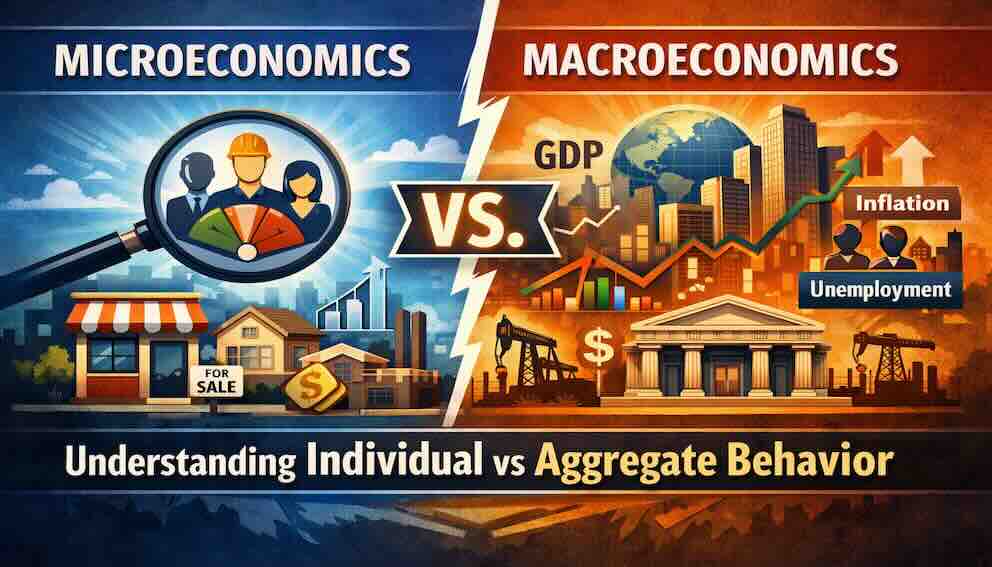
To understand economics, you must learn to see the same reality through two different lenses.
The Micro Lens: Individual Actors in Sharp Focus
The first lens – microeconomics – brings individual actors into sharp focus. It studies the behaviour of a single household deciding how much to spend, a single firm setting a price, a single worker choosing whether to accept a job, or a single market for a specific good.
Microeconomics asks questions like:
- Why did this company raise its prices?
- How will a new tax affect a particular industry?
Its tools are supply and demand curves, cost structures, elasticity, and the logic of incentives operating within specific markets.
The Macro Lens: The Whole System in View
The second lens – macroeconomics – pulls back to reveal the whole system. It studies the sum total of all those individual actions aggregated into national or global outcomes.
Macroeconomics asks questions like:
- Why are prices rising across the entire economy?
- What causes a recession?
- Why does unemployment persist for years?
Its tools are Gross Domestic Product (GDP), inflation rates, national unemployment figures, interest rates, the money supply, and exchange rates – variables that describe the health of the entire economy, not the condition of any single part.
Why the Distinction Matters
These two perspectives are often confused, treated as if macroeconomics is simply "bigger" microeconomics. But they are fundamentally different ways of seeing, each with its own focus, its own questions, and its own tools.
The distinction is not about importance. Both perspectives are essential because they answer different questions. But the deeper insight comes from recognising that these two levels are not separate. They are locked in a continuous, dynamic relationship.
Macro Is Not the Sum of Micro
This phrase can sound mysterious, but the idea is actually simple. If macroeconomics were just the sum of microeconomics, you could predict what the whole economy would do by adding up what individual households and firms do. But you cannot.
The reason is something called the fallacy of composition – the mistake of assuming that what is true for one part must be true for the whole.
Consider saving. One household decides to save more. That household is being prudent. It reduces its spending and puts money in the bank. From a micro perspective, this is rational.
Now suppose every household in the country decides to save more at the same time. Every household reduces its spending. Total spending in the economy falls. Businesses see falling demand, so they reduce production and lay off workers. Incomes fall. With lower incomes, households cannot save as much as they wanted to.
The collective attempt to save more leads to a recession and, paradoxically, to lower total saving. This is the paradox of thrift.
What is rational for one household (saving more) is disastrous for all households together. The whole behaves differently from the sum of its parts. This is why macroeconomics is not just "big micro." The economy has emergent properties – patterns and behaviours that appear only when you look at the whole system – that cannot be seen from the perspective of any single household or firm.
Seeing the Difference in Action
Abstract distinctions become clear when we watch them play out in real events. Below are four examples that show how the same economic phenomenon looks different through the micro lens versus the macro lens.
Example 1: Prices
Micro view: A local bakery raises the price of a loaf of bread from three dollars to three-fifty because the cost of wheat has jumped or because it cannot find enough workers to staff the ovens. This is one business responding to its own specific circumstances – a story of supply and demand in a single market.
Macro view: During 2021 and 2022, prices did not rise in just one bakery or one sector; they rose across the entire economy. Groceries, housing, fuel, used cars, and services all became more expensive in a sustained, broad-based manner. This economy-wide increase in the general price level is inflation.
Understanding inflation requires stepping back from the individual bakery to examine aggregate demand, the money supply, and the capacity of the entire economy to produce goods and services. The micro question asks why one product is more expensive; the macro question asks why everything is.
Example 2: Interest Rates and Investment
Micro view: A manufacturing company deciding whether to borrow money for a new factory weighs the expected profits from the expansion against the cost of the loan. That cost – the interest rate – is for the firm a given fact, a condition to which it must adapt.
Macro view: In 2022, the U.S. Federal Reserve raised its benchmark interest rate from near zero to over five per cent in a concerted effort to fight inflation. This single macroeconomic decision did not merely affect one company's expansion plans. It altered:
- The cost of mortgages for millions of homebuyers
- The borrowing conditions for businesses of every size
- The valuations of stocks and bonds across financial markets
- The exchange rate of the U.S. dollar against other currencies
A microeconomist studies how an individual firm responds to a given interest rate. A macroeconomist studies how the central bank sets that rate to influence the entire economy's level of borrowing, spending, and inflation.
Example 3: Employment
Micro view: A retail chain hiring extra workers for the holiday season, or a struggling restaurant laying off two servers – these are individual firm-level decisions, shaped by each business's unique outlook and constraints.
Macro view: When millions of firms simultaneously face collapsing sales, as they did during the 2008–2009 Global Financial Crisis, those individual layoff decisions aggregate into a macroeconomic outcome. The national unemployment rate surged from around 4.4 per cent to 10 per cent. What began as countless separate microeconomic adjustments became a systemic collapse in labour demand across the entire economy – a phenomenon that no individual firm could solve on its own.
Example 4: Supply Shocks
Micro view: A specialty coffee shop that sources its beans from a single cooperative raises its prices when that cooperative faces a disruption. This is a microeconomic event, confined to one small market.
Macro view: When geopolitical conflict disrupts global oil production, the price of crude oil rises sharply on world markets. Because oil is a foundational input for transportation, manufacturing, and heating, that price increase does not stay contained in the energy sector. It feeds into transportation costs for all goods, pushing up prices at grocery stores, retail outlets, and airlines everywhere. A disruption that begins in a single commodity market cascades through interconnected sectors to become a macroeconomic event like global inflation.
The Boundary Is Not Rigid
The examples above show that the boundary between micro and macro is not rigid. Shocks in one market can, under the right conditions, spread across the entire economy. A local event can become a national phenomenon. An individual decision can, when multiplied across millions of agents, reshape the whole system.
Conversely, macroeconomic conditions constrain microeconomic choices. A central bank raising interest rates does not force any single firm to cancel its investment plans, but it makes borrowing more expensive for all of them. A recession does not force any single restaurant to lay off workers, but it makes keeping them harder.
Understanding that flow – from individual decisions to system-level outcomes, and from system-level conditions back to individual constraints – is central to economic thinking. The micro and the macro are not separate worlds. They are two perspectives on the same reality, and learning to move fluently between them is a defining skill in economics.
The Two-Way Street: How Micro and Macro Shape Each Other
The examples above reveal a deeper truth: microeconomics and macroeconomics are not separate domains but two moments in a continuous feedback loop. When macroeconomic conditions change, they reshape microeconomic incentives.
The pandemic put this feedback loop on vivid display.
Step 1 – Macro shock: Lockdowns and widespread uncertainty created a sudden macroeconomic collapse.
Step 2 – Micro response: Households could not spend because restaurants, shops, and travel were closed – this was forced saving. At the same time, fear of job loss and an uncertain future led to precautionary saving. The savings rate soared to historic highs.
Step 3 – Macro outcome: Consumer spending collapsed as a result of both forced and precautionary saving, threatening to deepen the recession.
Step 4 – Macro policy: Governments responded to the collapse in economic activity with unprecedented fiscal interventions. The UK introduced the Furlough Scheme, promising to pay 80% of wages for workers who would otherwise have been laid off – its stated aim was "to avoid mass redundancies across the country". The US passed the CARES Act, sending $1,200 stimulus cheques to most adults, expanding unemployment benefits, and providing loans to small businesses. The goal was twofold: to provide humanitarian relief to households facing hardship and to prop up aggregate demand during the forced economic shutdown.
Step 5 – Micro response (unexpected): Contrary to what many policymakers expected, most households saved their stimulus cheques or used them to pay down debt, rather than spending them. Studies found that only about 25-40% of the money was spent; the rest was saved or used to reduce debt. As the Permanent Income Hypothesis predicts, temporary income increases are mostly saved, especially when uncertainty is high.
Step 6 – Macro outcome (delayed): When economies reopened, a combination of supply chain bottlenecks, energy price shocks (Russia/Ukraine), and pent-up demand for services led to the inflation surge of 2021-2022. The stimulus cheques played an indirect role by keeping household balance sheets healthy, but they were not directly spent into inflation.
Step 7 – Macro policy: Central banks raised interest rates aggressively to fight inflation.
Step 8 – Micro response: Higher interest rates made mortgages more expensive for individual homebuyers, cooling housing markets and gradually bringing inflation down.
Key Lessons from This Correction
- Forced saving (inability to spend) was a larger driver of excess savings than precautionary saving (fear of the future).
- Stimulus cheques were largely saved or used to pay down debt, not spent. This is consistent with the Permanent Income Hypothesis: temporary income increases have small effects on consumption.
- The inflation surge was driven more by supply shocks and pent-up demand than by direct stimulus spending.
- The feedback loop is more complex than a simple linear sequence. Household behaviour was shaped by both constraints (forced saving) and choices (precautionary saving). Policy responses had unexpected effects because households behaved differently than policymakers assumed.
This dynamic shows that the boundary between micro and macro is not rigid. A local shock can spread across the entire economy. An individual decision can, when multiplied across millions of agents, reshape the whole system. Conversely, macroeconomic conditions constrain microeconomic choices. A central bank raising interest rates does not force any single firm to cancel its investment plans, but it makes borrowing more expensive for all of them. Recognizing this two-way flow – from individual decisions to system-level outcomes, and from system-level conditions back to individual constraints – is essential for understanding why macroeconomics cannot simply be microeconomics scaled up. The whole behaves differently from the sum of its parts because the interactions between those parts create new dynamics. The micro and the macro are not separate worlds. They are two perspectives on the same reality, and learning to move fluently between them is the single most important skill in economics.
Microfoundations, Expectations, and Policy Transmission
With this framework in place, we can explore three deeper concepts that define how modern economists understand the relationship between micro and macro. These ideas move us beyond simple observation to the actual machinery of economic analysis.
The first is microfoundations. In the past, macroeconomists sometimes made claims about aggregate behaviour—"consumption will fall when interest rates rise"—without grounding those claims in a model of how individual consumers actually behave. Modern macroeconomics rejects this approach. Microfoundations is the practice of building macroeconomic models from the ground up, starting with the assumed behaviour of individual households and firms.
But this seems to contradict what we learned earlier about the fallacy of composition. The paradox of thrift showed that when every household saves more, total spending collapses. What is rational for one household is disastrous for all. So how can microfoundations claim to build macro models from individual behaviour?
The answer lies in emergence. Emergence is the appearance of new properties at the aggregate level that do not exist at the individual level. One household saving more does not cause a recession. But millions of households saving more at the same time does cause a recession, because the act of saving reduces the income that other households earn. The recession is an emergent property of the interaction between savers. It cannot be predicted by looking at a single household alone. Microfoundations and emergence together resolve the apparent contradiction: microfoundations ensures macro models are grounded in individual behaviour, while emergence explains why the whole can still behave differently from the sum of its parts.
The second concept is expectations. In macroeconomics, what people expect to happen tomorrow can profoundly shape what happens today. If businesses collectively expect a recession next year, they will stop hiring and investing now, thereby causing the very recession they feared. If consumers expect inflation to rise sharply, they may rush to make large purchases today, which can actually fuel that inflation. This dynamic adds a crucial layer of sophistication to the micro-macro feedback loop. During the 2022 inflation surge, surveys showed that consumers' expectations of future inflation had become "unanchored"—they no longer fully believed the central bank would keep inflation under control. Those expectations then influenced real behavior, as workers demanded higher wages and consumers accelerated purchases, creating a self-fulfilling spiral that central banks had to break with aggressive interest rate hikes. Expectations act as a psychological bridge between the micro and macro realms, and managing them is now considered one of the central tasks of modern macroeconomic policy.
The third concept is policy transmission mechanisms. When a central bank raises interest rates or a government passes a stimulus package, these are macroeconomic policy actions. But they do not affect the economy through magic. They work through specific channels that operate at the microeconomic level. Consider the interest rate hikes of 2022–2023. The Federal Reserve set a single macroeconomic policy—a higher federal funds rate. This policy then transmitted through several distinct pathways. Through the credit channel, banks raised the interest rates they charged businesses and households for loans. Through the asset price channel, higher rates reduced stock and bond valuations, affecting household wealth and the willingness to spend. Through the exchange rate channel, higher U.S. interest rates attracted foreign investment, strengthening the dollar and making American exports more expensive abroad. Each of these channels is a pathway through which a macro policy tool reaches into the microeconomic decisions of individual firms, households, and investors. Understanding these transmission mechanisms is essential for predicting whether a policy will work and for identifying who will be affected by it.
The Distributional Reality
Throughout this tutorial, we have discussed macroeconomic variables like GDP, inflation, and unemployment as if they affect everyone uniformly. But one of the most important lessons of modern economics is that these aggregates mask significant differences in how economic events impact different groups. Understanding distribution is not a separate concern from micro and macro; it is where the two perspectives meet most concretely.
Consider inflation. When prices rise, a retired person living on a fixed pension experiences a direct decline in purchasing power, while a worker in a booming industry may see wages rise faster than inflation. A household with a fixed-rate mortgage benefits from inflation eroding the real value of their debt, while a household renting sees no such benefit and faces higher housing costs. The macroeconomic phenomenon of inflation has profoundly different microeconomic consequences depending on whether one is a borrower or a saver, a homeowner or a renter, a worker in a high-demand sector or one facing stagnant wages.
The same is true for unemployment. A national unemployment rate of five percent tells us little about the experiences of a recent college graduate entering the labor market versus a factory worker in a declining industrial region, or about the stark disparities in unemployment rates across racial and ethnic groups. Similarly, GDP growth can be robust while median incomes stagnate, with the gains concentrated among the highest earners. A complete economic analysis requires us to look not only at the size of the pie but at how it is divided. Macroeconomics tells us whether the pie is growing; microeconomics—with its attention to individual markets, skills, and constraints—helps us understand who gets the slices.
Conclusion: Mastering the Dual Perspective
The great economic challenges of our time – persistent inequality, climate change, the restructuring of global supply chains, the rise of digital currencies – cannot be understood through a single lens. They demand that we analyse the individual decisions of households and firms while never losing sight of the system those decisions create.
The core insight that anchors this dual perspective is simple but profound: the whole is not the sum of its parts. What is rational for one household – saving more, cutting back on spending – can be disastrous for all households together. Macroeconomic outcomes emerge from the interactions between millions of individual choices, and those outcomes then become the environment that constrains the next round of choices. This two-way flow – from micro to macro and back again – is the heartbeat of the economy.
Mastering the ability to move between these perspectives is not merely an academic skill. It is central to sound economic reasoning. The reader of economic news who understands this dual perspective can move more easily between a story about a single company's struggles and a story about national unemployment, seeing how they connect. The citizen who grasps the fallacy of composition can recognise when a politician applies the logic of household budgeting to the national economy – arguing that if a family must tighten its belt, so must the government – and understand why that reasoning is dangerously wrong. The student who masters this interplay has acquired not a collection of facts but a framework for thinking – a way of seeing the brushstrokes and the canvas at the same time, without mistaking one for the other.
About Swati Sharma
Lead Editor at MyEyze, Economist & Finance Research WriterSwati Sharma is an economist with a Bachelor’s degree in Economics (Honours), CIPD Level 5 certification, and an MBA, and over 18 years of experience across management consulting, investment, and technology organizations. She specializes in research-driven financial education, focusing on economics, markets, and investor behavior, with a passion for making complex financial concepts clear, accurate, and accessible to a broad audience.
Disclaimer
This article is for educational purposes only and should not be interpreted as financial advice. Readers should consult a qualified financial professional before making investment decisions. Assistance from AI-powered generative tools was taken to format and improve language flow. While we strive for accuracy, this content may contain errors or omissions and should be independently verified.