Tutorial Categories
Last Updated: May 7, 2026 at 18:30
Understanding the Balance of Payments: Current Account, Financial Account, and Global Capital Flows Explained
A clear and practical walkthrough of how countries track their economic transactions with the rest of the world
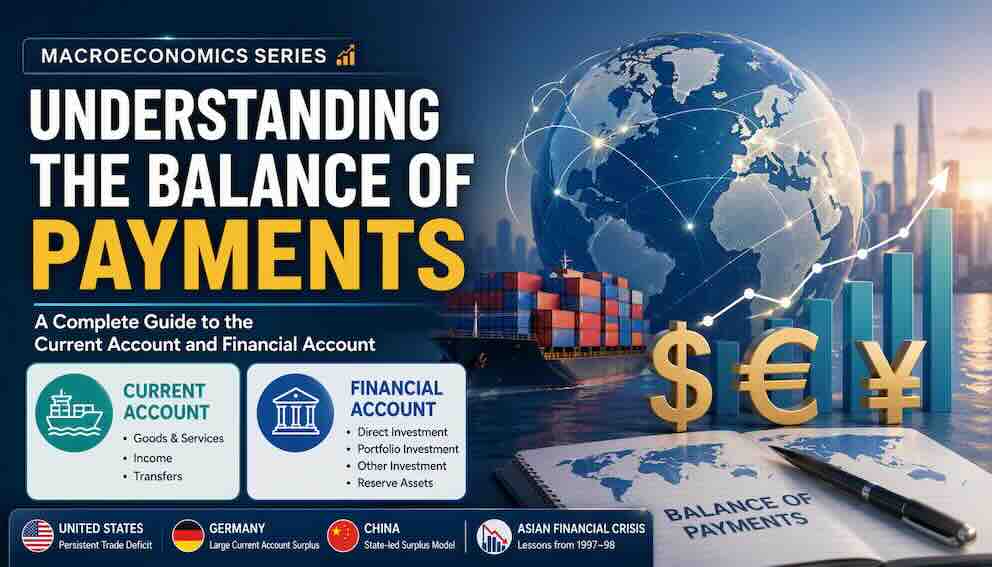
Why can the United States run a trade deficit year after year while other countries cannot? The answer lies in the Balance of Payments. This tutorial explains the Balance of Payments in a simple and intuitive way, focusing on its two key components: the current account and the financial account. It walks through how countries record trade, investments, and financial flows using real-world examples from the United States, Germany, China, and the Asian Financial Crisis. Beyond the basic structure, the tutorial also explains why a currency depreciation often makes trade imbalances worse before they get better (the J-curve), when a depreciation actually helps (the Marshall-Lerner condition), and the link between government budget deficits and current account deficits (the twin deficits hypothesis). By the end, readers will understand not just the structure of the Balance of Payments, but also how these concepts play out in the real world.
Introduction: A Country's Ledger with the World
When we think about an economy, we often focus on what happens inside its borders: production, inflation, unemployment. But every country also has an external dimension. It buys from abroad. It sells to abroad. It borrows. It lends. Its citizens invest overseas, and foreigners invest in it.
Every single one of these transactions is recorded in a systematic accounting framework called the Balance of Payments (BoP). Think of it as a country's financial ledger with the rest of the world.
The Balance of Payments is not a single number but a detailed set of accounts. It records all economic transactions between residents of a country and the rest of the world over a given period, usually a year or a quarter. The word "balance" can be confusing. In a technical accounting sense, the BoP always balances because of the way transactions are recorded. But the underlying components can show deficits or surpluses, and those carry important economic meaning.
To understand this system properly, we need to explore its two major parts: the current account and the financial account. (A word of clarification: older textbooks sometimes call the financial account the "capital account." Modern international accounting standards distinguish between a relatively small capital account (covering transfers of assets) and a much larger financial account. This tutorial uses the modern terminology.)
The Balance of Payments as a System of Accounts
Before we dive into the individual components, it helps to think of the Balance of Payments as similar to a company's financial statements. Just as a business records its revenues and expenses, a country records the flow of money coming in and going out.
Every transaction in the Balance of Payments is recorded twice: once as a credit and once as a debit. A credit represents money flowing into the country (an export, an investment from abroad). A debit represents money flowing out (an import, an investment abroad).
For example, when a country exports cars, it receives payment. That is a credit. When it imports oil, it pays money. That is a debit.
This double-entry system ensures that the accounts always balance in an accounting sense. But here is an important nuance. In practice, not every transaction is measured perfectly. Some are missed. Some are misreported. To make the books balance, economists use a residual item called "net errors and omissions." In major economies, this residual can run into tens of billions of pounds or dollars. When that happens, it signals that the official data may be incomplete or that some transactions are not fully captured in official data.
The Current Account: Trade, Income, and Transfers
What the Current Account Includes
The current account is the most widely discussed part of the Balance of Payments because it reflects a country's trade and income flows. It has three main components.
First, trade in goods and services. Goods are physical products: cars, machinery, food, oil. Services are intangible: tourism, banking, consulting, education. When a country exports more than it imports, it runs a trade surplus. When it imports more, it runs a trade deficit.
Second, primary income. This captures earnings from investments and work. If a UK company owns a factory in Poland, the profits it sends back to the UK are recorded as a credit in the UK's current account. If workers in the UK send money home to another country(from the UK), that is a debit.
Third, secondary income (also called current transfers). This includes remittances (money sent home by workers abroad), foreign aid, and gifts. These are one-way transfers where no good or service is exchanged in return.
A Real-World Example: The United Kingdom
Consider the United Kingdom. The UK imports a significant amount of goods: electronics, clothing, energy. At the same time, it exports services: financial services, legal expertise, education, tourism.
For many years, the UK has run a current account deficit. This means that more money is flowing out to pay for imports than is coming in from exports and income. The deficit is not necessarily a sign of weakness. But it does mean that the UK needs to finance this gap through other means, which brings us to the financial account.
Understanding Surpluses and Deficits
A current account surplus means a country is exporting more than it imports and receiving more income from abroad than it pays out. Germany and China have run large surpluses for years. They are, in effect, lending to the rest of the world.
A current account deficit means a country is spending more on foreign goods and services than it is earning. The United States has run a deficit for decades. The UK has also run persistent deficits.
Is a deficit always bad? No. A rapidly growing economy may import machinery and technology to fuel its development. That spending is an investment in future growth. The key question is not whether a deficit exists, but how it is financed and what the money is used for.
The Financial Account: Investment and Borrowing
What the Financial Account Represents
The financial account records transactions that involve the transfer of assets between a country and the rest of the world. It includes three main categories.
Foreign direct investment (FDI) occurs when a company or individual from one country invests in a business in another country with the intention of having a lasting interest and some degree of control. When Toyota builds a factory in the United States, that is FDI flowing into the US.
Portfolio investment involves buying financial assets such as stocks and bonds without seeking control. When a pension fund in Norway buys shares in Apple, that is portfolio investment.
Other investment includes bank loans, deposits, trade credit, and other financial flows that do not fit into the first two categories.
Reserve assets are foreign currency reserves held by a country's central bank. These are used to manage exchange rates and respond to financial crises.
A Real-World Example: Financing a Deficit
Returning to the United Kingdom: if the UK runs a current account deficit, it must attract enough funds through the financial account to cover the gap. How does this happen?
Foreign investors may buy UK government bonds. International companies may invest in British businesses. Global banks may hold deposits in London.
These are all financial inflows. They are recorded as credits in the financial account. They provide the funds that allow the UK to pay for its excess imports. The counterpart of a current account deficit is a financial account surplus, meaning net capital inflows into the country.
The Relationship Between the Accounts
One of the most important insights in macroeconomics is that the current account and the financial account are two sides of the same coin.
Current account deficit = Financial account surplus
A country that spends more abroad than it earns must borrow the difference or sell assets. That borrowing or asset sale shows up in the financial account.
Current account surplus = Financial account deficit
A country that earns more abroad than it spends is accumulating claims on the rest of the world. It is lending or buying assets abroad.
This relationship is not just an accounting identity. It reflects real economic behavior. A country cannot consume more than it produces indefinitely without financing that gap. The Balance of Payments shows how that financing happens.
The Twin Deficits Hypothesis
There is a well-documented tendency for government budget deficits and current account deficits to move together. This is called the twin deficits hypothesis.
Here is the logic. When a government runs a budget deficit, it borrows money. This borrowing reduces the pool of national saving available for private investment. If national saving falls but investment remains constant, the country must borrow from abroad to fill the gap. That borrowing from abroad is exactly what a current account deficit measures.
The United States in the 1980s provided a clear example. Large tax cuts and increased military spending created significant budget deficits. At the same time, the current account moved sharply into deficit. The two deficits moved together.
The relationship is not perfect. Countries can have budget deficits and current account surpluses if private saving is very high. Japan in the 1990s is an example. But the tendency is strong enough that economists pay close attention when both deficits are large.
Flows vs Stocks: The Net International Investment Position
The Balance of Payments records flows over a period. But countries also accumulate stocks of foreign assets and liabilities over time. The net of these is called the Net International Investment Position (NIIP) .
If a country runs current account deficits for many years, it builds up a large negative NIIP. It owes more to the rest of the world than it owns. This makes the country vulnerable to changes in investor confidence or interest rates, or exchange rate movements.
If a country runs surpluses, it builds up a positive NIIP. It is a net creditor. This provides a buffer against shocks.
To make this concrete, consider two examples. Japan has one of the world's largest positive NIIPs. Decades of trade surpluses have made Japan a net creditor to the rest of the world. The United States, by contrast, has a deeply negative NIIP despite being the world's largest economy. It has borrowed from abroad for many years to finance its current account deficits.
The NIIP is the accumulated result of past BoP flows. Understanding both flows and stocks is essential for assessing a country's external position.
Exchange Rates and the Trade Balance
The J-Curve Effect
When a country's currency depreciates, you might expect its trade balance to improve immediately. Exports become cheaper for foreign buyers. Imports become more expensive for domestic consumers. But the real world rarely works that smoothly.
The J-curve effect describes what often happens instead. In the short run, a depreciation can actually worsen the trade balance before it improves.
Why? Because prices adjust faster than volumes. When a currency falls, the price of imports rises immediately. If import volumes do not fall right away, the total value of imports increases. At the same time, the price of exports falls, but export volumes take time to increase. Contracts need to be renegotiated. New customers need to be found. Production capacity takes time to expand.
So in the months immediately after a depreciation, the trade balance often gets worse. The country pays more for its imports while still waiting for export volumes to respond. Over time, as volumes adjust, the trade balance improves. If you plot this on a graph, the line looks like the letter J: a dip downward, then a rise upward.
The Marshall-Lerner Condition
When does a currency depreciation actually improve the current account? The answer is given by the Marshall-Lerner condition.
The condition is conceptually simple. A depreciation will improve the current account if the sum of the price elasticities of demand for exports and imports is greater than one.
In plain language, this means that export demand and import demand must be sufficiently responsive to price changes. If exporters can find more buyers when their goods become cheaper, and if domestic consumers switch away from expensive imports, the depreciation will help.
If demand is insensitive to price changes, a depreciation may not help at all. This is why the Marshall-Lerner condition matters for policy. A country that devalues its currency without knowing its trade elasticities may be disappointed with the result.
The Surplus Countries: Germany vs China
Germany and China both run large current account surpluses, but the underlying causes are quite different. Treating them as the same oversimplifies the story.
Germany's surplus is largely a private sector phenomenon. German companies produce high-quality machinery, automobiles, and chemicals that the rest of the world wants to buy. The surplus reflects strong corporate competitiveness. German households save more than they consume, and German firms export more than they import. The government's role is relatively small.
China's surplus involves deliberate state policy. China for many years actively managed its exchange rate to support export competitiveness. It accumulated large foreign exchange reserves. It suppressed domestic consumption through high household saving and limited social safety nets. The surplus reflects policy choices, not just private sector competitiveness.
Understanding this distinction matters for policy. A German-style surplus is difficult to reduce because it is rooted in private behavior. A Chinese-style surplus could, in principle, be reduced through policy changes such as currency appreciation, increased social spending, or consumption subsidies.
The Exorbitant Privilege and Its Critics
The United States has run current account deficits for decades. Yet the US dollar remains the world's primary reserve currency. Foreign governments, companies, and investors want to hold dollar-denominated assets, especially US Treasury bonds.
This means that the US can finance its deficits more easily than most countries. The demand for US assets provides a steady flow of financial inflows. This has been called the "exorbitant privilege" of the dollar, a phrase coined by French finance minister Valéry Giscard d'Estaing in the 1960s.
However, this interpretation is contested. Some economists, notably Barry Eichengreen, argue that the privilege comes with costs. The global demand for dollars keeps the US currency stronger than it would otherwise be. A stronger dollar makes US exports less competitive and harms American manufacturing. The net benefit to the US may be smaller than commonly assumed.
The exorbitant privilege is a useful concept, but it should be understood as a contested one, not a settled fact.
Capital Controls: An Alternative to Free Capital Flows
The discussion so far has assumed that capital flows freely across borders. But some countries choose to restrict these flows. These restrictions are called capital controls.
During the Asian Financial Crisis of 1997-98, Thailand, South Korea, and Indonesia saw massive capital outflows as foreign investors panicked. Their currencies collapsed. Their economies plunged into recession. But one country in the region responded differently.
Malaysia imposed capital controls. It restricted the ability of foreign investors to withdraw funds quickly. This was controversial at the time, but it is widely considered to have reduced the severity of the downturn. Malaysia suffered less economic damage than its neighbours and recovered more quickly.
China provides a modern example. China maintains tight capital controls to this day. Foreign investors cannot freely move money in and out. This gives China's government more control over its exchange rate and insulates it from sudden capital flight. It also allows China to maintain an undervalued currency to support exports.
Capital controls have trade-offs. They provide stability and policy space. But they can also deter foreign investment and create opportunities for corruption. The choice between free capital flows and controls is one of the central debates in international economics.
Putting It All Together: The Story of Northland
Let us walk through a complete fictional example to see how all these concepts fit together.
Imagine a country called Northland. For several years, Northland has run a current account deficit. Its citizens love imported goods. Its companies are not very competitive in export markets.
Northland finances this deficit by selling bonds to foreign investors. These are financial inflows. Over time, Northland accumulates a negative Net International Investment Position. It owes more to the rest of the world than it owns.
Investors begin to worry. Northland's currency, the northmark, starts to depreciate. At first, the trade balance gets worse. The J-curve effect: import prices rise immediately, but export volumes do not increase right away. The current account deficit deepens.
Over time, Northland's exports become cheaper. Foreign buyers start purchasing more. Domestic consumers switch away from expensive imports. The Marshall-Lerner condition holds (the elasticities sum to more than one), so the depreciation eventually improves the current account.
Northland's government also runs a budget deficit. The twin deficits hypothesis would predict that this contributes to the current account deficit, and indeed, Northland's national saving is low.
Throughout this process, Northland's central bank must decide whether to let the currency float freely or intervene. It chooses a managed float, buying and selling reserves to smooth the most extreme fluctuations. It does not impose capital controls, but it watches nervously as foreign investors might pull out.
By the end of this cycle, Northland's currency is lower, its trade balance has improved, but its NIIP remains negative. It will take years of surpluses to restore its net asset position.
Every concept in this tutorial appears somewhere in Northland's story. The current account deficit. The financial account surplus. The negative NIIP. The J-curve. The Marshall-Lerner condition. The twin deficits. Each piece plays its part.
Why the Balance of Payments Matters
Exchange Rates
The BoP has a direct impact on a country's currency. When a country exports goods or attracts investment, demand for its currency rises. Other things being equal, the currency appreciates.
When a country imports heavily or sees capital flowing out, demand for its currency falls. The currency depreciates. Whether this depreciation helps or hurts depends on the J-curve and the Marshall-Lerner condition.
Financial Crises
The importance of the BoP becomes particularly clear during crises. The Asian Financial Crisis of 1997-98 is a powerful example.
In the early 1990s, countries like Thailand ran large current account deficits. They financed these deficits by borrowing from foreign banks, often in US dollars, and mostly short-term. When investor confidence turned, those short-term loans were not renewed. Capital flowed out rapidly. Currencies collapsed. Economies plunged into recession.
Thailand's current account deficit was not the problem by itself. The problem was how it was financed: short-term, foreign-currency-denominated debt that could be withdrawn quickly. This is why economists pay close attention to the composition of the financial account, not just the overall balance.
Policy Implications
Governments and central banks monitor the BoP closely. A large and persistent deficit financed by short-term capital flows is a warning sign. A deficit financed by long-term foreign direct investment is much less risky.
Countries with persistent surpluses face different pressures. They may be accused of manipulating their currency to keep exports cheap. They may face pressure to increase domestic spending and reduce reliance on foreign demand.
Conclusion
The Balance of Payments provides a comprehensive framework for understanding the economic relationship between a country and the rest of the world. It does so by carefully recording every transaction in a structured and meaningful way.
The current account captures the flow of goods, services, income, and transfers, revealing whether a country is earning more than it spends internationally or relying on external resources. The financial account shows how these imbalances are financed through investment, borrowing, and lending. The Net International Investment Position records the accumulated stocks that result from years of flows.
When these components are studied together, they offer a rich and nuanced picture of economic reality. They reveal the interconnected nature of modern economies, where trade, investment, and financial flows are deeply intertwined. A country's trade deficit may be financed by a foreign pension fund buying its bonds. A country's surplus may end up as a factory built on another continent.
The J-curve reminds us that policy effects take time and that things often get worse before they get better. The Marshall-Lerner condition provides a concrete test for whether a depreciation will actually help. The twin deficits hypothesis links external imbalances to domestic fiscal policy. Capital controls represent a deliberate choice to manage financial flows rather than let them move freely.
Understanding this system allows us to interpret real-world economic events with greater clarity. The Asian Financial Crisis showed what happens when financing is fragile. The US current account deficit shows how a reserve currency can sustain imbalances for decades. The German and Chinese surpluses show how different economic structures can produce the same external outcome for different reasons.
No country is an island. Every transaction across a border is recorded somewhere. The Balance of Payments is the ledger that captures it all. It is a map of how a country is positioned in the global economy, showing not only what it produces and consumes, but how it is financed and how it is connected to the rest of the world.
About Swati Sharma
Lead Editor at MyEyze, Economist & Finance Research WriterSwati Sharma is an economist with a Bachelor’s degree in Economics (Honours), CIPD Level 5 certification, and an MBA, and over 18 years of experience across management consulting, investment, and technology organizations. She specializes in research-driven financial education, focusing on economics, markets, and investor behavior, with a passion for making complex financial concepts clear, accurate, and accessible to a broad audience.
Disclaimer
This article is for educational purposes only and should not be interpreted as financial advice. Readers should consult a qualified financial professional before making investment decisions. Assistance from AI-powered generative tools was taken to format and improve language flow. While we strive for accuracy, this content may contain errors or omissions and should be independently verified.