
Tutorial Categories
Last Updated: May 7, 2026 at 18:30
Behavioral Macroeconomics Explained: How Human Psychology Shapes Inflation, Unemployment, and Economic Cycles
Why real economies don't always follow rational expectations—and what that means for policy and markets
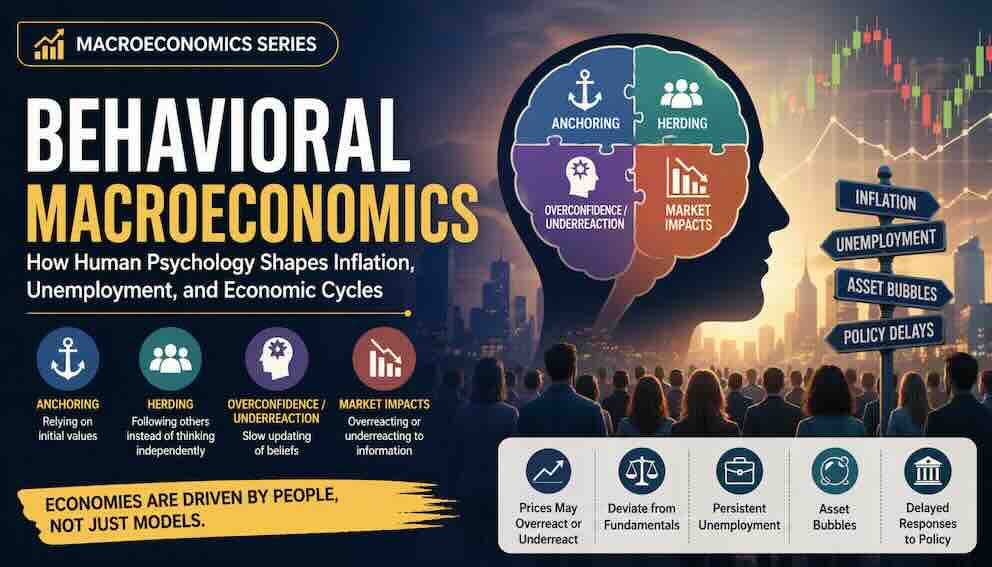
Why did investors keep buying technology stocks in 1999 even when prices had no relation to company earnings? Behavioral macroeconomics provides the answer. This tutorial defines behavioral macroeconomics as the study of how psychological biases affect aggregate economic outcomes. It explores cognitive biases such as anchoring, herding, loss aversion, money illusion, and overconfidence, showing how each shapes inflation, unemployment, and financial markets. Using the dot-com bubble of the late 1990s as a detailed case study, the tutorial demonstrates why real economies often deviate from rational expectations models. It also discusses how policymakers have adapted through nudging, forward guidance, and inflation targeting. By the end, you will understand why psychology matters for macroeconomics and how taking human behavior seriously leads to better economic models.
Introduction: What Traditional Models Miss
For decades, mainstream macroeconomics rested on a powerful assumption: that people form rational expectations. This meant that individuals and firms use all available information efficiently, learn quickly from mistakes, and make decisions that are, on average, correct. This assumption allowed economists to build elegant mathematical models.
But there was a problem. When economists compared these models to real-world data, especially during crises and periods of instability, the models often failed. People did not behave like perfectly informed calculators. They made systematic errors. They followed the crowd. They held onto outdated beliefs.
Behavioral macroeconomics emerged to address these gaps. It is the study of how psychological biases and heuristics affect aggregate economic outcomes such as inflation, unemployment, and growth. Instead of assuming perfect rationality, it asks a different question: how do real human beings actually make decisions, and what are the macroeconomic consequences of those decisions?
This perspective does not reject traditional macroeconomics. It builds on it by relaxing some of its strongest assumptions. The result is a richer framework that helps explain why economies sometimes behave unpredictably.
This tutorial is part of a series that has already covered rational expectations and adaptive expectations. Behavioral macroeconomics can be seen as a response to the limitations of both. Rational expectations assumed too much cognitive perfection. Adaptive expectations assumed too little forward-looking behavior. Behavioral macroeconomics offers a middle ground: people are not perfectly rational, but their deviations from rationality follow predictable patterns.
Motivation: Where Rational Expectations Falls Short
The assumption of rational expectations implies that people learn quickly from mistakes and adjust their beliefs efficiently. If inflation rises unexpectedly, individuals and firms are supposed to revise their expectations immediately, incorporating the new information into wages, prices, and contracts.
But real-world evidence tells a different story. Surveys of households and businesses reveal that expectations about inflation, growth, and interest rates can remain outdated for long periods. People may continue to believe that inflation is high even after it has fallen. They may underestimate risks during periods of rapid expansion.
Consider the years following the high inflation of the 1970s. In many countries, individuals continued to expect high inflation years after central banks had successfully stabilized prices. These expectations influenced wage negotiations and price-setting behavior, making it harder for policymakers to maintain low inflation. This persistence cannot be easily explained by rational expectations.
Another limitation is that rational expectations assumes individuals interpret information in the same way. In reality, people interpret the same data differently depending on their experiences, beliefs, and social environment. This diversity leads to outcomes that are more complex and sometimes less stable than traditional models predict.
Key Cognitive Biases in Macroeconomics
Behavioral macroeconomics identifies several cognitive biases that systematically influence economic decisions. These biases are not random errors. They follow patterns that can be studied and incorporated into economic analysis.
Anchoring: The Weight of Past Experience
Anchoring refers to the tendency of individuals to rely heavily on an initial piece of information when making decisions. In macroeconomics, this often appears in expectations about inflation, wages, and prices.
If inflation has been high for several years, people may continue to expect high inflation even after conditions have changed. Workers demand higher wages because they expect prices to keep rising. Firms raise prices in anticipation of higher costs. This creates a self-reinforcing cycle that keeps inflation elevated longer than expected.
Countries that have experienced hyperinflation provide a powerful illustration. Even after stabilization policies are implemented, people often remain skeptical and continue to behave as if inflation will return. This anchoring to past experiences slows down the adjustment process and complicates economic recovery.
Anchoring also affects financial decisions. Investors may anchor their expectations to past stock prices or growth rates, leading them to misjudge current conditions. This can result in markets reacting too slowly to new information.
Loss Aversion: The Fear of Losses
Loss aversion is the tendency for people to feel losses more intensely than equivalent gains. Losing £100 feels worse than finding £100 feels good. This asymmetry has profound macroeconomic implications.
Loss aversion helps explain why households reduce consumption sharply during downturns. The fear of losing income or wealth outweighs the pleasure of potential gains. It also explains why firms are reluctant to cut nominal wages. Workers perceive a wage cut as a loss and resist it strongly, even if prices have fallen and real wages have not changed.
This resistance to nominal wage cuts, rooted in loss aversion, contributes to unemployment persistence. During recessions, firms may lay off workers rather than cut wages because wage cuts provoke strong resistance. The result is higher unemployment than standard models predict.
Money Illusion: Thinking in Nominal Terms
Money illusion is the tendency to think in nominal rather than real terms. People often focus on the number on their paycheck or the price tag in the shop without adjusting for inflation.
This bias helps explain why workers resist nominal wage cuts even when prices are falling. A 2 percent nominal wage cut feels like a loss, even if falling prices mean that real wages have actually increased. Similarly, workers may feel satisfied with a 3 percent nominal raise even when inflation is 4 percent, not realizing that their real wages have fallen.
Money illusion has direct macroeconomic consequences. It contributes to wage stickiness, which in turn affects unemployment and the effectiveness of monetary policy. Central banks sometimes use inflation to facilitate real wage adjustments when nominal cuts are socially unacceptable.
Herding: Following the Crowd
Herding behavior occurs when individuals make decisions based on what others are doing rather than relying on their own information or analysis. In macroeconomics, herding is particularly important in financial markets, where it can amplify booms and busts.
When investors see others buying a particular asset, they may interpret this as a signal that the asset is valuable, even if they do not fully understand why. As more people join in, prices rise further, attracting even more participants. This process can continue until prices become disconnected from underlying fundamentals.
Herding is not limited to investors. Firms may follow industry trends when setting prices or making investment decisions. If most firms are expanding production, others may do the same to avoid being left behind, even if market conditions do not justify such expansion.
Overconfidence: Excessive Trust in Judgment
Overconfidence leads people to place too much trust in their own judgments. They underestimate risks and overestimate their ability to predict future events.
During economic expansions, overconfidence can lead to excessive risk-taking. Firms and investors become overly optimistic about future growth. They take on more debt. They invest in risky projects. This behavior builds up vulnerabilities that can trigger severe downturns when conditions change.
The buildup to financial crises often involves widespread overconfidence. Before a crisis, many market participants believe that risks are low and that they can manage any potential problems. This overconfidence leads to excessive borrowing and investment, which amplifies the severity of the downturn when it eventually arrives.
Underreaction: Slow Updating of Beliefs
Underreaction refers to the tendency to adjust beliefs too slowly in response to new data. This bias is related to anchoring but has its own distinctive features.
In macroeconomic contexts, underreaction can explain why economies sometimes take longer to respond to policy changes than expected. When central banks lower interest rates to stimulate the economy, households and firms may not immediately change their behavior. They wait to see if the policy change is sustained or underestimate its impact.
Underreaction also affects inflation expectations. If inflation falls, people may continue to expect higher inflation for some time. This delays the adjustment of wages and prices, prolonging the period during which inflation remains above target.
A Real-World Case Study: The Dot-Com Bubble (1997-2001)
The dot-com bubble of the late 1990s provides a perfect illustration of these biases in action.
At the beginning of 1997, the Nasdaq stock market, dominated by technology companies, stood at around 1,300. Over the next three years, it rose to over 5,000. Many of the companies driving this increase had never made a profit. Some had no revenue at all.
Anchoring played a role. Investors anchored their expectations to the recent past. Since stocks had risen for several years, they expected them to keep rising. Each new high became the anchor for the next expectation.
Herding was everywhere. As more investors bought technology stocks, others followed. The fear of missing out outweighed any careful analysis of company fundamentals. People who had never traded stocks before opened brokerage accounts to join the frenzy.
Overconfidence was rampant. Investors believed they had found a new way to get rich. They dismissed warnings from economists and experienced investors as outdated thinking. The old rules, they believed, no longer applied.
When the bubble burst in 2000, the Nasdaq fell from over 5,000 to under 1,200 by 2002. Trillions of dollars of wealth evaporated. The collapse contributed to a mild recession. But the psychological patterns that drove the bubble were not new. They have appeared in every major financial mania from tulip bulbs in the 1630s to housing in the 2000s.
Macroeconomic Consequences
The influence of behavioral biases extends beyond individual markets to the broader economy. These biases shape aggregate outcomes in ways that traditional models struggle to explain.
Persistent Unemployment
Standard models predict that unemployment should return to its natural rate relatively quickly after a shock. In reality, high unemployment can persist for years.
Loss aversion and money illusion help explain this. Workers resist nominal wage cuts. Firms are reluctant to impose them. Instead of cutting wages, firms lay off workers. During the recovery, firms hesitate to hire because they are uncertain about future demand. Workers hold out for wages that reflect past conditions. The result is persistent unemployment.
Asset Bubbles
Herding and overconfidence drive asset bubbles. As prices rise, more investors enter the market. Rising prices are interpreted as confirmation that the initial decision was correct. This feedback loop continues until prices become disconnected from fundamentals.
The dot-com bubble and the housing bubble of the 2000s are clear examples. In both cases, prices eventually collapsed, leading to financial instability and economic downturns.
Delayed Policy Responses
Macroeconomic policy relies on influencing expectations and behavior. If individuals do not respond immediately or predictably to policy changes, the effectiveness of these policies is reduced.
When central banks adjust interest rates, they expect changes in borrowing, spending, and investment. However, if households and firms are anchored to past conditions or underreact to new information, the impact of these changes may be delayed. This lag makes it harder for policymakers to stabilize the economy.
How Policymakers Have Adapted
Recognizing these behavioral patterns has led to changes in how policymakers operate.
Inflation targeting is one response. By announcing a clear numerical target for inflation, central banks provide an anchor for expectations. Over time, if the central bank is credible, people come to expect inflation to be at the target. This anchoring helps break the hold of past high inflation.
Forward guidance is another tool. Central banks now communicate not just what they are doing today but what they expect to do in the future. This helps shape expectations directly, rather than waiting for people to learn from past data.
Nudging has been adopted in some policy areas. A nudge is a small change in the way choices are presented that influences behavior without restricting options. Automatic enrolment in pension schemes, for example, uses the tendency to stick with default options to increase retirement saving.
These adaptations do not eliminate behavioral biases. But they work with them rather than against them.
Conclusion
Behavioral macroeconomics provides a framework for understanding why real-world economies often behave in ways that differ from the predictions of traditional models. By incorporating insights from psychology, it highlights the role of human behavior in shaping economic outcomes.
Individuals do not act as perfectly rational agents. They anchor to past experiences. They fear losses more than they value gains. They think in nominal terms. They follow the crowd. They become overconfident. They update their beliefs slowly.
These tendencies influence everything from inflation expectations to financial market dynamics and employment patterns. They can lead to persistent deviations from equilibrium, creating challenges for policymakers and increasing the complexity of economic management.
The dot-com bubble showed how herding, overconfidence, and anchoring can drive prices to unsustainable levels. The persistence of unemployment after recessions reflects loss aversion and money illusion. The delayed response to policy changes stems from slow updating of beliefs.
Recognizing these patterns does not make the economy easier to control. But it does make our understanding of it more realistic. And it has led to practical changes in how central banks communicate and how policies are designed.
In the end, behavioral macroeconomics reminds us that the economy is not just a system of equations and models. It is a system shaped by human decisions, perceptions, and interactions. The biases that affect individual judgment do not cancel out at the aggregate level. They amplify. They persist. They create patterns that would not exist if we were all perfectly rational.
Understanding those patterns is not just an academic exercise. It is the first step toward making better decisions ourselves—as investors, as workers, as policymakers, and as citizens trying to make sense of a complex economic world.
A Real-World Case Study: The Dot-Com Bubble (1997-2001)
The dot-com bubble of the late 1990s provides a perfect illustration of these biases in action.
At the beginning of 1997, the Nasdaq stock market, dominated by technology companies, stood at around 1,300. Over the next three years, it rose to over 5,000. Many of the companies driving this increase had never made a profit. Some had no revenue at all.
Anchoring played a role. Investors anchored their expectations to the recent past. Since stocks had risen for several years, they expected them to keep rising. Each new high became the anchor for the next expectation.
Herding was everywhere. As more investors bought technology stocks, others followed. The fear of missing out outweighed any careful analysis of company fundamentals. People who had never traded stocks before opened brokerage accounts to join the frenzy.
Overconfidence was rampant. Investors believed they had found a new way to get rich. They dismissed warnings from economists and experienced investors as outdated thinking. The old rules, they believed, no longer applied.
When the bubble burst in 2000, the Nasdaq fell from over 5,000 to under 1,200 by 2002. Trillions of dollars of wealth evaporated. The collapse contributed to a mild recession. But the psychological patterns that drove the bubble were not new. They have appeared in every major financial mania from tulip bulbs in the 1630s to housing in the 2000s.
Macroeconomic Consequences
The influence of behavioral biases extends beyond individual markets to the broader economy. These biases shape aggregate outcomes in ways that traditional models struggle to explain.
Persistent Unemployment
Standard models predict that unemployment should return to its natural rate relatively quickly after a shock. In reality, high unemployment can persist for years.
Loss aversion and money illusion help explain this. Workers resist nominal wage cuts. Firms are reluctant to impose them. Instead of cutting wages, firms lay off workers. During the recovery, firms hesitate to hire because they are uncertain about future demand. Workers hold out for wages that reflect past conditions. The result is persistent unemployment.
Asset Bubbles
Herding and overconfidence drive asset bubbles. As prices rise, more investors enter the market. Rising prices are interpreted as confirmation that the initial decision was correct. This feedback loop continues until prices become disconnected from fundamentals.
The dot-com bubble and the housing bubble of the 2000s are clear examples. In both cases, prices eventually collapsed, leading to financial instability and economic downturns.
Delayed Policy Responses
Macroeconomic policy relies on influencing expectations and behavior. If individuals do not respond immediately or predictably to policy changes, the effectiveness of these policies is reduced.
When central banks adjust interest rates, they expect changes in borrowing, spending, and investment. However, if households and firms are anchored to past conditions or underreact to new information, the impact of these changes may be delayed. This lag makes it harder for policymakers to stabilize the economy.
How Policymakers Have Adapted
Recognizing these behavioral patterns has led to changes in how policymakers operate.
Inflation targeting is one response. By announcing a clear numerical target for inflation, central banks provide an anchor for expectations. Over time, if the central bank is credible, people come to expect inflation to be at the target. This anchoring helps break the hold of past high inflation.
Forward guidance is another tool. Central banks now communicate not just what they are doing today but what they expect to do in the future. This helps shape expectations directly, rather than waiting for people to learn from past data.
Nudging has been adopted in some policy areas. A nudge is a small change in the way choices are presented that influences behavior without restricting options. Automatic enrolment in pension schemes, for example, uses the tendency to stick with default options to increase retirement saving.
These adaptations do not eliminate behavioral biases. But they work with them rather than against them.
Conclusion
Behavioral macroeconomics provides a framework for understanding why real-world economies often behave in ways that differ from the predictions of traditional models. By incorporating insights from psychology, it highlights the role of human behavior in shaping economic outcomes.
Individuals do not act as perfectly rational agents. They anchor to past experiences. They fear losses more than they value gains. They think in nominal terms. They follow the crowd. They become overconfident. They update their beliefs slowly.
These tendencies influence everything from inflation expectations to financial market dynamics and employment patterns. They can lead to persistent deviations from equilibrium, creating challenges for policymakers and increasing the complexity of economic management.
The dot-com bubble showed how herding, overconfidence, and anchoring can drive prices to unsustainable levels. The persistence of unemployment after recessions reflects loss aversion and money illusion. The delayed response to policy changes stems from slow updating of beliefs.
Recognizing these patterns does not make the economy easier to control. But it does make our understanding of it more realistic. And it has led to practical changes in how central banks communicate and how policies are designed.
In the end, behavioral macroeconomics reminds us that the economy is not just a system of equations and models. It is a system shaped by human decisions, perceptions, and interactions. The biases that affect individual judgment do not cancel out at the aggregate level. They amplify. They persist. They create patterns that would not exist if we were all perfectly rational.
Understanding those patterns is not just an academic exercise. It is the first step toward making better decisions ourselves—as investors, as workers, as policymakers, and as citizens trying to make sense of a complex economic world.
About Swati Sharma
Lead Editor at MyEyze, Economist & Finance Research WriterSwati Sharma is an economist with a Bachelor’s degree in Economics (Honours), CIPD Level 5 certification, and an MBA, and over 18 years of experience across management consulting, investment, and technology organizations. She specializes in research-driven financial education, focusing on economics, markets, and investor behavior, with a passion for making complex financial concepts clear, accurate, and accessible to a broad audience.
Disclaimer
This article is for educational purposes only and should not be interpreted as financial advice. Readers should consult a qualified financial professional before making investment decisions. Assistance from AI-powered generative tools was taken to format and improve language flow. While we strive for accuracy, this content may contain errors or omissions and should be independently verified.